

For an English speaker, Japanese takes roughly 2,200 class hours to reach professional working proficiency. At one hour a day, that is a journey of several years. Basic conversation and the first JLPT level come much sooner: most committed learners can read the two kana scripts within weeks and handle simple everyday exchanges within the first year. How fast you move depends on how many hours you study each day, how you spend them, and whether someone is guiding you.
This guide turns the published estimates into plain timelines. You will see what a year of study buys, how the JLPT levels line up with hours, and what shortens the road. We have also set out where a private tutor fits, because personalised tuition is one of the most reliable ways to make each hour count.
TL;DR
- Japanese is rated among the hardest languages for English speakers, with an estimated 2,200 class hours (88 weeks) of full-time study for professional proficiency.
- Hiragana and katakana can each be learnt in as little as one week. Kanji takes years.
- At one hour a day, expect to be inside the beginner JLPT N5 range after about a year. Two to four hours a day roughly halves or quarters the long-term timeline.
- Daily, spaced practice beats occasional long sessions, and focused one-on-one lessons help you spend your hours on what matters for your goal.
Table of Contents
- The short answer: it depends on the level you mean
- Why Japanese takes longer than Spanish or French
- An important detail about the 2,200 hours
- How daily study time changes the timeline
- JLPT levels and the hours behind them
- A realistic first-year roadmap
- What makes Japanese faster or slower for you
- Perspective: why a tutor shortens the road
- How to get the most from your hours
- Finding a Japanese tutor on TUTOROO
- FAQ
- Sources
The short answer: it depends on the level you mean
"Learning Japanese" covers very different finish lines. Ordering a meal in Tokyo, passing the JLPT N3 and negotiating a contract in Japanese are three separate projects, and each has its own price in hours.
A useful way to think about it:
| Goal | Rough time at 1 hour a day | What it looks like |
|---|---|---|
| Read hiragana and katakana | 1 to a few weeks | You can sound out signs, menus and simple words |
| Survival and travel Japanese | 3 to 6 months | Greetings, ordering, directions, simple questions |
| JLPT N5 | About 8 to 13 months | Basic grammar, a few hundred kanji-level words and short everyday exchanges |
| JLPT N4 and N3 | 1.5 to 3 years in total | Everyday conversation and simple reading |
| JLPT N2 and N1 | Several more years | Work and study use, newspapers, nuanced speech |
| Professional proficiency | 2 to 3 years full time, or 6 to 12 years at 1 to 2 hours a day | Speaking and reading at work |
The ranges come from the sources discussed below. They are estimates, not promises. Two people with the same schedule can land months apart, depending on their background, their method and their consistency.
Why Japanese takes longer than Spanish or French
The benchmark most people quote comes from the US Foreign Service Institute (FSI), which groups languages by how long English-speaking diplomats need to learn them. Japanese sits in the hardest tier. The FSI estimate for reaching General Professional Proficiency (ILR Level 3) in speaking and reading is 88 weeks, or 2,200 class hours. The same chart flags Japanese as usually harder than other languages in its own category.
By comparison, languages such as Spanish, French, Italian and Portuguese need 24 to 30 weeks, or 600 to 750 class hours to reach the same level. Japanese takes roughly three times as long.
Three features explain most of that gap:
- A different writing system. Japanese uses hiragana, katakana and kanji together. The two kana scripts are quick, but the Embassy of Japan notes that memorising the roughly 2,000 kanji in regular use typically takes years of dedicated study.
- Few familiar words. Spanish and French share a great deal of vocabulary with English. Japanese shares very little, so almost every word is new.
- Grammar and politeness. Verbs come at the end of the sentence, particles carry meaning, and the level of politeness changes the words you choose.
None of this is a reason to hesitate. It is a reason to plan, because a learner who knows the shape of the road is far more likely to stay on it.
An important detail about the 2,200 hours
The FSI figure describes intensive, full-time classroom learning. A breakdown of it puts the real workload at 23 class hours plus 17 hours of self-study per week, which adds up to roughly 3,700 hours over about 20 months once independent study is counted.
That matters for working adults and students. If you have one or two hours a day, you are not on the FSI schedule. You are on a longer one, and that is perfectly normal. The task is to build a routine you can keep for years rather than months.
How daily study time changes the timeline
Here is the same 2,200-hour target spread across different daily schedules. One calculation finds that at one hour a day, a learner covers about 17% of the baseline in a year, about 33% at two hours and about 66% at four hours.
Projected to professional proficiency, one source gives these figures: 12.4 years at 1 hour a day, 6.2 years at 2 hours, 3.1 years at 4 hours and 1.6 years at 8 hours.
| Daily study | Hours in a year | Approx. time to professional level |
|---|---|---|
| 30 minutes | About 180 | Well over a decade |
| 1 hour | About 365 | About 12 years |
| 2 hours | About 730 | About 6 years |
| 4 hours | About 1,460 | About 3 years |
| 8 hours | About 2,920 | About 1.6 years |
The yearly hours are our own arithmetic (daily hours times 365). The final column follows the source above.
Do not read the one-hour row as discouraging. Professional proficiency is the top of the range. Most learners want something nearer to confident conversation or a solid JLPT result, and those arrive much sooner.

What this means for a realistic plan
If you can give Japanese one hour a day, you will log about 365 hours in a year. That is enough to be well inside N5 territory and approaching N4. If you can give two hours, you could reach N4 comfortably in the same time frame. Learners preparing for a trip or a short exchange often choose a focused three to six month sprint instead, aiming only at the phrases and scripts they will use.
JLPT levels and the hours behind them
The Japanese-Language Proficiency Test (JLPT) is the most common yardstick for learners. It has five levels, from N5 (beginner) to N1 (advanced). The test organisers do not publish study hours for the current levels. The Japan Foundation's level descriptions define what each level covers in reading and listening but say nothing about how long it takes.
The old four-level test did publish figures. Its official comparison table said that Level 4 was normally reached after around 150 study hours, Level 3 after around 300, Level 2 after around 600 and Level 1 after around 900, counting from the start of study for learners who already read kanji. Those numbers suit learners from kanji-using backgrounds, so English speakers should expect more.
School estimates for the current levels run higher. They put N5 at about 350 hours with prior kanji knowledge and 400 to 500 without, N4 at 550 to 1,000, N3 at 900 to 1,300 and N2 at 1,500 to 2,200 hours. Treat these as cumulative totals, not hours per level.

Translated into months for someone studying one hour a day, one study guide estimates that N5 takes 8 to 13 months, N4 a further 6 to 12, N3 a further 10 to 17, N2 a further 17 to 30 and N1 a further 34 to 55 months.
Another estimate for English speakers puts comfortable fluency (B2) at about 1,550 hours and advanced C1 at 2,200 hours. At one hour a day that stretches to years, which is why daily time is the biggest lever you control.
Choosing the right test goal
If you are aiming at an exam, work backwards from the test date and the level you need. Our guide on JLPT tutoring and trying one lesson first explains how a tutor can build a plan around the paper and its sections. For setting a goal you can actually measure, see how to set language learning goals.
A realistic first-year roadmap
Here is how a first year might look at about an hour a day. It is a guide, not a prescription.
- Weeks 1 to 2: the kana. Learn hiragana, then katakana. Both can take as little as a week each with focused daily practice. Pair every character with real words so the sounds stick.
- Months 1 to 3: core phrases and grammar. Greetings, self-introductions, numbers, time, particles and the polite verb form. Start speaking aloud from the first week.
- Months 3 to 6: everyday situations. Shopping, directions, ordering food, talking about your day. Add your first few hundred words and begin simple kanji.
- Months 6 to 12: N5 and the edge of N4. Short texts, longer conversations, past and negative forms, more kanji. This is where regular speaking practice with a tutor pays off most, because mistakes become habits unless someone corrects them.
For a structured way to organise this, our 90-day language study workflow breaks a quarter into manageable blocks you can repeat.
What makes Japanese faster or slower for you
Published timelines are averages. Several things move your own number.
Consistency and spacing
Studying a little every day beats cramming. A meta-analysis of 839 assessments from 317 experiments found that spaced learning reliably outperforms massed, back-to-back study on a later test. In one vocabulary study, a spaced schedule produced more than double the retention of a massed schedule a week later (29% against 14%).
Habit research points the same way. One real-world study reported an average of 66 days to make a habit automatic, with a range from 18 to 254 days, and found that missing a single day did not materially harm progress. So a slip is not a failure. Pick up again the next day.
Active practice over passive exposure
Watching anime helps your ear, but speaking, writing and being corrected are what move you forward. Combine listening, flashcards and conversation. Our overview of top language learning methods compares what works for lasting results, and our guide to effective study routines shows how to fit them into a week.
Your reason for learning
A learner who wants to chat with a host family needs different material from one preparing for a business meeting or a university exam. Matching content to purpose avoids spending months on vocabulary you will never use.
Feedback and accountability
Self-study is powerful, but pronunciation, pitch, politeness levels and natural phrasing are hard to judge on your own. Regular feedback catches errors early, and a lesson booked in the diary is a lesson you do not skip.
Perspective: why a tutor shortens the road
We see the same pattern again and again. Learners rarely stall because Japanese is too hard. They stall because their hours drift: a week of apps, a gap, a restart from page one.
A private tutor turns that drift into a plan. In one-on-one lessons the time is built around your goal, whether that is a trip, an exam or a career move, and every session ends with something concrete to practise before the next one.
That is why we built TUTOROO around personalised tuition. Students can find a tutor by language, location and availability, message them directly and arrange lessons online or locally. Hearing Japanese from an expert tutor, and speaking it back from the first lesson, opens doors to culture, connection and opportunity far sooner than silent study alone.
The 2,200-hour benchmark is long, but it is made of ordinary days. Make each one count.
TUTOROO
How to get the most from your hours
Whether you study alone or with a tutor, these habits make the biggest difference.
- Set a daily minimum you cannot fail. Twenty minutes on a bad day keeps the habit alive.
- Schedule review before new material. Spaced review is where retention is built.
- Speak early. Even simple sentences spoken aloud build recall faster than silent reading.
- Keep a mistake log. Review it before each lesson.
- Prepare for lessons. Arriving with questions and a short piece of work to discuss makes the session far more productive. Our guide to preparing for language lessons effectively shows how.
- Work in stages. Our step by step language learning guide maps the path from first words to confident use.
If you have chosen Mandarin as well, the same logic applies: the FSI puts it in the same tier, and we explain how tutoring can cut the time.
Finding a Japanese tutor on TUTOROO
If you are ready to turn a timeline into a schedule, TUTOROO connects you with private Japanese teachers for one-on-one lessons, online or in person. You can search by location and availability, message tutors directly and agree a lesson rhythm that suits your week. Tutors set their own schedules and are paid directly by students for ongoing lessons.
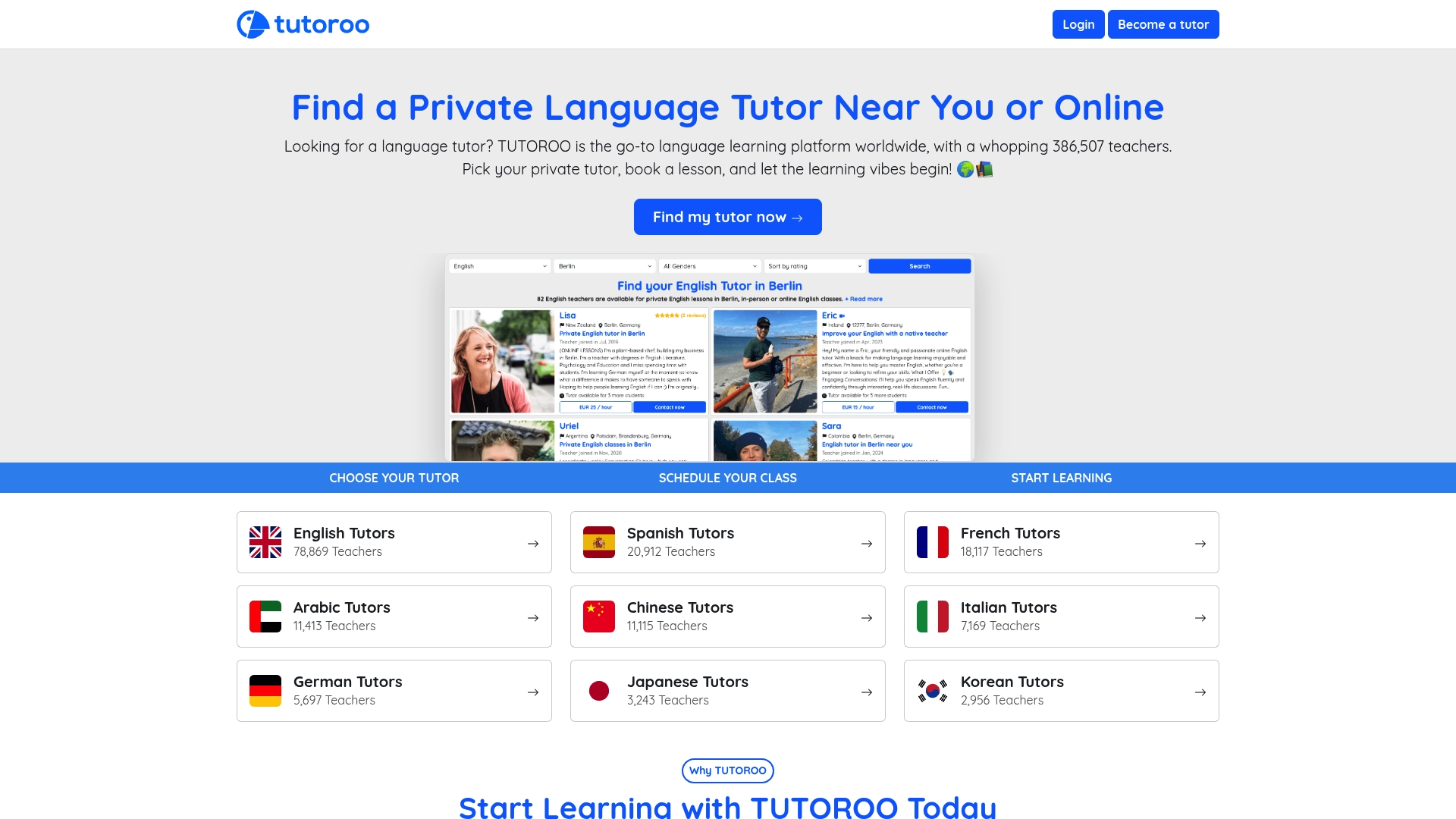
Browse Japanese teachers, alongside English, Spanish, French, Chinese/Mandarin, German, Italian and Portuguese, on the TUTOROO home page. For help choosing, read how to choose a Japanese tutor who fits your goals, and for budgeting see our guide to Japanese tutor costs by goal.
FAQ
How many hours does it take to learn Japanese?
The FSI estimate for professional proficiency is 2,200 class hours, and that assumes full-time study with extra self-study on top. For beginner N5, school estimates run from 350 to 500 hours depending on kanji background.
Can I learn Japanese in a year?
You can reach a solid beginner level in a year. At one hour a day, you will be inside N5 and approaching N4, with enough Japanese for simple conversations and travel. Professional fluency takes considerably longer unless you study full time.
How long does it take to learn hiragana and katakana?
The Embassy of Japan says each script can be learnt in as little as one week. Most learners need a little longer to read them smoothly, so keep practising with real words after your first pass.
Is two hours a day better than one?
More daily time shortens your overall timeline, with the projections above halving the time as daily hours double. Spread the hours across the day if you can, because spaced sessions are retained better than one long block.
Will a tutor make me learn faster?
A tutor gives you a plan built around your goal, speaking practice and immediate correction, which helps you use each hour well. Total hours still matter, so pair lessons with short daily practice between sessions.
Sources
- J-Compass: realistic goals for learning Japanese
- Embassy of Japan in the United States: Learn Japanese language
- JLPT: comparison of old and new test levels
- Ukiyoe Japanese: how long to learn Japanese
- Lenguia: how long to learn Japanese
- JLPT Mastery: study time for each JLPT level
- The World In Japanese: daily study time needed
- J-Compass: the daily listening routine
- Effects of practice schedule
- J-Compass: your first daily study routine