

Reaching solid conversational Mandarin usually takes between six months and two years of consistent effort, while professional working fluency sits around the US Foreign Service Institute's benchmark of 2,200 classroom hours. Survival phrases and basic small talk can arrive within a few months if you study daily. Beyond that, your timeline depends almost entirely on how you study, not just how long.
TL;DR:
- Immersion and daily speaking practice can significantly shorten the time to conversational fluency, sometimes achieving basic proficiency in two to nine months.
- Structured, supported study, including regular tutoring and deliberate practice, can reduce the total hours needed to reach milestones like HSK 3 or HSK 4.
- The 2,200-hour benchmark from the Foreign Service Institute represents a minimum for professional fluency and is higher for self-directed learners without full-time immersion.
- Relying solely on passive recognition or early focus on character writing slows progress compared to active speaking and correction-based learning.
- Hiring a private tutor can make study hours more effective, with learners generally progressing about 1.11 times faster than self-study alone.
Table of Contents
- How long to learn Chinese: what the FSI 2,200-hour benchmark actually means
- Chinese learning timeline: hours, milestones and calendar time
- What actually determines your Chinese language learning time
- How to speed up learning Chinese, and where tutoring fits
- Sample study plans by timeframe and budget
- Myths that quietly slow Chinese learners down
- Why tutoring is an accelerator, not a shortcut
- Ready to put a real timeline behind your Chinese goals?
- Sources
How long to learn Chinese: what the FSI 2,200-hour benchmark actually means
The Foreign Service Institute trains American diplomats headed for postings in Beijing, Taipei, and beyond, and it has tracked how long that training takes for decades. Mandarin sits in FSI's Category IV, its hardest tier, alongside Japanese, Korean, and Arabic. The institute's figure, roughly 2,200 classroom hours to reach professional working proficiency, is the most cited number in language learning for a reason: it comes from real cohorts of adult learners in structured, full-time immersion programs, not a marketing estimate.
That distinction matters for how you use the number. FSI hours are classroom contact hours, taught by trained instructors in small groups, often paired with homework, cultural briefings, and evening study. They do not capture the extra hours a diplomat spends listening to the radio, chatting with a host family, or reading signage on the walk to class. A self-taught learner working from an app in isolated 20-minute bursts, without speaking practice or expert feedback, will typically need more raw hours than an FSI student to hit the same milestone.
FSI's 2,200 hours is best treated as a floor for professional fluency, not a ceiling on how long the whole journey takes. It's a benchmark built for full-time, supported learners. If your setup looks different, your hour count will too.
Use it as a planning anchor, not a promise. If you are studying alone with inconsistent structure, expect the real hour count to climb; if you add regular one-to-one tutoring and immersion, you can sometimes beat it.
Chinese learning timeline: hours, milestones and calendar time
Turning "hours needed" into "months until I can actually order dinner in Chinese" is where most learners get stuck. The table below maps rough milestones, drawn from FSI's own scale and complementary milestone research, against the HSK and CEFR frameworks, then converts those hours into calendar time at four common study paces.
A few assumptions sit behind these numbers. The hour ranges assume reasonably focused study, not passive video watching, and the calendar conversions assume no long breaks. Full-time FSI students study close to 25 hours a week in a classroom, which is why their 2,200-hour target compresses to roughly 88 weeks rather than years. The self-study columns also carry what researchers sometimes call an efficiency penalty: without corrective feedback, unguided practice at home often takes noticeably longer per hour than structured, supported study.
Immersion is the outlier worth noting. Learners who move to a Mandarin-speaking environment, or otherwise create one, routinely report conversational competence in two to nine months, far ahead of what the hour math alone would predict, because every waking hour becomes practice.
What actually determines your Chinese language learning time
Two people with the same number of study hours can land in very different places, and the gap almost always comes down to how those hours were spent.
- Speaking versus listening: passive exposure, podcasts, subtitled shows, builds comprehension, but active speaking practice with correction is what converts vocabulary into usable fluency.
- Immersion and daily exposure: hearing tones and rhythm constantly trains your ear faster than any app can, which is why immersion learners often outpace classroom-only peers on pronunciation.
- One-to-one tutoring: personalised correction closes gaps that group classes and apps miss entirely.
- Individual background: learners who already speak a tonal language, or who have studied another second language seriously, tend to progress faster than absolute beginners.
- Study tools: spaced repetition systems for characters, AI conversation partners for extra practice reps, and graded readers for comprehensible input all shrink the hours needed per milestone.
Tutoroo's own analysis of HSK test takers found that learners working with a private tutor progressed about 1.11 times faster than those relying purely on self-study, a gap that widens further on speaking-specific measures. The mechanism is not mysterious: tutoring forces output, and output with immediate correction is the single most reliable lever for cutting a timeline down.
How to speed up learning Chinese, and where tutoring fits
Cutting years off your timeline is less about finding a secret method and more about ruthlessly prioritising the practices that actually move the needle.
- Speak from week one, not week twenty. Waiting until you "know enough" to start speaking delays the corrective feedback loop that builds real fluency.
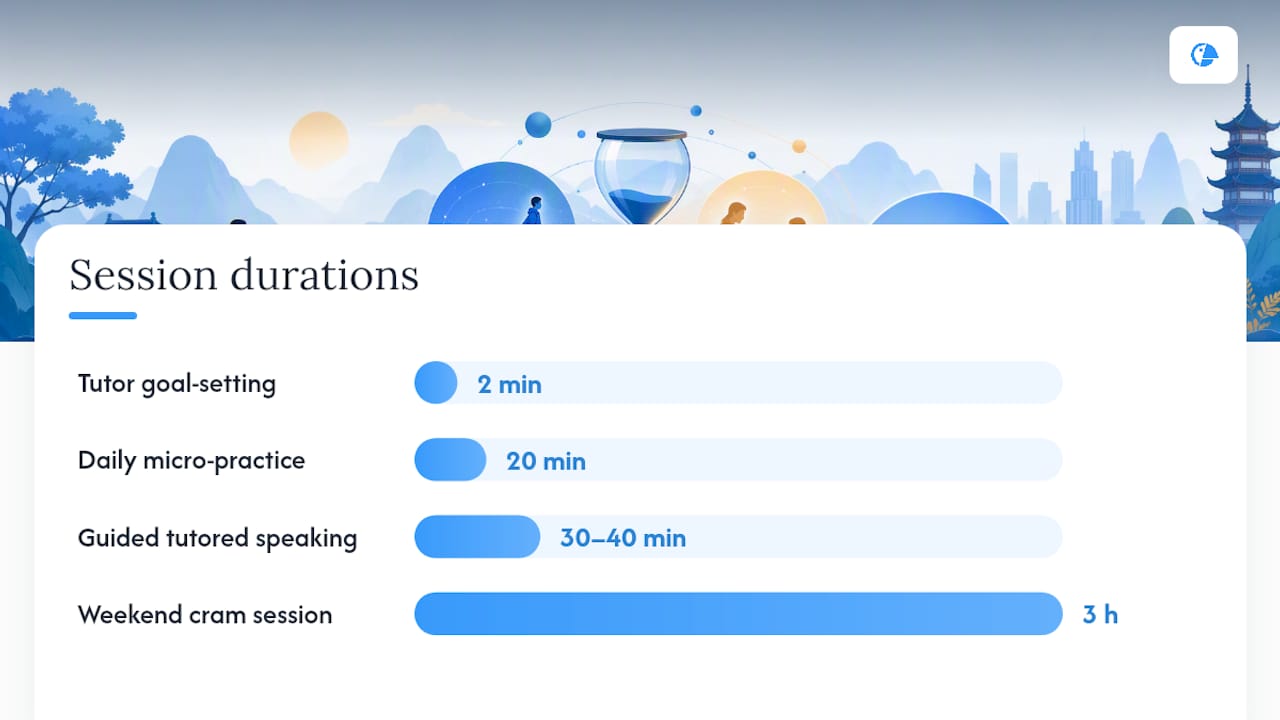
- Keep sessions short and frequent. Twenty focused minutes daily beats a single three-hour weekend cram, especially for tone and pronunciation habits that need daily reinforcement.
- Use spaced repetition for characters and high-frequency vocabulary. Spaced repetition and structured feedback rank among the highest-impact study techniques in second-language acquisition research, well ahead of passive rereading.
- Pair daily micro-practice with weekly tutoring. Self-study builds vocabulary; a tutor turns it into conversation and catches errors before they calcify.
- Structure every tutoring session around one clear goal. Walk in with a specific target, ordering food, discussing work, past tense verbs, so the session corrects real gaps instead of drifting.
Pro Tip: Track your progress against HSK vocabulary counts and a simple speaking benchmark, like recording a two-minute unscripted monologue every month, rather than relying on how confident you feel. Confidence and actual fluency often move at different speeds.
A well-structured tutoring session usually starts with two minutes of goal-setting, moves into 30 to 40 minutes of guided speaking with correction, and ends with a short homework loop the tutor checks the following week. That loop, more than any app streak, is what compounds.
Sample study plans by timeframe and budget
Your plan should match your goal, not a generic "learn Chinese" checklist. Here is what realistic paths look like at three common stages.
- Zero to six months, survival and beginner conversation. Aim for 20 to 30 minutes of daily vocabulary and listening practice using a spaced repetition app, plus one or two weekly tutoring sessions focused purely on speaking and pronunciation. This pace typically reaches HSK 1 to 2 territory.
- Six to twelve months, solid conversational ability. Layer in graded readers and short native audio alongside two to three tutor sessions a week, following the blended schedule research suggests works best: daily micro-practice plus regular guided output. Expect to be operating comfortably around HSK 3.
- One to two years, workplace competence. Push toward five or more study hours weekly, mixing intensive tutoring, business-relevant vocabulary, and regular exposure to native news or workplace content. This is the realistic runway toward HSK 4 to 5.
Whatever plan you pick, reassess every eight to ten weeks. If your speaking benchmark recording is not visibly improving, the mix of hours needs adjusting before the calendar time does.
Myths that quietly slow Chinese learners down
Some of the biggest timeline blowouts come from believable-sounding shortcuts rather than laziness.
- Claims of "fluent in six months" almost always mean survival-level conversation, not the working fluency most learners actually want.
- Scrolling through a vocabulary app without ever speaking out loud builds recognition, not the retrieval skill conversation demands.
- Chasing character writing too early, before your spoken vocabulary is solid, can slow overall progress; most learners do better prioritising speaking and reading recognition first.
- Studying without any external correction, whether from a tutor or a study partner, tends to lock in pronunciation and grammar errors that get harder to fix the longer they go unchecked.
Why tutoring is an accelerator, not a shortcut
Tutoroo connects learners with private Mandarin tutors worldwide, and the pattern in our own data is consistent with what the broader research suggests: guided, corrected practice moves faster than unguided practice. Our analysis of HSK test takers found tutored learners progressing 1.11 times faster than self-study peers, with some speaking-specific measures showing gains closer to three times faster. Those figures come with a caveat worth stating plainly: they describe averages across many learners, not a guarantee for any individual.
We would rather you treat tutoring as an efficiency investment than a shortcut. It does not remove the hours. It makes the hours you do put in count for more.
— TUTOROO
Ready to put a real timeline behind your Chinese goals?
Reading about hour counts is useful. Actually shortening your timeline means putting more of your practice into speaking with correction, which is exactly where a private tutor changes the maths. Tutoroo connects you directly with Mandarin tutors for online or in-person lessons, whether you are cramming for an HSK exam, building everyday conversation skills, or working toward business Mandarin for a new role.

Tutors on the platform set their own schedules and rates, so you can find a pace and price that fits your budget rather than committing to a fixed course structure. If you are weighing up costs, our breakdown of what a Chinese tutor typically charges is a useful starting point before you book. Search Chinese and Mandarin tutors on Tutoroo, message a few who fit your goals and availability, and book a first session this week to see how quickly focused, corrected practice moves your timeline.
Sources
- Foreign Language training | U.S. Department of State
- How long to learn Chinese | Fluentide
- How long to learn Chinese? Realistic timelines for 2026 | Be Chinese