

TL;DR:
- Setting clear, measurable language learning goals enhances focus, motivation, and progress by linking daily actions to specific skill milestones. Layering objectives across short, medium, and long-term horizons ensures sustained momentum and aligns efforts with personal motivation and proficiency targets. Regular review and adjustment, supported by Can-Do statements and a focus on behavior over outcomes, optimize learning efficiency and achievement.
Language learning goals are specific, measurable targets that define what you want to achieve in your target language and by when. Without them, study sessions become scattered and progress becomes invisible. With them, every lesson, vocabulary drill, and conversation practice connects to a clear destination. Frameworks like SMART goals, CEFR proficiency levels, and ACTFL Can-Do statements give learners of all levels a structured way to turn ambition into achievement. Tools like Anki, Memrise, and Grammarly become far more effective when they serve a defined objective rather than a vague wish to "get better."
What are language learning goals and why do they matter?
Language learning goals, known in education as language learning objectives, are precise, learner-centred targets that direct your attention, effort, and resources toward measurable outcomes. The distinction matters because objectives carry accountability. "I want to speak Spanish" is a wish. "I will hold a 10-minute conversation with a native speaker about daily routines by the end of March" is a goal.
Clear goals direct attention and increase effort in ways that vague aspirations simply cannot. This means learners who define their objectives before opening a textbook or app make faster, more consistent progress than those who study without direction. Goal-setting is essentially designing your study plan, directly determining which resources you use and which methods you prioritise.
The practical benefit is also motivational. When you can measure progress, you experience small wins regularly. Those wins sustain the discipline required to study a language over months or years. Without measurable targets, most learners plateau and lose momentum without understanding why.
What makes a language learning goal effective?
Effective language learning objectives share five characteristics, captured by the SMART framework: Specific, Measurable, Achievable, Relevant, and Time-bound. Applied to language learning, each criterion does specific work.
- Specific: Name the skill and context. "Learn 200 high-frequency Spanish words related to food and ordering in restaurants" beats "improve my Spanish vocabulary."
- Measurable: Define what success looks like. "Score 80% or above on a weekly Anki vocabulary quiz" gives you a clear pass or fail.
- Achievable: Realistic goals outperform ambitious but unattainable ones. A learner with 30 minutes per day cannot reasonably target C1 proficiency in three months.
- Relevant: Tie the goal to your personal reason for learning. A traveller needs survival phrases and cultural etiquette. A professional needs industry vocabulary and formal register.
- Time-bound: Set a deadline. "By the end of six weeks" creates urgency and a natural review point.
Beyond SMART, the most overlooked distinction in goal-setting is the difference between outcome goals and behaviour goals. An outcome goal is "understand French podcasts." A behaviour goal is "listen to 15 minutes of French audio five days per week." Behaviour-focused goals improve progress because they target actions you control, not results that depend on many variables. Outcome goals are useful as destinations; behaviour goals are the road.
Pro Tip: Write one behaviour goal for every outcome goal you set. If your outcome is "hold a conversation in Mandarin," your behaviour goal might be "practise speaking with a tutor for 20 minutes, three times per week." The behaviour goal is what you actually schedule.

How should you structure goals across short, medium, and long terms?
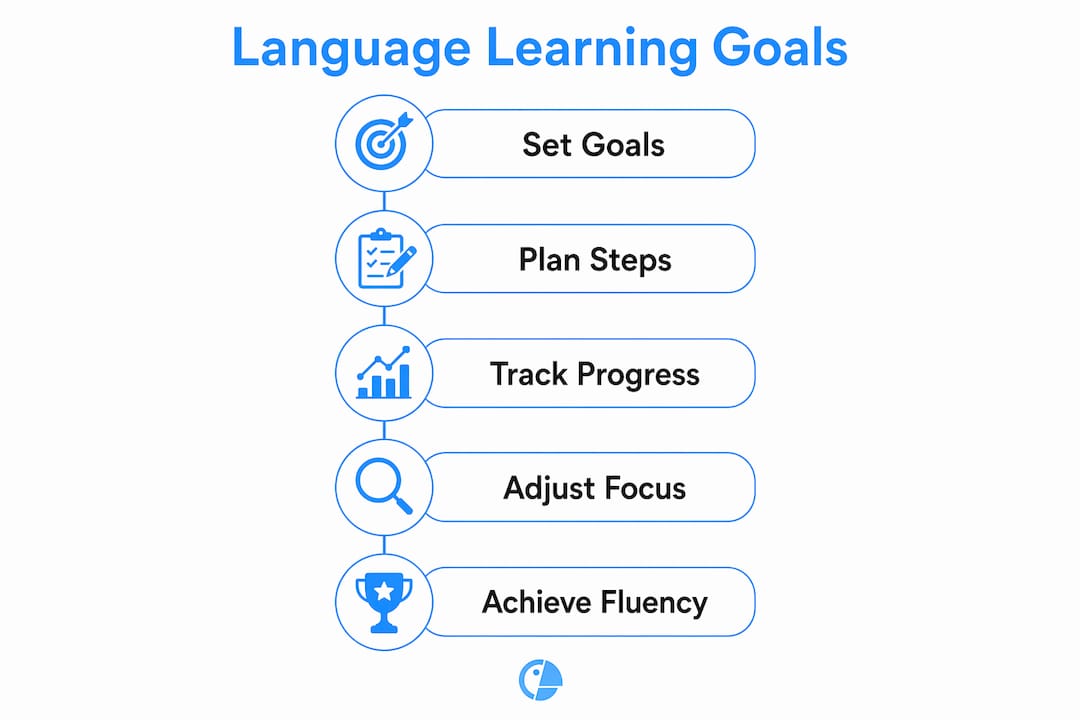
Layering goals across different time horizons is what separates learners who sustain progress from those who burn out after a few weeks. Structuring goals into short, medium, and long-term milestones maintains momentum and prevents the paralysis that comes from staring at a distant, years-away destination.
A practical three-tier structure works as follows:
- Short-term micro-goals (weekly to monthly): These are your daily and weekly behaviours. Examples include memorising 20 new words per week using Anki, completing one grammar exercise per day, or recording a two-minute spoken diary entry in your target language each evening.
- Medium-term milestones (three to six months): These mark a meaningful skill threshold. Reaching CEFR A2 in reading, passing a Goethe-Institut practice test, or completing a full beginner course on a structured platform are solid medium-term targets.
- Long-term destinations (six to twenty-four months): These define your ultimate proficiency aim. Achieving CEFR B2 in spoken French, passing the JLPT N3 in Japanese, or conducting a job interview in German are examples that give your entire study programme a clear purpose.
The CEFR (Common European Framework of Reference for Languages) is the most widely used proficiency benchmark globally, covering levels from A1 (beginner) to C2 (mastery). Using CEFR levels as milestones gives you a shared, internationally recognised language to describe your progress to employers, universities, and tutors.
| Time horizon | Example goal | Benchmark |
|---|---|---|
| Short-term (weekly) | Memorise 20 new words using Anki | Personal tracking |
| Medium-term (3 months) | Hold a 5-minute conversation on familiar topics | CEFR A2 |
| Medium-term (6 months) | Read a news article without a dictionary | CEFR B1 |
| Long-term (12 months) | Conduct a professional meeting in the target language | CEFR B2 |
Frequent small wins at the short-term level are what keep motivation alive during the long stretches between major milestones. Celebrating a week of consistent Anki practice matters as much as passing a formal test. You can find more on sustaining learner motivation through goal alignment and regular progress checks.
How do Can-Do statements help you measure language progress?
Can-Do statements are a self-assessment tool developed by ACTFL (the American Council on the Teaching of Foreign Languages) that convert abstract proficiency levels into concrete, observable tasks. Instead of asking "how good is my French?", a Can-Do statement asks "can I introduce myself and describe my daily routine in French to a native speaker?"
ACTFL recommends Can-Do statements for student self-assessment across all four skill areas: speaking, listening, reading, and writing. This four-domain approach prevents the common mistake of over-investing in one skill (usually reading or grammar) while neglecting others (usually speaking or listening).
Here is how Can-Do statements look in practice across levels:
- Beginner (A1): "I can understand simple greetings and farewells in spoken conversation."
- Elementary (A2): "I can read and understand short, simple texts such as menus, signs, and postcards."
- Intermediate (B1): "I can write a short personal email describing an experience or event."
- Upper-intermediate (B2): "I can follow the main points of a radio news broadcast on familiar topics."
The power of Can-Do statements is that they are written from the learner's perspective, not the teacher's. This makes them ideal for self-directed language practice and for communicating your current level clearly to a private tutor.
Pro Tip: At the start of each month, review a Can-Do checklist for your target CEFR level. Tick what you can do confidently, circle what you are working on, and use the gaps to set your behaviour goals for the coming weeks.
What are the most common pitfalls in setting language goals?
Even motivated learners fall into predictable traps when setting language learning targets. Recognising these pitfalls early saves months of wasted effort.
- Vague outcome goals without action plans. "Become fluent" is not a goal. It has no deadline, no measurable threshold, and no defined behaviour. Replace it with a specific CEFR target and a weekly study schedule.
- Cognitive overload from targeting too many skills at once. Trying to improve vocabulary, grammar, speaking, and listening simultaneously leads to cognitive overload and goal abandonment. Experts recommend focusing on one skill area first, then expanding. If you are a beginner, prioritise listening comprehension for the first month before adding active speaking practice.
- Setting static goals that never get reviewed. Most learners fail by treating goals as a one-off task. Life changes, schedules shift, and proficiency grows unevenly. Successful learners review and recalibrate their goals weekly.
- Ignoring personal motivation. Aligning goals with your personal reason for learning is what sustains discipline over months and years. A goal built around career advancement feels different from one built around connecting with family heritage. Both are valid, but the goal must reflect your "why" to remain motivating when progress feels slow.
- Neglecting to write goals down. Documented goals boost success rates significantly compared to private intentions. Writing your goals and sharing them with a tutor or study partner adds accountability that private wishes cannot provide.
For beginners especially, the tips for new language learners that actually work often come down to this: start small, stay consistent, and review often.
Key takeaways
Effective language learning goals combine specific behaviour targets with measurable milestones, structured across short, medium, and long time horizons, and aligned with your personal motivation.
| Point | Details |
|---|---|
| Define objectives precisely | Use SMART criteria to turn vague wishes into specific, time-bound targets. |
| Separate behaviour from outcome | Set behaviour goals (daily actions) alongside outcome goals (skill thresholds) for consistent progress. |
| Layer goals across time horizons | Use weekly micro-goals, three to six month milestones, and long-term CEFR destinations together. |
| Use Can-Do statements monthly | Self-assess across speaking, listening, reading, and writing to identify gaps and set next steps. |
| Review and adjust weekly | Treat goal-setting as an ongoing practice, not a one-off task, to stay on track as life changes. |
Tutoroo's perspective on goal-setting that actually works
Goal-setting in language learning is not a planning exercise you complete once and file away. At Tutoroo, we have seen thousands of learners across dozens of languages, and the pattern is consistent: the learners who make the most progress are not always the most talented. They are the ones who treat their goals as a living document, returning to them every week with honesty.
One insight that surprises many learners is how much focusing on a single skill area at a time accelerates overall progress. Spreading effort thinly across vocabulary, grammar, speaking, and writing simultaneously feels productive but rarely is. Spending four weeks on listening comprehension alone, then four weeks on speaking, produces more measurable gains than trying to do everything at once.
We also advocate strongly for writing goals down and sharing them with your tutor before your first lesson. A tutor who knows your CEFR target, your timeline, and your personal motivation can design lessons that serve those exact objectives rather than following a generic syllabus. That specificity is what makes private tuition genuinely different from classroom learning. The lesson preparation habits that produce the best results almost always begin with a clearly stated goal.
Celebrate the small wins. Completing a week of daily Anki reviews, holding your first unscripted conversation, or reading your first paragraph without a dictionary. These moments are not minor. They are evidence that your goals are working.
— TUTOROO
Start achieving your language goals with Tutoroo
Setting clear language learning goals is the first step. The second is having expert support to help you reach them. Tutoroo connects you with over 386,000 private language tutors worldwide, covering languages from English and Spanish to Arabic, Mandarin, and French. Every tutor on the platform can tailor lessons directly to your CEFR targets, Can-Do milestones, and personal learning timeline. Whether you prefer online sessions from home or in-person lessons in your city, Tutoroo makes it straightforward to find the right match. Explore private language tutors on Tutoroo and take your first personalised lesson toward the goals you have set.
FAQ
What are language learning goals?
Language learning goals are specific, measurable objectives that define what you want to achieve in a target language and by when. They guide your study choices, focus your effort, and give you a clear way to measure progress over time.
How do I set effective language learning goals?
Apply the SMART framework: make goals Specific, Measurable, Achievable, Relevant, and Time-bound. Pair each outcome goal with a behaviour goal that describes the daily or weekly actions you will take to reach it.
What is the difference between short-term and long-term language goals?
Short-term goals are weekly or monthly behaviour targets, such as memorising 20 words per week. Long-term goals are proficiency destinations, such as reaching CEFR B2 within 18 months. Both are necessary and work together to sustain motivation.
What are Can-Do statements in language learning?
Can-Do statements, developed by ACTFL, are self-assessment prompts that describe what a learner can do in a language at a given proficiency level. They cover speaking, listening, reading, and writing, and help learners identify skill gaps and plan next steps.
How often should I review my language learning goals?
Successful learners review and recalibrate their goals weekly rather than treating them as fixed. Regular review accounts for changes in schedule, proficiency growth, and motivation, keeping goals realistic and relevant.