

TL;DR:
- Effective language study routines involve daily sessions that balance listening, speaking, and review to build fluency. Consistency in these components, even for 30 minutes, outperforms irregular longer study hours. Regular practice with techniques like shadowing, self-narration, and spaced repetition enhances speaking and vocabulary retention.
Effective language study routines are defined as daily structured sessions that combine listening input, active speaking output, and targeted review to build lasting fluency. Consistency across these three components predicts success more reliably than the total number of hours studied. Learners who practise for 30 minutes daily using a balanced input-output-review split outperform those who cram for hours once a week. This guide covers the core components, habit-building strategies, vocabulary and speaking techniques, and how to troubleshoot your routine when life gets in the way.
What makes effective language study routines work?
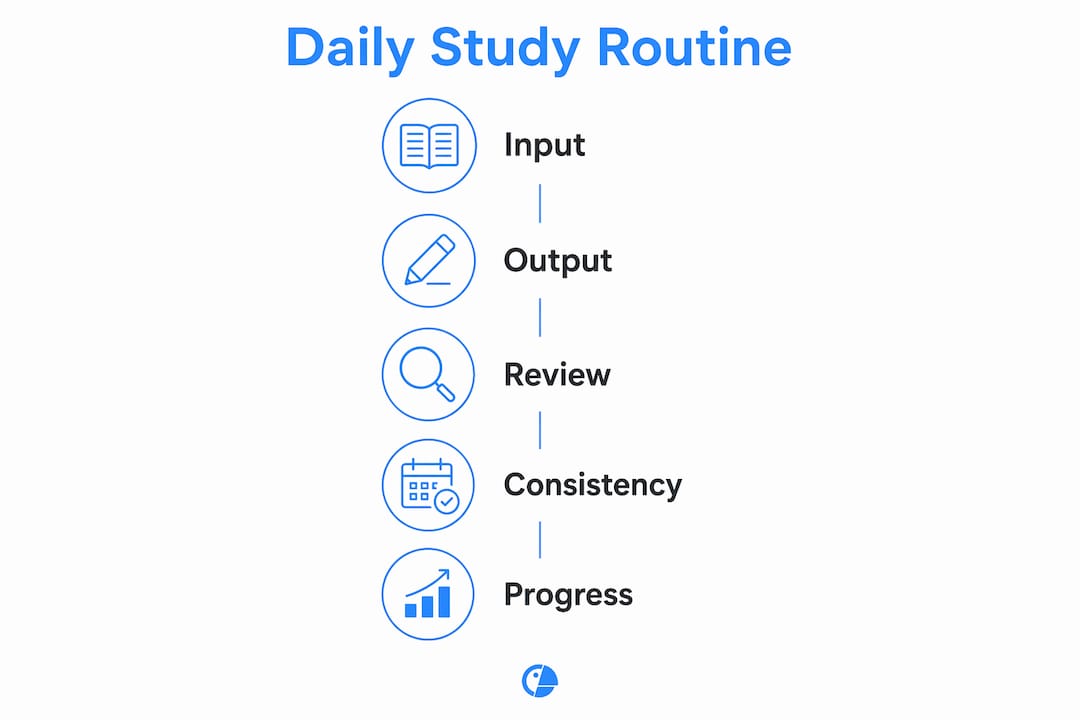
The most effective daily language study routine divides 30 minutes into three equal parts: 10 minutes of input, 10 minutes of output, and 10 minutes of review. Each part trains a different cognitive skill, and skipping any one of them creates a gap that compounds over time. Consistency beats total hours as the strongest predictor of language acquisition success. That means a learner who studies 30 minutes every day will outpace one who studies three hours on weekends.

The term used in linguistics for this approach is structured acquisition practice, though most learners simply call it a daily routine. Whatever the label, the principle is the same: short, frequent, balanced sessions build fluency faster than long, irregular ones.
| Session component | Time | Primary benefit |
|---|---|---|
| Input (listening or reading) | 10 minutes | Builds comprehension and natural grammar sense |
| Output (speaking or shadowing) | 10 minutes | Trains active production and pronunciation |
| Review (flashcards or notes) | 10 minutes | Reinforces vocabulary and corrects errors |
Why input matters: Comprehensible input, meaning content slightly above your current level, exposes you to grammar patterns in context. Reading a short news article or listening to a podcast episode at near-native speed gives your brain real language data to process.
Why output matters: Active production pressure closes the gap between understanding a language and speaking it. Passive immersion alone often leaves learners with strong comprehension but poor speaking skills. Output forces retrieval, which strengthens memory.
Why review matters: Without review, new vocabulary fades within 48 hours. Spaced repetition flashcards during the review block lock words into long-term memory by timing each repetition just before you would naturally forget.
Pro Tip: If 30 minutes feels like too much to start, cut each block to five minutes. A 15-minute session done daily beats a 60-minute session done twice a month.
How to build consistent language learning habits that stick
Consistency is the single biggest challenge for adult language learners. Motivation fades, schedules shift, and study sessions get skipped. The solution is not more willpower. It is better habit design.
Habit stacking is the most reliable method for building a daily language practice. It means attaching your study session to an existing daily ritual, such as morning coffee, a commute, or a lunch break. When the existing behaviour triggers automatically, the new habit follows without requiring a conscious decision. Learners who use habit stacking report significantly higher routine adherence than those who schedule study as a standalone task.
Practical strategies for building consistent study habits:
- Anchor to a strong trigger. Link your session to something you already do every day without thinking, like brushing your teeth or making breakfast.
- Start absurdly small. A 10-minute daily session builds better long-term retention than a 45-minute session three times a week. Small wins create momentum.
- Use the "never miss twice" rule. Missing one session is a slip. Missing two in a row is the start of a broken habit. Protect the streak after any gap.
- Set SMART goals for each session. "Practise Spanish" is not a goal. "Shadow one 90-second audio clip and review 20 flashcards" is a goal you can complete and measure.
- Track your streak visibly. A simple calendar with a mark for each completed session creates a visual chain you will not want to break.
Pro Tip: Remove every barrier between you and your study session. Pre-load your flashcard app, bookmark your podcast, and lay out your notebook the night before. Friction kills habits.
What are the best techniques for vocabulary retention and speaking fluency?
Vocabulary: go beyond word lists
Mastering the 1,000 most frequent words in your target language covers approximately 75–90% of everyday speech. That is a concrete, achievable target. The method matters as much as the word list. Cloze-deletion flashcards, where you fill in a missing word within a sentence, outperform isolated word memorisation because they teach collocations and context simultaneously.
Extensive reading slightly above your current ability accelerates vocabulary acquisition further. Context and grammatical cues in real sentences do the work that isolated word lists cannot. A short graded reader or a subtitled video in your target language gives you vocabulary in action, not in isolation. For a deeper look at proven vocabulary methods, the 9 proven vocabulary techniques guide covers spaced repetition, frequency lists, and more.
Speaking: practise actively and often
Three 20-minute conversation sessions per week represent the minimum viable cadence for accelerated speaking progress. Active output consistently outperforms passive consumption for building fluency. The challenge for many learners is finding speaking opportunities outside a classroom.
Solo speaking techniques that work without a partner:
- Shadowing. Listen to a native speaker and repeat their words simultaneously, matching rhythm, stress, and intonation. Controlled studies show shadowing improves speech rate, pronunciation, and listening accuracy at the same time.
- Self-narration. Describe what you are doing in your target language as you go about your day. Cooking, commuting, and shopping all become speaking practice.
- Recorded self-review. Record yourself speaking for 60 seconds, then listen back. The gap between what you think you sound like and what you actually sound like is where improvement lives.
| Technique | Skill targeted | Solo-friendly |
|---|---|---|
| Cloze-deletion flashcards | Vocabulary in context | Yes |
| Extensive reading | Vocabulary and grammar | Yes |
| Shadowing | Pronunciation and fluency | Yes |
| Self-narration | Speaking confidence | Yes |
| Conversation sessions | Real-time retrieval | Requires a partner or tutor |
Pro Tip: Practising conversation skills in a new language with a live partner accelerates progress faster than any solo method. Even one weekly session with a tutor or language exchange partner adds real-time feedback that self-review cannot replicate.
How to structure and troubleshoot your daily study routine
A sample 30-minute session
A well-structured daily session follows a simple sequence. Start with input to warm up your comprehension. Move to output while your mind is engaged and alert. Finish with review to consolidate what you encountered during input and output.
- Minutes 1–10: Input. Listen to a short podcast clip or read a page of a graded reader. Do not stop to look up every word. Focus on understanding the overall meaning.
- Minutes 11–20: Output. Shadow the audio clip you just heard, narrate a task aloud, or record a 60-second monologue on a familiar topic.
- Minutes 21–30: Review. Work through your spaced repetition flashcard deck. Flag any words you missed for extra repetition tomorrow.
Signs your routine is working
Progress in language learning is gradual and easy to miss. Clear signs that your routine is producing results include: understanding more of your input without pausing, producing sentences faster during output, and needing fewer repetitions to recall flashcard words. If none of these are happening after four weeks, the routine needs adjustment, not abandonment.
Common mistakes and how to fix them
Deliberate practice with narrow, skill-specific goals and immediate feedback outperforms unfocused repetition. Most learners plateau because they default to passive consumption, listening without active engagement, or skip output entirely because speaking feels uncomfortable. Beginners especially stagnate by focusing on grammar drills rather than real production.
Fix these mistakes by:
- Replacing passive listening with active shadowing or note-taking.
- Scheduling output first if you consistently skip it.
- Shortening sessions during busy weeks rather than skipping them entirely. A five-minute session preserves the habit.
- Rotating your input sources every two weeks to prevent boredom.
Pro Tip: Record yourself at the start of each month and again at the end. Comparing recordings is the most objective way to measure speaking progress. The improvement you hear will motivate the next month's sessions.
Key takeaways
Effective language study routines work because they balance input, output, and review in short daily sessions that build on each other over time.
| Point | Details |
|---|---|
| Daily consistency beats intensity | Thirty minutes daily outperforms three-hour weekend sessions for long-term retention. |
| Use the 10-10-10 split | Divide each session into input, output, and review for balanced skill development. |
| Habit stacking sustains practice | Attach study to an existing daily ritual to remove reliance on motivation. |
| Active output is non-negotiable | Speaking practice at least three times weekly closes the gap between comprehension and fluency. |
| Vocabulary targets are achievable | The 1,000 most frequent words cover 75–90% of everyday speech. Start there. |
Tutoroo's view on building a routine that lasts
The most common mistake we see is learners treating language study as something that happens when they find time. Time is never found. It is made, and the only reliable way to make it is to attach practice to something that already happens automatically every day.
Solo techniques like shadowing and self-narration are genuinely powerful, and we encourage every learner to use them. But active speaking without feedback is like practising a golf swing in the dark. You build habits, but you cannot tell if they are good ones. The learners who progress fastest combine a solid solo routine with regular sessions where someone can hear them, correct them, and push them past comfortable patterns.
Small daily actions compound in ways that are hard to see week to week but impossible to miss after six months. The learner who does 20 minutes every morning, without exception, will speak with more confidence than the one who waits for a perfect two-hour block that never arrives. Incremental improvement, chosen deliberately each day, is what fluency is actually made of.
— Tutoroo
Tutoroo and your language study routine

A strong solo routine builds the foundation, and a private tutor is what turns that foundation into real conversation. Tutoroo connects learners with over 386,000 private language tutors worldwide, covering languages from Spanish and French to Arabic, Chinese, and Malay. Lessons are available online or in person, and you can match with a tutor based on your language, schedule, and learning goals. One weekly session with a tutor adds the real-time feedback and speaking pressure that solo practice cannot provide. Whether you are building a routine from scratch or looking to accelerate an existing one, find a language tutor on Tutoroo and make your next session count.
FAQ
How long should a daily language study session be?
A 30-minute daily session split into input, output, and review is the recommended structure for consistent progress. Short daily sessions produce better long-term retention than longer, irregular ones.
What is the fastest way to build speaking fluency?
Active speaking practice at least three times per week accelerates fluency more than any passive method. Shadowing, self-narration, and sessions with a live tutor or partner all qualify as active output.
How do I stop skipping my language study sessions?
Habit stacking, attaching your study session to an existing daily ritual, reduces dependence on motivation and improves adherence. The "never miss twice" rule helps recover quickly after an unavoidable gap.
How many words do I need to learn to hold a basic conversation?
Mastering the 1,000 most frequent words in your target language covers approximately 75–90% of everyday speech. Learning these words in context using cloze-deletion flashcards is more effective than memorising isolated word lists.
Can I make progress without a language partner or tutor?
Yes, solo techniques like shadowing, self-narration, and recorded self-review build real skills. Adding even one weekly session with a tutor or live speaking practice partner accelerates progress significantly by introducing real-time feedback.