

TL;DR:
- Step-by-step language learning emphasizes structured input, vocabulary review, and active speaking practice for effective fluency development. A daily routine involving 20 minutes of conversation, five minutes of spaced repetition, and five minutes of grammar study over 90 days ensures sustainable progress. Using CEFR levels to identify weaknesses and focusing on comprehension-first input enhances overall language acquisition.
Step by step language learning is a structured method that builds fluency through sequenced input, vocabulary review, and active production rather than random study. The formal term for this approach is systematic language acquisition, and it draws on frameworks like the Common European Framework of Reference for Languages (CEFR), Stephen Krashen's Input Hypothesis, and spaced repetition systems to make progress measurable. Whether you are starting from zero or pushing past an intermediate plateau, a structured routine of speaking practice, graded input, and grammar study is the most reliable path to real fluency. This guide gives you the exact steps to follow.
What are the best tools for step by step language learning?
The right resources make or break a structured study plan. Each tool serves a specific function, and mixing them deliberately produces better results than relying on any single app.
Core tools every learner needs:
- Anki (flashcard software): Uses spaced repetition to schedule vocabulary review at optimal intervals, improving retention and exam performance. Pair it with contextual listening on the same day to close the gap between recognising a word and using it.
- AI conversation platforms (such as Speak or Pimsleur): Provide low-stakes speaking practice between tutor sessions, letting you build confidence before live conversation.
- Graded readers and podcasts: Thematic, level-appropriate content increases vocabulary retention and comprehension without overwhelming you. Programmes like Dreaming Spanish for Spanish learners or the Slow News podcast for German learners are well-regarded examples.
- Grammar references: Resources like the Cambridge Grammar in Use series give you a reliable reference for targeted mini-study sessions rather than cover-to-cover reading.
| Resource Type | Primary Purpose | Best Used |
|---|---|---|
| Anki (spaced repetition) | Vocabulary retention | Daily, 5-minute sessions |
| Graded readers | Comprehensible input | Reading phase, 15–20 minutes |
| AI conversation tools | Speaking confidence | Between tutor sessions |
| Grammar references | Targeted rule clarification | Short daily mini-study |
| Podcasts and audio | Listening comprehension | Commuting or downtime |
Pro Tip: Do not treat Anki as your entire vocabulary strategy. Spaced repetition works best as part of a broader system that includes practical use and contextual exposure through listening and reading.
How to build a daily routine: the 30-minute study stack
Consistent daily practice outperforms sporadic intensive study every time. A minimum of 30 minutes per day for 90 days, structured in phases, produces lasting acquisition results.
Here is the proven daily stack:
- 20 minutes: Speaking or conversation practice. This is the core of your session. Use a tutor, an AI conversation tool, or a language exchange partner. Speaking first, while your mind is fresh, builds the production skills that most learners neglect.
- 5 minutes: Spaced repetition vocabulary review. Open Anki and work through your due cards. Keep this short and consistent. The goal is daily exposure, not marathon sessions.
- 5 minutes: Grammar mini-study. Pick one grammar point from your reference book. Read the explanation, look at two or three examples, and move on. Depth comes from repeated encounters, not single long sessions.
The 90-day phased plan
A phased 90-day framework gives your routine a clear arc. It prevents the common mistake of doing the same activities at the same intensity for months without progression.
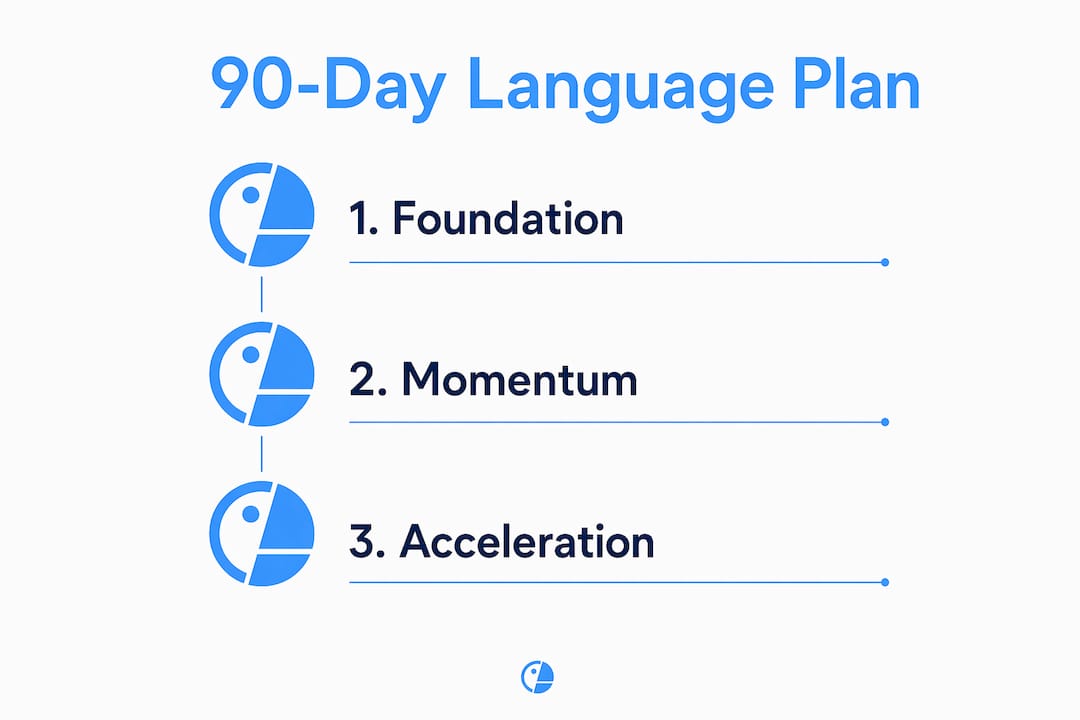
Days 1–30 (Foundation phase): Focus on building the habit and loading comprehensible input. Prioritise listening and reading at A1 to A2 level. Keep your Anki deck small and manageable, around 10 new cards per day.

Days 31–60 (Momentum phase): Increase your flashcard volume to 15–20 new cards per day. Add a weekly conversation session with a tutor or language partner. Start producing short written sentences in a journal.
Days 61–90 (Acceleration phase): Introduce fluency tasks such as summarising a podcast episode in the target language or writing a short paragraph on a familiar topic. Sit a CEFR-aligned practice test to measure your progress objectively.
Pro Tip: Pair your daily study habit with a fixed trigger, such as studying immediately after your morning coffee. Attaching study to an existing routine dramatically improves consistency in the first 30 days.
How do CEFR levels guide your progression?
The Common European Framework of Reference for Languages (CEFR) is the most widely used standard for measuring language proficiency. It runs from A1 (complete beginner) to C2 (mastery), and each level is defined by skill-based "can-do" statements rather than fixed study hours.
CEFR maps roughly to 60–200+ guided hours per level, but the more useful application is using its descriptors to identify your weakest skill. A learner might read at B1 level but speak at A2. Targeting the weaker skill produces faster overall progress than studying evenly across all four skills.
| CEFR Level | Typical Learner Activities | Focus Skill |
|---|---|---|
| A1 | Greetings, numbers, basic phrases | Listening and pronunciation |
| A2 | Simple conversations, everyday topics | Speaking and vocabulary |
| B1 | Expressing opinions, narrating events | Reading and writing |
| B2 | Debating, understanding native media | Fluency and nuance |
| C1 | Academic and professional use | Precision and register |
Using CEFR skill evaluation to identify your bottleneck skill is the single most efficient way to break through a plateau. If your speaking lags behind your reading, shift 10 minutes of your daily reading time into conversation practice until the gap closes.
Practical milestones to set:
- Complete a free CEFR self-assessment test at the start of each 30-day phase.
- Write down three specific "can-do" statements you want to achieve by the end of the phase.
- Review your weakest skill at the end of each phase and adjust your resource mix accordingly.
What role does comprehension-first input play?
Comprehension-first input is the foundation of natural language acquisition. Stephen Krashen's Input Hypothesis states that learners acquire language most effectively when they receive input that is slightly above their current level, a principle he labelled i+1.
"We acquire language when we understand messages in the target language — when we understand what people say to us or what we read — not when we consciously study and memorise rules." — Stephen Krashen
Comprehensible input improves listening comprehension significantly after just eight weeks in a structured programme. That result matters because it confirms that input-focused phases are not passive or slow. They build the mental grammar that makes speaking feel natural later.
Comprehension-first input is active, not passive. You engage with meaning and linguistic form simultaneously, which is what drives acquisition. Watching a Spanish film with subtitles while mentally noting unfamiliar structures is active input. Having it on as background noise is not.
How to apply comprehension-first input in practice:
- Choose graded readers or podcasts at your current CEFR level, not one level above.
- Use narrow input, meaning content on the same topic across multiple sources, to increase vocabulary repetition naturally.
- Avoid jumping to output production until you can understand at least 80 per cent of your input material without pausing.
- Keep a vocabulary notebook for words that appear repeatedly. These are the words worth adding to Anki.
How to stay motivated and overcome common plateaus
Every learner moves through predictable phases: initial excitement, early frustration, a plateau, and eventual breakthrough. Knowing this cycle in advance removes much of its power to derail you.
The most common cause of stalling is a difficulty mismatch in your materials. If your input is too easy, you stop acquiring new language. If it is too hard, you lose comprehension and motivation together. The fix is simple: adjust your materials until you understand roughly 70–80 per cent without assistance.
Strategies to maintain momentum:
- Track your streak, not your perfection. Missing one day does not reset your progress. Resume the next day without guilt.
- Rotate your content formats every two weeks. Swap a podcast for a graded reader, or replace a grammar workbook with a short film in the target language.
- Schedule one conversation session per week with a private language tutor to get corrective feedback you cannot get from apps alone.
- Celebrate CEFR milestone completions. Finishing a level is a genuine achievement worth acknowledging.
Pro Tip: When motivation dips, reduce your daily target rather than skipping entirely. Ten minutes of consistent daily practice maintains the habit loop and keeps your acquisition active, even on difficult days.
Key takeaways
Systematic language acquisition works because it sequences comprehensible input, spaced vocabulary review, and daily speaking practice into a repeatable routine that compounds over 90 days.
| Point | Details |
|---|---|
| Daily 30-minute stack | Spend 20 minutes speaking, 5 minutes on Anki, and 5 minutes on grammar every day. |
| CEFR as a skill compass | Use CEFR can-do statements to identify your weakest skill and focus study there. |
| Comprehensible input first | Build listening and reading comprehension before pushing into heavy output production. |
| Phased 90-day plan | Divide your study into foundation, momentum, and acceleration blocks for sustainable growth. |
| Adjust difficulty actively | Match materials to your current level so you understand 70–80 per cent without assistance. |
What Tutoroo has learned about structured language learning
Consistency beats intensity. That is the single most important lesson from working with learners across dozens of languages and proficiency levels. Learners who study 30 minutes every day for 90 days reliably outperform those who do three-hour weekend sessions and nothing in between. The brain consolidates language during rest, so daily exposure gives it more opportunities to do that work.
The second lesson is that technology is a support structure, not a replacement for human interaction. Anki and AI conversation tools are genuinely useful, but they cannot replicate the adaptive feedback of a skilled tutor who notices your specific error patterns and adjusts in real time. The most effective learners we see use apps for vocabulary and grammar, then bring that material into live conversation practice where it gets tested and refined.
The third lesson is about imperfection. Learners who wait until they feel "ready" to speak rarely progress past the intermediate plateau. Speaking badly, being corrected, and trying again is not a sign of failure. It is the actual mechanism of acquisition. Embrace the awkward early conversations. They are doing more for your fluency than any flashcard deck ever will.
You can find a structured approach to faster fluency that combines self-study with expert guidance, and it makes a real difference to how quickly learners move through CEFR levels.
— Tutoroo
Take your learning further with Tutoroo
A structured self-study plan gets you far. Pairing it with personalised, one-on-one tutoring gets you there faster.

Tutoroo connects you with over 386,000 private language tutors across the world, covering languages from English and Spanish to Arabic, French, and Chinese. Each tutor brings the kind of real-time, adaptive feedback that no app can replicate. Whether you want to practise conversation, work through grammar gaps, or prepare for a CEFR assessment, a private tutor fits directly into your daily study stack. You can find private language tutors online or in person to match your schedule, level, and language goals. For those focused on English specifically, Tutoroo's online English tutors are available across multiple time zones.
FAQ
What is step by step language learning?
Step by step language learning is a structured approach to language acquisition that sequences comprehensible input, vocabulary review, and speaking practice in a daily routine. It uses frameworks like CEFR and tools like Anki to make progress measurable and sustainable.
How long does it take to reach conversational fluency?
A consistent 30-minute daily routine over 90 days builds a strong foundation, but conversational fluency typically requires reaching B1 or B2 on the CEFR scale, which takes 200–400 hours of guided study depending on the language.
Is spaced repetition enough on its own for vocabulary learning?
Spaced repetition with Anki improves retention, but it works best as part of a broader system that includes contextual listening and reading. Combine daily Anki sessions with input that contains the same words in natural context.
How do i know when to move to the next CEFR level?
Move up when you consistently meet the can-do statements for your current level across all four skills. CEFR skill descriptors are the most reliable guide, not a fixed number of study hours.
Can beginners use this method, or is it only for intermediate learners?
The step by step language guide works at every level. Beginners start with A1 graded input and a small Anki deck, while intermediate learners adjust the same framework to target their specific weak skills within the CEFR structure.