

A reliable language study workflow follows a simple daily split: 10 minutes of input (listening or reading), 10 minutes of spaced repetition review, and 10 minutes of output (speaking or writing). Run that pattern every day and you have the foundation of everything that follows. The 1,000 most frequent words in any language cover roughly 75–90% of everyday speech, so your early weeks are not about breadth — they are about depth with a small, high-frequency core.
Here is what that looks like across the first 90 days:
- Days 1–30 (habit foundation): Build the 30-minute daily session. Start your first Anki deck with 10–15 new cards per day. Prioritise listening to graded material you understand most of. Book one weekly tutor session on Tutoroo for early pronunciation and grammar feedback.
- Days 31–60 (volume expansion): Increase input to native-adjacent material. Add a second weekly tutor or language-exchange session. Grow your Anki deck to 20 new cards per day and begin sentence cards.
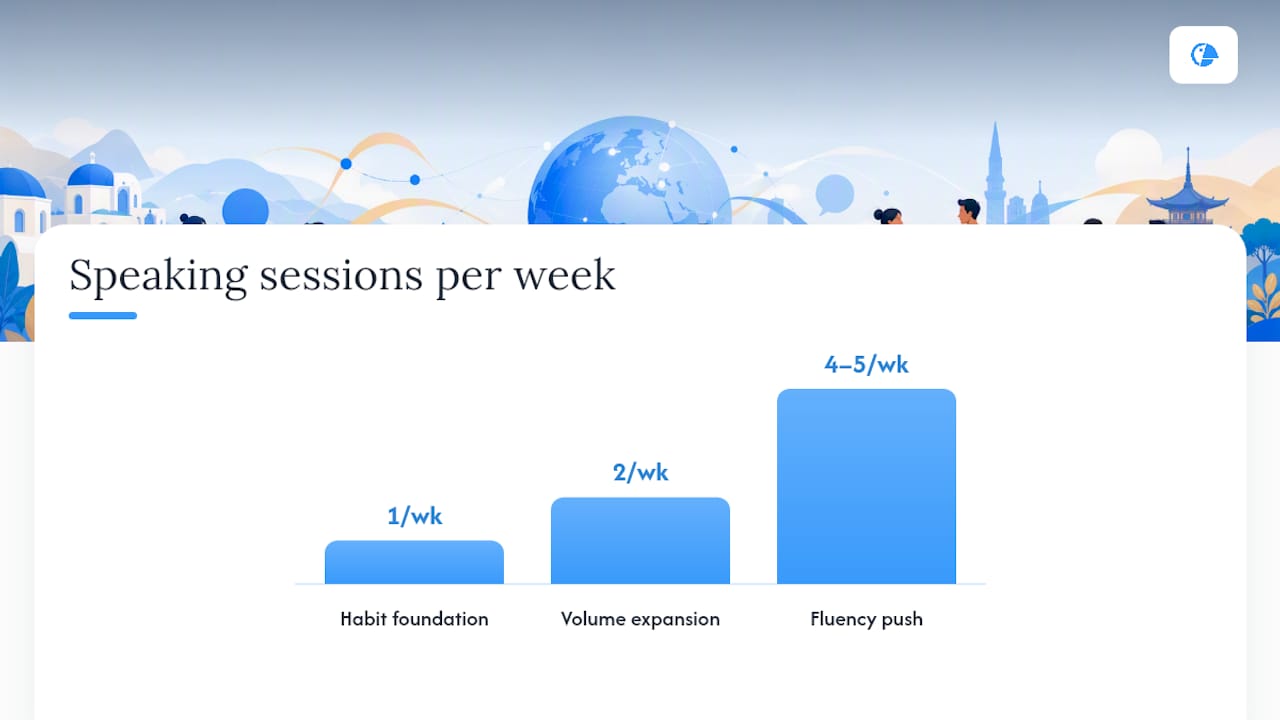
- Days 61–90 (fluency push): Shift the session balance toward output. Target 4–5 speaking sessions per week. Run your first CEFR self-assessment and record a short audio diary to measure fluency gains against Day 1.
Key takeaways
A structured language study workflow combining daily 30-minute sessions, Anki-based spaced repetition, and regular tutor feedback produces measurable progress across a realistic 90-day arc.
| Point | Details |
|---|---|
| Start with the 10–10–10 split | Ten minutes each of input, SRS review, and output gives every session a clear purpose from day one. |
| Use context-based Anki cards | Cloze deletion and error-log cards transfer vocabulary into production far faster than word-translation pairs. |
| Follow the three-phase arc | Days 1–30 build the habit, Days 31–60 expand volume, Days 61–90 push output to 4–5 speaking sessions per week. |
| Measure with CEFR and recordings | Monthly audio diaries and CEFR can-do checklists make progress visible and keep goals concrete. |
| Tutoroo for tutor-guided feedback | Book a private tutor on Tutoroo to accelerate the recognition-to-production gap with targeted, real-time correction. |
Table of Contents
- What does an effective language study workflow look like?
- How to structure your daily and weekly study sessions
- How to make spaced repetition actually transfer into conversation
- What input strategies build real comprehension?
- How do you turn comprehension into fluent speaking and writing?
- How do you measure progress against CEFR milestones?
- Which tools support a language study workflow in Australia?
- A realistic 90-day phased plan with weekly checkpoints
- Common mistakes that stall progress and how to fix them
- Why tutor-guided workflows accelerate output
- How a private tutor from Tutoroo fits this workflow
- Sources
What does an effective language study workflow look like?
Most learners treat language study as a collection of tasks rather than a staged process. The difference between slow progress and real momentum is almost always structure: knowing which skill to build first, how much time each deserves, and when to shift the balance.
A well-designed language acquisition strategy moves through three core phases, each with a distinct purpose.
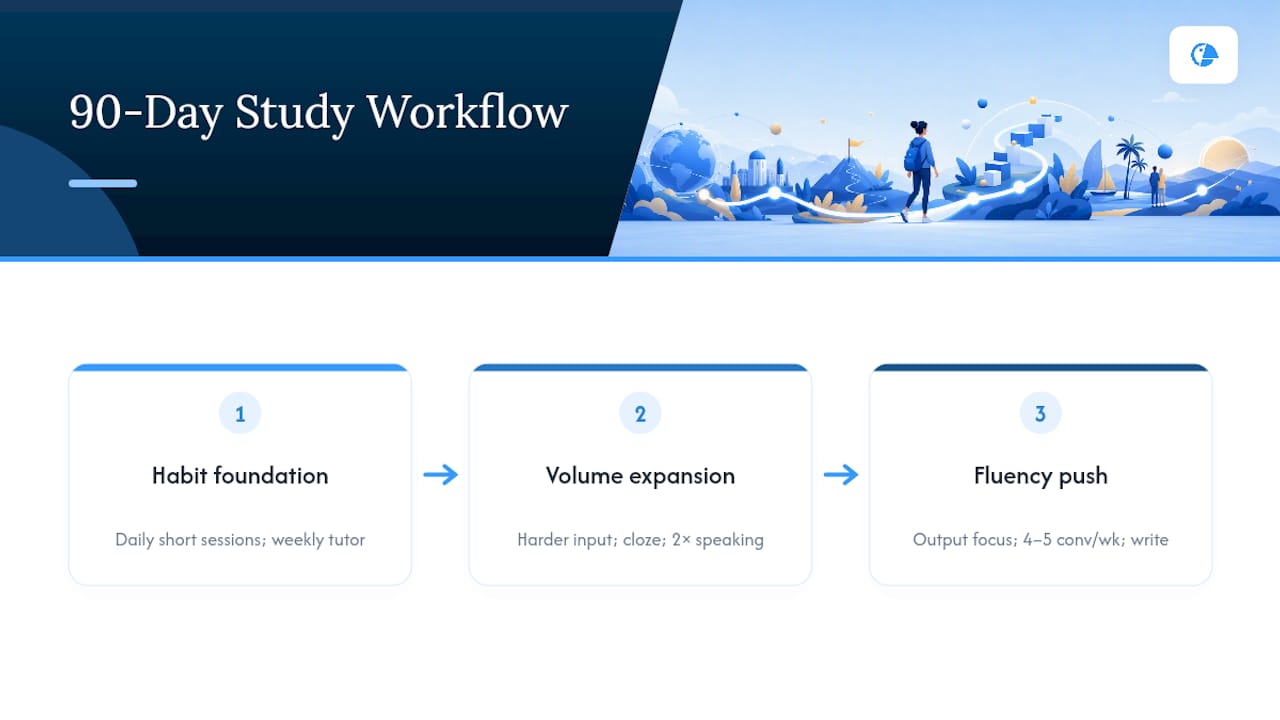
Stage 1: Habit foundation (Days 1–30) The goal here is consistency, not volume. A 30-minute daily session beats a two-hour Saturday session every time, and short, balanced daily sessions produce better long-term retention than irregular long blocks. A typical week in this stage looks like: 20 minutes of graded listening or reading each day, 10 minutes of Anki review, and one 45-minute tutor session focused on pronunciation and core grammar patterns.
Stage 2: Volume expansion (Days 31–60) Once the habit is stable, you increase the difficulty and variety of your input. Native podcasts, short YouTube videos, and graded news articles replace the beginner material. Anki cards shift from isolated words to full sentence cloze deletions. Speaking practice doubles, with a second weekly session added.
Stage 3: Fluency push (Days 61–90) Output becomes the priority. You spend more time producing language than consuming it: narrating your day aloud, writing short journal entries, and attending 4–5 conversation sessions per week. CEFR can-do statements serve as the checkpoint: can you introduce yourself and handle a simple transaction? That is A2. Can you discuss familiar topics with some fluency? That is B1.
Stage 4: Consolidation and stretch (beyond Day 90) This is where many learners plateau. The fix is deliberately choosing harder input and seeking feedback on specific error patterns rather than general conversation. A tutor who targets your fossilised mistakes is worth more here than a language-exchange partner who lets errors pass.
How to structure your daily and weekly study sessions
The session template matters more than the total time. Forty minutes of unfocused listening produces far less than a structured 30-minute block with a clear purpose for each segment.
The 10–10–10 daily template (30 minutes)
| Segment | Activity | Purpose |
|---|---|---|
| Minutes 1–10 | Graded input (listen or read) | Build comprehension and expose new vocabulary in context |
| Minutes 11–20 | Anki SRS review + 10–15 new cards | Consolidate vocabulary through spaced repetition |
| Minutes 21–30 | Output (speak aloud, write, or shadow) | Force production and close the recognition-to-production gap |
For learners with more time, a 60–90 minute session simply expands each segment: 25 minutes of input, 20 minutes of SRS, 25 minutes of output, and a final 10–15 minutes reviewing errors or updating cards from the day's input.
Sample weekly rotation
- Monday / Wednesday / Friday: Full 30-minute 10–10–10 session + one tutor or exchange session
- Tuesday / Thursday: Input-heavy day (podcast episode + read-along); 10 minutes of Anki only
- Saturday: Longer 60-minute session with a focus on writing or recorded self-review
- Sunday: Anki review only (15 minutes maximum); rest is recovery
Habit architecture is what keeps this rotation alive when motivation dips. The most practical approach is habit stacking and emergency protocols: attach your Anki review to an existing daily ritual (morning coffee, commute, lunch break) so it fires automatically. When life disrupts the schedule, the "never miss twice" rule applies — one missed day is a rest, two consecutive missed days is a broken habit. On genuinely busy days, a five-minute emergency session (Anki review only, or one shadowing repetition) preserves the chain.
Pro Tip: Schedule output practice at the time of day when you are most alert, not most convenient. Speaking and writing require active retrieval; input can tolerate lower energy. Most people do better placing output in the morning and passive listening during commutes or evenings.
How to make spaced repetition actually transfer into conversation
Anki is the most widely used SRS tool for language learners, and it works — but only when the cards are built correctly. The most common mistake is creating isolated word-translation pairs. Seeing "gato = cat" 50 times does not help you produce the word in a sentence under pressure.
The fix is context-based cards. Reviewing vocabulary inside original sentences or dialogues improves transfer from recognition to production far more reliably than isolated word lists. Three card types that work:
- Cloze deletion card: Take a sentence from your input that day ("El gato ___ en la silla" → "está"). The context is real; the gap forces production.
- Audio + sentence card: The front plays a short audio clip; the back shows the transcript. Trains listening and reading simultaneously.
- Error-log card: After a tutor session, note a mistake you made and create a card with the corrected version in context. These are the highest-value cards in your deck.
Anki settings to start with: set new cards per day to 10–15, leave the default intervals, and turn on the "bury related cards" option so siblings of a card do not appear on the same day. If a card feels impossible after several failed reviews, suspend it rather than letting it pile up — return to it after more input exposure.
Pro Tip: Create new Anki cards immediately after your input session, while the context is fresh. Pairing same-day input, card creation, and output practice forms a strategy chain that produces stronger retention than doing each activity on separate days.
What input strategies build real comprehension?
Input is the raw material of language acquisition, but not all input is equally useful. The guiding principle is comprehensible input at the i+1 level: choose material where you understand roughly 80–90% of the words, so the remaining 10–20% is learnable from context rather than opaque.
Different material types suit different stages:
- Graded readers and graded podcasts (A1–B1): Controlled vocabulary, slower pace, and predictable grammar make these ideal for the first 30–60 days. Titles like Short Stories in Spanish or the Coffee Break podcast series are widely available and accessible in Australia through library apps and streaming platforms.
- Native podcasts with transcripts (B1–B2): Once comprehension is stable, switch to real speech. The transcript lets you read along and catch what your ear missed.
- Short YouTube videos (B1+): Native speakers, natural pace, visual context. Watch once for gist, then again with subtitles, then once more without.
- News articles (B2+): Formal register, consistent vocabulary, and short paragraphs make news a good bridge to academic or professional language.
The most effective input technique for memory is multimodal exposure: listening first, then reading the same content again strengthens memory traces more than either mode alone. Shadowing, where you speak along with the audio at near-native pace, sits between input and output and is a particularly effective bridge when you are ready to move from comprehension to production.
How do you turn comprehension into fluent speaking and writing?
Comprehension and production are separate skills. You can understand a sentence perfectly and still be unable to produce it under time pressure. Closing that gap requires scheduled, deliberate output practice — not just more listening.
Speaking session template (20–30 minutes)
- Warm-up (3–5 minutes): Narrate what you did yesterday in the target language. No notes, no pausing to look up words. The goal is fluency, not accuracy.
- Targeted task (10–15 minutes): Pick one topic or grammar pattern and speak about it. Record yourself on your phone.
- Feedback loop (5 minutes): Play back the recording. Note two or three specific errors or hesitations. Create Anki error-log cards for each.
- Repetition (2–3 minutes): Repeat the targeted task. Notice whether the errors from step three recur.
Low-barrier strategies to start producing early include self-narration (describing your surroundings or actions aloud as you go about your day), recorded voice memos reviewed weekly, and shadowing with output (repeating the audio line by line, then trying to reproduce it without the audio).
For tutor sessions, arrive with a prepared agenda rather than leaving the direction to the tutor. Useful prompts to bring:
- "Can we do a five-minute free conversation and then you correct my top three errors?"
- "I made these mistakes this week — can we drill the correct forms?"
- "Can you give me a scenario to role-play that uses the vocabulary I'm studying?"
Language lessons structured around real speaking tasks produce faster gains than open-ended conversation, because the tutor can target specific gaps rather than simply responding to whatever comes up.
How do you measure progress against CEFR milestones?
Progress in language learning is easy to feel but hard to measure. CEFR can-do statements give you an objective framework: each level describes what you can do, not what you know. A2 means you can handle routine transactions and simple exchanges; B1 means you can describe experiences and give reasons for opinions.
Weekly and monthly goal templates
- Weekly proximal goal: "By Friday, I can use three new verbs from this week's input in a spoken sentence without notes."
- Monthly goal: "By the end of Month 1, I can introduce myself and ask basic questions at A1 level."
- 90-day goal: "By Day 90, I can hold a five-minute conversation on a familiar topic without long pauses."
Breaking large ambitions into proximal subgoals sustains motivation far better than a single distant target. When a weekly goal feels too easy, increase the difficulty of the input or the complexity of the output task rather than skipping ahead.
Progress checkpoints to track monthly:
- Comprehension rate: Can you follow a graded podcast episode without rewinding more than twice?
- Vocabulary size: How many cards in your Anki deck have a mature interval (21+ days)?
- Output fluency: Record a two-minute spoken response to a prompt. Compare it to last month's recording.
- CEFR self-assessment: Work through the CEFR can-do checklists for your target level and note which statements you can tick confidently.
Recording a short audio or video diary once a month is one of the most revealing checkpoints available. Sentence length, hesitation frequency, and vocabulary range all improve visibly across 90 days when you have recordings to compare.
Which tools support a language study workflow in Australia?
A tight tool stack outperforms a sprawling one. The practical rule is three to five tools maximum, with a one-in-one-out policy: before adding a new app, identify which existing one it replaces.
- SRS / vocabulary: Anki (free, cross-platform, available on iOS, Android, and desktop). The desktop version is free; the iOS app is a one-time purchase. No subscription required.
- Input sources: Graded readers from your local library (many Australian public libraries carry language learning collections through apps like BorrowBox), the Coffee Break podcast series, and YouTube channels in your target language.
- Output and recording: Your phone's built-in voice memo app is sufficient for self-review. No specialist tool needed.
- Tutor sessions: Tutoroo connects you with private tutors online or in person across Australia, covering languages from Spanish and French to Arabic, Mandarin, and dozens more.
- Structured digital learning: For learners interested in how multilingual digital formats support structured input, multilingual e-learning design offers useful context on how to choose and evaluate digital resources.
For Australian learners, timezone alignment is a genuine advantage when booking tutors in Asia-Pacific regions. Tutoroo's platform lets you filter by availability, so finding a native Spanish or Mandarin speaker in a compatible timezone is straightforward. In-person meetups through local language exchange groups (Meetup.com lists active groups in Sydney, Melbourne, Brisbane, and Perth) complement online tutor sessions well.
Pro Tip: Audit your tool stack every 30 days. If you have not opened an app in a week, remove it. App guilt — the feeling that you should be using a tool you downloaded — is one of the quieter causes of study avoidance.
A realistic 90-day phased plan with weekly checkpoints
The phased 90-day structure works because it shifts the focus of your effort as your ability grows, preventing the plateau that hits learners who keep doing the same thing past the point of diminishing returns.
| Phase | Days | Weekly focus | Checkpoint |
|---|---|---|---|
| Habit foundation | 1–30 | 30-min daily session; 10–15 new Anki cards/day; 1 tutor session/week | Can follow a graded podcast episode; 150+ Anki cards active |
| Volume expansion | 31–60 | Native-adjacent input; 20 new cards/day; 2 speaking sessions/week | Can read a short native article with a dictionary; 300+ cards active |
| Fluency push | 61–90 | Output-dominant sessions; 4–5 speaking sessions/week; CEFR self-assessment | Can hold a 5-minute conversation; recorded Day 90 audio vs Day 1 |
Week-by-week sample tasks:
- Weeks 1–2: Set up Anki, create your first 50 cards from a frequency list, listen to one graded episode daily.
- Weeks 3–4: Add sentence cloze cards from your input. Book your first tutor session and bring three specific grammar questions.
- Weeks 5–6: Switch one input source to native material. Add a second weekly speaking session.
- Weeks 7–8: Begin writing short journal entries (3–5 sentences) in the target language after each session.
- Weeks 9–10: Increase speaking to three sessions per week. Record your first monthly audio diary.
- Weeks 11–12: Push to 4–5 speaking sessions per week. Complete a CEFR self-assessment. Compare your Day 90 recording to Day 1.
The minimal effective stack across all three phases is comprehensible input, cloze SRS cards, and regular conversation. Everything else is optional.
Common mistakes that stall progress and how to fix them
Most plateaus have a straightforward cause. Conscious strategy use and reflection — actively diagnosing what is not working rather than repeating the same habits — is a stronger predictor of progress than raw study hours.
- Too many apps: Learners who use five vocabulary apps simultaneously spread their review across disconnected systems. Fix: consolidate everything into one SRS (Anki) and delete the rest.
- Passive-only input: Listening without active engagement (no cards created, no output attempted) produces slow gains. Fix: after every input session, create at least two Anki cards and speak one sentence using a new word.
- Skipping output entirely: Many learners delay speaking until they feel "ready." That moment rarely arrives without scheduled practice. Fix: add a five-minute self-narration to every session, starting today.
- Review overload: Adding too many new Anki cards early creates a review backlog that feels unmanageable. Fix: cap new cards at 10–15 per day until your daily review stays under 20 minutes.
For broken habits: If you have missed more than three consecutive days, do not try to catch up. Reset to the minimum: one Anki review session and five minutes of listening. Rebuild from there. The emergency five-minute protocol exists precisely for this: it keeps the habit alive without the pressure of a full session.
For busy weeks: Reduce new Anki cards to five per day, keep the daily review, and replace the full session with a single podcast episode during a commute. The chain stays unbroken; volume recovers the following week.
Why tutor-guided workflows accelerate output
The single biggest gap in self-directed language study is the absence of real-time correction. You can listen, read, and review cards for months and still carry the same pronunciation errors and grammar habits, because no one has flagged them as errors. A tutor changes that dynamic immediately.
What makes a tutor session maximally productive within this workflow is preparation. Arrive with specific material: the errors from your error-log cards, a topic you want to discuss using vocabulary from the current week's input, and a request for the tutor to interrupt and correct rather than wait until the end. That kind of targeted correction creates the feedback loop that personalised one-on-one lessons are uniquely positioned to provide. A language exchange partner will often let errors pass to keep the conversation flowing; a skilled tutor will not.
The transition from recognition to production is the single most important threshold in long-term fluency, and scheduled tutor sessions are the most reliable way to cross it faster. Personalised feedback accelerates speaking ability precisely because it targets the specific gap between what you understand and what you can produce under pressure.
How a private tutor from Tutoroo fits this workflow
Tutoroo connects you with over 386,000 private language tutors online and in person, covering languages from Spanish and French to Arabic, Mandarin, Japanese, and many more. Within the 90-day workflow, tutor sessions slot in at specific points: one session per week during the habit foundation phase for early correction and direction, two sessions per week during volume expansion, and up to daily sessions during the fluency push if your schedule allows.

For your first session, bring a diagnostic checklist: ask the tutor to assess your pronunciation, identify your top three grammar gaps, and suggest input material at your current level. After the session, convert every correction into an Anki error-log card. That single habit turns each lesson into a permanent addition to your SRS deck rather than a conversation you forget by the following week. Tutoroo's platform lets you filter tutors by language, location, availability, and lesson format, so whether you prefer online sessions from anywhere in Australia or face-to-face lessons in your city, the right match is straightforward to find. Book a private tutor on Tutoroo and bring your workflow to your first session.
Sources
- Language learning strategies (Cambridge Guide to Teaching English to Speakers of Other Languages)
- Research on strategy awareness and language acquisition (ScienceDirect)
- Language learning daily routine (MeloLingua blog)
- How to learn a language fast: a science-backed plan (Notesmakr)
- How to build a self-study language learning routine in 2026 (TalkMe blog)