

TL;DR:
- Well-structured one-on-one tutoring accelerates language learning by focusing on personal gaps and goals.
- Sessions follow a deliberate sequence: review, targeted instruction, guided practice, and independent closure.
- Successful progress relies on embracing mistakes, consistent reflection, and tailored tasks aligned with individual needs.
Many learners reach a frustrating wall where effort no longer equals progress. You study vocabulary lists, watch foreign films, and still stumble through basic conversations. The missing ingredient is rarely motivation. It is structure. A well-designed one-on-one tutoring process cuts through the noise by focusing precisely on your gaps, your goals, and your pace. This guide walks you through every stage of effective language tutoring, from what to bring to your first session all the way through to troubleshooting slow progress, so you can approach each lesson with clarity and confidence.
Table of Contents
- What you need to get started with language tutoring
- Step-by-step: What happens in a one-on-one session
- Personalisation: Tailoring sessions to your level and goals
- Tools and technology: Making tutoring sessions flexible and effective
- Expert strategies and troubleshooting for lasting progress
- Perspective: What most learners miss about mastering a language with a tutor
- Ready to fast-track your fluency?
- Frequently asked questions
Key Takeaways
| Point | Details |
|---|---|
| Prepare with a goal | Set your aim and level for clear progress tracking from your very first session. |
| Structured sessions work | Following phased lessons boosts learning with research-backed routines. |
| Personalisation accelerates results | Tailored lessons and tools adapt to your unique needs and real-life scenarios. |
| Embrace expert methods | Use communicative techniques, varied activities, and spaced review for lasting fluency. |
| Missteps are part of learning | Asking for feedback and taking risks leads to the fastest improvement. |
What you need to get started with language tutoring
Before your first session, a little preparation goes a long way. The most effective tutoring relationships begin with a clear picture of where you are and where you want to go. Most tutors will start with a short placement chat or online assessment to gauge your current level against recognised frameworks. Understanding language proficiency levels helps both you and your tutor set realistic, measurable targets from day one.
Two frameworks you will likely encounter are ACTFL and CEFR. The ACTFL Proficiency Guidelines define proficiency by Functions, Accuracy, Context, and Text type, a framework known as FACT. CEFR runs from A1 (complete beginner) through to C2 (mastery). Knowing which band you sit in shapes every lesson that follows. Research into personalised learning gains shows that learners who start with a clear level assessment progress significantly faster than those who jump straight into content.
What to bring to your first session:
- A notebook or digital document for vocabulary and notes
- A reliable device with a camera and microphone
- Video call software such as Zoom or Google Meet installed and tested
- A short list of your goals (travel, job interviews, academic study)
- Examples of real situations where you need the language
| Goal type | Example scenario | Suggested starting focus |
|---|---|---|
| Travel | Ordering food, asking directions | Functional phrases, pronunciation |
| Business | Writing emails, presenting ideas | Formal register, vocabulary |
| Academic | Exams, essays, reading | Grammar accuracy, text types |
| Social | Making friends, small talk | Conversational flow, listening |
The one-on-one language teaching benefits become clear the moment your tutor tailors the very first activity to your specific context rather than following a generic textbook chapter.
Pro Tip: Write down three to five situations where you genuinely need the language right now. Bring these to your first session. Your tutor can build early lessons around real, meaningful contexts rather than abstract exercises.
Step-by-step: What happens in a one-on-one session
Knowing what to expect inside a session removes anxiety and helps you engage more fully. A well-structured tutoring session is not a random conversation. It follows a deliberate sequence designed to maximise retention and skill transfer.
Tutoring session planning research shows that standard one-on-one sessions follow a structured process: a 5 to 10 minute review and warm-up using retrieval practice, 15 to 20 minutes of targeted instruction on identified gaps, 10 to 15 minutes of guided practice with immediate feedback, and a 5 to 10 minute independent practice and closure phase where next goals are set.
Typical session phases:
- Warm-up and retrieval (5 to 10 minutes): Your tutor asks you to recall vocabulary or structures from the previous session without looking at notes. This is retrieval practice, and it is far more powerful for memory than re-reading.
- Targeted instruction (15 to 20 minutes): Your tutor introduces or refines a specific skill based on your diagnosed gaps. This could be a grammar point, a pronunciation pattern, or a functional phrase set.
- Guided practice (10 to 15 minutes): You use the new material in a supported activity, such as a role-play or structured dialogue, while your tutor provides real-time feedback.
- Independent practice and closure (5 to 10 minutes): You attempt a short task with less support. You and your tutor agree on a goal or mini-task for before the next session.
"Retrieval practice consistently outperforms re-reading for long-term retention. The act of recalling information, even imperfectly, strengthens memory far more than passive review."
Exploring one-on-one tutoring benefits reveals why this structure consistently outperforms group classes. Your tutor can adjust the timing of each phase in real time based on how you are responding. The top teaching methods used by expert tutors all share this principle: deliberate, targeted practice beats passive exposure every time. Understanding how skilled tutors unlock language potential shows just how much the right structure accelerates results.
Personalisation: Tailoring sessions to your level and goals
One of the most powerful aspects of one-on-one tutoring is how deeply it can be shaped around you. No two learners are identical, and effective tutors know this well. Personalised language learning tips consistently point to goal clarity and honest self-assessment as the starting points for meaningful customisation.

Using the ACTFL Proficiency Guidelines, tutors assess your level across the Novice to Advanced spectrum, then map your goals, whether travel, work, or academic, to real-life scenarios such as ordering food at a restaurant or writing a professional email. This means your lessons feel immediately relevant rather than abstract.
How personalisation looks in practice:
- A beginner traveller focuses on survival phrases, listening comprehension, and pronunciation
- A professional learner works on formal register, email conventions, and presentation language
- An exam candidate drills specific text types, timed writing, and vocabulary breadth
- A social learner practises conversational flow, humour, and cultural references
Edge cases matter too. Young learners and those with English as a second language benefit from slower pacing and embedded vocabulary, with more processing time and visual supports. Adolescents often thrive with collaborative tasks that generate more meaningful language use. Low-level adult speakers typically respond well to phonics-based starts and picture-supported vocabulary. Exploring the range of lesson types for personalisation gives a clear sense of how varied and adaptive sessions can be.
Looking at best tutoring practices reinforces that the most effective tutors treat each learner as a unique case, not a template.
Pro Tip: Before each session, jot down one specific situation where you struggled with the language that week. Bring it to your tutor as a starting point. Real pain points make for the most productive lessons.
Tools and technology: Making tutoring sessions flexible and effective
Modern language tutoring is no longer limited by geography. Technology opens the door to expert tutors anywhere in the world, and when used well, it genuinely enhances the learning experience rather than simply replacing the classroom.
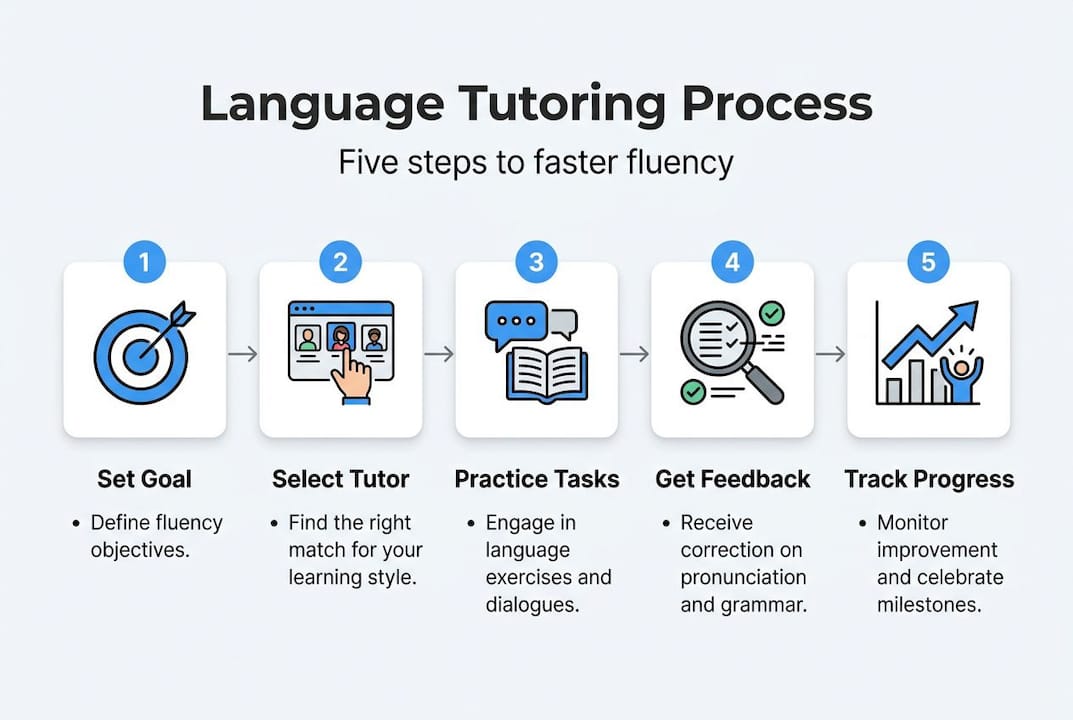
One-on-one tutoring excels for personalisation, but it requires tutor expertise in diagnostics, feedback, and motivation. Combining this with tools like Zoom and interactive whiteboards adds flexibility without sacrificing quality. Following clear online tutoring steps helps both tutor and learner get the most from every digital session.
Recommended tools for online tutoring:
- Video calls: Zoom, Google Meet, or Skype for face-to-face interaction
- Shared documents: Google Docs for collaborative writing and note-taking in real time
- Interactive whiteboards: Jamboard or Miro for visual brainstorming and grammar mapping
- Spaced repetition apps: Anki for vocabulary retention between sessions
- Screen sharing: Useful for reviewing written work or watching short clips together
Spaced repetition deserves special mention. Apps like Anki use algorithms to show you vocabulary just before you are likely to forget it, dramatically improving long-term retention with minimal daily effort. The tech-powered teaching methods that top tutors use frequently incorporate these tools as homework companions between live sessions.
Building flexible tutoring progress into your routine means you can learn consistently even with a busy schedule. Looking at real online tutoring examples shows how learners across different time zones and life situations achieve genuine fluency through smart use of technology.
Pro Tip: Always do a quick tech check five minutes before your session starts. Test your audio, camera, and internet connection. A smooth start means more time learning and less time troubleshooting.
Expert strategies and troubleshooting for lasting progress
Even with the right structure and tools, learners can hit plateaus. Knowing how to identify and fix common problems separates those who eventually reach fluency from those who stay stuck.
Research into research-backed language teaching techniques is clear: prioritise speaking over grammar study, use spaced repetition, seek real-time feedback, and vary your tasks regularly. For advanced learners, metalinguistic tasks such as analysing language patterns and structured debates push fluency to the next level. Avoiding the trap of answer-giving and scaffolding independence are equally critical.
Six strategies for lasting progress:
- Prioritise speaking: Aim for at least 60% of every session to involve you producing language, not just listening or reading.
- Request direct feedback: Ask your tutor to correct errors immediately rather than letting them slide to protect your confidence.
- Use pushed output: Ask your tutor to give you tasks slightly beyond your comfort zone, such as explaining a complex idea or arguing a position.
- Vary your tasks: Rotate between role-plays, writing tasks, listening activities, and debates to prevent stagnation.
- Review with spaced repetition: Use Anki or a similar tool to review new vocabulary between sessions.
- Reflect after each session: Spend five minutes writing what you learned and what still feels unclear.
"The best results come from reflecting, not just repeating. Learners who pause to examine their own language use grow faster than those who simply do more of the same."
If you are not seeing progress, review your session structure honestly. Are you spending too much time on grammar rules and not enough actually speaking? Are tasks too easy? Exploring private tutoring success and multilingual strategies can offer fresh perspectives when you feel stuck.
Perspective: What most learners miss about mastering a language with a tutor
Here is something most guides will not tell you: the learners who progress fastest are rarely the most diligent studiers. They are the ones most willing to sound foolish. True language breakthroughs happen in the messy, imperfect moments of real communication, not in polished exercises where every answer is prepared in advance.
Many learners invest heavily in study but quietly avoid the discomfort of genuine, unscripted conversation. They prefer structured drills because drills feel safe. But language mastery grows fastest when you embrace uncertainty, make mistakes in front of your tutor, and ask for targeted feedback on exactly where you went wrong.
Tutoring's real value is not the content delivered. It is the safe space it creates to fail, reflect, and try again without judgement. Understanding personalised gains explained makes it clear that the emotional safety of one-on-one learning is as important as the methodology.
Our advice: ask your tutor for stretch activities regularly. Request tasks that feel slightly too hard. Discomfort in a tutoring session is usually a sign you are growing, not struggling.
Ready to fast-track your fluency?
Now that you understand the full tutoring process, from preparation and session structure through to expert strategies and troubleshooting, the next step is finding the right tutor to bring it all to life.
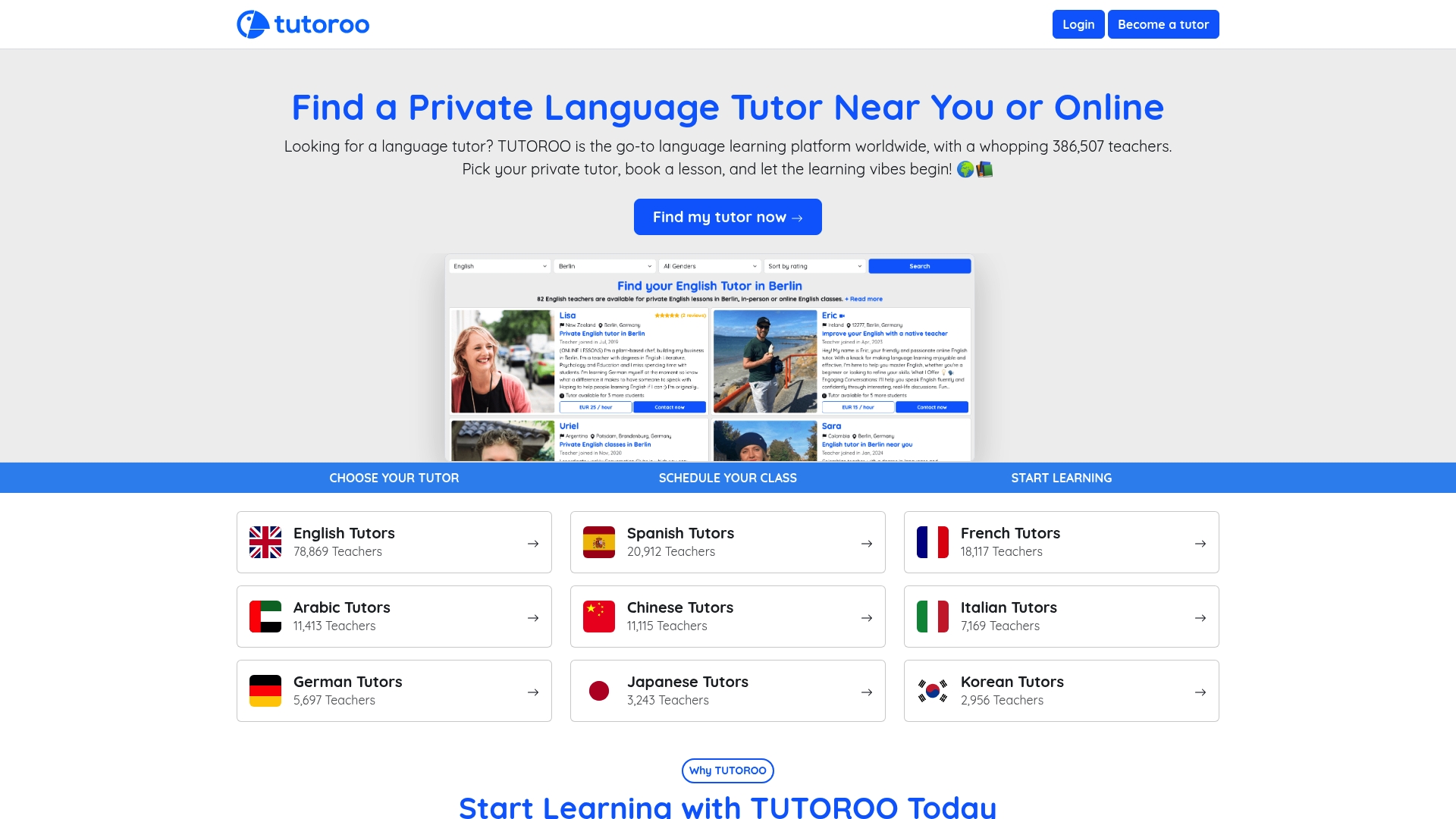
TUTOROO connects you with over 386,000 vetted language tutors worldwide, ready to deliver personalised, one-on-one lessons that fit your schedule and goals. Whether you are looking to find your perfect tutor for any language, explore dedicated English tutoring options, or connect with Lebanese tutors online, the right match is waiting. Every session is tailored to you. Start your fluency journey today and experience the difference that genuine personalisation makes.
Frequently asked questions
How long does it take to move from beginner to advanced with a tutor?
Empirical benchmarks show it takes around 135 to 900 tutoring hours to move from Novice to Advanced, depending on the target language and your starting level.
What's the most effective method used in one-on-one language tutoring?
Task-based and communicative approaches, retrieval practice, and spaced repetition are the top research-backed methods for effective language learning in one-on-one settings.
Can young children benefit from online language tutors?
Yes, provided sessions are adapted with slower pacing and interactive visual activities, young children respond very well to online one-on-one tutoring.
How is progress measured in personalised tutoring?
Tutors use frameworks like ACTFL or CEFR to set clear proficiency benchmarks and track milestones using defined criteria across Functions, Accuracy, Context, and Text type.
What if I'm not seeing results in my language learning?
Review your session structure, prioritise speaking over passive study, and request varied feedback. Research shows that stagnation most often comes from repeating tasks that are too comfortable rather than pushing into new territory.