

TL;DR:
- Structured online tutoring accelerates language learning up to three times faster than self-study.
- Personalised, consistent sessions with suitable frameworks effectively improve fluency and confidence.
- Human tutors provide empathy and adaptability that AI tools cannot fully replace.
Many language learners know the feeling well: hours of apps, textbooks, and YouTube videos, yet real conversations still feel out of reach. Unfocused self-study can leave you spinning your wheels without clear direction or measurable results. The good news is that structured, step-by-step online tutoring changes this completely. Online tutoring can accelerate language progress up to three times faster than traditional methods, giving learners a genuine path forward. Whether you are preparing for travel, an exam, or simply want to connect with a new culture, this guide walks you through everything you need to know.
Table of Contents
- What you need to get started with online tutoring
- Step-by-step online tutoring: How it works
- Instruction methods, frameworks, and personalisation
- Troubleshooting and avoiding common online tutoring mistakes
- What most guides miss about online tutoring success
- Find your ideal language tutor and start your journey
- Frequently asked questions
Key Takeaways
| Point | Details |
|---|---|
| Clear starting requirements | Gather the right tech and environment for focused, effective tutoring sessions. |
| Follow a proven structure | Use step-by-step lesson frameworks and adapt methods to your personal learning goals. |
| Personalisation accelerates success | A personalised plan leads to progress two to three times faster than generic study approaches. |
| Mind common mistakes | Be aware of pitfalls like screen fatigue and misaligned strategies so you can resolve them quickly. |
| Human plus AI works best | Combine human guidance with technology for both fast practice and real-world motivation. |
What you need to get started with online tutoring
Now that you know what is possible, let us get you set up for success. Before your first session, a little preparation goes a long way. The right setup removes friction and lets you focus entirely on learning.
Essential tech requirements:
- A reliable device: laptop, tablet, or desktop computer
- Stable internet connection (minimum 10 Mbps for smooth video)
- A quality headset or earphones with a built-in microphone
- A webcam, either built-in or external, for face-to-face interaction
- A quiet, well-lit space free from background noise
The role of technology in education has grown enormously, and even modest home setups now support rich, interactive lessons. A stable connection and clear audio matter far more than a high-end camera.
One of the most important decisions you will make is choosing between one-on-one and small-group sessions. Research confirms that personalised 1-on-1 tutoring accelerates progress two to three times faster than group or self-study, particularly for adults and professionals. That said, small groups can suit social learners or those on tighter budgets.
| Format | Best for | Pace | Cost |
|---|---|---|---|
| One-on-one | Adults, exam prep, professionals | Fastest | Higher |
| Small group (2-4) | Social learners, beginners | Moderate | Lower |
| Self-study | Supplementary practice | Slowest | Lowest |
Scheduling matters too. Consistent, shorter sessions (45 to 60 minutes, three times per week) outperform marathon weekend cram sessions. Build your tutoring into your weekly routine the same way you would a gym class. The personalised learning gains from regular, focused lessons compound quickly over time.
Finally, selecting the right tutor is critical. Look for someone whose teaching style, availability, and language specialisation align with your goals. A tutor who specialises in conversational Spanish for travellers is a very different match from one who focuses on business Mandarin.
Pro Tip: Before committing to a tutor, request a short trial session. Use it to assess communication style, lesson structure, and whether you feel genuinely comfortable asking questions.
Step-by-step online tutoring: How it works
With your essentials ready, here is exactly what a well-structured tutoring process looks like. Understanding the workflow helps you engage more actively and get more from every session.
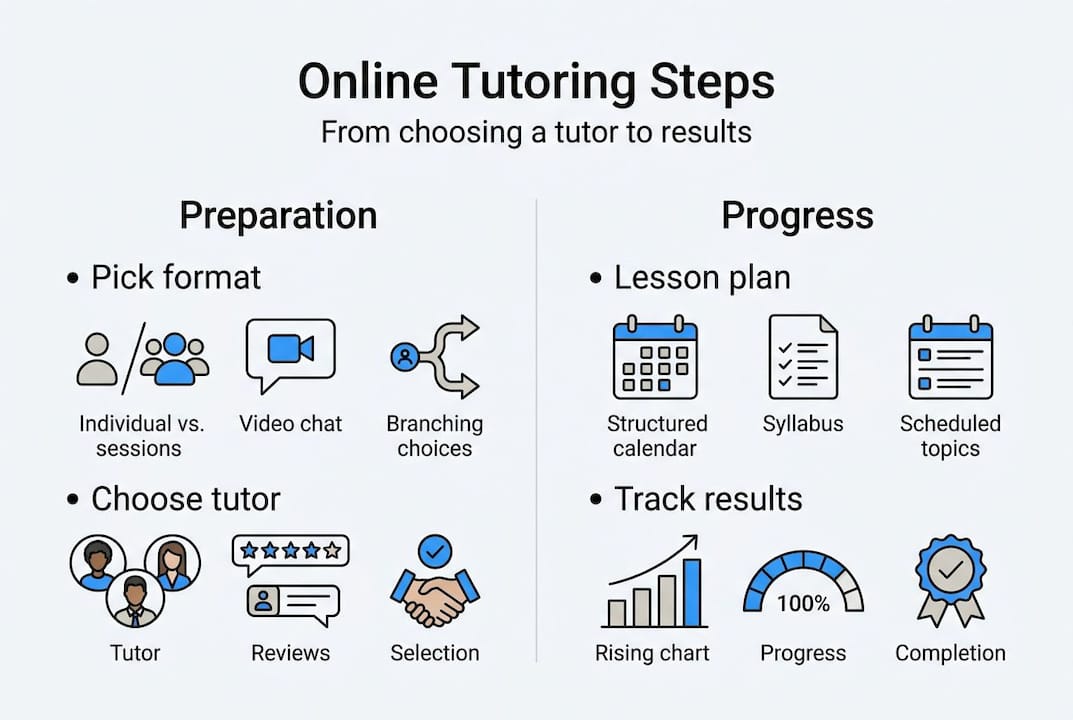
A typical step-by-step tutoring process:
- Goal setting: Define clear, measurable objectives (for example, hold a five-minute conversation in French within eight weeks).
- Initial assessment: Your tutor evaluates your current level using speaking, listening, and writing tasks.
- Tailored lesson plan: Based on the assessment, your tutor builds a personalised roadmap aligned to your goals.
- Structured sessions: Each lesson follows a clear arc: warm-up, new content introduction, guided practice, free production, and feedback.
- Progress tracking: After every few sessions, you and your tutor review benchmarks and adjust the plan.
- Goal review: At key milestones, revisit your original objectives and set new ones.
Tutors draw on proven lesson frameworks to keep sessions focused and productive. Three of the most widely used are PPP (Present, Practise, Produce), ESA (Engage, Study, Activate), and TBL (Task-Based Learning). Each serves a different purpose depending on your level and goals.
| Framework | Best use | Stage focus |
|---|---|---|
| PPP | Grammar, beginners, exam prep | Accuracy first |
| ESA | Conversation, travel, engagement | Motivation first |
| TBL | Advanced fluency, real-world tasks | Fluency first |
The results from structured tutoring are striking. A Preply study of 67 adults over 12 weeks showed that one third advanced a full CEFR level, up to three times faster than standard benchmarks, with 94% reporting greater fluency. These are not outliers. They reflect what consistent, structured tutoring can achieve. Explore tutoring examples for fluency to see how these frameworks play out in real lessons, and review best tutoring practices for strategies that accelerate results.
Pro Tip: Keep a simple learning journal. After each session, write down three new words or phrases and one grammar point. Reviewing it weekly reinforces retention dramatically.
Instruction methods, frameworks, and personalisation
Once you understand the steps, it is important to see how tutors individualise the learning process. No two learners are alike, and the best tutors adapt their methods to suit your age, level, and specific goals.

PPP (Present, Practise, Produce) is ideal for beginners and grammar-focused learners. The tutor introduces a new structure, guides you through controlled exercises, and then invites you to use it freely in conversation. It builds accuracy before fluency, which suits exam preparation beautifully.
ESA (Engage, Study, Activate) works well for learners who need motivation and real-world application. A tutor might open with a short video clip or roleplay scenario (Engage), explain the language point (Study), and then have you use it in a discussion or creative task (Activate). This approach is particularly effective for travel conversations and general communication goals.
TBL (Task-Based Learning) suits advanced learners who want to sharpen fluency. Rather than studying grammar in isolation, you complete a real-world task (booking a hotel, negotiating a price, debating a topic) and the language emerges naturally from the activity.
As ESL lesson planning frameworks highlight, tutors also integrate interactive tools such as breakout rooms, polls, and shared documents to keep sessions dynamic. Age matters too. Younger learners benefit from shorter activities and more frequent topic changes to manage screen fatigue, while adults can sustain longer focused blocks.
"The most effective tutors do not just follow a framework. They read the learner, adjust the pace, and find the angle that makes the language click personally."
Personalisation extends to content choices. A tutor working with a nurse learning medical Spanish will use very different vocabulary and scenarios than one helping a backpacker prepare for South America. Discover proven teaching methods that tutors use to tailor lessons, and explore the broader private tutoring benefits that make one-on-one learning so powerful. Research on tutoring for young learners also confirms that structured, personalised approaches yield the strongest outcomes across all age groups.
Troubleshooting and avoiding common online tutoring mistakes
Any system can have hiccups, so let us explore how to fix problems before they stall your progress. Even the best-matched tutor and learner pair can hit rough patches. Knowing what to look for makes all the difference.
Common challenges and how to address them:
- Screen fatigue: Break sessions into shorter blocks with brief movement breaks. Young learners especially benefit from activities lasting no more than 10 to 15 minutes before switching focus.
- Technical issues: Test your connection and audio before every session. Have a backup plan, such as switching to phone audio if your video drops.
- Scheduling conflicts: Use a shared calendar tool and set recurring session reminders. Consistency is more important than intensity.
- Tutor-learner mismatch: If a teaching style is not working after three or four sessions, say so. A good tutor will adapt, and a good platform will help you find a better match.
- Lack of actionable feedback: Ask your tutor to give specific corrections, not just encouragement. Feedback should tell you what to improve and how.
Research on small-group tutoring outcomes shows that low-literacy learners benefit from high-intensity tutoring in groups of one to three students, while young learners need short, varied activities to combat screen fatigue. Beginners do best with PPP for accuracy, while advanced learners thrive with TBL for fluency. Matching the method to the learner is not optional. It is essential. Explore tips for fast progress to keep momentum, understand the flexible tutoring benefits of online learning, and weigh up local vs online tutoring to find the right fit for your lifestyle.
Pro Tip: If progress feels slow, ask your tutor to share a simple progress chart. Seeing measurable improvement, even small gains, is one of the most powerful motivators in language learning.
What most guides miss about online tutoring success
Beyond the checklist, here is what truly matters in step-by-step online tutoring, drawn from real-world experience across thousands of learner journeys.
Most guides focus on tools and frameworks. What they underestimate is the human element. A tutor who notices you are frustrated and shifts the lesson accordingly, or who celebrates a breakthrough with genuine enthusiasm, creates the kind of motivation that no app can replicate. Human tutors excel in empathy, motivation, and nuance, while AI tutors offer scalable practice and instant feedback but lack emotional support. A hybrid approach, using AI for daily vocabulary drills and a human tutor for conversation and feedback, is the realistic and most effective path forward.
The danger of over-relying on automated practice is real. AI tools can reinforce errors if they are not calibrated correctly, and they cannot read the subtle signs that a learner is losing confidence. Research on AI-assisted language practice confirms benefits for repetitive skill-building, but the nuance of real communication still requires a human guide. When you start with a tutor, ask them directly: "Can you build me a personalised plan with weekly milestones?" That single request separates great tutoring experiences from average ones. The private tutoring benefits of working with an expert who genuinely adapts to you are irreplaceable, and no algorithm has matched them yet.
Find your ideal language tutor and start your journey
Ready to put what you have learned into action? Here is how to get started on your step-by-step language journey.
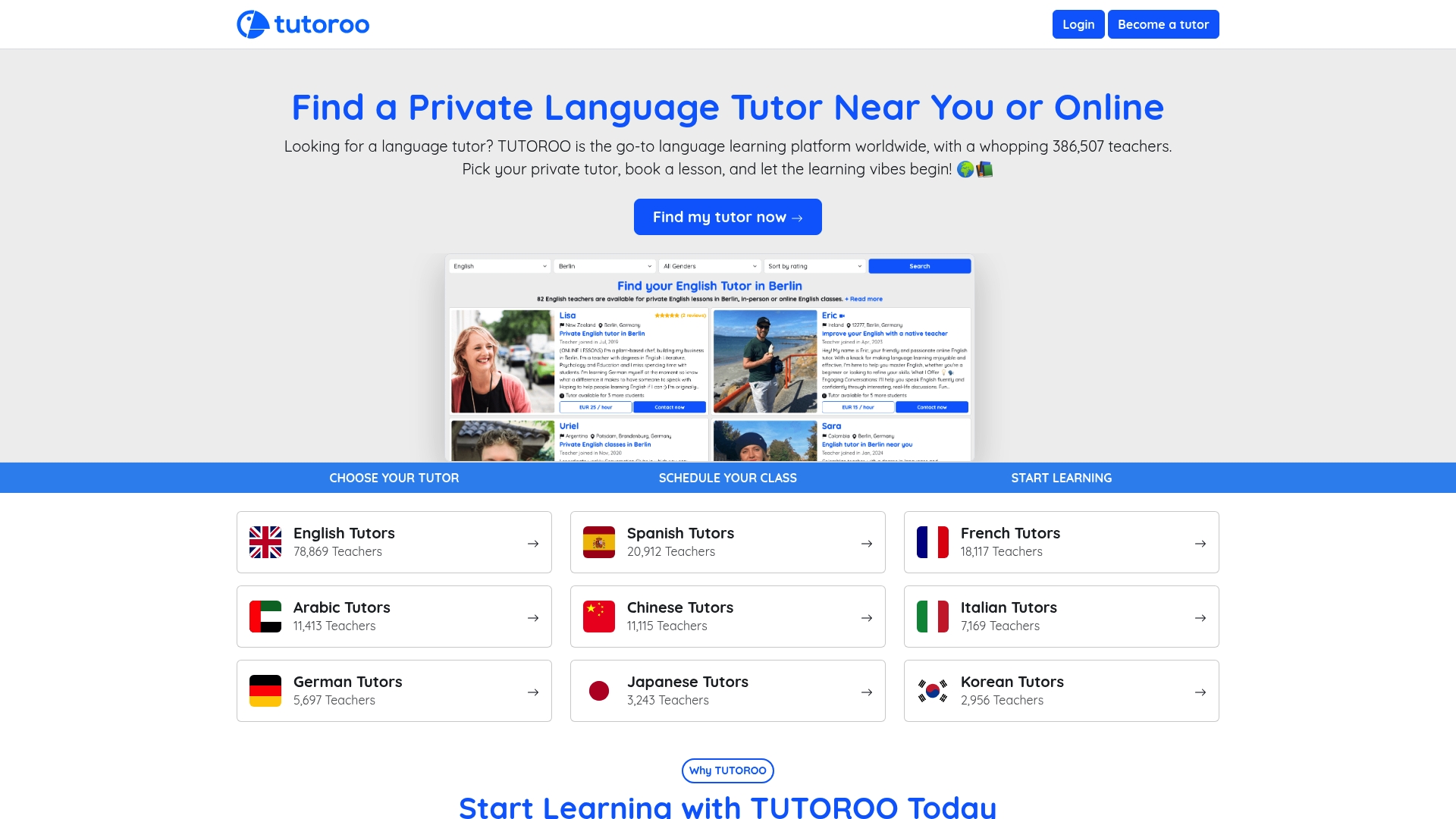
TUTOROO connects you with over 386,000 expert language tutors across the globe, covering every level, age group, and learning goal. Whether you are a complete beginner or polishing advanced skills for a professional context, you can find language tutors online who match your schedule, budget, and preferred language. From Spanish and French to Arabic and Chinese, every learning path is covered. If you are exploring a specific language, browse specialised options such as Malay tutors to find the right expert for your goals. Book a trial session today and start seeing measurable progress from your very first lesson.
Frequently asked questions
How quickly can I improve with step-by-step online tutoring?
Empirical studies show many learners advance a CEFR level in 24 to 48 hours of online tutoring, roughly three times faster than traditional classroom methods.
Is online tutoring suitable for young children and beginners?
Yes. Short, structured activities and methods like PPP help young learners and beginners stay engaged while building foundational skills at a comfortable pace.
What frameworks do tutors use for step-by-step progress?
Tutors commonly use PPP for grammar and exam preparation and ESA for engaging conversation skills, adapting the method to each learner's level and goal.
Do AI tutors replace human online language tutoring?
AI supplements practice and provides instant feedback, but human tutors excel in empathy and adaptability. A hybrid approach combining both delivers the best outcomes.
What if my online tutoring is not working?
Review your goals with your tutor, communicate openly about what is not clicking, and consider whether the method suits your needs. Small-group tutoring can also be a valuable alternative if one-on-one sessions are not the right fit.