

TL;DR:
- Effective private tutoring requires clear goals, personalized assessment, and structured micro-goals.
- Using science-backed methods like spaced repetition and multisensory learning accelerates language acquisition.
- Regular, well-structured sessions with active feedback and ongoing adaptation maximize progress.
Spending months on a language app only to freeze when a native speaker says hello is a frustratingly common experience. Group classes move at the pace of the slowest learner, and generic resources rarely address your specific gaps. Private one-on-one tutoring changes this equation entirely, but only when it is approached with intention. This guide walks you through the four pillars of effective private language tutoring: preparation, execution, troubleshooting, and measuring success. Whether you are learning for travel, a professional qualification, or a major exam, these best practices will help you make every session count.
Table of Contents
- Set clear goals and assess your starting level
- Choose the right methodology for rapid progress
- Structure your sessions for maximum impact
- Troubleshooting: adapt for unique needs and measure success
- Why personal preparation is the secret ingredient
- Ready to accelerate your language goals?
- Frequently asked questions
Key Takeaways
| Point | Details |
|---|---|
| Start with clear goals | Define your language objectives and assess your level for targeted progress. |
| Use proven techniques | Adopt evidence-backed methods like spaced repetition and active recall for faster results. |
| Structure sessions carefully | Divide each lesson into warm-up, core, and review for more effective learning. |
| Adapt and review regularly | Monitor progress every few weeks and adjust methods or tutors when needed. |
| Active learner preparation | Prepare, communicate, and review between sessions for the best results. |
Set clear goals and assess your starting level
Effective tutoring does not begin in the first session. It begins the moment you decide what you actually want to achieve. Without a clear destination, even the most talented tutor is navigating without a map.
Start by defining your primary objective. Are you preparing for a proficiency exam like IELTS or DELF? Planning to work in a second language? Or simply wanting to hold a confident conversation on your next holiday? Each goal calls for a different focus, pace, and set of materials.
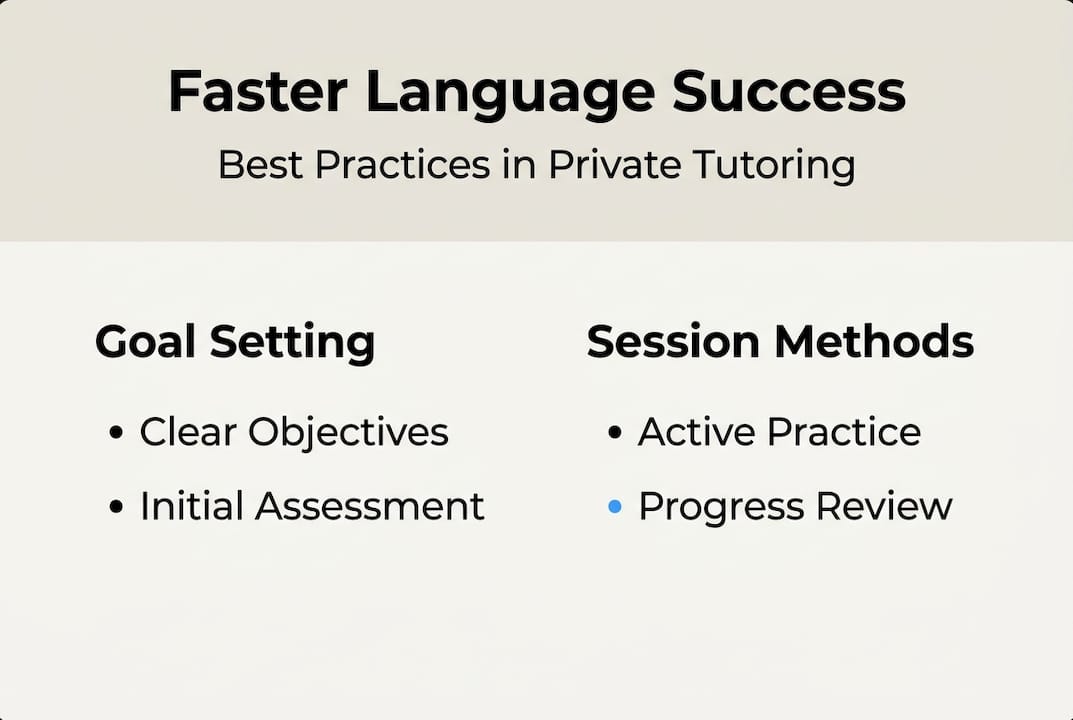
Once your objective is clear, establish your starting point. Personalised assessment and goal-setting are foundational to effective private tutoring, and using a recognised framework makes this far more precise. You can use ACTFL proficiency levels to structure goal-setting, giving both you and your tutor a shared language for measuring progress. ACTFL describes learner ability across five levels, from Novice to Distinguished, so you always know where you stand.
From there, work with your tutor to break your main goal into session-by-session micro-goals. These small wins keep motivation high and make progress visible. Setting proficiency goals and testing against them regularly ensures your lessons stay aligned with what matters most to you.
Here is a quick overview of common learner profiles and recommended starting points:
| Learner profile | Primary objective | Recommended assessment |
|---|---|---|
| Exam candidate | Pass IELTS, DELF, HSK | Official practice test + ACTFL placement |
| Travel learner | Conversational fluency | Tutor-led oral interview |
| Professional | Business communication | Role-play simulation + written sample |
| Heritage speaker | Formal literacy or dialect | Diagnostic writing and speaking task |
Keep your goals written down and visible. Revisiting them at the start of each session takes less than a minute and sharpens your focus immediately. The personalised learning gains that come from this kind of structured approach are well documented, and they begin with this simple habit.
Key steps for goal-setting success:
- Define one primary objective before your first session
- Complete a placement assessment using ACTFL or a tutor-designed tool
- Set three to five micro-goals per month
- Review and adjust goals every four to six weeks
- Write goals down and share them with your tutor
Choose the right methodology for rapid progress
Once your goals are clear, your next move is choosing methods that actually deliver faster results. Not all techniques are created equal, and the difference between slow and rapid acquisition often comes down to method selection.
Research consistently shows that spaced repetition, active recall, and multisensory learning can accelerate acquisition by 50 to 65 per cent over traditional approaches. That is a remarkable gap, and it is entirely within your control to close it.
Here is how to incorporate the most effective methods into your tutoring sessions:
- Spaced retrieval practice: Review vocabulary and grammar at increasing intervals rather than in one long session. Ask your tutor to quiz you on material from two sessions ago, not just the most recent lesson.
- Active recall: Instead of re-reading notes, close them and try to reproduce the information. Flashcard tools like Anki work well between sessions.
- Multisensory and contextual learning: Connect new words to images, sounds, and real-life situations. Ask your tutor to teach vocabulary within stories or dialogues rather than isolated lists.
- Pushed output: Speak and write just beyond your current comfort level. Your tutor should gently push you to use structures you are still acquiring, not just ones you have already mastered.
- Task variation: Rotate between speaking, writing, listening, and reading tasks within a single session to prevent mental fatigue and reinforce learning from multiple angles.
The contrast with traditional methods is striking:
| Approach | Speed of acquisition | Retention after 30 days |
|---|---|---|
| Rote memorisation | Slow | Low |
| Grammar translation | Slow to moderate | Moderate |
| Spaced repetition + active recall | Fast | High |
| Multisensory contextual learning | Fast | Very high |
Exploring the private tutoring benefits of these approaches reveals why one-on-one settings are so well suited to implementing them. A group class simply cannot pivot to your preferred mode mid-session. There are also many lesson types for personalisation worth discussing with your tutor to find the right mix.
Pro Tip: Mix at least three modes in every session: speaking, writing, and listening. Even a five-minute dictation exercise covers all three and reinforces the same target language from different angles.
Structure your sessions for maximum impact
With the right techniques chosen, it is time to put them into practice during each tutoring session. Structure is not just a nice-to-have. It is the difference between a productive hour and an enjoyable but forgettable chat.
A well-designed session follows a clear arc:
- Warm-up and review (10 to 15 minutes): Begin with a brief recap of the previous session. Use a short quiz, a question in the target language, or a quick retelling of a story from last time. This activates prior knowledge and eases you into the session.
- Core instruction (25 to 35 minutes): Introduce new vocabulary, grammar, or functional language. Use contextual examples, role-plays, and real-world scenarios. Your tutor should model full sentences, not just isolated words.
- Production and feedback (10 to 15 minutes): You produce language independently, and your tutor provides real-time correction. This is where fluency is actually built.
Session structures with warm-up, core instruction, and production phases are consistently linked to stronger fluency outcomes, particularly when real-time correction and role-play are included. This is not accidental. Feedback at the moment of production is far more memorable than corrections delivered after the fact.
"Distributed practice outperforms massed sessions" is a finding backed by decades of research. Three one-hour sessions per week will outperform a single three-hour block every time.
Consistency matters as much as content. Booking regular time slots trains your brain to expect and prepare for language input, which accelerates the consolidation of new material. This is one of the keys to faster mastery that experienced learners often cite. For more practical ideas, explore these tips for fast learning that complement a structured session approach.

Pro Tip: Build a short ritual at the start of every session, such as describing your day in the target language for two minutes. Recurrent activities create a sense of rhythm and make progress feel tangible over time.
Troubleshooting: adapt for unique needs and measure success
Even well-planned sessions need regular checks and adaptation to individual learning profiles. Language learning is rarely a straight line, and knowing when and how to adjust is a skill in itself.
Different learner profiles face different challenges:
- Heritage speakers often have strong oral fluency but gaps in formal grammar or literacy. They benefit most from tutors who can address dialect-specific features and formal register.
- Adult beginners frequently experience interference from their first language, particularly with pronunciation and sentence structure. Explicit grammar instruction helps here.
- Advanced learners often plateau because they stop being pushed. A native-speaking tutor who can model authentic nuance, idiom, and register is invaluable at this stage.
- Exam candidates need tutors familiar with the specific format and marking criteria of their target qualification.
Knowing when to adapt is just as important as knowing how. Edge cases like heritage speakers and advanced learners each require specific tutor profiles and techniques, and switching methods or tutors when progress stalls is a legitimate and often necessary strategy. If you have not progressed a sub-level after 20 sessions, that is a clear signal to reassess.
For tracking progress, use a simple four to six week review cycle. Ask yourself: Can I do something now that I could not do six weeks ago? Is my tutor adjusting the difficulty upward? Are sessions still challenging?
When exploring your options, understanding the differences between local vs online tutoring can help you decide which format suits your learning style and schedule. There are also excellent online tutoring methods specifically designed for virtual settings that replicate the best elements of in-person sessions.
Signs it is time to adjust your approach:
- No measurable progress after four to six weeks
- Sessions feel repetitive or unchallenging
- Communication with your tutor has broken down
- Your goals have shifted significantly
- You dread sessions rather than look forward to them
Why personal preparation is the secret ingredient
Beyond troubleshooting, there is a perspective that sets top language learners apart from the rest, and it has nothing to do with talent or aptitude. It is preparation.
Too many learners treat tutoring as a service they consume passively, expecting the tutor to carry the full weight of progress. The reality is that communicating expectations, previewing materials, and tracking progress every four to six weeks are the habits that separate fast learners from slow ones. Your tutor can open the door, but you have to walk through it.
Between sessions, review your notes, prepare two or three questions for next time, and preview any materials your tutor has shared. This takes fifteen minutes but doubles the value of the session that follows. It signals to your tutor that you are engaged, which naturally raises the quality of their preparation too.
The most effective learners we see treat tutoring as a partnership, not a transaction. They communicate openly about what is working and what is not. They arrive with energy and curiosity. Exploring online tutoring examples from successful learners reinforces this point beautifully. Shift your mindset from "I am paying for lessons" to "We are building something together," and your results will reflect that change.
Ready to accelerate your language goals?
Putting these best practices into action is far easier when you have the right tutor by your side. Whether your goal is to pass an exam, prepare for travel, or advance your career in a new language, a personalised approach makes all the difference.
TUTOROO connects learners with over 386,000 private language tutors worldwide, available for online or in-person sessions across dozens of languages. You can find a private tutor matched to your goals, schedule, and preferred learning style within minutes. If you are looking for something more specific, such as Malay language tutors or support for a particular exam format, TUTOROO has options to suit. Start your search today and put every best practice from this guide to work with a tutor who is genuinely invested in your success.
Frequently asked questions
How do I know if my private language tutor is the right fit?
Assess fit by checking whether your goals are being met, you see measurable progress every four to six weeks, and there is open, honest communication between you and your tutor. If no sub-level progress after 20 sessions occurs, it is worth reconsidering the match.
What is the most effective language tutoring method?
Science-backed methods like spaced repetition and active recall deliver faster and longer-lasting results than traditional memorisation, accelerating acquisition by up to 65 per cent.
How often should I schedule private tutoring sessions?
Consistent, regular sessions at least once a week support faster progress and build effective learning routines. Distributed practice outperforms concentrated blocks, so spreading sessions across the week is more effective than cramming.
When should I consider changing tutors or methods?
If you have not progressed a sub-level after 20 sessions without improvement, or your goals and learning style have shifted significantly, it is a sensible time to switch tutors or explore new techniques.