

Choosing the right private language lesson can feel overwhelming when you're faced with countless options promising fluency, exam success, or conversational confidence. Each lesson type serves different goals and learning styles, from intensive grammar drills to relaxed conversation practice. This guide cuts through the confusion by outlining practical criteria and exploring the main types of private language lessons available, helping you make an informed decision that aligns with your specific objectives and maximises your learning investment.
Table of Contents
- Key Takeaways
- Criteria to consider when choosing a private language lesson
- Common types of private language lessons explained
- Comparing private language lesson types side by side
- Choosing the best private lesson based on your goals
- Start your private language journey with expert tutors
- Frequently asked questions
Key Takeaways
| Point | Details |
|---|---|
| One on one time | Private lessons maximise speaking practice and provide immediate personalised feedback that is hard to match in groups or self study. |
| Exam and travel goals | Private lessons can be tailored to specific aims like IELTS or travel conversations, aligning practice with test formats and practical scenarios. |
| Practical teaching methods | Communicative and task based methods thrive in private lessons because you get full speaking time and quicker, personalised correction. |
| Hybrid learning boosts progress | Combining private lessons with apps or self study can extend and reinforce learning beyond standalone formats. |
| Clear objectives drive choice | Identify three real situations you will use the language in the next six months to prioritise the most practical lesson type. |
Criteria to consider when choosing a private language lesson
Before diving into specific lesson types, you need to understand what factors will make or break your learning experience. Your language goals form the foundation of this decision. Are you preparing for travel conversations, studying for IELTS or DELF exams, or building professional fluency? Each objective demands different emphasis on speaking, writing, grammar, or cultural context.
One-on-one time becomes your most valuable asset in private lessons. Unlike group settings where you might speak for only minutes per hour, private instruction gives you continuous practice. This matters enormously for developing pronunciation and conversational confidence. Teaching methodologies like communicative language teaching and task-based learning thrive in private formats precisely because you get 100% speaking time versus fragmented opportunities in groups. Tones and pronunciation particularly benefit from immediate, personalised correction that only one-on-one feedback provides.
Compatibility between your learning preferences and the tutor's teaching style shapes your progress trajectory. Some learners thrive with structured grammar explanations and written exercises, whilst others need immersive conversation with minimal explicit instruction. Consider whether you prefer visual aids, repetition drills, or spontaneous dialogue. Trial lessons help reveal this chemistry before you commit.
The immediacy and quality of feedback distinguish private lessons from self-study or apps. When a native-speaking tutor catches your pronunciation error in real-time and demonstrates the correction, you internalise it faster than reviewing recorded feedback hours later. This personalised attention accelerates skill acquisition in ways that standardised programmes cannot replicate.
Pro Tip: Write down three specific situations where you'll use your target language within the next six months. This concrete vision helps you prioritise which lesson type will deliver the most practical value for your immediate needs.
Common types of private language lessons explained
Private language instruction comes in several distinct formats, each designed to address particular learning challenges and goals. Understanding these categories helps you narrow your search efficiently.
Conversational lessons prioritise speaking fluency and natural interaction over formal grammar study. Your tutor guides discussions through everyday topics, travel scenarios, or professional contexts whilst correcting errors organically. These lessons suit learners who already grasp basic grammar but struggle to speak spontaneously or understand native speakers at natural speed. Expect to spend 80-90% of lesson time actively speaking rather than listening to explanations.

Exam preparation lessons target specific test formats like IELTS, TOEFL, DELF, or HSK with focused drills and strategy coaching. Tutors familiar with exam rubrics help you maximise scores through timed practice, feedback on weak areas, and insider tips about what assessors expect. This structured approach works best when you have a test date within three to six months and need efficient score improvement.
Grammar-intensive lessons concentrate on linguistic structure, rules, and accuracy for learners who want deep understanding of how the language works. You'll analyse verb conjugations, sentence patterns, and exceptions through explanations and exercises. This suits analytical learners or those preparing for academic writing where grammatical precision matters more than conversational fluency.
Pronunciation coaching addresses accent reduction, tone mastery in tonal languages, or specific sound difficulties through targeted exercises and repetition. Tutors use phonetic instruction, mouth position demonstrations, and recording analysis to refine your speech. This specialised format benefits learners whose pronunciation significantly hampers comprehension despite strong vocabulary and grammar.
Hybrid lessons combine private tutoring with app-based practice or group sessions to balance personalised attention with supplementary learning. Research shows that apps and AI tutors alone produce modest gains of 0.3 to 0.6 standard deviations compared to human private tutoring, but combining approaches can optimise results. You might use apps for vocabulary drilling whilst reserving private time for conversation and feedback. This model suits budget-conscious learners wanting private instruction's benefits without full-time private lesson costs. Explore online tutoring examples to see how others blend learning methods successfully.
Comparing private language lesson types side by side
Seeing lesson types compared directly clarifies which format matches your profile and priorities. This comparison highlights duration patterns, primary focus areas, feedback quality, and ideal learner characteristics across the main private lesson categories.
| Lesson type | Typical duration | Primary focus | Feedback quality | Best for |
|---|---|---|---|---|
| Conversational | 45-60 minutes | Speaking fluency, comprehension | Immediate verbal correction | Intermediate learners, travellers, professionals |
| Exam preparation | 60-90 minutes | Test strategies, timed practice | Detailed rubric-based assessment | Test takers with 3-6 month timeline |
| Grammar-intensive | 60 minutes | Linguistic structure, accuracy | Written corrections, explanations | Beginners, academic writers, analytical learners |
| Pronunciation coaching | 30-45 minutes | Accent, tones, specific sounds | Real-time phonetic correction | Learners with comprehension issues from pronunciation |
| Hybrid model | Variable | Balanced skills with supplementary practice | Combination of immediate and app-based | Budget-conscious learners wanting flexibility |
The communicative and task-based methodologies that dominate modern language teaching achieve their full potential in private settings because you receive 100% speaking time versus the fragmented opportunities in group classes. This makes conversational and exam preparation lessons particularly effective for developing speaking confidence and pronunciation accuracy, skills that deteriorate without regular practice and immediate feedback.
Personalised feedback quality varies significantly across lesson types. Conversational lessons provide instant verbal correction that you can immediately apply, whilst grammar-intensive formats offer detailed written explanations you can review later. Pronunciation coaching delivers the most specialised feedback, often including recordings of your speech for comparison with native models. This immediate, tailored correction represents private lessons' core advantage over self-study or large group instruction.
Beginners typically benefit most from grammar-intensive or hybrid approaches that build foundational structure before emphasising fluency. Intermediate learners gain more from conversational practice that pushes them beyond their comfort zone. Advanced learners often need pronunciation coaching or exam preparation to refine specific weaknesses rather than broad skill development.
Pro Tip: Book trial lessons in two different formats before committing to a package. The contrast will reveal which teaching style energises you and produces tangible progress, even if it differs from what you initially expected to prefer.
Choosing the best private lesson based on your goals
Applying this knowledge to your specific situation requires honest assessment of your priorities, timeline, and learning preferences. Follow these steps to make a confident, informed decision that maximises your investment.
-
Define your primary objective with specific metrics. Instead of "improve Spanish," aim for "hold 10-minute conversations about work topics" or "score 7.0 on IELTS speaking." This clarity immediately narrows suitable lesson types. Exam goals point toward preparation lessons, whilst conversational targets suit speaking-focused formats.
-
Assess your current skill level realistically. Complete a placement test or trial lesson to identify whether you're truly a beginner needing structure or an intermediate learner ready for immersive practice. Mismatched lesson intensity wastes time and money when you're either bored by too-simple content or overwhelmed by advanced material.
-
Consider combining private lessons with supplementary resources for optimal results. Research demonstrates that apps and AI tutors alone produce smaller learning gains than human tutoring, but hybrid approaches that pair private instruction with app-based practice or occasional group sessions can optimise both cost-efficiency and learning outcomes. You might schedule two private lessons weekly for speaking practice whilst using apps daily for vocabulary and grammar reinforcement.
-
Plan for regular feedback sessions focused on pronunciation and speaking confidence. These skills deteriorate quickly without practice and improve dramatically with consistent correction. Even if grammar study forms your primary focus, incorporate 10-15 minutes of speaking practice into each lesson to maintain fluency development.
-
Match lesson style and tutor expertise to your cultural and linguistic context. A native tutor offers authentic pronunciation models and cultural insights, whilst a non-native tutor who learned your target language as an adult may better understand your specific challenges. Consider whether you need formal or colloquial language, regional accent familiarity, or industry-specific vocabulary when selecting your tutor.
-
Trial lessons before committing to long-term packages. Most platforms offer single sessions or short trial periods that reveal whether the tutor's personality, pace, and methodology suit your learning style. Pay attention to whether you feel comfortable making mistakes, whether explanations make sense, and whether you're genuinely engaged rather than watching the clock. These subjective factors predict long-term success better than credentials alone. Explore the language learning tips blog for additional guidance on maximising your private lesson investment.
Start your private language journey with expert tutors
Now that you understand how different private lesson types serve specific goals and learning styles, you're ready to connect with qualified tutors who can deliver personalised instruction. Whether you need conversational practice for upcoming travel, exam preparation for university admission, or pronunciation coaching to boost professional confidence, the right tutor makes all the difference.
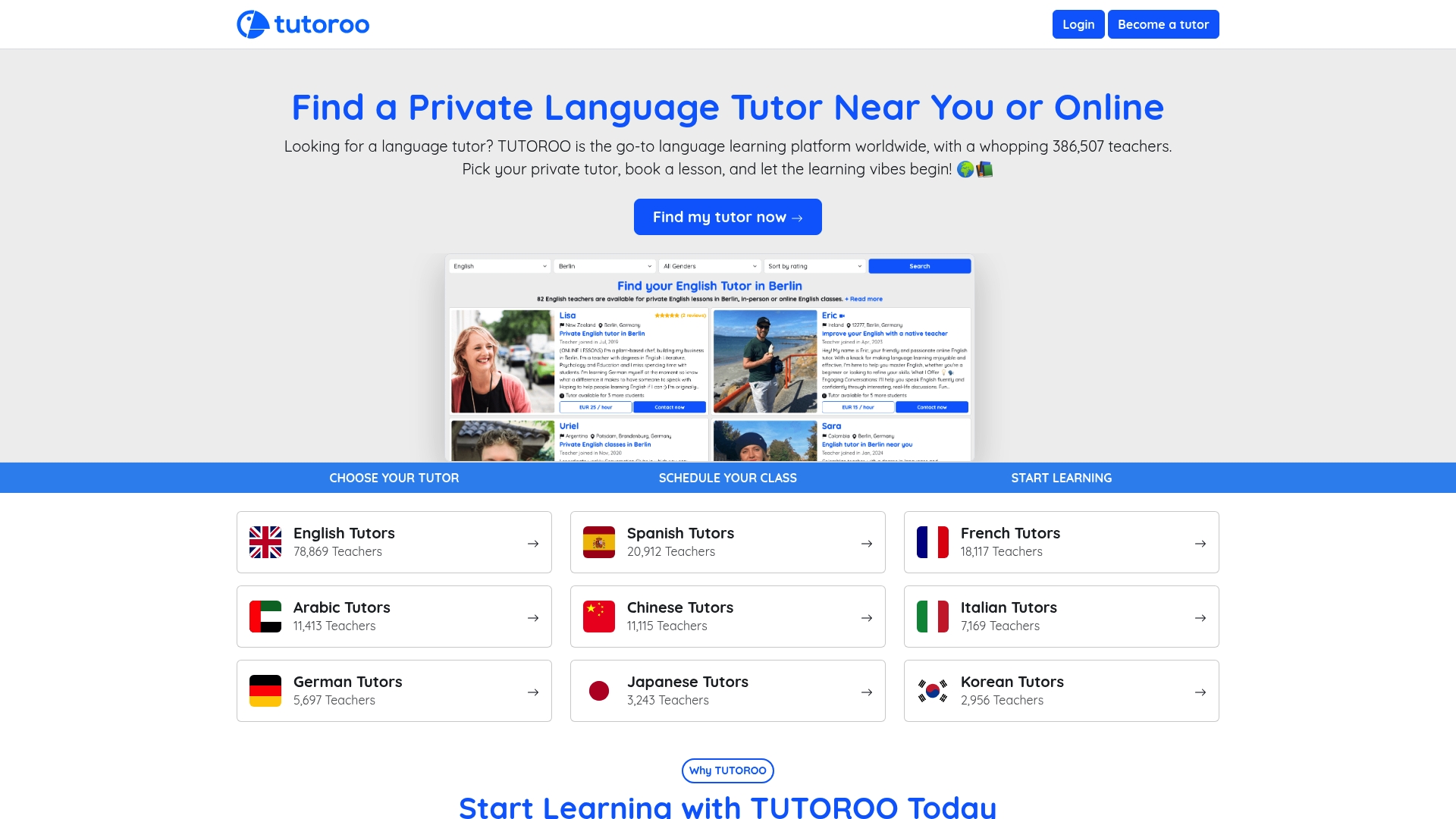
Tutoroo connects you with over 386,000 private language tutors across dozens of languages, offering both online and in-person lessons that fit your schedule. Browse profiles to find English tutors for business communication, Japanese tutors for travel preparation, or specialists in any language you're pursuing. Filter by teaching style, availability, and rates to discover tutors whose expertise aligns perfectly with your learning objectives. The platform's messaging system lets you discuss your goals and confirm compatibility before booking, ensuring you invest in lessons that deliver genuine progress toward your language aspirations.
Frequently asked questions
What is the best type of private language lesson?
The best type depends entirely on your specific goals and current skill level. Conversational lessons excel for building fluency and confidence, whilst exam preparation lessons deliver focused test strategies. Grammar-intensive formats suit analytical learners or beginners needing structure, and pronunciation coaching addresses specific speech challenges. Assess your priority skills and timeline to select the format that targets your most urgent needs.
How do private lessons improve pronunciation?
Private lessons provide immediate, tailored feedback that group settings cannot match. When you mispronounce a sound or tone, your tutor corrects you instantly and demonstrates the proper articulation. Early one-on-one feedback proves crucial for mastering pronunciation and tones, particularly in languages with sounds absent from your native tongue. This real-time correction prevents bad habits from solidifying and accelerates accurate speech development.
Can I combine private lessons with language apps?
Absolutely, and hybrid learning approaches often produce optimal results by combining private tutoring's personalised feedback with apps' convenient practice opportunities. Use apps for vocabulary drilling, grammar exercises, and daily exposure whilst reserving private lessons for speaking practice, pronunciation correction, and personalised guidance. This combination maximises cost-efficiency without sacrificing the human interaction essential for fluency development. Many successful learners follow hybrid language learning models that balance structured private instruction with supplementary self-study.
How often should I schedule private language lessons?
Lesson frequency depends on your goals, budget, and available study time. Twice weekly sessions with daily independent practice produce steady progress for most learners. Intensive exam preparation may require three to four lessons weekly in the months before your test date. Conversely, one weekly lesson supplemented by app practice and immersion activities can maintain skills for casual learners. Consistency matters more than frequency, so choose a schedule you can sustain for months rather than burning out with daily lessons.
What qualifications should I look for in a private language tutor?
Prioritise teaching experience and methodology over credentials alone. Effective tutors demonstrate clear communication, patience, and ability to adapt explanations to your learning style. Native speakers offer authentic pronunciation models and cultural insights, whilst non-native tutors who learned the language as adults may better understand your specific challenges. Look for tutors with relevant specialisation, whether exam preparation expertise, business language experience, or pronunciation coaching skills that match your goals.