

One-on-one language teaching represents a transformative approach to language learning that delivers results up to three times faster than group classes. Unlike traditional classroom settings where instruction follows a fixed curriculum, personalised tutoring adapts to your unique goals, learning style, and pace. Whether you're preparing for an overseas job, planning extended travel, or simply enriching your personal capabilities, this individualised approach offers unmatched flexibility and effectiveness. This guide explains what one-on-one language teaching involves, how it works, its proven advantages, and practical considerations to help you decide if it's right for your language learning journey.
Table of Contents
- Key Takeaways
- What is one-on-one language teaching?
- How one-on-one language teaching works: core methods and strategies
- Key benefits and evidence supporting one-on-one language teaching
- Challenges and special considerations in one-on-one language teaching
- Discover personalised language tutoring with TUTOROO
- Frequently asked questions about one-on-one language teaching
Key Takeaways
| Point | Details |
|---|---|
| Personalised tutoring benefits | Personalised tutoring tailors lessons to your goals, pace and learning style to improve outcomes. |
| Real time feedback | Tutors correct errors instantly and explain why, helping you avoid developing bad habits. |
| Flexible delivery options | Sessions can be online, in person or hybrid to suit your schedule. |
| Faster progress than groups | Evidence shows you can progress up to three times faster than in group classes. |
| Ideal for shy learners | One on one formats suit shy learners by boosting confidence and participation. |
What is one-on-one language teaching?
One-on-one language teaching is a personalised tutoring approach where a single learner receives individualised instruction focusing on communication skills, fluency, and confidence with tailored lessons and immediate feedback. This format fundamentally differs from group classes where instruction must accommodate multiple learners with varying abilities and objectives.
The defining characteristics include complete customisation of lesson content, pacing that matches your learning speed, and immediate correction of errors without waiting for group turns. Your tutor designs each session around your specific needs, whether that's mastering business vocabulary for client presentations, perfecting pronunciation for travel conversations, or preparing for language proficiency exams.
This teaching format offers remarkable flexibility in delivery:
- Online sessions connect you with tutors worldwide via video platforms, eliminating geographical barriers and enabling access to native speakers regardless of your location
- In-person meetings provide face-to-face interaction when you prefer physical presence or need hands-on practice with cultural gestures and body language
- Hybrid arrangements blend both formats, letting you switch between online convenience and occasional in-person immersion
- Flexible scheduling accommodates your commitments, with sessions available during early mornings, lunch breaks, or late evenings
The instructional focus centres on building practical communication abilities rather than theoretical grammar knowledge. Your tutor emphasises speaking and listening skills through meaningful conversations, real-world scenarios, and authentic materials like news articles, podcasts, or videos relevant to your interests. This contextual approach helps you internalise vocabulary and structures naturally.
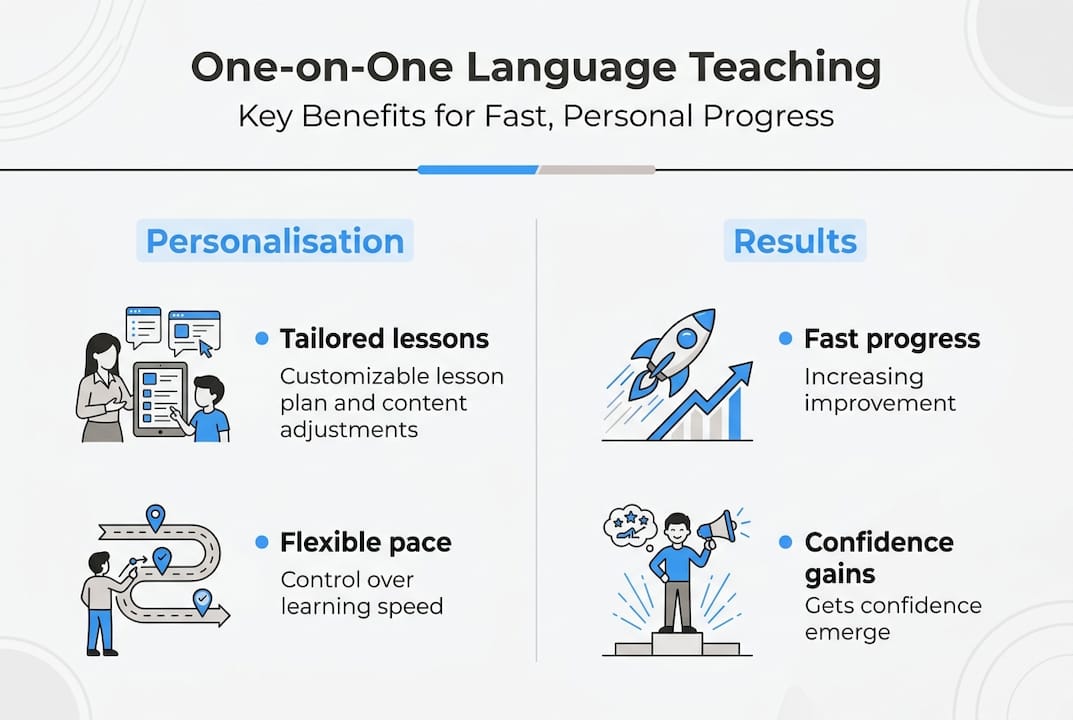
Immediate, personalised feedback represents another crucial advantage. When you make an error, your tutor corrects it instantly and explains why, preventing bad habits from forming. You can ask questions freely without feeling self-conscious about slowing down a group. Many tutors also integrate examples of online tutoring methods that enhance engagement through interactive tools and multimedia resources.
The approach often blends structured lessons with self-study components. Your tutor assigns homework, recommends apps or resources, and tracks your progress between sessions. This combination of guided instruction and independent practice maximises learning efficiency while keeping you accountable to your goals.
How one-on-one language teaching works: core methods and strategies
The instructional mechanics of one-on-one language teaching employ customised lesson plans, real-time feedback, intensive speaking practice, role-playing, vocabulary in context, and progress assessments with learner-centred approaches that adapt to your personality and objectives. These techniques create an immersive learning environment that accelerates skill development.
Full sentence modelling forms the foundation of many lessons. Your tutor demonstrates correct sentence structures, then asks you to repeat and modify them with different vocabulary. This technique builds grammatical intuition without tedious rule memorisation. For example, after hearing "I travelled to Sydney last month," you practise variations like "She visited Melbourne last year" or "We explored Brisbane last week."
Open-ended questions drive conversation practice. Rather than simple yes/no queries, your tutor asks questions requiring detailed responses: "What would you do if you won the lottery?" or "Describe your ideal weekend." These prompts push you to construct complex sentences, use varied vocabulary, and think in your target language.
Role-play scenarios simulate real-world situations you'll encounter:
- Restaurant interactions where you practise ordering meals, asking about ingredients, and handling bill payments
- Job interviews that prepare you for professional conversations, including discussing your experience and asking about company culture
- Travel situations covering airport check-ins, hotel bookings, asking for directions, and handling emergencies
- Social conversations developing small talk skills, expressing opinions, and understanding cultural nuances
Sentence frames provide scaffolding for complex ideas. Your tutor offers templates like "In my opinion... because..." or "Although..., I believe..." that you fill with your own content. This structure supports you while building confidence to express sophisticated thoughts.
Vocabulary instruction happens within meaningful contexts rather than isolated word lists. If you're learning business language, your tutor introduces terms through actual business scenarios, emails, or presentations. This contextual learning improves retention and immediate applicability.
Continuous assessment happens informally throughout each session. Your tutor notes recurring errors, identifies knowledge gaps, and adjusts upcoming lessons accordingly. This responsive teaching ensures you're always working at the optimal challenge level, neither bored by material that's too easy nor frustrated by content that's too advanced.
The benefits of native-speaking tutors become particularly evident in these interactive methods. Native speakers provide authentic pronunciation models, teach current slang and idioms, and explain cultural contexts that textbooks often miss.
Teaching style adapts to your personality and learning preferences. Introverted learners might benefit from more preparation time before speaking, while extroverts thrive with spontaneous conversation. Visual learners receive diagrams and written examples, while auditory learners focus on listening exercises and verbal explanations.
Pro Tip: Request that your tutor avoid over-correction during initial speaking practice. Constant interruptions can damage confidence and motivation. Instead, ask them to note errors and address patterns at session end, allowing you to build fluency before perfecting accuracy. This approach, emphasising building rapport and balanced correction, maintains enthusiasm while still improving your skills.
Key benefits and evidence supporting one-on-one language teaching
Empirical research demonstrates that one-on-one learners progress three times faster, with 94% feeling more fluent, and can advance a CEFR level in 24 to 48 hours versus 160 to 240 hours in groups. These dramatic differences stem from the personalised attention and tailored instruction that one-on-one teaching provides.
The speed advantage translates to tangible time savings. A learner moving from A2 to B1 proficiency through group classes typically requires 160 to 240 classroom hours spread over months. With individualised tutoring, that same progression happens in 24 to 48 hours of instruction, potentially within weeks rather than an entire academic year. This acceleration occurs because every minute focuses exclusively on your needs, with no time wasted on content you've already mastered or waiting for other students.
"After 12 weeks of one-on-one tutoring, learners reported significant improvements in confidence and practical communication abilities, with the majority achieving measurable progress equivalent to multiple group class semesters."
Fluency improvements extend beyond test scores. The 94% of learners reporting increased fluency describe practical gains: holding longer conversations, understanding native speakers more easily, and expressing complex ideas without lengthy pauses. These real-world communication improvements matter more than grammar test results for most language learners.
The data comparing different learning formats reveals striking contrasts:
| Learning format | Hours to advance one CEFR level | Personalisation level | Speaking practice time | Flexibility |
|---|---|---|---|---|
| One-on-one tutoring | 24-48 hours | Fully customised | 40-50% of session | High |
| Group classes | 160-240 hours | Minimal | 10-15% of session | Low |
| Self-study apps | 300-400 hours | Algorithm-based | 5-10% of time | High |
| Language exchange | 200-300 hours | Moderate | 50% of session | Moderate |
Confidence building represents another significant advantage. Many learners feel intimidated speaking in group settings, fearing judgement from peers. Private tutoring eliminates this anxiety, creating a safe space to make mistakes and ask questions freely. This psychological safety accelerates progress, particularly for shy or introverted individuals.

The format accommodates diverse learner profiles effectively. Neurodivergent learners who struggle with group classroom distractions benefit from focused, one-on-one attention. Professionals with irregular schedules appreciate flexible timing. Advanced learners seeking to polish specific skills, like reducing accent or mastering industry jargon, receive targeted instruction impossible in general group classes.
Detailed studies on tutoring effectiveness consistently show higher retention rates and greater satisfaction among one-on-one learners compared to those in traditional classroom settings. The personalised feedback loop, where tutors immediately address your specific errors and confusion, prevents misunderstandings from becoming ingrained habits.
For learners with specific goals, like preparing for job interviews, relocating abroad, or passing certification exams, one-on-one teaching delivers focused preparation that group classes cannot match. Your tutor dedicates entire sessions to your exact requirements, whether that's practising technical vocabulary, simulating interview scenarios, or drilling exam formats.
Challenges and special considerations in one-on-one language teaching
Despite compelling advantages, higher cost, tutor-learner boundary challenges, and less peer social interaction are key limitations, with the format best suited for shy or neurodivergent learners and those with specific goals. Understanding these drawbacks helps you make informed decisions about whether this approach fits your circumstances.
Cost represents the most significant barrier for many learners. Private tutoring typically costs two to five times more per hour than group classes. While the faster progress partially offsets this expense, the upfront financial commitment remains substantial. A learner requiring 40 hours of instruction to achieve their goal might spend $1,600 to $3,200 at typical rates, compared to $400 to $800 for equivalent group class hours, though those group hours would likely require 120 to 200 total hours to achieve similar results.
Boundary and privacy considerations require attention:
- Professional boundaries can blur in one-on-one settings, particularly with online tutoring where sessions happen in home environments
- Personal information sharing occurs naturally during conversation practice but requires discretion about sensitive topics
- Dependency issues may develop if learners become overly reliant on their tutor rather than building independent language skills
- Scheduling conflicts create more disruption in one-on-one arrangements than group classes, where other students continue if you miss a session
Limited peer interaction removes valuable learning opportunities. Group classes expose you to different accents, speaking styles, and perspectives. You hear how others construct sentences, learn from their mistakes, and practise social language skills like turn-taking and interrupting politely. One-on-one tutoring lacks this social dimension, potentially leaving gaps in your ability to navigate multi-person conversations.
The format demands more active participation than passive group attendance. You cannot hide in the back of a one-on-one session or let others carry the conversation. This intensity benefits motivated learners but can feel exhausting for those preferring a more relaxed pace. Every moment requires your full attention and engagement.
Tutor compatibility becomes critical. In group classes, personality clashes with the instructor matter less because you interact with classmates too. With one-on-one teaching, if you and your tutor don't connect, the entire learning experience suffers. Finding the right match may require trying several tutors, adding time and expense to your journey.
Certain learner profiles particularly benefit from one-on-one teaching. Shy individuals who freeze in group settings flourish with private attention. Neurodivergent learners who struggle with classroom distractions focus better in one-on-one environments. Advanced learners polishing specific skills need the targeted instruction that group classes cannot provide. Professionals with demanding schedules require the flexibility that private tutoring offers.
Pro Tip: Combine one-on-one tutoring with occasional group practice sessions or language exchange meetups. This hybrid approach delivers personalised instruction's efficiency while maintaining social interaction and cultural exposure. Many learners find that 70% private lessons and 30% group activities creates the optimal balance. Additionally, explore tips for motivation in private tutoring and understand balancing correction with rapport to maximise your one-on-one learning experience.
Self-discipline becomes more important without the external structure of scheduled group classes. You must maintain consistent practice, complete assigned homework, and stay motivated without peer accountability. Some learners thrive with this independence, while others need the external pressure of group commitments.
Discover personalised language tutoring with TUTOROO
If you're ready to experience the accelerated progress and personalised attention that one-on-one language teaching delivers, TUTOROO connects you with experienced tutors who match your goals and learning style. Our platform offers access to over 386,000 qualified language teachers worldwide, specialising in everything from conversational fluency to business language and exam preparation.
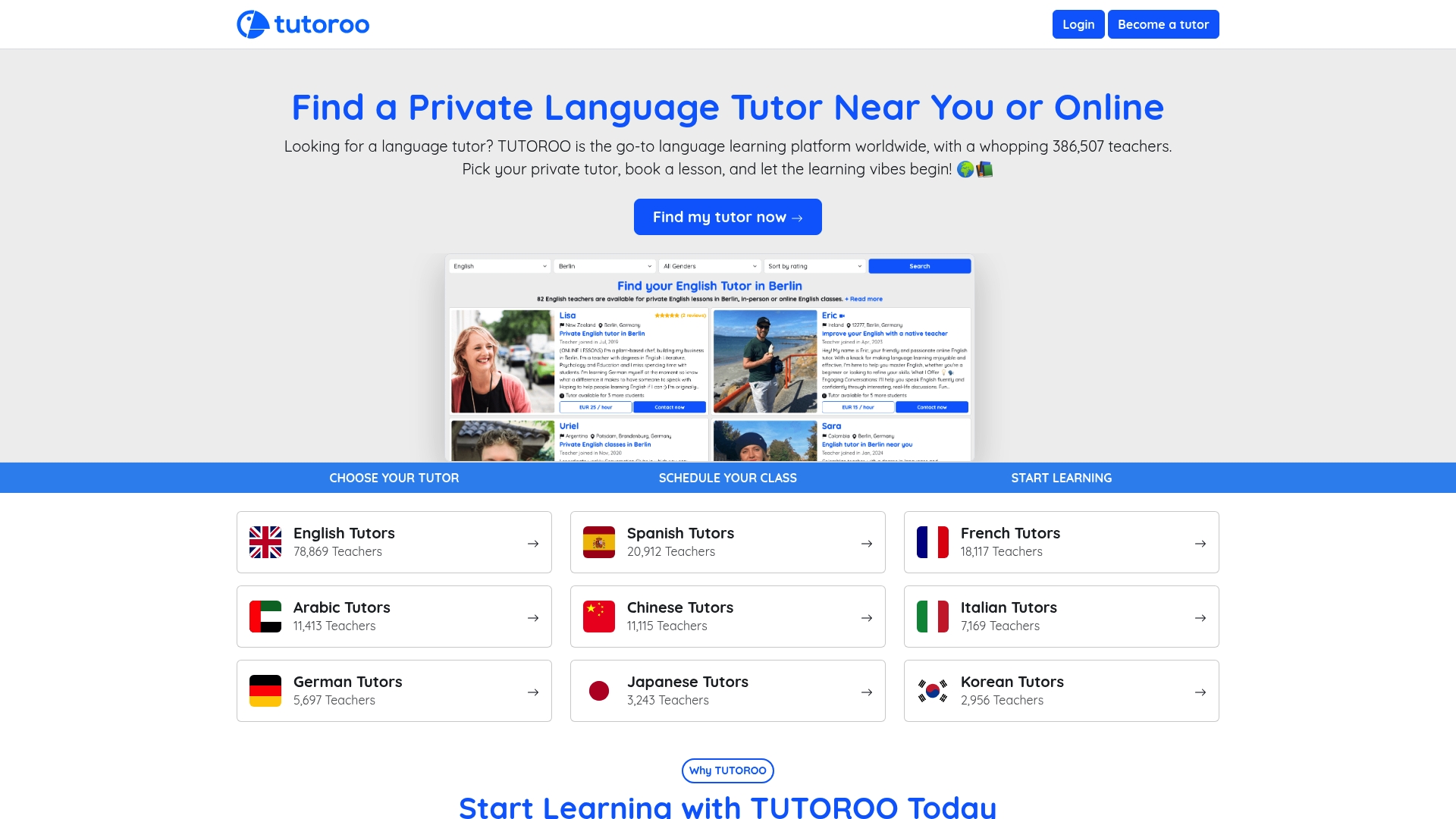
Choose from private language tutors at TUTOROO who offer flexible online or in-person sessions tailored to your schedule. Whether you need English tutors online for professional advancement, Japanese tutors online for travel preparation, or instruction in dozens of other languages, you'll find native speakers and qualified professionals ready to guide your learning journey. Our platform simplifies tutor selection based on your location, language preference, availability, and budget, while our messaging system facilitates easy communication and scheduling. Start your personalised language learning journey today and experience the difference that individualised instruction makes.
Frequently asked questions about one-on-one language teaching
How much faster is one-on-one language teaching compared to group classes?
Research shows one-on-one learners progress up to three times faster than group class students, advancing one CEFR level in 24 to 48 hours versus 160 to 240 hours in traditional classrooms. This acceleration happens because every minute focuses exclusively on your needs without time wasted on content you've mastered or waiting for other students.
What makes one-on-one language teaching more effective than self-study apps?
Private tutoring provides immediate, personalised feedback that apps cannot match, correcting your specific errors and explaining why mistakes happen. Human tutors adapt lessons to your learning style, interests, and goals in real-time, while apps follow fixed algorithms. The interactive conversation practice with a responsive teacher builds fluency far more effectively than pre-recorded exercises.
Is one-on-one language teaching suitable for complete beginners?
Absolutely. Private tutoring works exceptionally well for beginners because tutors can start at your exact level, explain concepts in your native language when needed, and build foundations without the pressure of keeping pace with a group. The benefits of native-speaking tutors include authentic pronunciation modelling from your first lesson, establishing correct speech patterns from the start.
How do I maintain motivation in one-on-one language lessons without peer support?
Set specific, measurable goals with your tutor and track progress visibly through regular assessments or recordings of your speaking. Many learners supplement private lessons with language exchange partners or online communities for social interaction. Varying lesson activities, celebrating milestones, and connecting language learning to real-life applications like upcoming travel or job opportunities sustain long-term motivation.
Can one-on-one tutoring prepare me for real-world conversations with multiple speakers?
Yes, though you should complement private lessons with group practice. Tutors simulate multi-person scenarios through role-play and can introduce guest speakers occasionally. Request that your tutor expose you to various accents through audio materials and practise conversation skills like interrupting politely and managing turn-taking. Combining 70% private instruction with 30% group activities or language exchanges provides comprehensive preparation.