

TL;DR:
- Tutoring produces significantly faster language proficiency gains than self-study or apps.
- Personalized, real-time feedback and adaptive instruction make tutors more effective.
- Frequent sessions with a skilled tutor enhance confidence and fluency at all learner levels.
Language apps are convenient, but convenience rarely equals fluency. A systematic review of 20 studies found that tutoring produces a very large effect on language achievement, with a mean effect size of g=1.111, far outpacing self-study and app-based approaches. That is not a small difference. It means learners working with tutors reach meaningful proficiency milestones significantly faster than those relying on apps alone. This guide explores the real, evidence-based impact of language tutors, how they personalise instruction, which strategies they use, and who benefits most. Whether you are a complete beginner or an advanced speaker preparing for an exam, understanding how tutors work can change the way you approach language learning entirely.
Table of Contents
- Why choose a tutor over self-study or language apps?
- How tutors tailor instruction for your language goals
- The science-backed strategies tutors use to boost results
- Who benefits most from language tutoring?
- Our perspective: What most learners miss about tutoring
- Start your personalised language journey with a tutor
- Frequently asked questions
Key Takeaways
| Point | Details |
|---|---|
| Tutors accelerate mastery | Personalised tutor support leads to faster and longer-lasting language gains than self-study or apps. |
| Evidence-based techniques | Tutors use feedback, adaptive methods, and task-based learning shown to boost vocabulary, grammar, and speaking results. |
| All levels benefit | Beginners to advanced speakers see measurable improvements from structured guidance and regular practice. |
| Best progress with frequency | Meeting tutors three or more times a week yields the highest achievement rates. |
Why choose a tutor over self-study or language apps?
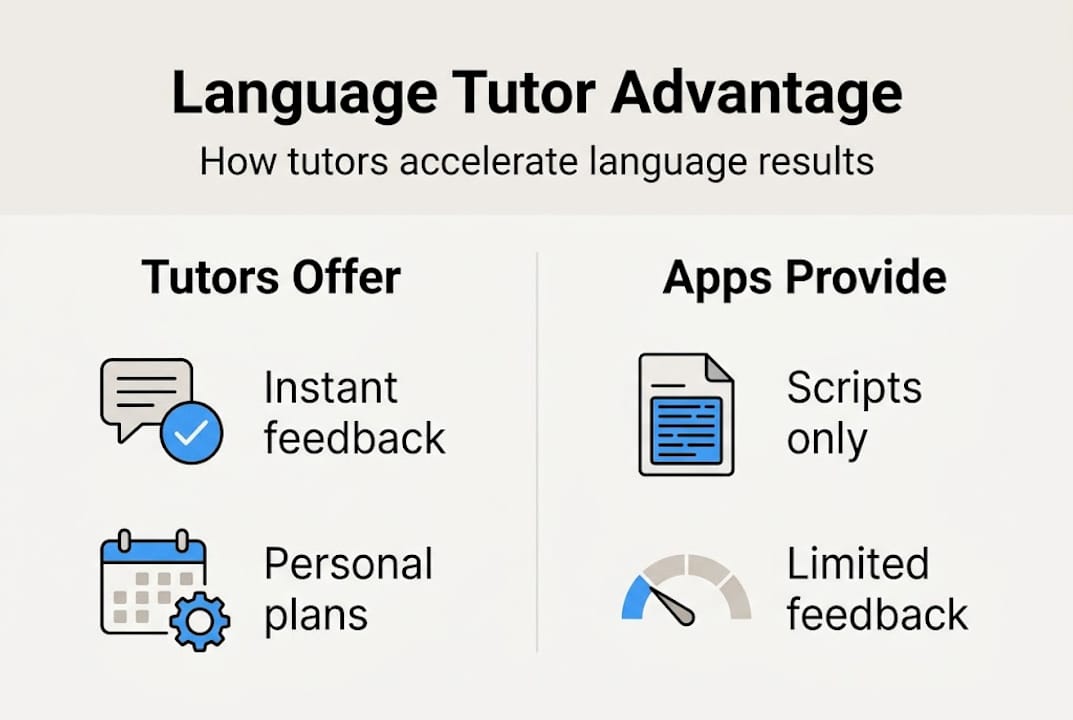
Most learners start with apps. They are free, flexible, and feel productive. But there is a ceiling. Apps follow scripts. They cannot notice that you are struggling with a specific vowel sound, adjust the lesson mid-session, or offer genuine encouragement when frustration sets in. A tutor can do all of that, and research confirms the difference is measurable.
Tutoring strategies and techniques show that tutors provide adaptive instruction, immediate corrective feedback, and cognitive load management, which are features missing from most language apps. When you mispronounce a word or misuse a tense, a tutor catches it instantly and helps you correct it before the error becomes a habit. Apps, by contrast, often reward completion over accuracy.
The meta-analytic evidence on intelligent tutoring systems also confirms that tutor-guided learning yields very large proficiency gains compared to traditional or app-based methods. The gap is especially pronounced for speaking and listening skills, which require real interaction to develop properly.
Here is a quick comparison of how tutors and apps stack up:
| Feature | Language apps | Private tutor |
|---|---|---|
| Real-time feedback | Limited | Yes, immediate |
| Personalised lessons | No | Yes, every session |
| Speaking practice | Scripted | Live, adaptive |
| Anxiety reduction | Minimal | Significant |
| Goal-specific focus | No | Yes |
Beyond the numbers, tutors also make learning more enjoyable. The dialogue between a learner and tutor builds confidence and reduces language anxiety, which is one of the biggest barriers to fluency. When you feel safe making mistakes, you practise more, and that is when real progress happens.
Key advantages of working with a private tutor include:
- Immediate correction that prevents errors from becoming ingrained habits
- Flexible pacing that matches your current level and goals
- Live conversation practice that builds real communicative confidence
- Accountability that keeps you consistent between sessions
Explore how private tutors support faster language mastery or read more about private tutoring benefits to see the full picture. If you are weighing your options, the comparison between local vs online language tutoring is also worth exploring.
Pro Tip: Schedule at least three tutor sessions per week to hit the high-dosage threshold that research links to the fastest and most sustained proficiency gains.
How tutors tailor instruction for your language goals
One of the most powerful things a tutor does is listen, not just to your pronunciation, but to your goals. A learner preparing for a trip to Japan needs very different sessions from someone sitting the IELTS exam or a professional seeking business fluency. Tutors begin by identifying your priorities and then build a learning plan around them.

According to tutoring strategies and techniques, effective tutors deploy explicit instruction, guided practice, spaced retrieval, and formative assessment to move learners up proficiency levels quickly. These are not abstract concepts. In practice, it means your tutor introduces a grammar point clearly, walks you through examples, gives you tasks to apply it, and then revisits it in later sessions so it sticks.
Here is how goal-based tutoring typically looks across different learner types:
| Learner goal | Tutor focus areas | Methods used |
|---|---|---|
| Travel preparation | Everyday dialogue, pronunciation | Role-play, situational tasks |
| Exam readiness | Grammar, writing, listening | Timed practice, mock tests |
| Business fluency | Formal vocabulary, presentations | Task-based, feedback loops |
| General fluency | Idioms, natural conversation | Communicative approach |
Tutors also adjust week by week. If you master a grammar concept faster than expected, your tutor moves on. If something is proving difficult, they slow down, try a different explanation, and use worked examples until the concept clicks. That kind of responsiveness is simply not possible with a static app.
Building rapport also plays a role that is easy to underestimate. When you trust your tutor, you take more risks with the language. You attempt sentences you are not sure about. You ask questions you might feel embarrassed to ask in a classroom. That willingness to experiment is where real fluency begins.
For a deeper look at how personalised sessions translate into measurable gains, see one-on-one tutoring and personalised learning and tips for fast, personalised language learning.
Pro Tip: Ask your tutor to blend communicative and task-based methods. This combination has strong research support and keeps sessions varied, engaging, and effective.
- Share your specific goal in your first session, whether it is travel, exams, or daily conversation.
- Ask for a rough lesson plan so you can see how sessions will build on each other.
- Request spaced retrieval, where your tutor revisits earlier material regularly to reinforce it.
- Give honest feedback on what is working and what is not so your tutor can adapt.
The science-backed strategies tutors use to boost results
Personalisation is just the beginning. What makes tutoring genuinely powerful is the set of evidence-based techniques that skilled tutors bring to every session. These are not guesswork. They are grounded in decades of learning science.
Effective tutors use a combination of:
- Explicit instruction to introduce new grammar or vocabulary clearly
- Worked examples that show learners how to apply rules in real sentences
- Guided practice where the tutor supports you as you attempt new structures
- Formative assessment through informal checks that reveal gaps before they become problems
- Spaced retrieval to revisit earlier content and lock it into long-term memory
Immediate correction during conversation practice is particularly valuable. When a tutor catches an error the moment it happens and helps you self-correct, the right form is more likely to stick. Tutors construct a feedback loop with learners that classroom or app methods simply cannot replicate.
Research also highlights the role of technology. GenAI and intelligent tutoring systems combined with tutor guidance yield large gains in vocabulary, pronunciation, and motivation. A tutor who incorporates AI-powered tools into sessions creates a richer, more interactive learning environment without losing the human connection that drives engagement.
Cognitive load management is another strategy that separates great tutors from average ones. Language learning involves processing grammar rules, vocabulary, pronunciation, and meaning all at once. A skilled tutor breaks this down into manageable steps, introducing complexity gradually so your brain is not overwhelmed.
'Real-time feedback from a tutor is proven to accelerate language progress compared to delayed correction from self-study apps.'
For practical guidance on how these strategies play out in sessions, explore step-by-step online tutoring, tutoring best practices, and online tutoring examples.
Who benefits most from language tutoring?
The short answer is: almost everyone. But the research does point to specific groups who see the greatest gains from working with a tutor.
Beginners benefit enormously because they can build correct habits from the start. Without a tutor, beginners often internalise errors early and spend months unlearning them. Live corrective feedback prevents this from happening.
Intermediate learners often hit a frustrating plateau where progress feels invisible. A tutor identifies exactly where the gaps are, whether it is verb conjugation, listening comprehension, or hesitation in speaking, and targets those areas directly.
Advanced learners preparing for exams or seeking accent reduction gain from highly specific coaching that apps cannot provide. Tutors can simulate exam conditions, assess written work, and give targeted pronunciation guidance.
A study of 357 learners found that positive tutor perception led to measurably higher attainment, particularly for learners with stronger self-efficacy. In other words, when you feel good about your tutor and the sessions, your results improve. That relationship matters.
Research also confirms that [teacher proficiency and instructional time](https://centaur.reading.ac.uk/70107/3/Final author version_ELL_factors.pdf) are among the strongest predictors of learner progress, outweighing other factors like class size or materials used. This finding holds whether you are a child learning a second language or an adult preparing for a professional certification.
Learners who experience language anxiety also benefit significantly. The low-stakes environment of a one-on-one session reduces the fear of judgement that holds many people back in group settings. You can make mistakes freely, ask basic questions without embarrassment, and build genuine confidence at your own pace.
Key learner groups who see the biggest gains:
- Beginners building foundational confidence and accuracy
- Intermediate learners breaking through plateaus
- Advanced speakers targeting exam readiness or accent work
- Anxious learners who need a safe, supportive space to practise
- Multilingual learners managing interference between languages
For more on how tutoring builds confidence alongside competence, see flexible language tutoring and progress and tutors for exam preparation.
Our perspective: What most learners miss about tutoring
There is a tendency among language learners to treat tutoring as a supplement, something you add on top of your app streak or grammar workbook when you are really serious. We think this gets it backwards.
The most consistent finding across research is not about technique. It is about relationship. Learners who connect with their tutors, who feel genuinely supported and challenged, make progress that no algorithm can match. Apps can deliver content. Tutors deliver accountability, encouragement, and the kind of adaptive guidance that responds to how you feel on a given day.
We have seen learners who spent years with apps make more progress in eight weeks of regular tutoring than in all that time before. The difference is not the content. It is the human element.
'The secret is not just smarter content, but a smarter connection — tutors inspire you to persevere when self-doubt hits.'
If you are serious about fluency, the question is not whether to work with a tutor. It is how to find the right one. Explore what private tutors offer for faster language mastery and take that step with clarity.
Start your personalised language journey with a tutor
Ready to move beyond apps and experience the kind of progress that research consistently supports? TUTOROO connects you with over 386,000 private language tutors across the world, offering flexible online and in-person sessions tailored to your goals, schedule, and level.
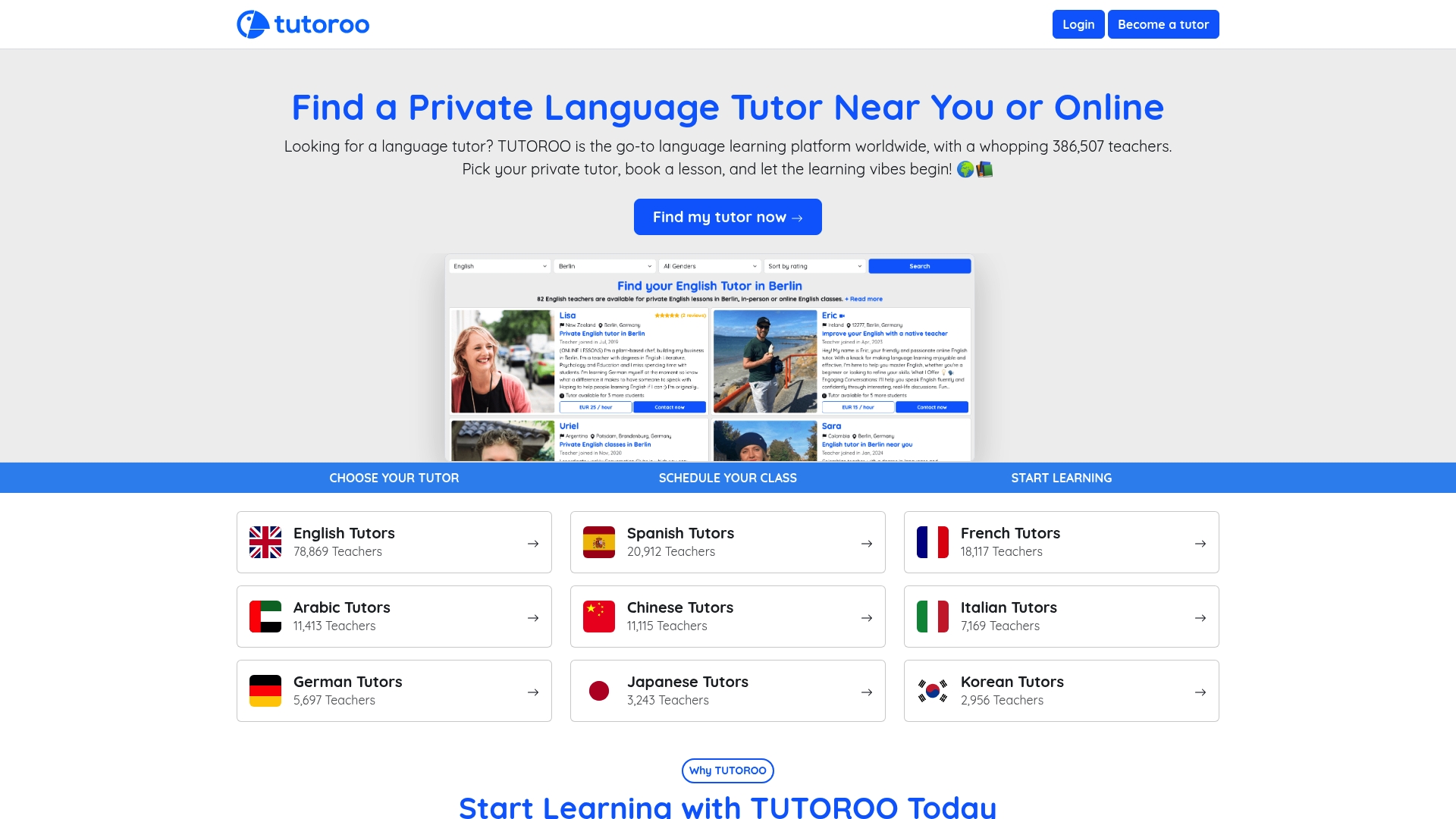
Whether you are looking to find an English tutor for exam preparation, everyday conversation, or professional development, or searching for specialist support such as Malay tutors, TUTOROO makes it simple to connect with the right person. Every session is one-on-one, personalised, and designed around what you actually need. Browse the tutor community today and take the first step towards real, lasting fluency.
Frequently asked questions
How often should I meet with a language tutor for best results?
Meeting with a tutor three or more times a week delivers the fastest and most sustainable progress, according to the latest high-dosage tutoring research. Consistency matters as much as session quality.
What can a tutor do that language learning apps can't?
Tutors provide personalised feedback, adapt lessons to your needs in real time, and offer live conversation practice that builds genuine confidence. Adaptive instruction and rapport-building are simply beyond what apps can replicate.
Is tutoring effective for advanced speakers or just beginners?
Tutoring accelerates learning at every level. Advanced speakers benefit from targeted exam coaching, accent reduction, and high-level fluency work, with large proficiency gains recorded regardless of baseline level.
Are online tutors as effective as in-person tutors?
Both formats can deliver excellent results. [Session frequency and teacher proficiency](https://centaur.reading.ac.uk/70107/3/Final author version_ELL_factors.pdf) are stronger predictors of success than whether lessons happen online or face to face.