

Most people start their language learning journey with a group class or a popular app, expecting quick wins. The reality is often a slow grind of forgotten vocabulary, silent classroom moments, and zero real conversation practice. Research shows that one-on-one learners can make up to three times faster progress than app users, with measurable gains in just twelve weeks. This article breaks down exactly why personalised lessons outperform the alternatives, which learners benefit most, how the options compare, and how you can find the right tutor to get started.
Table of Contents
- Why one-on-one language learning works
- Who benefits most from personalised language lessons
- How one-on-one compares to group classes and language apps
- Getting started: how to find a great one-on-one tutor
- What most language learners misunderstand about one-on-one lessons
- Ready to learn one-on-one? Find your language tutor now
- Frequently asked questions
Key Takeaways
| Point | Details |
|---|---|
| Faster language mastery | One-on-one learning enables up to 3x quicker progress than group classes or apps. |
| Boosted confidence | Personalised lessons lead to higher speaking confidence and learner satisfaction. |
| Best fit for busy lives | Flexible scheduling makes private tutoring ideal for working professionals and travellers. |
| Personalised for your goals | Tutoring sessions focus on your real-world needs, from exams to job skills to travel situations. |
Why one-on-one language learning works
Group classes follow a fixed syllabus designed for the average learner. That means if you already know the basics, you wait. If you are struggling, the class moves on without you. One-on-one lessons are built around you, your goals, your weaknesses, and your timeline. That difference alone changes everything.
The core advantage is immediate, personalised feedback. When you mispronounce a word or use the wrong tense in a group setting, the teacher rarely stops to correct you in front of everyone. In a private lesson, every mistake becomes a learning moment. Your tutor catches errors in real time, explains why they happen, and helps you correct them before they become habits. This is how genuine fluency develops.
Speaking time is another critical factor. In a class of ten students, you might speak for five minutes per session. In a one-on-one lesson, you are speaking the entire time. That volume of authentic practice builds confidence fast. One-on-one teaching benefits go well beyond speed; they reshape how learners relate to the language itself.

The data backs this up clearly. Learners gained confidence at a rate of 93% versus 78% for app users, and made up to three times faster progress. Meanwhile, personalised learning gains are reflected in satisfaction scores too, with a Net Promoter Score of 65 for one-on-one learners compared to just 6.5 for app users.
Here is a quick summary of what sets one-on-one lessons apart:
- Custom lesson plans built around your specific goals, not a generic curriculum
- Instant error correction that stops bad habits before they form
- More speaking time per session than any group class can offer
- Flexible pacing so you move faster through what you know and slower through what challenges you
- Cultural context woven into lessons by tutors with real-world experience
| Feature | One-on-one lessons | Group classes | Language apps |
|---|---|---|---|
| Personalised content | Yes | Rarely | No |
| Instant feedback | Yes | Limited | No |
| Speaking time per session | High | Low | Minimal |
| Confidence growth | 93% | Moderate | 78% |
| Learner satisfaction (NPS) | 65 | Varies | 6.5 |
Pro Tip: Ask your tutor to build practice scenarios around your real-life needs. If you are preparing for work meetings in French, say so. If you need survival Spanish for a trip to Mexico, tell them. The more specific you are, the faster you will progress.
Who benefits most from personalised language lessons
Not every learner has the same goal, and that is exactly why personalised lessons shine. The format adapts to whoever sits down for the lesson. Three groups in particular see outstanding results.
Travellers often need language skills fast. They are not interested in conjugating every verb perfectly; they want to order food, ask for directions, navigate transport, and connect with locals. A private tutor can focus entirely on survival language, practical phrases, and cultural nuances that no textbook covers. This kind of immersive, real-world focus is what opens doors to genuine cultural connection.
Students preparing for exams such as IELTS, DELF, or JLPT need a different approach entirely. They benefit from targeted grammar drills, timed writing practice, and rapid skill correction. A tutor who understands the exam format can identify exactly where marks are being lost and fix those gaps efficiently. Group classes rarely have the time or flexibility to do this.
Professionals need business vocabulary, industry-specific language, and the confidence to hold meetings or present ideas in another language. They also tend to have unpredictable schedules. Research confirms that one-on-one lessons suit busy professionals best, offering the flexibility and real conversation practice that group classes simply cannot match.
Exploring the types of private lessons available can help you identify which format aligns with your specific situation.
| Learner type | Primary need | How one-on-one helps |
|---|---|---|
| Traveller | Practical phrases, cultural tips | Immersion-focused, real-world scenarios |
| Student | Exam skills, grammar accuracy | Targeted drills, rapid feedback |
| Professional | Business language, flexible timing | Industry vocab, schedule adaptability |
Key benefits by learner type:
- Travellers build conversational confidence in weeks, not months
- Students close skill gaps before exam deadlines with precision practice
- Professionals learn on their own schedule without missing work commitments
- All learners get a tutor who adjusts to their learning style, not the other way around
How one-on-one compares to group classes and language apps
Choosing how to learn a language is a real decision with real consequences for your time and money. So it is worth looking at the evidence clearly.
Progress speed is where the gap is most obvious. One-on-one learners reach proficiency faster, up to three times faster than app users, particularly for speaking skills. Group classes fall somewhere in between, but they are still limited by class size and fixed pacing.
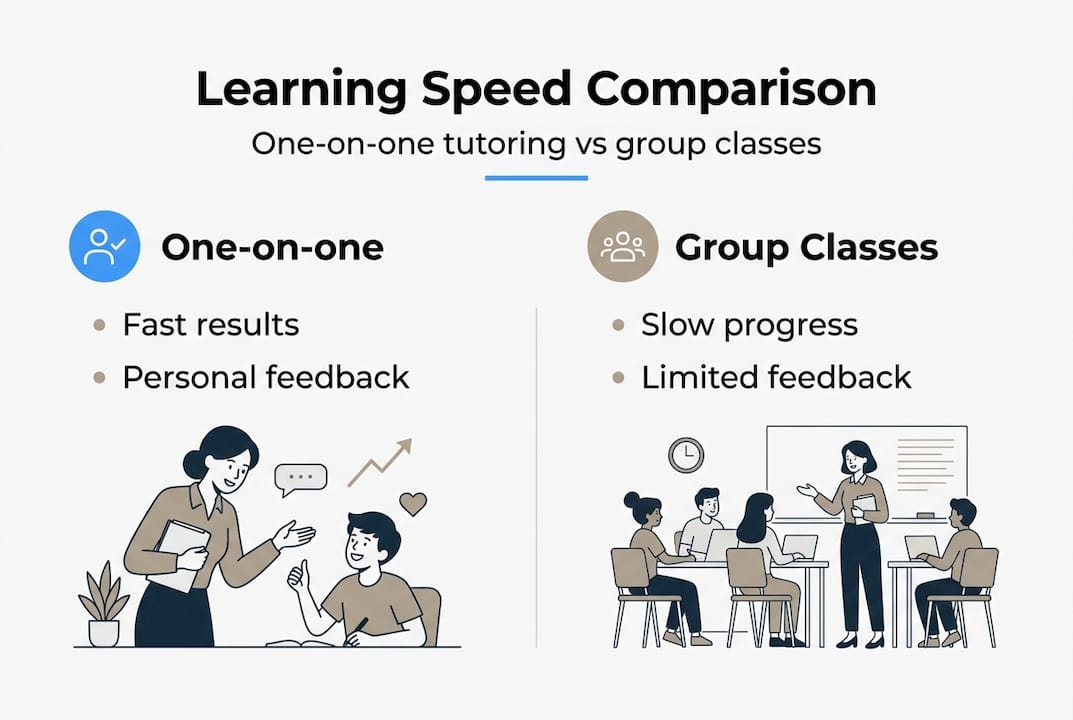
Satisfaction and retention tell a similar story. An NPS of 65 for one-on-one learners versus 6.5 for apps is not a small difference; it is a completely different experience. Learners who feel supported and see progress keep going. Those who feel stuck or bored drop off.
Flexibility is the third dimension. Most group classes run at fixed times, in fixed locations, with fixed syllabuses. Private lessons fit around your calendar. Whether you prefer local or online tutoring, the format adapts to your life rather than demanding you adapt to it.
"One-on-one learners showed a 93% confidence rate compared to 78% for app users, and reached measurable proficiency milestones up to three times faster, with an NPS of 65 versus 6.5 for apps."
Here is how the three methods stack up:
| Method | Progress speed | Confidence boost | Flexibility | Satisfaction (NPS) |
|---|---|---|---|---|
| One-on-one lessons | Fastest | 93% | High | 65 |
| Group classes | Moderate | Moderate | Low | Varies |
| Language apps | Slowest | 78% | High | 6.5 |
The top reasons learners switch to private lessons:
- They stopped progressing in group classes after the basics
- They needed speaking confidence, not just grammar knowledge
- Their schedule made fixed group times impossible
- They wanted a tutor who understood their specific industry or travel goal
- They saw real results in weeks rather than months
For practical examples of how online tutoring boosts fluency, the evidence from real learners is compelling.
Getting started: how to find a great one-on-one tutor
Knowing one-on-one works is one thing. Finding the right tutor is another. The good news is that the process is straightforward when you approach it with a clear plan.
Research on busy professionals consistently highlights flexibility and real conversation practice as the two most important factors in tutor selection. Keep those in mind as you search.
Follow these steps to find a tutor who genuinely fits your needs:
- Define your goal clearly. Are you preparing for an exam, planning a trip, or advancing your career? Your goal shapes everything else.
- Shortlist tutors by experience. Look for tutors who have worked with learners in your situation, whether that is business language, travel prep, or exam coaching.
- Check their teaching style. Read reviews and look for comments about how they give feedback, how they structure lessons, and whether they adapt to the learner.
- Confirm schedule compatibility. A great tutor who is never available when you are free is not the right match for you.
- Book a trial lesson. Most platforms offer this. Use it to assess whether the tutor's approach suits your learning style before committing.
A flexible tutoring guide can help you understand what to expect from private lessons and how to make the most of each session. The private tutoring benefits extend well beyond speed; they include motivation, accountability, and a genuine connection with your tutor.
Pro Tip: Always request a trial lesson before committing to a regular schedule. Chemistry matters. A tutor who makes you feel comfortable making mistakes is worth their weight in gold.
What most language learners misunderstand about one-on-one lessons
Here is a perspective that most articles skip over. One-on-one lessons are not the easy option. They are actually more demanding than group classes, and that is precisely why they work.
In a group, you can hide. You can stay quiet, let others answer, and coast through a session without being challenged. In a private lesson, there is nowhere to hide. Every gap in your knowledge surfaces quickly. That can feel uncomfortable, especially in the early weeks. But discomfort is where real learning happens. The brain consolidates language fastest when it is pushed to retrieve, produce, and self-correct.
The learners who get the most from private lessons are the ones who treat that exposure as a gift, not a threat. They lean into the mistakes, ask questions, and use their tutor as a mirror rather than a safety net. Exploring private lesson formats that challenge you, rather than just comfort you, is where genuine fluency is built.
If you are choosing one-on-one lessons purely for convenience, you will get results. But if you choose them as a deliberate strategy to stretch your abilities, you will get results that surprise you.
Ready to learn one-on-one? Find your language tutor now
If you are serious about making real progress, the next step is finding a tutor who fits your goals, your schedule, and your learning style. TUTOROO makes that process simple.
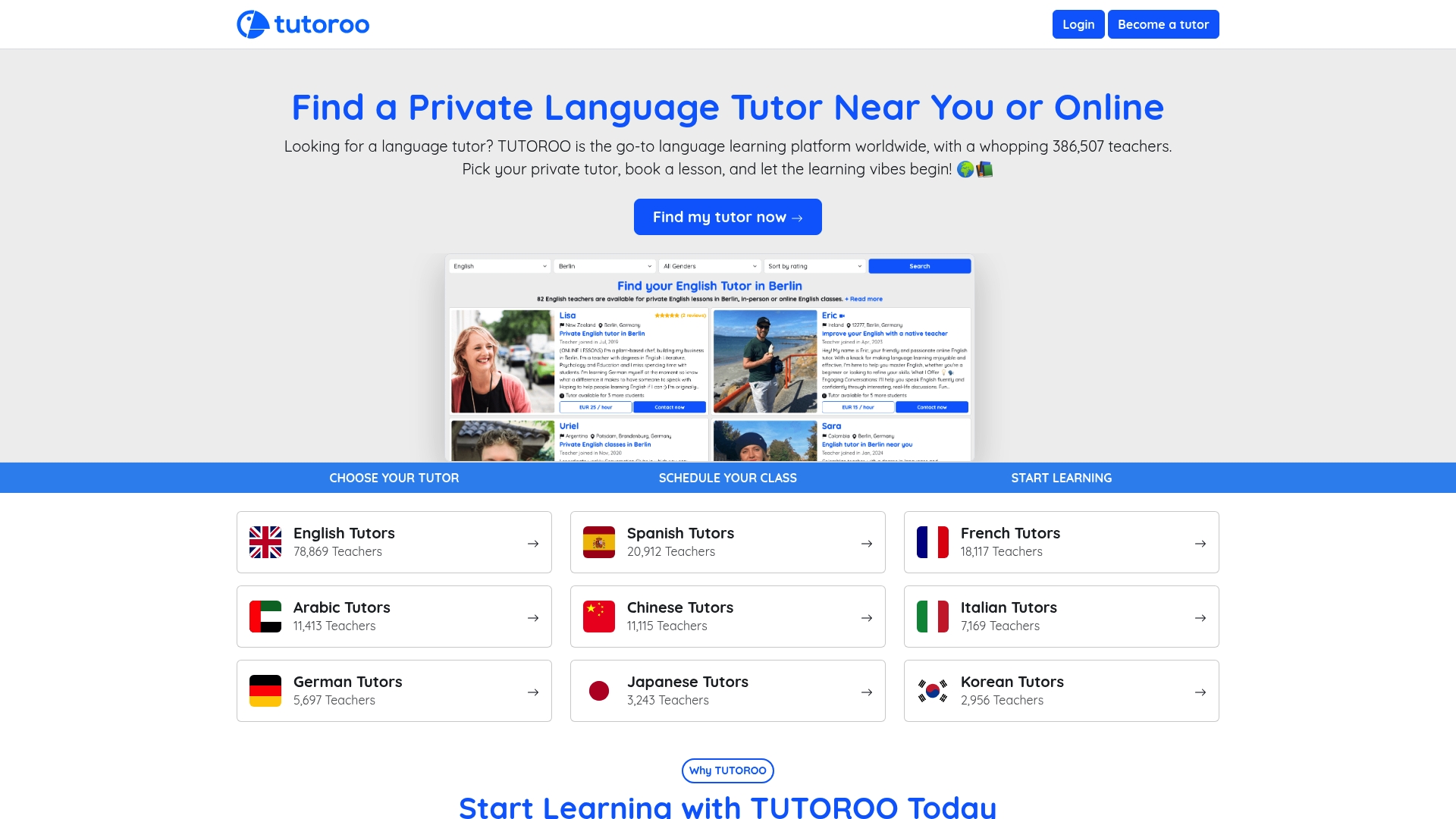
With over 386,000 language teachers available worldwide, TUTOROO connects you with qualified tutors for in-person or online lessons across dozens of languages. Whether you are looking for an English tutor to sharpen your professional communication, a Lebanese tutor for cultural immersion, or any other language, you can find a language tutor in just a few clicks. Browse by language, location, and availability, then message your tutor directly to get started. Your next lesson could be sooner than you think.
Frequently asked questions
Does one-on-one language learning really speed up progress?
Yes, studies show one-on-one students can reach proficiency up to three times faster than group or app learners, with measurable gains in as little as twelve weeks.
Is one-on-one tutoring worth the cost for exam preparation?
One-on-one tutoring offers targeted practice and rapid feedback on exactly the skills being assessed, making it far more efficient for exam success than general group classes. Students benefit from focused drills and faster progress toward their specific exam goals.
How does one-on-one tutoring fit into a busy professional schedule?
Private lessons offer flexible scheduling that adapts to your calendar, making them far more practical than fixed group classes. Research confirms that this flexibility is one of the primary reasons professionals choose private tutoring.
What is the main benefit of one-on-one lessons for travellers?
Travellers gain rapid immersion, practical conversation skills, and cultural insights that general group classes rarely cover. One-on-one lessons maximise speaking practice and real-world readiness in a short period of time.