

Comprehensible input is language you can follow the gist of, even though it contains some words or structures you haven't met yet. The idea is simple, but applying it is harder: you have to find material that sits at the right level, and keep finding it as you improve. A private tutor does that sorting for you, choosing and adjusting material lesson by lesson, which is why many learners pair their own listening and reading with one-on-one lessons on TUTOROO.
TL;DR
- Comprehensible input is language you mostly understand, with a little new material you can work out from context.
- Stephen Krashen's i+1 formula: i is your current level, +1 is the next step up. Too easy teaches nothing, too hard is noise.
- Aim for material you understand roughly 80 to 90 percent of, and mix listening with reading.
- Shadowing, repeating speech aloud just behind a speaker, trains your ear and complements input rather than replacing it.
- Input works best alongside speaking practice and feedback, which is where a personal tutor adds the most.
Table of Contents
- What comprehensible input means
- Examples you can picture
- Finding the right level
- A weekly routine that works
- Shadowing: training your ear
- Input and output together
- Where a tutor changes the equation
- Find a tutor on TUTOROO
- Our perspective
- FAQ
- Sources
What comprehensible input means
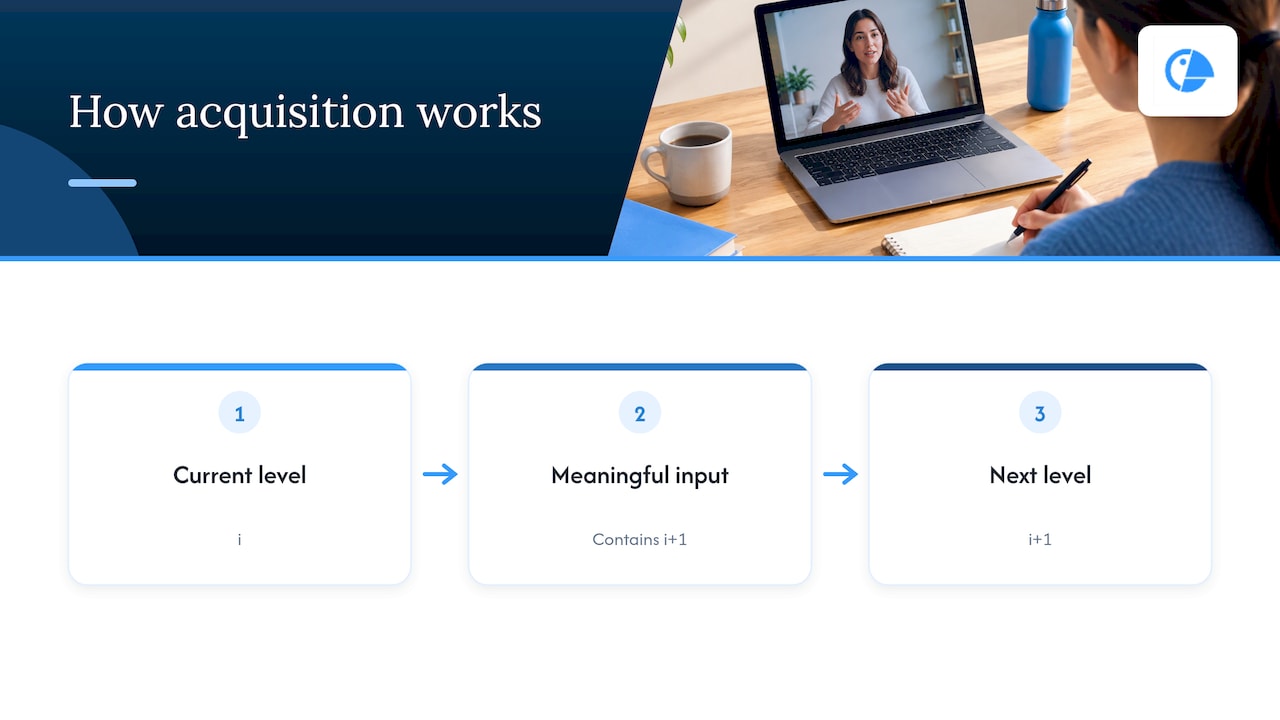
The term comes from linguist Stephen Krashen. In his 1982 book on second language acquisition, he proposed that we move from our current level (i) to the next (i+1) by understanding input that contains i+1. Here, "understand" means focusing on meaning rather than form, helped by context and general knowledge.
Put plainly, you don't memorise a rule and then apply it. You meet a new form inside something you already follow, and your brain picks it up. The American Council on the Teaching of Foreign Languages (ACTFL), the main US professional body for language teachers, cites this idea in its guiding principles: learners acquire language when they hear large quantities of input that is interesting, a little beyond their level, and not grammatically sequenced.
The University of Oregon's open textbook on learning languages describes the same principle as choosing content slightly above your level, so you process meaning easily while still meeting new vocabulary and structures in context.
Examples you can picture
A good example makes the new word guessable. A University of Chicago student publication gives a German one: a learner recognises Mr. Spock, sees a picture of someone pointing at his ears, hears "Mr. Spock hat zwei Ohren" and may infer that zwei means two and Ohren means ears.
Reading works the same way. The Oregon textbook's reading chapter shows a sentence about a tree falling with a crash in an unfamiliar word's place. You can guess the word from context and keep reading, which keeps your attention on meaning.
Images and familiar surroundings do a lot of this work. Tools that teach through context clues and visual links show how new words stick when they attach to something you already know.
A Spanish beginner might watch a video where a presenter says "Hoy me levanto a las siete" while visibly waking up, eating and putting on shoes. The meaning of me levanto comes from the action, as one learning guide illustrates.
Finding the right level
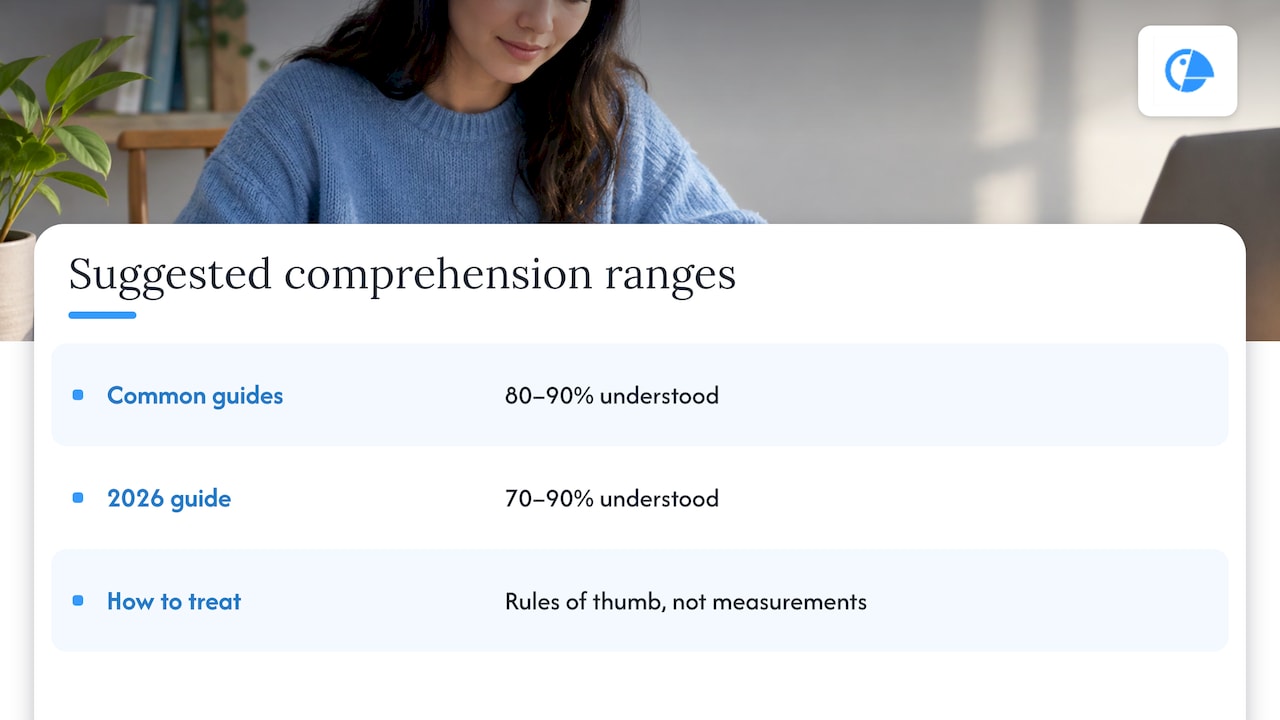
The "+1" is the tricky part. Too much unknown language and you are lost. Too little and nothing new arrives. Guides commonly suggest material you understand about 80 to 90 percent of, with one 2026 guide giving a wider band of 70 to 90 percent. Treat these as rules of thumb, not measurements.
The Oregon authors offer a practical way to think about it: stay in the slightly-beyond zone until it feels comfortable, then level up and accept being a little uncomfortable again.
Beginners
Start with short, easy listening and simple texts you can read in volume. Choose material with strong visual support: picture books, slow videos, content made for learners. UNC's Learning Center suggests authentic sources such as children's picture books and TV shows in segments of about 15 minutes, using subtitle options.
Intermediate learners
At this stage, graded news articles, podcasts for learners and series with subtitles in the target language work well. Mix listening and reading: reading lets you stop and look, listening trains you to keep up.
Advanced learners
Move to native material across genres that is challenging but manageable. Here the +1 often hides in idiom, register and speed rather than vocabulary. Our guide to what advanced language instruction involves covers what changes at this level.
A weekly routine that works
- Pick one source you enjoy. A show, a podcast or a graded reader. Interest keeps you coming back, and volume is what matters.
- Work in short blocks. Fifteen to twenty minutes of focused listening beats an hour of half-attention.
- Follow the gist first. Don't pause for every unknown word. Note two or three recurring ones and look them up afterwards.
- Re-expose yourself. Return to the same episode or chapter after a few days. It will feel easier, and that is the signal to move up a level.
- Say something back. Write or speak a few sentences about what you heard.
That last step matters. ACTFL stresses that comprehensible input and comprehensible output go hand in hand. For a fuller plan, see our step by step language learning guide and the beginner's guide.
Shadowing: training your ear
Shadowing means listening to speech and repeating it aloud while it plays, about a second behind the speaker, copying sounds, stress, rhythm and intonation. It is a different activity from input: you are not mainly working out meaning, you are tuning your ear and mouth.
A workable routine, adapted from a step-by-step shadowing guide:
- Choose a clip of 30 seconds to two minutes with an accurate transcript.
- Listen to the whole clip first.
- Read the transcript and mark where speakers stress or link words.
- Shadow sentence by sentence with the text, then without it.
- Shadow the full clip at normal speed without stopping when you slip.
- Record yourself and compare.
- Repeat the same clip over several days before changing material.
UNC suggests starting with short sections of 20 to 30 seconds and focusing on rhythm, intonation and pacing before worrying about meaning.
What the research says
A 2016 study in The Language Teacher found that Japanese university students who shadowed for eight lessons improved in listening but not reading, while a repetition group improved in reading but not listening. The author's conclusion: use each technique for the situation it suits. A pilot study in Accents Asia of silent shadowing of an audiobook reported gains in listening comprehension and fluency, with the author noting that larger groups are needed to confirm it.
In practice, shadowing is ear training. If you can't yet catch the sounds of a language, it helps to build that skill before expecting speaking gains.
Input and output together
Krashen argued that input is the engine of acquisition. Researchers such as Merrill Swain added that producing language forces you to notice gaps in what you know. The University of Chicago article reports that Swain developed her output hypothesis after watching French immersion students who received lots of input but struggled to express their thoughts. Studies comparing input-based and output-based learning found both build vocabulary and competence.
The practical reading is a balance: plenty of input at the right level, plus regular chances to speak and be corrected. Critics have also pointed out that i+1 is hard to define in advance for any given learner, which is a good reason to have someone who can judge your level in the moment.
Where a tutor changes the equation
Self-study input has one weak spot: you are the one judging what is "just right". A tutor can hear what you actually understand, adjust the difficulty within a lesson, and turn your listening into conversation. We cover how this looks in practice in language lessons that build real speaking skills and in our language tutoring process.
A tutor can also recommend a show, podcast or reader suited to your goal, whether that is travel, an exam or professional use, then talk it through with you. Adult learners may want our practical guide to tutoring for adults, and those moving from basics to fluency can read about personalised tutoring from beginner to advanced.
Find a tutor on TUTOROO
TUTOROO connects learners with private language tutors for one-on-one lessons, online or locally, across a community of over 386,000 teachers. You can search by language, location and availability, message tutors directly, and choose the one whose approach suits how you learn. Teachers are available in English, Spanish, French, Japanese, Chinese/Mandarin, German, Italian and Portuguese, among others.
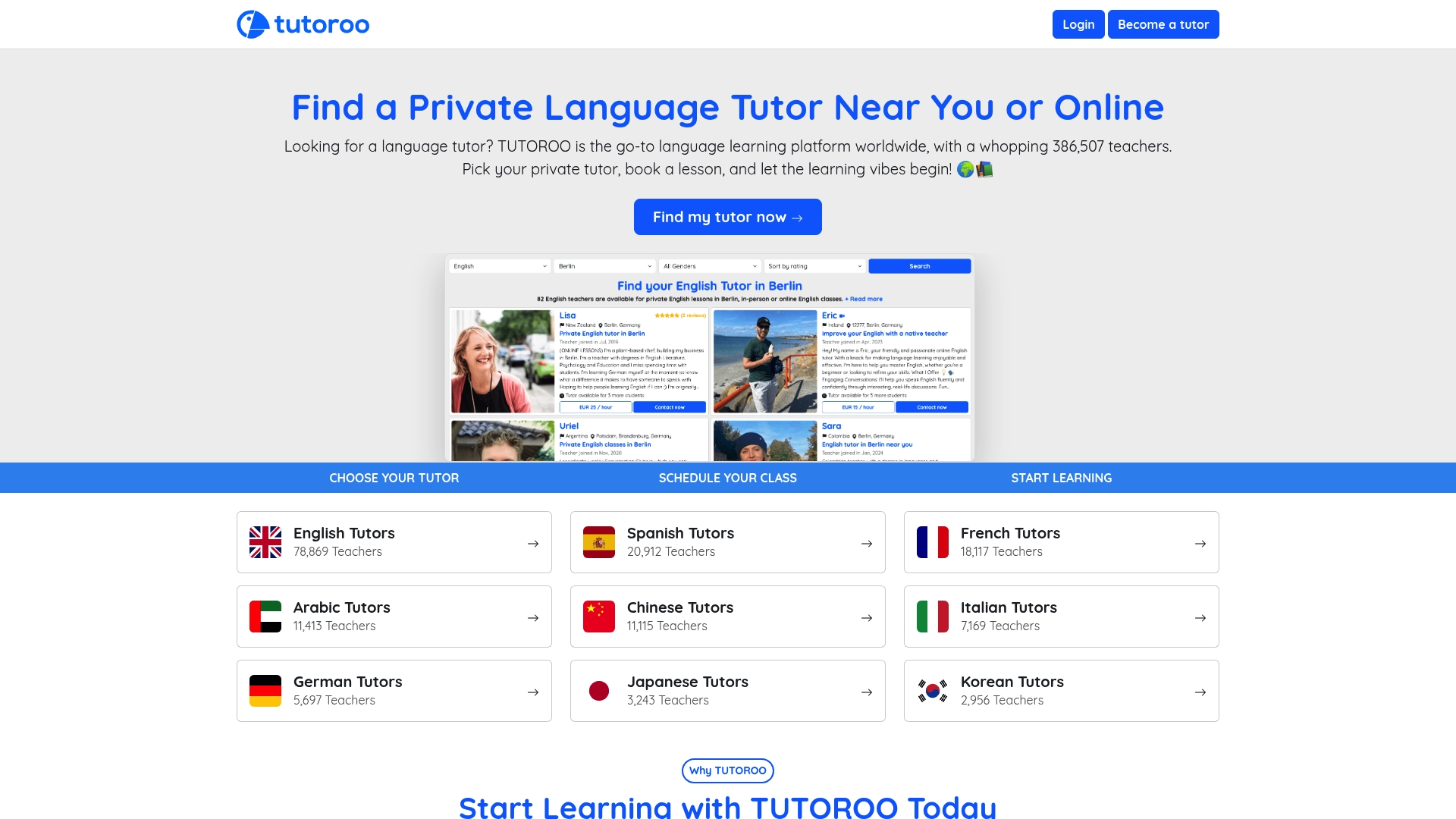
Browse tutors on TUTOROO, or go straight to Spanish-speaking and French-speaking options and Japanese tutors.
Our perspective
Input is the foundation of every language we have helped people learn, but a foundation is not a house. Learners tell us the hardest part is never finding content, it is knowing whether it is right for them today.
That is why we believe in personalised, one-on-one tuition. A tutor listens to you, hears where meaning breaks down, and builds the next step from material that interests you. Authentic voices and cultural context make that input memorable, and conversation turns it into something you can use.
We built TUTOROO so learners can reach expert and native-speaking tutors wherever they are, message them directly and agree a schedule that fits. Understanding opens the door; a good tutor helps you walk through it.
TUTOROO
FAQ
What is comprehensible input in simple terms?
It is language you can mostly understand, with a little new material you can work out from context. Krashen's formula calls your level i and the next step i+1. Content that is far beyond you is just noise, and content you already know fully teaches little.
How do I get comprehensible input as a beginner?
Choose short, visual material: picture books, slow videos and learner-friendly podcasts. Aim to follow most of it, use subtitles or transcripts, and work in blocks of about 15 minutes. A tutor can pick material for your exact level and talk it through with you.
Is shadowing the same as comprehensible input?
No. Shadowing is repeating speech aloud as you hear it, mainly to train your ear and rhythm. Comprehensible input is about understanding meaning. They work well together: input builds understanding, shadowing sharpens how you hear and sound.
Is input enough to become fluent?
Input is central, but researchers such as Merrill Swain show that speaking and getting feedback deepen what you acquire. Most learners progress best by combining plenty of input with regular conversation practice.
Sources
- Krashen, Principles and Practice in Second Language Acquisition (1982)
- ACTFL: Facilitate Target Language Use
- University of Oregon: Listening or Viewing Skills
- University of Oregon: Reading Principles to Live By
- University of Chicago Triple Helix: Focus on input or output?
- UNC Learning Center: Learning Languages
- Comprehensible Input in Language Learning (Appewa)
- Comprehensible Input: The Science-Backed Method (Leonardo English)
- Shadowing Technique guide
- The Language Teacher (JALT, 2016)
- Accents Asia: Silent Shadowing of Audiobooks
- What is Comprehensible Input (Taalhammer)