

TL;DR:
- Consistent daily practice of 15 to 20 minutes surpasses long, infrequent study sessions for long-term language retention.
- Starting with one core resource and incorporating supportive tools like spaced repetition, graded readers, and AI practice accelerates beginner progress.
A language learning guide for beginners is defined as a structured set of research-backed strategies that take an absolute beginner from zero to basic conversational ability through consistent daily practice. The most important finding from current research is this: daily consistent practice of 15 to 20 minutes outperforms long, infrequent study sessions for long-term memory retention. That means you do not need hours free each day. You need a reliable method, the right tools, and a routine you can actually keep. This guide covers all three.
What tools and resources do beginners need to start learning a language?
The foundation of any beginner language resource is choosing one core method and committing to it fully. Bouncing between multiple apps without finishing any reduces adult learners' success significantly. This is one of the most common beginner mistakes, and it leads to burnout rather than progress. Pick one structured programme and see it through before adding anything else.
Once you have a core resource, the following tools support your learning without replacing it:
- Spaced repetition apps like Anki use algorithms to show you vocabulary at the exact moment you are about to forget it, making review sessions far more efficient than rereading notes.
- Graded readers are books or stories written at your current level. They build reading comprehension and vocabulary in context, which is far more effective than word lists.
- AI speaking practice tools let you have low-pressure conversations in your target language at any time of day. They are particularly useful for overcoming the anxiety of speaking with a real person before you feel ready.
- Comprehensible input content such as story-based videos or podcasts pitched just above your current level. Linguist Stephen Krashen's Input Hypothesis confirms that natural acquisition improves when you focus on understanding messages rather than drilling grammar rules.
When evaluating whether a resource suits your needs, ask three questions. Does it offer content at your current level? Does it include audio so you can hear the language spoken naturally? Does it give you feedback on your output, either through a tutor, an AI tool, or a structured answer key?
Pro Tip: Before committing to any app or course, use the free trial for one full week at the same time each day. If you find yourself skipping it by day four, it is not the right fit for your lifestyle, regardless of how highly rated it is.

How should beginners organise their daily language learning routine?
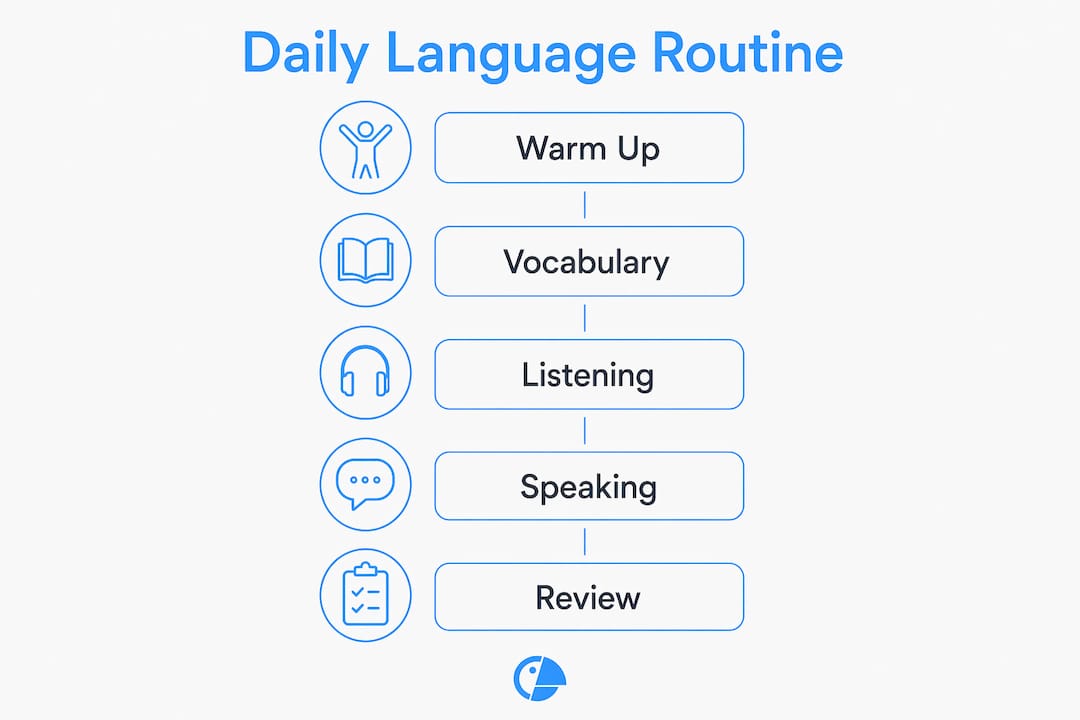
The most effective structure for beginners is what practitioners call the "30-minute stack." It is a daily session divided into three focused blocks that cover the core skills without overwhelming you. Here is how it works:
- 20 minutes of speaking practice. This is the highest-value activity for beginners. Use an AI speaking tool, a language exchange partner, or a private tutor. Speaking activates vocabulary and grammar simultaneously in a way that reading alone cannot.
- 5 minutes of vocabulary review. Open your spaced repetition app and work through your due cards. Do not add new words during this block. Focus entirely on reviewing what you already know.
- 5 minutes of grammar or pronunciation work. Pick one specific point, such as verb conjugation in the present tense or the pronunciation of a tricky vowel sound. Study it, practise it aloud, and move on.
Consistent daily practice of this structure can bring basic conversational ability in Spanish within 600 to 750 hours of total study, while more complex languages like Mandarin require over 2,200 hours. That context matters because it sets realistic expectations. You are not failing if Spanish feels hard after two weeks. You are simply early in the process.
If 30 minutes feels too long on busy days, split the stack into two 15-minute sessions. Research on distributed practice confirms that spacing sessions across the day still produces strong retention outcomes. The key is not the length of any single session but the frequency across the week.
Shadowing is one technique worth adding once you have two to three weeks of speaking practice behind you. It involves speaking aloud in sync with an audio recording, matching the rhythm and intonation of a native speaker. Shadowing accelerates pronunciation and fluency improvements faster than silent reading or solo practice. Use a podcast, a graded audio story, or a short YouTube clip with a clear speaker.
Pro Tip: Attach your language practice to an existing habit, such as your morning coffee or your commute. Habit researchers call this "habit stacking," and it removes the daily decision of when to study, which is often the biggest barrier for beginners.
Which vocabulary strategies work best for beginners?
Vocabulary is the single fastest lever a beginner can pull. Learning the 1,000 most frequent words in your target language covers approximately 75 to 85% of everyday conversation. That means a focused beginner who masters this core vocabulary can understand the majority of what they hear in daily life, even before tackling advanced grammar.
The method matters as much as the word list. Vocabulary learned in isolation, such as "hambre = hunger," fades quickly because the brain has no context to anchor it. Cloze-style flashcards that embed words in sentences, for example "Tengo __ (hunger). I am hungry," produce significantly better long-term retention and natural usage. Anki supports this format natively, and many shared decks are already built this way.
| Vocabulary method | Retention outcome |
|---|---|
| Isolated word pairs (e.g. hambre = hunger) | Low retention; words forgotten without context |
| Cloze flashcards in sentences | High retention; words recalled in natural speech |
| Vocabulary from graded readers | Strong retention; reinforced through repeated exposure in story context |
| Frequency-based word lists (top 1,000) | High efficiency; covers 75 to 85% of daily conversation |
Encountering a new word multiple times across different contexts is what moves it from short-term recognition to long-term use. Aim to meet each new word in at least three different settings: once in a flashcard, once in a graded reader, and once in a listening exercise. This repeated contextual exposure mirrors how children absorb vocabulary naturally and is far more effective than reviewing the same list repeatedly.
How do beginners develop speaking and listening skills from day one?
Speaking early is the single most important habit a beginner can build. Many learners delay speaking until they feel "ready," but that moment rarely arrives on its own. The tips for beginner language learners that consistently produce results all share one feature: they prioritise output from the very first week.
Listening and speaking develop together, not separately. Here is how to build both from the start:
- Use comprehensible input daily. Story-based podcasts, graded listening content, and slow-speech news programmes give your brain the exposure it needs to absorb grammar patterns naturally. Content pitched just above your current level, what researchers call "i+1," is the most effective zone for acquisition.
- Practise with AI speaking tools. These remove the social pressure of speaking with a native speaker before you are confident. They also allow you to repeat the same conversation multiple times without embarrassment, which is genuinely useful for drilling specific phrases.
- Add a human element as soon as possible. AI tools aid speaking practice but cannot replace the social feedback that is essential for fluency. A private tutor or language exchange partner provides correction, cultural nuance, and the unpredictability of real conversation that no app can fully replicate.
- Normalise the silent period. Most beginners go through a phase where they understand more than they can produce. This is normal and temporary. Do not measure progress by how fluently you speak in week one. Measure it by how much more you understand compared to last week.
Pro Tip: Record yourself speaking for 60 seconds in your target language at the end of each week. Do not edit or delete the recordings. After one month, listen back to week one. The improvement is almost always more dramatic than you expect, and hearing it directly is one of the most motivating experiences a beginner can have.
How do you troubleshoot common challenges in early language learning?
Every beginner hits the same walls. Knowing they are coming makes them far easier to get through.
"The discomfort you feel when you cannot find the right word is not a sign that you are failing. It is the exact moment your brain is forming a new connection. Lean into it."
The most common challenges beginners face, and how to address them, are:
- Motivation dips after two to four weeks. The initial excitement fades and progress feels invisible. The fix is to shift your measure of progress from "how fluently I speak" to "how much I now understand." Comprehension grows faster than production and is a more honest indicator of real progress.
- Feeling overwhelmed by grammar. Stop trying to learn all the rules before you speak. Focus on the structures you need for basic conversation, present tense, common question forms, and a handful of connectors like "because," "but," and "so." Grammar expands naturally through exposure.
- Resource overload. If you are using four apps, two textbooks, and a podcast series simultaneously, you are not learning faster. You are spreading your attention too thin. Return to one core resource and use it consistently. The top language learning methods all emphasise depth over breadth, especially at the beginner stage.
- Inconsistent practice. Missing one day is fine. Missing a week creates a gap that feels hard to close. If your routine breaks down, restart with a shorter session, even five minutes, rather than waiting until you have a full 30 minutes free.
Tracking progress through comprehension tests, such as how much of a graded reader you understand without looking up words, gives you concrete evidence of growth that streaks and point systems cannot.
Key takeaways
Beginners who commit to a daily 30-minute routine built around speaking, spaced repetition, and comprehensible input will reach basic conversational ability faster than any other approach.
| Point | Details |
|---|---|
| Daily practice beats cramming | Short daily sessions of 15 to 20 minutes produce better long-term retention than infrequent long study. |
| One resource, used fully | Finishing one structured programme delivers better results than switching between multiple apps. |
| Vocabulary in context | Cloze-style flashcards improve retention significantly over isolated word pairs. |
| Speak from day one | Early speaking practice, even with AI tools, accelerates fluency and reduces anxiety over time. |
| Measure comprehension, not streaks | Tracking how much you understand gives a more accurate and motivating picture of real progress. |
What Tutoroo has learned from working with thousands of beginners
At Tutoroo, we have connected learners with private tutors across dozens of languages, and the pattern we see most often is this: the beginners who progress fastest are not the ones with the most time or the best apps. They are the ones who speak with a real person within their first two weeks.
Apps are genuinely useful. Spaced repetition works. Comprehensible input is real and powerful. But there is something that happens in a live conversation with a tutor that no algorithm can replicate. A tutor notices when you hesitate on a specific sound and corrects it in the moment. They adjust the vocabulary they use based on your face, not your score. They bring cultural context that makes the language feel alive rather than academic.
The advice we give every beginner is to stop waiting until you feel ready to speak. You will never feel ready. Start speaking badly, with support, and improve from there. Patience with yourself is not optional in this process. It is the method. Celebrate the moment you understand a sentence you would not have caught last month. That is real progress, and it compounds.
— Tutoroo
Start your language learning with Tutoroo
Tutoroo connects beginners with over 386,000 private language tutors available for lessons online or in person, across languages including English, Spanish, French, Arabic, and Mandarin Chinese. Every tutor on the platform offers personalised lessons tailored to your current level, your goals, and your schedule. There are no rigid curricula or classroom timelines. Your tutor works around you.
Whether you are preparing for travel, reconnecting with heritage, or simply opening a door to a new culture, a private tutor accelerates progress in ways that self-study alone cannot match. Find a private tutor on Tutoroo today and book your first session. For those focused on English specifically, Tutoroo's English tutors online are available across all time zones and experience levels.
FAQ
How long does it take a beginner to reach basic conversational ability?
Basic conversational skills are achievable within two months of daily practice at 15 to 20 minutes per session. Long-term fluency requires sustained exposure, social interaction, and ongoing feedback over many months.
What is the best language for beginners to learn?
Spanish, French, and Italian are widely considered the most accessible languages for English speakers due to shared vocabulary and relatively straightforward grammar structures. The best choice, however, is always the language you are most motivated to use.
Should beginners focus on grammar or vocabulary first?
Vocabulary comes first. High-frequency words covering the top 1,000 most common terms give beginners the tools to communicate in most everyday situations before grammar study becomes necessary.
Can AI tools replace a language tutor for beginners?
AI tools are useful for low-pressure speaking practice and vocabulary drilling, but technology cannot replace the social feedback, cultural nuance, and real-time correction that a human tutor provides. The most effective approach combines both.
How do beginners stay motivated when progress feels slow?
Shift your measure of success from speaking fluency to listening comprehension. Comprehension grows faster and more visibly than production, and tracking it through graded content gives beginners concrete evidence that their daily practice is working.