

TL;DR:
- Advanced language instruction involves deliberate teaching of complex grammar, style, and cultural content to attain near-native proficiency. It emphasizes correction of fossilized errors, authentic materials, and research-based techniques, with AI tools serving primarily as feedback enhancers. Consistent, guided practice with expert tutors is essential for bridging the gap between fluency and precision.
Advanced language instruction is defined as a pedagogical approach that deliberately shifts from predominantly implicit language acquisition to a structured blend of explicit teaching, authentic materials, and precision-focused practice. Where beginner and intermediate learners absorb language mainly through exposure, advanced learners require targeted instruction in complex grammar, register awareness, and stylistic control. This guide explains what advanced language instruction looks like in practice, which teaching methods produce the strongest results, and how modern tools including generative AI are reshaping high-level language learning in 2026.
What is advanced language instruction and how does it work?
Advanced language instruction is the systematic teaching of language at high-proficiency levels, where the goal shifts from basic communication to native-like precision and cultural fluency. The industry term for this field is "advanced language pedagogy," though "advanced language instruction" is the phrase most learners and educators use in practice. Both terms describe the same thing: deliberate, research-backed teaching designed to move learners beyond conversational competence.

At this level, the balance between implicit and explicit instruction changes significantly. Transitioning from Advanced Low to Superior requires 30–40% explicit instruction, compared to the 20–30% typical at intermediate stages. That shift matters because advanced learners have already absorbed the core grammar and vocabulary through exposure. What they need now is precise correction, stylistic refinement, and deliberate practice on the structures that exposure alone rarely fixes.
The three pillars of advanced language pedagogy are accuracy, register awareness, and cultural depth. Accuracy means correcting fossilised errors, the ingrained mistakes that fluent speakers repeat without noticing. Register awareness means knowing when to use formal, informal, academic, or colloquial language. Cultural depth means understanding the values, humour, and references that native speakers take for granted.
How does advanced instruction differ from beginner and intermediate teaching?
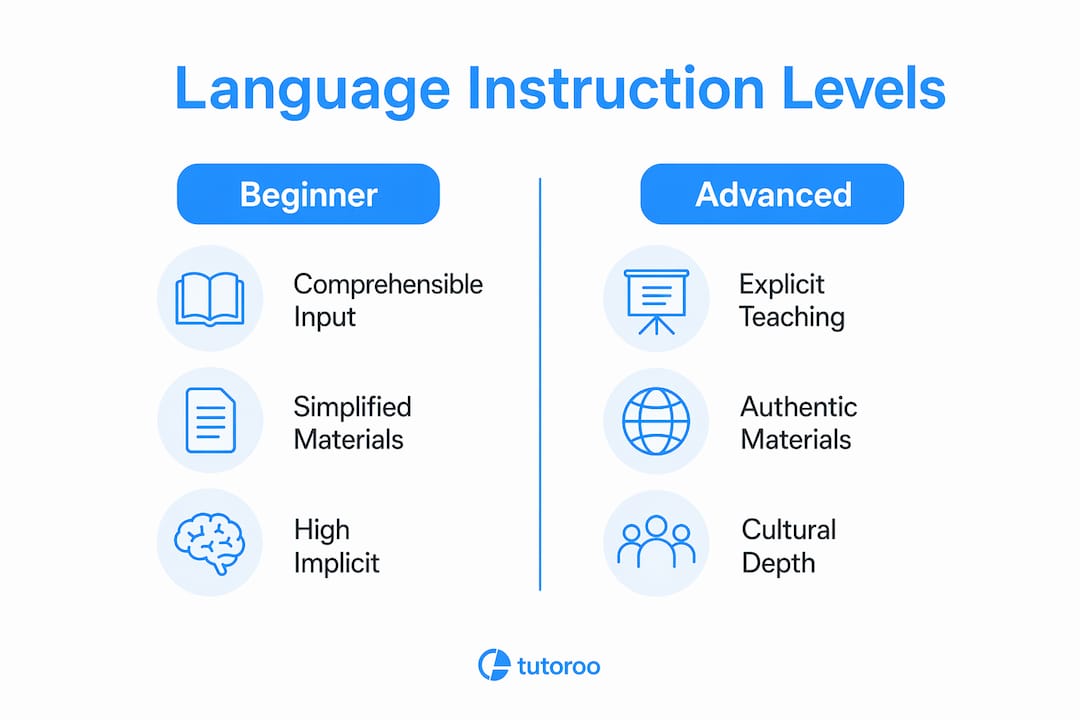
The most visible difference between proficiency stages is the role of authentic materials. Beginner learners need simplified texts, controlled vocabulary, and predictable sentence structures. Advanced learners need editorials, podcasts, literature, and social media content produced by and for native speakers. The shift from pedagogical texts to authentic materials is not just a change in difficulty. It is a change in purpose.
At beginner and intermediate levels, comprehensible input drives 70–80% of instruction. Learners absorb language by hearing and reading content just above their current level. At advanced levels, that proportion drops to 60–70%, with explicit instruction filling the gap. The reason is straightforward: implicit exposure rarely corrects complex grammatical structures or stylistic habits that have already become automatic.
Advanced learners also face a challenge that beginners do not: fossilised errors. These are mistakes so deeply embedded in a learner's speech or writing that they persist even after years of practice. Addressing them requires deliberate practice on accuracy, not more exposure. A tutor who simply converses with an advanced learner without correcting these patterns is not providing advanced instruction. They are providing conversation practice, which is valuable but not sufficient.
Key differences between proficiency stages include:
- Beginner focus: Comprehensible input, basic vocabulary, simple sentence structures, and survival communication.
- Intermediate focus: Expanding vocabulary, narrative ability, and increased fluency through sustained exposure.
- Advanced focus: Fossilised error correction, register control, stylistic precision, and authentic cultural content.
Pro Tip: If you are at an advanced level, ask your tutor to keep a written record of your recurring errors across sessions. Tracking patterns over time is far more effective than one-off corrections.
What advanced teaching methods work best for high-level proficiency?
Evidence-based instruction at advanced levels draws on a specific set of techniques, each targeting a different dimension of high-level language use. The most effective methods are not drills or rote repetition. They are techniques that embed explicit instruction within meaningful communication.
The four most research-supported techniques for advanced learners are:
- Spaced retrieval: Revisiting vocabulary and grammar at increasing intervals to move knowledge from short-term to long-term memory. This technique works because the brain consolidates information better when it is recalled after a delay rather than reviewed immediately.
- Input flood with focus on form: Exposing learners to a high volume of target structures in authentic contexts, then drawing explicit attention to those forms. Research-backed techniques show this combination outperforms either approach used alone.
- Pushed output: Requiring learners to produce language at the edge of their current ability, in speaking or writing, rather than staying within their comfort zone. Pushed output forces learners to notice gaps in their knowledge.
- Interaction with feedback: Structured conversation where a tutor or partner provides immediate, targeted correction. The feedback must be specific to be useful. "That sounds a bit off" teaches nothing. "In formal writing, you would use the subjunctive here" teaches something.
Two broader frameworks also define advanced instruction. Pedagogical translanguaging is the strategic use of a learner's first language to scaffold understanding of complex content in the target language. It is not a shortcut or a sign of weakness. It is a recognised method for helping advanced learners grasp abstract concepts that the target language alone cannot yet convey clearly.
Content and Language Integrated Learning (CLIL) takes a different approach. CLIL treats language as a vehicle for mastering subject knowledge, whether that is history, science, economics, or law. Learners studying a subject through their target language are forced to use register-specific vocabulary and complex sentence structures that textbooks rarely demand. The result is language use that feels genuinely purposeful.
Pro Tip: CLIL works best when the subject genuinely interests you. Choose a topic you would read about in your first language, then find quality content on that topic in your target language.
How do authentic materials and cultural content enhance advanced learning?
Authentic materials are texts, audio, and video produced by native speakers for native speakers, not simplified for language learners. For advanced learners, these materials are not optional extras. They are the primary vehicle for developing native-like fluency and cultural competence.
The cognitive benefits of culturally enriched instruction extend beyond language itself. Sustained language instruction is associated with a statistically significant cognitive benefit across academic performance, meaning learners who engage deeply with culturally rich content show measurable gains in broader thinking skills. Language learning at this level is not just about communication. It reshapes how learners process and organise information.
Effective authentic materials for advanced learners include:
- Editorials and opinion pieces: These expose learners to persuasive register, complex argumentation, and culturally specific references.
- Radio broadcasts and podcasts: Natural speech rate, regional accents, and colloquial expressions that textbooks never capture.
- Social media content by native speakers: Informal register, slang, humour, and the cultural shorthand that defines everyday communication.
- Literary texts: Stylistic precision, figurative language, and the full range of a language's expressive capacity.
Authentic materials paired with scaffolding support advanced learner comprehension most effectively when support tools such as glossaries, transcripts, and guided questions are provided alongside the raw content. The goal is not to make the material easier. It is to give learners the tools to engage with difficulty productively.
| Material type | Primary benefit | Best used for |
|---|---|---|
| Editorials | Persuasive register and argumentation | Writing and debate practice |
| Podcasts and broadcasts | Natural speech and listening comprehension | Ear training and vocabulary in context |
| Literary texts | Stylistic range and figurative language | Reading depth and written expression |
| Social media content | Informal register and cultural fluency | Colloquial expression and cultural literacy |
What role does technology play in advanced language learning?
Technology is most valuable to advanced learners when it generates feedback rather than simply delivering content. Passive consumption of language apps or vocabulary lists produces limited gains at this level. The real value lies in tools that respond to what a learner produces.
Generative AI tools show stronger effects with higher-proficiency learners, particularly for writing and speaking skills. That finding is significant. It means AI-assisted feedback is not just a convenience. It is a genuinely effective method for advanced skill development when used alongside explicit instruction. A learner who drafts an essay, receives AI-generated feedback on register and grammar, then revises with a tutor's guidance is using technology in the way research supports.
Best practices for technology use at advanced levels include:
- Use AI tools for first-pass feedback on writing, then bring that feedback to a human tutor for interpretation and deeper correction.
- Record yourself speaking, then use feedback-generating tools to identify pronunciation and fluency patterns you cannot hear in real time.
- Avoid using AI as a translation shortcut. Use it as a revision tool after you have already attempted the task independently.
- Pair technology with adaptive learning approaches that adjust difficulty and focus based on your specific error patterns.
The risk with technology at advanced levels is over-reliance. AI feedback is most effective when it complements explicit instruction from a qualified tutor, not when it replaces it. The role of technology in language education is to extend practice opportunities and surface patterns, not to substitute the human judgement that advanced correction requires.
Key takeaways
Advanced language instruction works because it combines explicit teaching, authentic materials, and targeted feedback to address the specific gaps that exposure alone cannot fix.
| Point | Details |
|---|---|
| Explicit instruction increases with proficiency | Advanced learners need 30–40% explicit instruction to correct fossilised errors and refine stylistic control. |
| Authentic materials are non-negotiable | Editorials, broadcasts, and literary texts develop register awareness and cultural fluency that textbooks cannot replicate. |
| Effective techniques are research-backed | Spaced retrieval, pushed output, and interaction with feedback produce stronger gains than exposure or drills alone. |
| CLIL and translanguaging add depth | Content and Language Integrated Learning and pedagogical translanguaging give advanced learners purposeful, complex language use. |
| Technology works best as a feedback tool | Generative AI is most effective for advanced learners when it generates specific feedback on writing and speaking output. |
Tutoroo's view on what advanced learners actually need
The most common mistake advanced learners make is treating their level as a reason to stop seeking structured instruction. They can hold a conversation, read a newspaper, and navigate daily life in their target language. That feels like fluency. But fluency and precision are not the same thing, and the gap between them is where advanced instruction lives.
Working with thousands of learners across dozens of languages, Tutoroo has seen this pattern repeatedly. A learner reaches a high intermediate level, stops formal study, and plateaus for years. The fossilised errors that formed early in their learning become permanent features of their speech. Correcting them later requires more effort than correcting them at the time, but it is absolutely possible with the right approach.
What actually works at this level is intentional, structured practice with someone who knows the difference between a stylistic choice and a grammatical error. Authentic materials matter enormously, but only when a learner has guidance on what to notice and how to respond to what they are reading or hearing. Technology can accelerate feedback loops, but it cannot replace the cultural knowledge and pedagogical judgement that an expert tutor brings to a session.
The learners who reach genuine, near-native proficiency share one habit: they keep seeking feedback long after they feel comfortable. Comfort is not mastery. Mastery is the ability to choose precisely the right word, register, and structure for every context. That takes deliberate, guided practice, and it is worth every bit of the effort.
— Tutoroo
Advanced language tutoring with Tutoroo
Reaching high-level proficiency requires more than self-study and language apps. It requires a tutor who understands the specific demands of advanced language pedagogy and can apply research-backed methods to your individual gaps.
Tutoroo connects learners with over 386,000 private language tutors worldwide, available for online or in-person sessions across languages including English, Spanish, French, Arabic, Chinese, and many more. Every tutor on the platform offers personalised lessons that adapt to your proficiency level, your error patterns, and your goals. Whether you are working on real speaking skills or refining written precision, a qualified private tutor makes the difference between a plateau and genuine progress. Find your private language tutor on Tutoroo today.
FAQ
What is advanced language instruction?
Advanced language instruction is a teaching approach that combines explicit grammar and style correction with authentic materials and culturally rich content to develop near-native proficiency. It differs from beginner instruction by prioritising accuracy, register awareness, and fossilised error correction over basic communication.
How much explicit instruction do advanced learners need?
Advanced learners benefit from 30–40% explicit instruction, with the remainder drawn from comprehensible input through authentic materials and meaningful communication tasks.
What are the most effective techniques for advanced language learners?
Spaced retrieval, pushed output, input flood with focus on form, and interaction with targeted feedback are the most research-supported techniques for advanced language acquisition.
How does CLIL support advanced language learning?
Content and Language Integrated Learning (CLIL) requires learners to use register-specific vocabulary and complex structures to engage with real subject matter, producing language use that goes well beyond what textbooks demand.
Can generative AI help advanced language learners?
Generative AI is most effective for advanced learners when used as a feedback tool for writing and speaking output, particularly when that feedback is then reviewed and interpreted with a qualified tutor.