

TL;DR:
- Effective language learning depends on well-targeted, timely feedback that guides progress rather than overwhelming learners. Combining formative, summative, and self-assessment feedback within flexible timing strategies maximizes overall skill development. Developing feedback literacy enables learners to actively interpret and apply corrections, fostering independence beyond tutoring sessions.
Most language learners assume that more feedback automatically leads to faster progress. Fill every lesson with corrections, and fluency will follow. However, evidence tells a more nuanced story. The quality, timing, and structure of feedback matter far more than sheer volume. Feedback that is well-targeted and thoughtfully delivered can accelerate learning in ways that endless corrections simply cannot. This guide explores what the research reveals about feedback in personalised language tutoring, and how you can use those insights to genuinely transform the way you learn.
Table of Contents
- Why feedback matters in language tutoring
- Types of feedback: What works and when
- The timing of feedback: Immediate, delayed, or blended?
- Feedback quality: More isn't always better
- Designing a feedback-rich tutoring experience
- Why feedback literacy trumps the old rules
- Unlock your progress with expert-guided, feedback-rich tutoring
- Frequently asked questions
Key Takeaways
| Point | Details |
|---|---|
| Feedback quality over quantity | Actionable, concise feedback is often more effective than lengthy explanations. |
| Timing shapes learning | Immediate feedback supports engagement, while delayed feedback fosters reflection—use both strategically. |
| Formative feedback is crucial | Ongoing, low-stakes feedback helps build confidence and allows you to learn from mistakes. |
| Feedback literacy empowers progress | Understanding and acting on feedback matters as much as receiving it. |
Why feedback matters in language tutoring
Feedback is the engine of a tutoring relationship. Without it, learners cannot identify where their understanding breaks down, and tutors cannot adapt their approach to suit a learner's evolving needs. Think of feedback as a compass rather than a report card. It does not just tell you where you went wrong; it points towards where you need to go next.
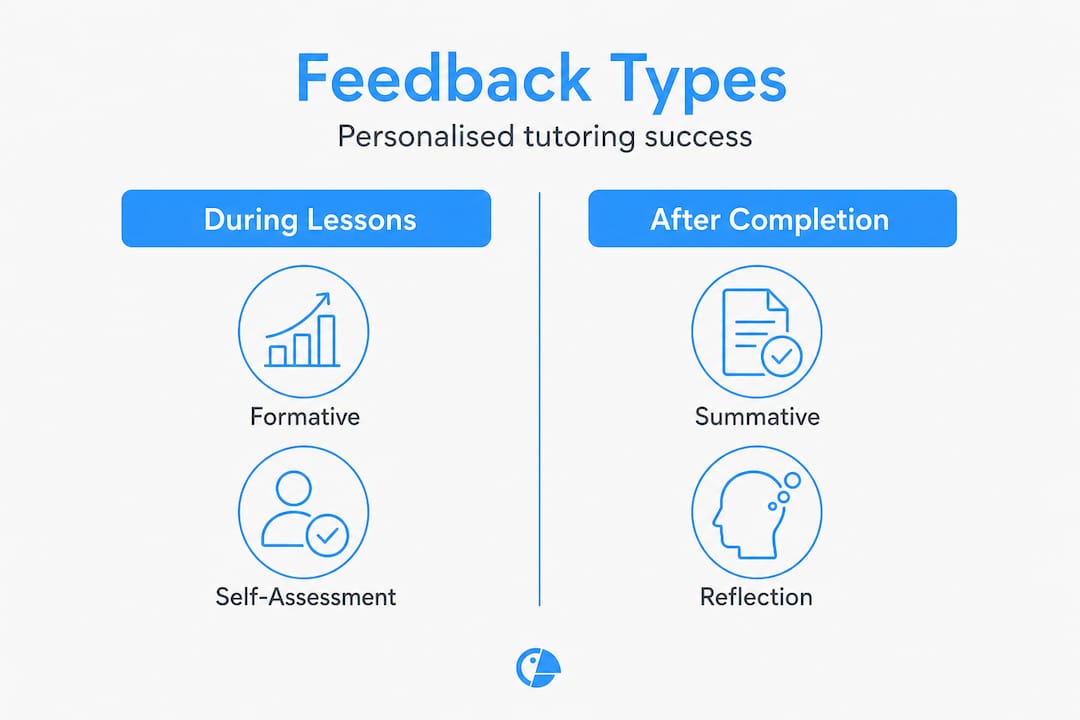
Personalised learning gains in one-on-one tutoring depend heavily on how well feedback bridges the gap between current ability and the target goal. Formative feedback, which is the kind offered during a lesson as you speak, write, or respond, helps you self-correct in the moment. Summative feedback, delivered at the end of a unit or assessment, gives you a broader picture of your progress over time. Both forms play distinct but equally important roles.
Not all feedback supports growth, however. Research confirms that feedback in language tutoring is critical for advancing language proficiency and should be specific, timely, relevant to learning goals, and not overwhelming. Vague comments like "that was good" or "try again" carry little instructional value. Equally, flooding a learner with ten corrections at once creates cognitive overload, a state where the brain struggles to process new information effectively.
Here are the qualities that distinguish genuinely helpful feedback from noise:
- Specific: Targets one clear aspect of language use, such as verb tense or word order
- Timely: Delivered close enough to the moment of learning to feel relevant
- Actionable: Gives a clear next step rather than just naming a problem
- Proportional: Prioritises the most impactful corrections, not every possible error
- Encouraging: Acknowledges effort and progress alongside areas for improvement
"Feedback is not a judgement. In the right tutoring context, it becomes a tool for building both skill and confidence at the same time."
Skilled tutors understand that unlocking language potential is rarely about identifying every mistake. It is about selecting the feedback that will move the learner forward most efficiently at their current stage of development.
Types of feedback: What works and when
Once you appreciate why feedback matters, the next step is understanding the different forms it takes and the conditions under which each type shines. In language tutoring, three major categories of feedback shape learner outcomes.
Formative feedback is delivered during the learning process itself. A tutor who gently rephrases a sentence you produced incorrectly, or offers a prompt when you hesitate over grammar, is providing formative feedback in real time. It is low-stakes, supportive, and designed to keep learning moving forward. ACTFL's guiding principles confirm that feedback should be specific, timely, and not overwhelming, qualities that make formative feedback particularly powerful in tutoring sessions.
Summative feedback arrives after a task or learning period is complete. A tutor reviewing your written assignment at the end of a topic, or discussing your performance across four weeks of lessons, is offering summative feedback. It is evaluative, giving you a sense of how far you have come and what still needs attention.
Self-assessment feedback is perhaps the most underestimated type. When learners reflect on their own progress using checklists, goal journals, or guided questions, they develop what researchers call metacognitive awareness, which is the ability to think about your own thinking. This skill transfers powerfully to independent language use outside the tutoring session.
A practical approach, supported by effective formative assessments, is to structure feedback around identifying gaps during the learning process and linking those gaps to concrete next steps. The table below summarises when each feedback type tends to work best.
| Feedback type | Best timing | Primary benefit | Example in tutoring |
|---|---|---|---|
| Formative | During a lesson | Builds fluency, reduces errors in real time | Tutor rephrases a grammar error mid-conversation |
| Summative | After a task or unit | Tracks progress, identifies patterns | Written review of a four-week speaking programme |
| Self-assessment | Ongoing, learner-led | Builds independence and reflection skills | Weekly journal comparing goals with actual practice |
The most effective tutoring best practices integrate all three types across a programme. Relying solely on one approach leaves gaps. A learner who receives only summative feedback, for instance, may feel confused about how to improve between sessions. One who never self-reflects may struggle to sustain progress once formal tutoring ends.
- Begin each lesson with a brief self-check: what did you find challenging last session?
- Allow the tutor to provide formative feedback during activities and conversation practice.
- End each session with a short summative reflection on what progressed and what needs work.
- Review and update your learning goals monthly based on summative feedback.
Flexible language tutoring structures adapt these feedback loops to suit each learner's pace and goals, making the process feel natural rather than mechanical.
The timing of feedback: Immediate, delayed, or blended?
Knowing the type of feedback to use is only part of the equation. When that feedback is delivered shapes how well the brain retains and applies the information. Timing is a variable that even experienced tutors sometimes overlook.
Immediate feedback, offered the moment an error occurs or a task is completed, tends to build confidence, especially in early-stage learners. It creates a direct connection between the mistake and the correction, which helps learners adjust their internal model of the language quickly. For learners who are anxious about making errors, knowing that a tutor will respond right away can also reduce the emotional burden of making mistakes.

Delayed feedback, on the other hand, introduces a period of reflection. Research in EFL contexts shows that both immediate and delayed feedback can improve engagement-related outcomes, but the timing may differentially affect cognitive engagement versus a learner's willingness to collaborate. When learners sit with an error briefly before receiving correction, they often engage more deeply with the problem, which can support longer-term retention.
Interestingly, educational psychology meta-analysis suggests that in computer-assisted learning, feedback timing alone may not significantly influence learning outcomes. What matters more is how the feedback is framed and what the learner is asked to do with it. A delayed correction that simply states the right answer produces little more benefit than an immediate one that does the same thing. The key is always what comes after the feedback is given.
| Timing type | Strengths | Limitations | Ideal context |
|---|---|---|---|
| Immediate | Builds confidence, reduces confusion early | Can interrupt flow and thinking | Early learners, high-stakes tasks |
| Delayed | Encourages reflection, stronger retention | May create confusion if too long after task | Intermediate learners, collaborative tasks |
| Blended | Balances both benefits | Requires tutor flexibility and planning | Most real-world tutoring contexts |
"The most effective tutors treat timing as a tool they adjust session by session, not a fixed rule they follow every time."
Pro Tip: Ask your tutor to tell you upfront whether they will correct you in real time or save feedback for after a speaking task. Knowing the approach in advance reduces anxiety and helps you engage fully with the activity.
Meaningful interaction with tutors includes agreeing on how and when feedback will arrive, so learners can prepare themselves mentally to receive and use it well.
Feedback quality: More isn't always better
There is a persistent belief in language learning that the more feedback a tutor provides, the more value the learner receives. This belief is understandable but misleading. Research is increasingly clear on this point.
A study published in Frontiers in Education found that when immediate corrective feedback is simplified to "correct response only" for certain online question types, it can actually outperform more elaborate feedback in terms of learning gains and a learner's own judgement of their understanding. In other words, a clean, simple correction sometimes teaches more than a lengthy explanation.
Why does this happen? When feedback becomes too complex or voluminous, learners shift their attention from understanding the language to managing the information itself. The mental load increases, and the actual lesson gets buried beneath layers of commentary.
Here is what high-quality, appropriately scoped feedback tends to look like in practice:
- One or two focus areas per session, such as pronunciation of a specific sound or correct use of past tense
- Brief, direct language rather than lengthy explanations that must be decoded
- Modelling the correct form rather than only describing what was wrong
- Connecting the correction to something the learner already knows, which builds on existing knowledge rather than starting from scratch
- Asking the learner to repeat or apply the correction immediately, reinforcing it before it fades
Pro Tip: At the end of each session, ask your tutor to name just two things to focus on before the next lesson. This filters the feedback to its most impactful elements and prevents you from feeling overwhelmed between sessions.
Exploring online tutoring examples that demonstrate targeted feedback in action can help you recognise what well-structured correction looks like and seek it out in your own learning experience.
Designing a feedback-rich tutoring experience
Understanding feedback theory is only useful if you apply it. Both tutors and learners share responsibility for creating an environment where feedback flows freely and is acted upon consistently. Building that kind of culture takes deliberate effort, but it opens doors to sustained, meaningful progress.
- Set feedback expectations at the start. Before a programme begins, learner and tutor should agree on what kinds of feedback will be given, how often, and in what format. This shared understanding removes guesswork and builds trust.
- Create low-stakes practice spaces. Encourage regular activities where errors are welcomed, such as free conversation, role play, or quick writing tasks, with no pressure for perfection. These spaces let learners take linguistic risks without fear, which is where growth tends to happen.
- Invite peer feedback where possible. If you are part of a language learning group, even informally, peer review adds a valuable perspective. Hearing how another learner understood the same grammar point can clarify your own thinking.
- Use AI tools with human oversight. Human-AI feedback ecosystems are increasingly part of modern tutoring, but evidence and design emphasise that human tutors should retain control over what feedback is used and that emotional literacy challenges must be managed carefully. AI can offer quick corrections and pattern analysis, but the emotional intelligence and contextual awareness of a skilled tutor remain irreplaceable.
- Review and apply feedback before the next session. Feedback that is noted but never revisited has little lasting impact. Build a short review habit into your study routine between sessions.
Following a structured language tutoring process supports these habits by keeping feedback integrated throughout the learning journey, not just reserved for assessment moments. Additional feedback strategies for learners can also complement your tutor's approach by building confidence in how you interpret and respond to constructive guidance.
Why feedback literacy trumps the old rules
For years, advice about feedback in language learning focused on quantity and frequency. More corrections, more often. The assumption was that exposure to feedback automatically translated into improvement. That thinking is outdated, and the most successful learners today are moving beyond it.
What separates learners who plateau from those who keep improving is not the amount of feedback they receive. It is what they do with it. Feedback literacy, which means the ability to seek out, interpret, apply, and even question feedback, is the skill that genuinely accelerates progress. A learner who receives three specific, actionable corrections per session and acts on each one will outperform someone who is handed fifteen observations and files them away without reflection.
We believe the future of effective tutoring lies in learners becoming active participants in their own feedback cycles. Rather than waiting for a tutor to hand down judgement, learners who ask "why was that incorrect?" or "how would a native speaker phrase that?" are engaging their own feedback literacy. They are not passive recipients; they are investigators.
This shift matters because language learning ultimately extends beyond the tutoring relationship. When learners develop the habit of seeking and applying feedback independently, they carry that capacity into every conversation, every film they watch in a target language, every article they read. Exploring effective tutoring styles that actively build this literacy, rather than creating dependency, is one of the most valuable choices a learner can make.
Old advice focused on volume. The new standard is individualised, responsive, literacy-building feedback that empowers rather than overwhelms.
Unlock your progress with expert-guided, feedback-rich tutoring
Feedback only reaches its potential when the person delivering it knows how to make it land. At TUTOROO, we connect learners with private language tutors who understand the art and science of constructive, evidence-driven feedback and know how to tailor every session to your individual goals.
Whether you are building conversational confidence, preparing for an exam, or simply falling in love with a new language, our community of over 386,000 tutors worldwide is ready to support you with personalised tuition grounded in real feedback strategies. Explore language tutoring options designed for every learning preference, available both online and in person. Find a tutor who matches your goals, your schedule, and your learning style, and start your journey towards faster, more confident fluency today.
Frequently asked questions
How can I tell if feedback from my tutor is effective?
Effective feedback is specific, timely, and gives you concrete next steps or strategies, not just generic praise. ACTFL's guidelines confirm that feedback in language tutoring should be specific, timely, and relevant to your learning goals.
What's better: immediate or delayed feedback?
Both can help, depending on the learner and the task. Research in EFL classrooms shows that both immediate and delayed feedback influence engagement, but with different strengths, so the best approach is often a blend.
Is more detailed feedback always best for language learning?
No. Research shows that simpler corrections sometimes lead to better learning outcomes, especially for routine or semi-open questions where the brain benefits from clarity over complexity.
How can I make the most of feedback in tutoring?
Actively review and apply your tutor's feedback between sessions, and do not hesitate to ask for clarification on next steps. Formative feedback should link directly to next steps and be modelled for learners to maximise its impact.
Can I use both AI and human feedback for language learning?
Yes, and combining both can be valuable. However, human tutors should manage and filter AI-suggested feedback to ensure emotional clarity and contextual accuracy remain central to the learning experience.