

TL;DR:
- Language lessons build speaking proficiency through personalized practice focused on real communication.
- Choosing the right format, combining human tutors and AI tools, and practicing daily speed up language learning.
Language lessons are structured, interactive sessions designed to build your speaking proficiency through personalised practice and real communication. Whether you are preparing for travel, advancing your career, or connecting with a new culture, the format and quality of your lessons determine how fast you progress. Reaching conversational fluency in a language like Spanish or French requires 600–750 hours of focused study. That figure makes one thing clear: the lesson type you choose matters as much as the time you invest.
1. Private tutoring for personalised feedback
Private tutoring is the most direct path to speaking improvement. A qualified tutor identifies your specific weaknesses, adjusts the lesson pace to suit you, and gives feedback in real time. Platforms like Tutoroo connect learners with over 386,000 language teachers across dozens of languages, including English, Spanish, French, Arabic, and Chinese. That breadth means you can find a native speaker who matches your schedule, budget, and learning goals.

The one-on-one format also removes the social pressure of group settings. You practise speaking without fear of embarrassing yourself in front of peers, which accelerates confidence. Student-tutor interaction is one of the strongest predictors of oral skill development.
2. Group interactive classes for social conversation
Group classes replicate the social dynamics of real conversation. You hear different accents, respond to unexpected questions, and practise turn-taking, all of which mirror authentic communication. This format suits learners who already have a basic foundation and want to build fluency through exposure to varied speech.
The trade-off is reduced individual attention. A tutor managing six learners cannot correct every error in real time. Group classes work best when combined with private sessions or self-directed speaking practice outside class hours.
3. Communicative Language Teaching (CLT) lessons
Communicative Language Teaching (CLT) is a method that prioritises real communication over grammar drills. The teacher acts as a facilitator rather than a lecturer, guiding learners through role plays, discussions, and authentic tasks. CLT shifts the focus from memorising rules to producing meaningful speech, which builds confidence faster than traditional textbook methods.
Research confirms that switching to communicative approaches helps learners prioritise meaning over grammatical perfection, encouraging them to speak despite imperfect grammar. For anyone preparing for travel or workplace conversations, CLT lessons are among the most practical available.
4. Immersive lessons combining language and culture
Immersive lessons go beyond vocabulary lists. They weave cultural context into every exchange, so you learn not just what to say but when and why to say it. A lesson on ordering food in Japan, for example, covers politeness levels, social customs, and the phrases locals actually use. This kind of cultural immersion enriches speaking skills and contextual understanding simultaneously.
Immersive lessons are particularly effective for learners preparing for extended travel or relocation. They close the gap between textbook language and the living, breathing version spoken on the street.
5. AI conversation partners for unlimited practice
AI conversation tools provide unlimited speaking time with instant correction, available at any hour without scheduling. AI tools offer unlimited speaking time at a fraction of the cost of human tutors. That accessibility removes two of the biggest barriers to speaking practice: cost and availability.
AI tutors are particularly useful for drilling pronunciation, rehearsing business phrases, or preparing for exams like IELTS. They are also judgement-free, which matters for learners who feel anxious speaking with a native speaker before they feel ready. The best approach combines AI practice for volume and a human tutor for nuanced feedback.
Pro Tip: Use an AI conversation tool for 15 minutes each morning to warm up before your scheduled tutor session. You will arrive more fluent and get more from your paid lesson time.
6. Online language classes with structured curricula
Language classes online combine the structure of a formal course with the flexibility of remote access. Platforms offering structured curricula guide learners through grammar, vocabulary, and speaking exercises in a logical sequence. This suits beginners who need a clear roadmap rather than ad hoc conversation practice.
The key advantage is consistency. A structured course sets milestones, tracks progress, and prevents the common beginner mistake of over-collecting resources without focused practice. Pair a structured online course with live speaking sessions for the strongest results.
How to choose the best language lesson format
The right lesson format depends on four factors: your current level, your goal, your schedule, and your budget. The table below maps common learner profiles to the most suitable lesson types.
| Learner profile | Best lesson type | Why it fits |
|---|---|---|
| Complete beginner | Structured online course plus private tutor | Builds foundations and speaking confidence together |
| Intermediate traveller | CLT lessons or immersive sessions | Focuses on real-world communication and cultural context |
| Busy professional | AI conversation partner plus weekly tutor | Flexible daily practice with expert feedback when needed |
| Exam candidate (IELTS, DELF) | Specialised private tutor | Targeted preparation with structured feedback |
| Social learner | Group interactive classes | Conversation practice with peers in a low-pressure setting |
Cost is a real consideration. Human tutors typically charge more per hour than AI tools or group classes. However, the personalised feedback from a qualified tutor accelerates progress in ways that self-paced tools cannot replicate. The most cost-effective approach for most learners is a combination: daily AI or self-study practice supplemented by weekly private sessions.
Pro Tip: Before booking lessons, write down your specific speaking goal. "I want to order food and ask for directions in Italian before my trip in september" is far more useful than "I want to learn Italian." A clear goal helps your tutor design sessions that deliver results faster.
For more guidance on matching methods to your goals, Tutoroo's blog covers top language learning methods in detail.
Key strategies to maximise speaking gains
Consistent daily practice outperforms long weekly sessions. A daily practice of 20–45 minutes, including at least 10 minutes of active listening, produces the strongest retention and speaking improvement. That means short, focused sessions every day beat a three-hour marathon on weekends.
1. Learn high-frequency words as chunks
High-frequency word lists account for 70% of typical language use. Learning these words in meaningful phrases rather than isolated flashcards gives you usable speech faster. Instead of memorising "bonjour" alone, learn "bonjour, je voudrais une table pour deux" as a complete chunk.
2. Prioritise communication over perfection
Fluency grows through sustained exposure and meaningful communication, not through memorising grammar rules. Speak even when you are unsure. Native speakers respond to intent and effort, not grammatical precision. Accepting imperfect speech early builds the confidence that carries you through harder stages.
3. Use shadowing to sharpen pronunciation
Shadowing means listening to a native speaker and repeating their speech in real time, matching rhythm, stress, and intonation. This technique trains your mouth and ear simultaneously. Address pronunciation early in your learning. Errors that go uncorrected for months become habits that are difficult to undo.
4. Distribute practice across the day
Short bursts of practice spread across the day outperform single long sessions. Review vocabulary during your commute, listen to a podcast at lunch, and speak with your tutor or AI tool in the evening. This distributed approach keeps the language active in your memory between formal lessons.
Pro Tip: Record yourself speaking for 60 seconds each week on the same topic. Listening back reveals pronunciation habits and filler words you cannot notice in the moment. Share the recording with your tutor for targeted feedback.
The role of technology in modern language lessons
Technology has changed what is possible in language teaching. AI conversation tools, spaced repetition apps, and online tutor platforms have made personalised speaking practice available to anyone with a phone and an internet connection.
The most effective digital tools for speaking practice include:
- AI conversation partners such as LinguaLive, which offer unlimited speaking sessions with instant grammar and pronunciation correction.
- Spaced repetition systems like Anki, which schedule vocabulary review at the exact moment you are about to forget a word, making retention far more efficient.
- Online tutor platforms like Tutoroo, which connect learners with qualified native-speaking tutors for live, personalised sessions in languages from English to Arabic to Mandarin.
- Pronunciation analysis tools built into many language apps, which use audio recognition to flag sounds you are producing incorrectly.
Integrating AI conversation partners into your lesson plan provides effective spoken practice without scheduling constraints or social anxiety. The technology does not replace a skilled human tutor. It fills the gaps between sessions and gives you the speaking volume that accelerates fluency. For learners studying harder languages like Arabic, resources such as Arabic language programmes from institutions like SimplyIslam Academy highlight just how much structured, specialised support matters alongside digital tools.
Key takeaways
The most effective language lessons combine personalised speaking practice, consistent daily effort, and the right mix of human instruction and technology support.
| Point | Details |
|---|---|
| Choose the right format | Match your lesson type to your level, goal, schedule, and budget for fastest progress. |
| Practise daily | Twenty to 45 minutes of focused daily practice beats infrequent long sessions for retention. |
| Prioritise speaking early | Use CLT methods and AI tools to speak from day one, even with imperfect grammar. |
| Learn words in chunks | High-frequency phrases build usable speech faster than isolated vocabulary lists. |
| Combine human and AI | Use AI tools for daily volume and a qualified tutor for nuanced, personalised feedback. |
Tutoroo's perspective on what actually works
The most common mistake learners make is treating language study as a reading exercise. They highlight textbooks, complete grammar worksheets, and feel productive without ever opening their mouths. Speaking is a physical skill. Like playing an instrument, it only improves through repetition and real-time feedback.
At Tutoroo, we have seen learners at every level make the same leap when they commit to speaking from the very first lesson. The discomfort of early imperfection is not a sign of failure. It is the signal that learning is happening. Accepting that discomfort and pushing through it is what separates learners who reach fluency from those who plateau at intermediate.
The other pattern worth naming is resource overload. Learners who subscribe to five apps, buy three textbooks, and follow a dozen language accounts rarely outperform those who pick one good tutor and show up consistently. Consistency with a single, well-chosen method beats variety every time. Set a realistic goal, find a tutor who understands it, and stay motivated through the inevitable slow patches. That is the approach that works.
— Tutoroo
Find your perfect tutor with Tutoroo
Tutoroo connects learners with over 386,000 qualified language tutors worldwide, covering languages from Spanish and French to Arabic, Mandarin, and beyond. Whether you prefer online sessions from your living room or in-person lessons in your city, the platform makes finding the right fit straightforward.
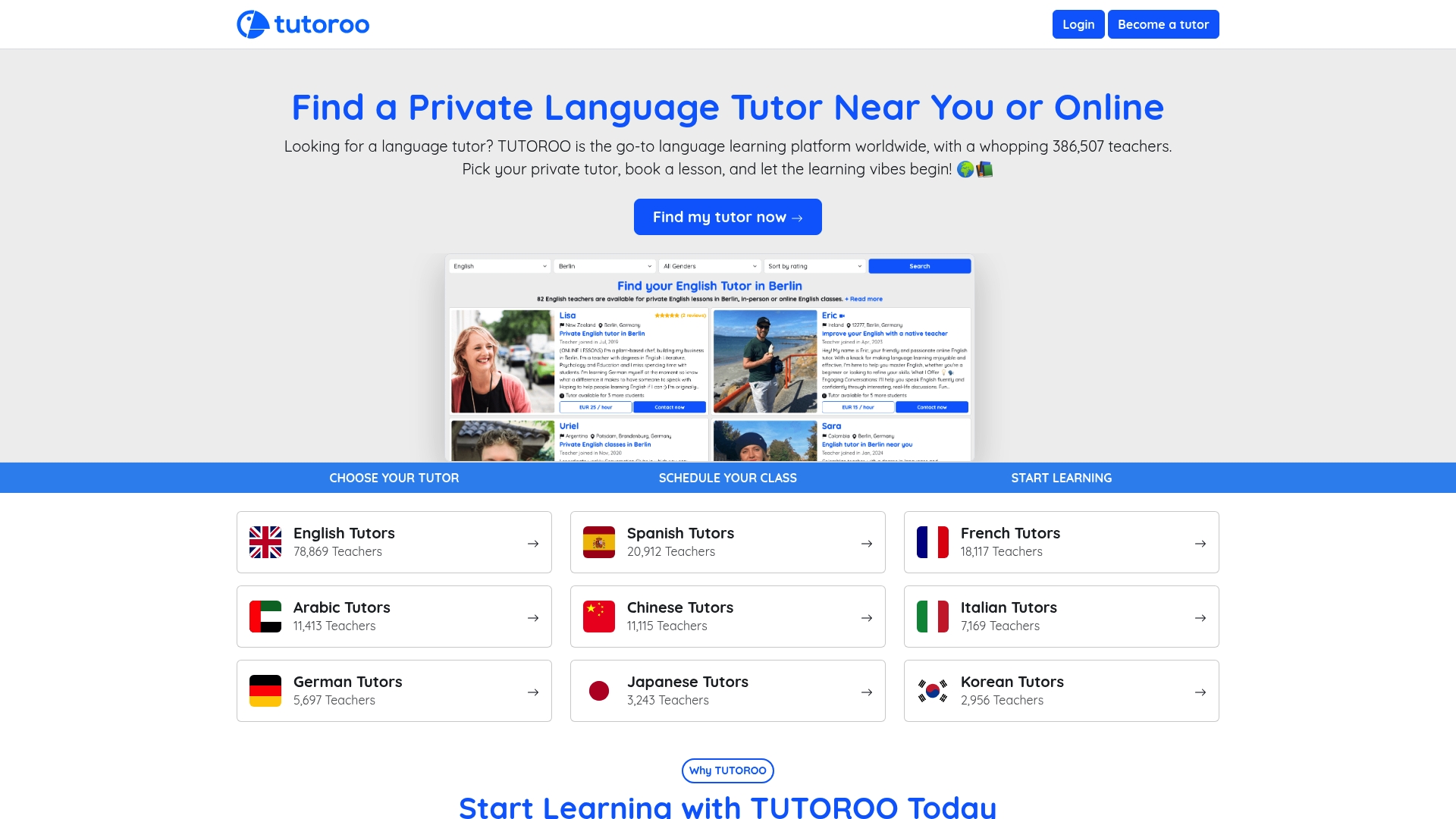
Every tutor on Tutoroo offers personalised, one-on-one instruction tailored to your speaking goals, whether that is preparing for a work presentation, navigating a new country, or simply connecting with another culture. Browse tutors by language, location, and availability, and message your chosen tutor directly before committing. Start your personalised language lessons today and experience the difference that expert, speaking-focused instruction makes.
FAQ
What are language lessons and how do they work?
Language lessons are structured sessions between a learner and a tutor or learning tool, focused on building speaking, listening, reading, or writing skills. The most effective lessons prioritise real communication and personalised feedback over passive study.
How long does it take to reach conversational fluency?
Romance languages like Spanish, French, and Italian require around 600–750 hours of study to reach conversational fluency. Harder languages such as Mandarin or Arabic require around 2,200 hours.
Are online language classes as effective as in-person lessons?
Online language classes are equally effective when they include live interaction, real-time feedback, and consistent speaking practice. The format matters less than the quality of instruction and the learner's daily commitment.
How often should I take language lessons for beginners?
Daily practice of 20–45 minutes produces the best results for beginners. Supplementing weekly tutor sessions with daily self-study or AI conversation practice accelerates progress significantly.
What is Communicative Language Teaching and why does it work?
Communicative Language Teaching is a method that focuses on real communication rather than grammar memorisation, with the teacher acting as a facilitator. It works because it builds speaking confidence through authentic interaction from the very first lesson.