

TL;DR:
- Adaptive learning personalizes language education by adjusting content and feedback based on learner responses. It improves performance by delivering real-time, data-driven instruction while still requiring educator involvement for best results. Combining adaptive platforms with human tutoring enhances language acquisition and engagement.
Adaptive learning in language education is an AI-powered instructional approach that personalises language acquisition by adjusting content, difficulty, and feedback in real time based on each learner's performance. The field uses a recognised industry term, "adaptive instruction," though "adaptive learning" has become the standard phrase across platforms and research. Tools like Duolingo, Pearson MyLab & Mastering, and Smart Sparrow lead this space, each building personalised learning paths that respond to what a learner does and does not yet know. Research confirms that adaptive learning methods improve student performance in 59% of analysed studies. That figure signals a genuine shift in how language instruction can work at scale.
What is adaptive learning in language education?
Adaptive learning in language education is a system that continuously reads a learner's responses and adjusts the next piece of instruction accordingly. Unlike a fixed curriculum, it does not move every learner through the same sequence at the same pace. A Spanish learner who masters verb conjugation quickly will receive more complex sentence construction tasks, while a learner who struggles with pronunciation gets additional targeted practice before moving on.

The concept draws on decades of research in cognitive science and educational psychology. Bloom's 2 Sigma Problem, identified by educational researcher Benjamin Bloom in 1984, showed that one-on-one tutoring produces learning outcomes two standard deviations better than conventional classroom instruction. Adaptive systems attempt to replicate that individual attention at scale, using data rather than a human tutor to make moment-by-moment decisions about what a learner needs next.
Personalised language education built on adaptive principles differs from self-paced learning. Self-paced learning lets you move faster or slower through fixed content. Adaptive learning changes the content itself, the difficulty level, the type of exercise, and the feedback provided, based on what the data shows about your current ability. That distinction matters for educators choosing between platforms.
How do adaptive learning technologies personalise instruction?
Adaptive learning technologies rely on several interconnected components to personalise language instruction effectively.
- Machine learning algorithms analyse patterns in learner responses over time, predicting which content will produce the best learning outcome for each individual.
- Natural language processing (NLP) powers grammar correction, writing feedback, and reading comprehension tools that respond to what a learner actually writes or says.
- Speech recognition enables pronunciation feedback in real time, a feature central to spoken language acquisition in platforms like Duolingo and Pearson MyLab.
- Engagement data tracking monitors time on task, error frequency, and response speed to adjust difficulty dynamically, not just at the end of a unit.
- Reinforcement learning frameworks represent the most advanced layer. Reinforcement learning enables continuous refinement of content sequencing to better support learner autonomy and engagement, moving beyond static decision trees to systems that genuinely learn from learner behaviour.
A review of 80 peer-reviewed articles published between 2020 and 2024 found that AI-driven tutoring systems enhance language education through real-time grammar correction, speech recognition, and interactive practice, raising both motivation and engagement. That breadth of evidence reflects how quickly the technology has matured. For educators, understanding these components helps when evaluating which platform best fits a specific language programme. For learners, it explains why a well-designed adaptive platform feels genuinely responsive rather than simply random in its difficulty choices. You can read more about technology in language teaching to see how these tools fit into broader instructional approaches.
What benefits does adaptive learning offer over traditional methods?
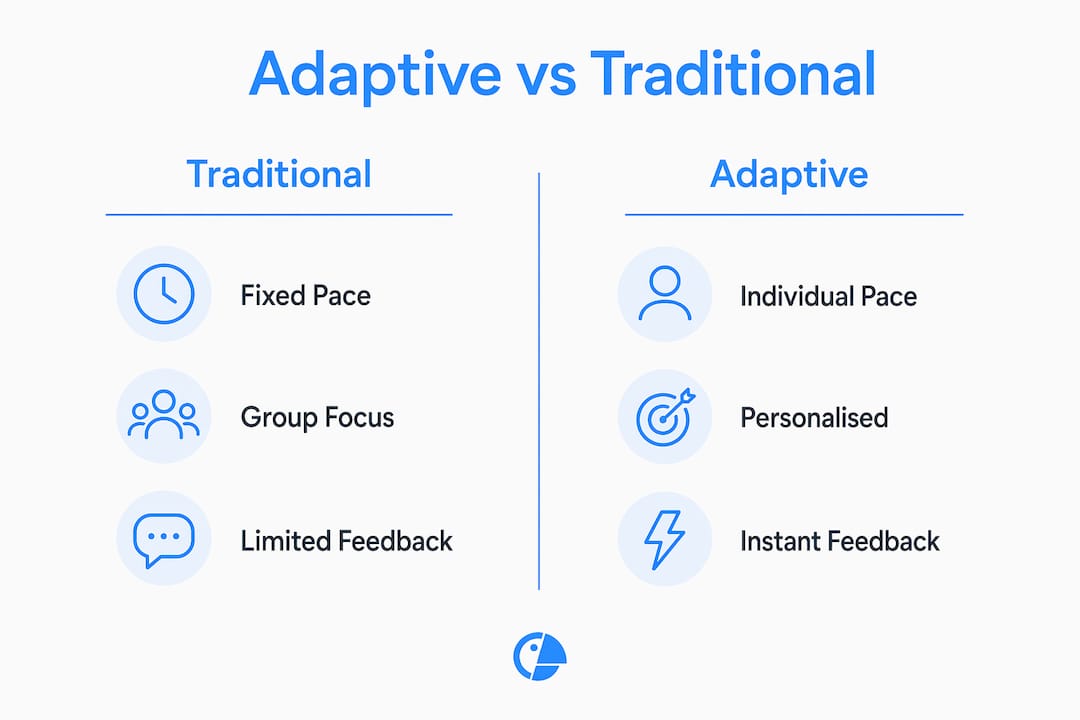
Adaptive learning delivers measurable advantages over conventional language teaching, particularly in three areas: pacing, feedback, and engagement.
Traditional classroom instruction moves at the pace of the group. A learner who already understands a grammar point sits through repetition they do not need, while a learner who is lost falls further behind. Adaptive systems eliminate that mismatch by giving each learner exactly the challenge they are ready for. Schools using personalised adaptive learning models show greater achievement growth in language subjects than non-adaptive groups, based on a two-year longitudinal study. That growth is not accidental. It reflects the compounding effect of learners spending more time on what they actually need to practise.
| Feature | Traditional teaching | Adaptive learning |
|---|---|---|
| Pacing | Fixed for the group | Individual, data-driven |
| Feedback | Delayed, often general | Immediate and specific |
| Content difficulty | Set by curriculum | Adjusted in real time |
| Learner engagement | Dependent on teacher | Built into the system |
| Progress tracking | Periodic assessments | Continuous and granular |
Cognitive load is another area where adaptive systems outperform fixed curricula. When a learner is given tasks that are too difficult, working memory becomes overloaded and retention drops. Adaptive platforms calibrate difficulty to sit just above a learner's current ability, a zone educational psychologists call the "zone of proximal development." That calibration keeps learners challenged without overwhelming them.
Motivation also responds to adaptive design. Learners who receive tasks matched to their level experience more frequent success, which builds confidence and sustains effort. This is particularly relevant in ESL contexts, where learner anxiety around speaking and writing can derail progress entirely.
Pro Tip: If you are using an adaptive platform for ESL learners, check whether the platform adjusts for affective factors like response hesitation, not just accuracy. The best systems treat slow responses as data, not just errors.
What challenges should educators consider when implementing adaptive learning?
Adaptive learning is not a set-and-forget solution. The most common misconception is that the technology runs itself. Successful adaptive learning requires ongoing educator interpretation and involvement to be effective. Without that involvement, platforms risk becoming digital busywork, where learners click through tasks without genuine engagement or deeper understanding.
Several practical challenges shape how well adaptive tools work in real classrooms.
- Teacher training takes time. Educators need to understand how to read platform dashboards, interpret learner data, and use that information to plan targeted interventions. That skill does not develop overnight.
- Participatory design matters. Educators who are involved in selecting and configuring adaptive platforms from the outset report better outcomes than those who receive a system already set up for them.
- Infrastructure requirements are real. Reliable internet access, compatible devices, and institutional support are prerequisites that many schools, particularly in regional Australia, cannot take for granted.
- Passive engagement is a genuine risk. Research shows that adaptive platforms can devolve into passive busy work without deep engagement if educators do not actively monitor and intervene.
- Classroom management uses blur the purpose. Some practitioners use adaptive tasks to keep disruptive students occupied rather than for genuine language instruction. That use produces activity without learning.
Adaptive technology transforms the teacher's role from content delivery to targeted intervention, enhancing instructional efficiency. That shift is positive, but it requires educators to develop new skills in data interpretation and instructional design. The partnership between educators and platforms is what determines whether adaptive learning produces real outcomes or just screen time.
Pro Tip: Before adopting any adaptive platform, ask the vendor for a sample data dashboard and spend time understanding what each metric means. If you cannot interpret the data, you cannot act on it.
How can learners and educators apply adaptive learning today?
Putting adaptive learning into practice requires choosing the right tools and combining them with human interaction.
-
Start with a well-established platform. Duolingo, Pearson MyLab & Mastering, Smart Sparrow, and Adaptemy each offer personalised learning paths built on adaptive algorithms. Each suits different contexts: Duolingo works well for self-directed learners building vocabulary and grammar habits, while Pearson MyLab suits formal academic language programmes.
-
Pair adaptive tools with live tutoring. Adaptive platforms handle repetition and assessment efficiently, but language acquisition requires social practice. Integrating adaptive platforms with live tutoring and peer interaction preserves the human interaction necessary for real communicative competence. A learner who practises grammar on an adaptive platform and then applies it in a conversation with a tutor retains far more than one who uses either method alone.
-
Use platform data to guide interventions. Educators should review learner progress reports weekly, not just at assessment time. Patterns in error data reveal systematic gaps, such as consistent confusion between past simple and present perfect, that a single lesson can address directly.
-
Encourage learners to monitor their own progress. Self-directed learners benefit from reviewing their own adaptive data. Seeing which topics generate the most errors builds metacognitive awareness and helps learners prioritise their study time. For practical guidance on this, expert tips for language learners offer a useful starting point.
-
Plan for gradual adoption. Immediate results are unrealistic. Participatory design and gradual adoption are critical for sustainable success. Educators who introduce one adaptive tool at a time, evaluate its impact, and adjust before adding another report far better outcomes than those who overhaul their entire programme at once.
The future of adaptive language education points toward greater integration of affective computing, systems that read emotional states like frustration or boredom and adjust accordingly. Research in this area is active, and platforms like Smart Sparrow are already experimenting with engagement signals beyond accuracy data. Exploring online teaching methods gives a broader picture of where these technologies are heading.
Key takeaways
Adaptive learning in language education works because it combines real-time data, AI-driven content adjustment, and educator involvement to deliver personalised instruction that fixed curricula cannot match.
| Point | Details |
|---|---|
| Core definition | Adaptive learning adjusts content, difficulty, and feedback in real time based on learner performance. |
| Technology foundation | Machine learning, NLP, speech recognition, and reinforcement learning power personalised language platforms. |
| Performance evidence | Adaptive methods improve student performance in 59% of analysed studies, with longitudinal gains in language subjects. |
| Educator role | Teachers must interpret platform data and intervene actively; adaptive tools do not replace instructional judgement. |
| Best practice | Combining adaptive platforms with live tutoring and peer interaction produces the strongest language outcomes. |
Tutoroo's perspective on adaptive learning and real human connection
Adaptive learning technology is genuinely impressive. Watching a platform recalibrate in real time as a learner works through a grammar exercise is a meaningful step forward from the fixed worksheets that defined language classrooms for decades. At Tutoroo, we see this technology as a powerful foundation, not a finished product.
The honest observation from working with language learners across the world is that no algorithm yet replicates the moment a skilled tutor notices that a learner's hesitation is not about vocabulary but about confidence. That distinction changes everything about how the next five minutes of instruction should go. Adaptive systems read accuracy and speed. They do not yet read the learner sitting behind the screen.
The educators and learners who get the most from adaptive tools are those who treat them as preparation for human interaction, not a substitute for it. A learner who uses Duolingo to build vocabulary and then practises that vocabulary in a live conversation with a tutor is using both tools at their best. The personalised language learning that produces real fluency still requires a human who can respond to what is actually happening in the room, or on the screen.
The next few years will bring more sophisticated adaptive systems. Affective computing, better speech analysis, and richer learner profiles will make these platforms more responsive. Tutoroo's view is that as the technology improves, the role of the skilled human tutor becomes more valuable, not less. The tutor's job shifts toward the work that data cannot do: building trust, sustaining motivation, and making language feel worth learning.
— Tutoroo
Personalised tutoring that works alongside adaptive learning
Adaptive platforms build strong foundations in grammar, vocabulary, and pronunciation. The next step is putting that knowledge to work in real conversation with an expert tutor who can respond to you specifically.
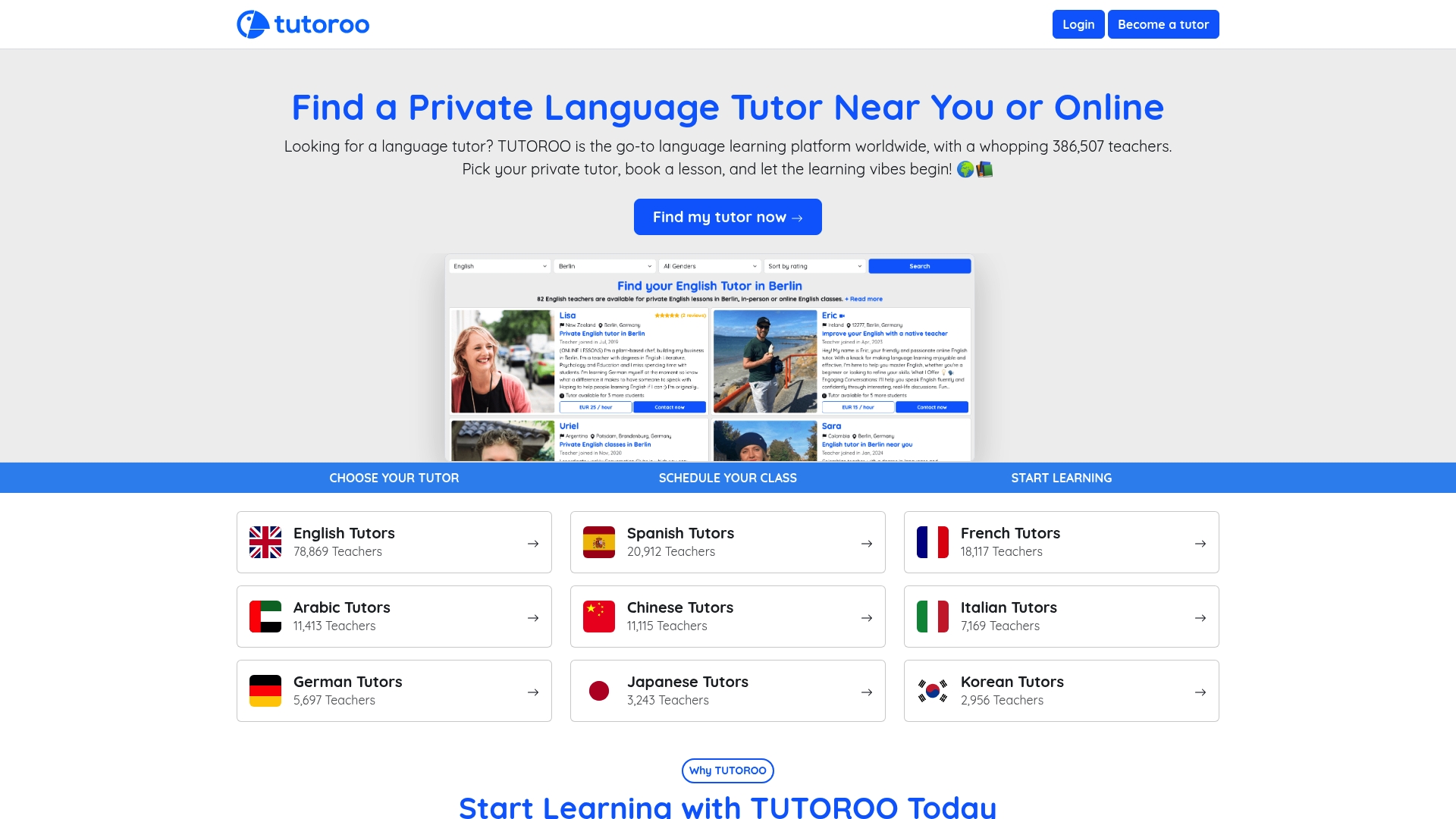
Tutoroo connects learners with over 386,000 private language tutors across the world, available for one-on-one lessons online or in person. Whether you are learning English, Spanish, French, Arabic, Chinese, or another language, Tutoroo matches you with a tutor based on your language goals, schedule, and location. The platform makes it straightforward to find a tutor, message them directly, and book lessons that fit your life. Adaptive technology and a skilled private tutor together create the conditions for genuine, lasting language progress.
FAQ
What is adaptive learning in simple terms?
Adaptive learning is an instructional approach that uses data and AI to adjust what a learner studies next based on their current performance. It replaces fixed lesson sequences with personalised paths that respond to each learner's strengths and gaps.
How does adaptive learning work in ESL classrooms?
Adaptive learning in ESL settings uses platforms like Duolingo or Pearson MyLab to deliver grammar, vocabulary, and pronunciation practice calibrated to each student's level. Teachers then use the platform's data to identify which students need targeted support before moving the class forward.
Is adaptive learning better than traditional language teaching?
Adaptive learning outperforms traditional methods in pacing, feedback speed, and individual targeting, with research showing performance improvements in 59% of studies. Traditional teaching retains advantages in social interaction and cultural nuance, which is why blended models combining both approaches produce the strongest outcomes.
Do teachers still have a role in adaptive language learning?
Teachers are central to effective adaptive learning. Research confirms that adaptive platforms require active educator involvement in data interpretation and targeted intervention to avoid becoming passive screen-based tasks without genuine learning value.
What are the most widely used adaptive language learning platforms?
Duolingo, Pearson MyLab & Mastering, Smart Sparrow, and Adaptemy are among the most widely used adaptive platforms for language learning, each offering personalised learning paths suited to different learner contexts and proficiency levels.