

TL;DR:
- Language immersion involves surrounding oneself with a target language in natural settings to accelerate fluency and cultural understanding. It relies on comprehensible input just above current ability levels, emphasizing active production alongside receptive skills. Different formats, from full to self-directed, suit various goals, with immersion offering broad cognitive and cultural benefits.
Language immersion is defined as the practice of surrounding yourself with a target language in natural, everyday contexts to accelerate fluency and cultural understanding. Unlike traditional classroom study, immersion places you inside the language rather than studying it from the outside. Grounded in Stephen Krashen's Input Hypothesis, it works by exposing learners to comprehensible input just above their current level, triggering natural acquisition rather than rote memorisation. Whether through living abroad, attending structured programmes, or building daily habits at home, language immersion is one of the most effective paths to genuine fluency.
What is language immersion and how does it work?
Language immersion works by placing learners in situations where the target language is the primary tool for communication, not just a subject to study. The brain responds to this by seeking patterns, context, and meaning rather than memorising rules. This mirrors how children acquire their first language: through constant, contextual exposure rather than grammar drills.

The scientific foundation is Krashen's Input Hypothesis, which states that acquisition happens when input is pitched at a level just above current ability, often written as "i+1." This input quality principle means learners absorb language naturally when the content is mostly understandable but contains a small stretch. Too easy and the brain switches off. Too difficult and comprehension collapses entirely.
Immersion also depends on two distinct processes: receptive and productive language use. Receptive skills include listening and reading, which build your internal model of the language. Productive skills, speaking and writing, force the brain to convert passive recognition into active recall. Both are necessary. Receptive input alone builds vocabulary and intuition, but it does not develop the grammatical precision or speaking fluency that real communication demands.
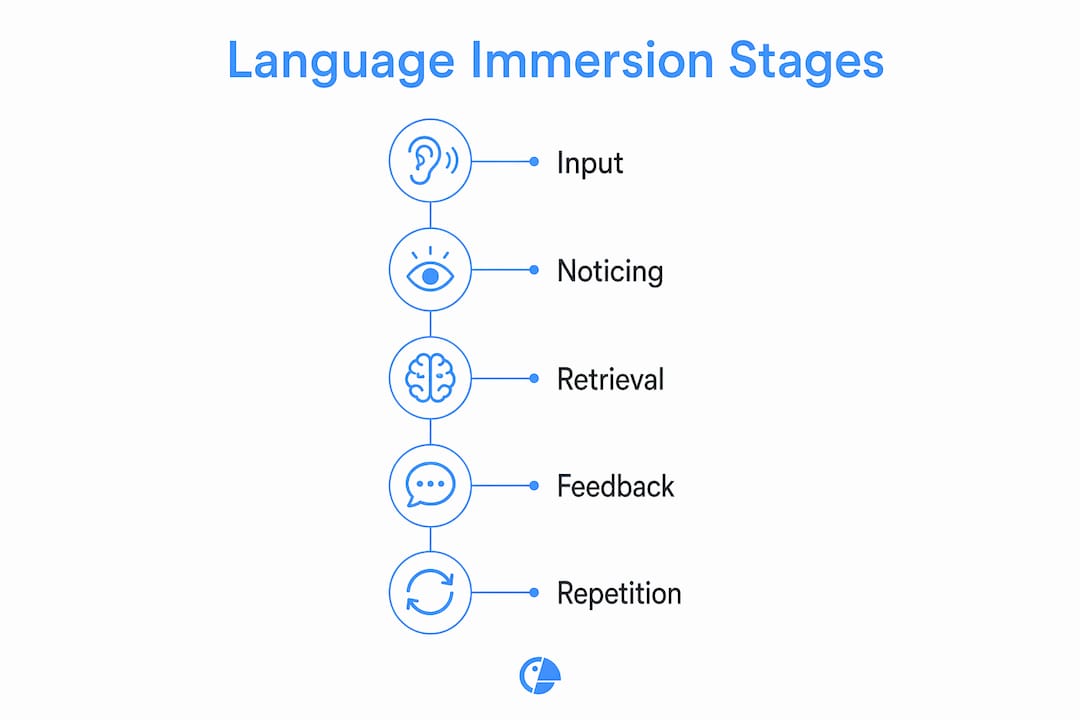
Effective immersion cycles through five stages repeatedly: input, noticing, retrieval, feedback, and repetition. Each loop deepens the neural pathways associated with the language. Programmes that provide meaningful input and feedback loops consistently outperform those that rely on passive exposure alone.
Pro Tip: Before diving into authentic content like films or podcasts, build a baseline of around 2,000–3,000 words in your target language. Research shows that authentic content aids acquisition most effectively once this threshold is reached.
What types of language immersion programmes exist?
Immersion is not a single format. It exists on a spectrum from total submersion in a foreign country to small daily habits practised at home. Understanding the options helps you choose the right intensity for your goals, schedule, and budget.
Full immersion means living and operating entirely in the target language. This typically involves relocating abroad or enrolling in an intensive residential programme. Professional in-country programmes range from two weeks to four months or more, depending on the learner's goals. The Chinese Language Institute in Guilin, for example, pairs daily language instruction with weekly cultural excursions, embedding language learning in authentic real-world experiences.
Partial immersion covers structured programmes where the target language is used for a significant portion of the day but not exclusively. Language schools, bilingual education settings, and online tutoring platforms all fall here. This format suits learners who cannot relocate but want consistent, guided exposure with expert feedback.
Self-directed immersion is the most accessible format. It involves building the target language into your existing daily routine at home or during your commute.
Here are practical ways to build self-directed immersion into everyday life:
- Label household items with their target-language names
- Switch your phone and streaming services to the target language
- Listen to radio or podcasts in the language during your commute
- Keep a short daily journal in the target language
- Watch films with target-language subtitles, then without
The table below compares the three main immersion formats across key factors:
| Format | Intensity | Cost | Accessibility | Best For |
|---|---|---|---|---|
| Full immersion abroad | Very high | High | Low to moderate | Advanced learners, long-term goals |
| Partial immersion (school/tutor) | Moderate to high | Moderate | High | Intermediate learners, structured progress |
| Self-directed at home | Low to moderate | Low | Very high | Beginners, busy schedules |
For beginners, starting with self-directed habits and supplementing with a tutor or structured programme is the most sustainable path. You can read more about learning languages outside classrooms to understand why this combination consistently outperforms classroom-only approaches.
What are the benefits of language immersion beyond vocabulary?
The benefits of language immersion extend well beyond learning new words and grammar rules. Immersion reshapes how you think, communicate, and connect with other cultures. This is why understanding language immersion matters for anyone serious about genuine fluency.
Research published in 2025 found that immersion enhances narrative competence, meaning learners develop the ability to tell stories, follow complex arguments, and process language at a sophisticated level. This goes far beyond the transactional language skills that classroom study typically produces. Immersion learners do not just know the language. They think in it.
Cultural understanding is another major outcome. Immersion places learners inside the social and cultural contexts that give language its meaning. Idioms, humour, tone, and register all make sense when you experience them in context. Studies show that immersion develops empathy and executive functions alongside language skills, making it a genuinely cognitive experience, not just a linguistic one.
Key benefits of language immersion include:
- Accelerated fluency through constant, contextual exposure
- Cultural competence and the ability to communicate with nuance
- Improved memory and stronger recall through active use
- Greater confidence in real conversations, reducing the fear of making mistakes
- Enhanced problem-solving skills linked to managing two or more language systems
- Stronger narrative skills, including storytelling and complex reasoning
Immersion also reduces the anxiety that holds many learners back. When you are surrounded by a language daily, mistakes become a normal part of communication rather than a source of embarrassment. That shift in mindset accelerates progress more than any textbook exercise.
How do you overcome common language immersion challenges?
Language immersion is genuinely effective, but it is not without friction. Knowing the common challenges in advance means you can prepare for them rather than be derailed by them.
The most common early challenge is overwhelm. When you first encounter authentic content in a new language, the gap between what you understand and what you hear can feel enormous. This is normal. The brain needs time to tune into the phonetic patterns of a new language. Reducing input complexity at the start, by choosing slower podcasts or graded readers, gives the brain a manageable entry point.
Plateauing is another real challenge. Many learners make fast progress early, then hit a wall where improvement feels invisible. This usually signals an imbalance between input and output. If you have been consuming a lot of content but not speaking or writing much, adding deliberate production practice breaks the plateau. Working with a tutor who can provide corrective feedback is one of the most direct ways to push through this stage. Tutoroo connects learners with private language tutors who specialise in exactly this kind of guided conversation practice.
Consistency matters more than intensity. Sustained, manageable exposure every day outperforms marathon study sessions once a week. Twenty minutes of focused listening during a commute, combined with a ten-minute writing habit before bed, builds more durable skills than a four-hour weekend session.
Pro Tip: Set a specific "immersion trigger" tied to an existing habit. For example, always listen to a target-language podcast while making your morning coffee. Attaching new habits to existing routines dramatically improves consistency.
For a broader look at teaching multiple languages and how structured approaches support immersion, Tutoroo's resource library offers practical frameworks for both learners and educators.
Key takeaways
Language immersion is the most effective path to fluency because it combines comprehensible input, active production, and cultural context in a way that no classroom method can replicate.
| Point | Details |
|---|---|
| Immersion is defined by context | Surrounding yourself with the target language in real situations drives natural acquisition. |
| Input quality beats quantity | Comprehensible input just above your current level triggers the most effective learning. |
| Active output is non-negotiable | Speaking and writing convert passive recognition into genuine fluency and grammatical accuracy. |
| Format should match your life | Full, partial, and self-directed immersion each suit different goals, budgets, and schedules. |
| Consistency drives results | Daily micro-immersion habits outperform occasional intensive sessions over the long term. |
Tutoroo's take on what makes immersion actually work
After working with hundreds of thousands of learners across dozens of languages, the pattern is clear: the learners who thrive in immersion are not necessarily the most talented. They are the most consistent and the most willing to produce output early.
The biggest mistake we see is treating immersion as purely passive. Learners watch films, listen to podcasts, and consume hours of content, then wonder why their speaking does not improve. Passive input builds a strong internal model of the language, but the brain will not activate that model for speaking until you force it to. Conversation practice, even imperfect and uncomfortable conversation, is what closes the gap between understanding and fluency.
The cultural dimension is also underestimated. Language carries the values, humour, and worldview of its speakers. When you engage with a language immersively, you are not just learning to communicate. You are learning to see the world through a different lens. That shift opens doors to genuine connection that no phrasebook can offer.
The learners who enjoy the process most are those who treat mistakes as data rather than failures. Every error is a signal about where the brain's model of the language needs refining. Immersion accelerates that refinement because it generates far more of those signals than a classroom ever could.
Start small, stay consistent, and prioritise speaking from day one. The fluency follows.
— Tutoroo
Start your immersion journey with Tutoroo
Ready to put immersion into practice with real support behind you?

Tutoroo connects you with over 386,000 private language tutors worldwide, offering personalised one-on-one lessons online or in person. Whether you are building conversational confidence in Spanish, deepening your Mandarin fluency, or beginning your first steps in Arabic, a Tutoroo tutor brings the immersive conversation practice that self-study alone cannot replicate. Sessions are flexible, tailored to your level, and designed to complement whatever immersion habits you are already building. Find your private language tutor today and give your immersion the structure it deserves.
FAQ
What is language immersion in simple terms?
Language immersion is the practice of learning a language by using it constantly in real contexts rather than studying it as a subject. The goal is natural acquisition through consistent exposure and active use.
Is language immersion effective for adults?
Language immersion is effective for adults, though progress depends on consistency and active output. Adults benefit from structured feedback alongside immersive exposure to accelerate grammatical accuracy.
How long does language immersion take to show results?
Results vary by intensity and starting level, but most learners notice meaningful improvement within a few weeks of daily immersive practice. Intensive in-country programmes typically run from two weeks to four months or more.
Can you do language immersion at home?
Self-directed immersion at home works well when built around consistent daily habits such as listening to target-language media, labelling household items, and keeping a short journal in the target language.
What is the difference between full and partial immersion?
Full immersion means operating entirely in the target language, typically through living abroad or an intensive residential programme. Partial immersion uses the target language for a significant portion of daily activity, such as through tutoring or language school attendance.