

TL;DR:
- A truly tailored curriculum aligns goals, content, and methods to the learner’s specific needs.
- Effective tutoring involves a cyclical process of assessment, goal-setting, instruction, practice, and review.
- Genuine personalisation reshapes the entire learning experience, beyond just adjusting the pace.
Many learners believe that booking a tutor is enough. Show up, repeat some vocabulary, practise a few phrases, and progress will follow. But the real breakthrough in language learning happens when lessons are expertly designed around your specific goals, strengths, and context, not simply repeated from a classroom or textbook. A tailored curriculum changes everything, and understanding what it truly involves could be the most important step you take on your language learning journey.
Table of Contents
- What is a tailored curriculum in tutoring?
- How a tailored curriculum is created and delivered
- Personalisation versus individualisation: What language learners need to know
- Tailoring curriculum for different language learning goals
- Why most language learners waste time with wrong-fit tutoring
- Find the right tailored tutoring for your language goals
- Frequently asked questions
Key Takeaways
| Point | Details |
|---|---|
| True personalisation matters | The best tutoring adapts curriculum and goals to your specific language needs and learning preferences. |
| Structured process boosts progress | Diagnostic assessment, targeted goals, and ongoing adjustment help you see measurable results faster. |
| Evaluate before committing | Ask whether a tutor personalises materials and approach, not just the pace of lessons. |
| Specific goals guide tailoring | Exam, travel, or professional learners benefit when curriculum addresses their context and vocabulary demands. |
What is a tailored curriculum in tutoring?
Simply having extra help after class is not the same as receiving a curriculum built for you. Many learners confuse the two, and that confusion costs them months of meaningful progress. A tailored curriculum is one where the goals, content, methods, and pace are all adapted to match the individual learner's context, not a one-size-fits-all programme designed for a general audience.
Research confirms that tutoring aligned with learner needs produces stronger outcomes than generic approaches that rely on off-the-shelf materials. When your tutor selects content that reflects what you actually need to achieve, whether that's ordering coffee in Tokyo or passing an IELTS exam, every lesson carries genuine purpose.
There are three core pillars that define a truly tailored curriculum:
- Goals: Lessons are driven by your specific outcome, such as travel, career, academic study, or cultural connection.
- Content: Materials are chosen to match your proficiency level, interests, and target context, not copied from a generic workbook.
- Methods: The teaching approach adapts to how you learn best, whether through conversation, visual tools, writing exercises, or structured grammar work.
It also helps to understand personalised learning gains and how one-on-one instruction consistently outperforms classroom settings when the curriculum is genuinely adapted.
Here's a clear comparison to illustrate the difference:
| Feature | Standardised tutoring | Tailored tutoring |
|---|---|---|
| Goal setting | Fixed by programme | Set with the learner |
| Content selection | Generic textbook material | Context-specific and learner-chosen |
| Teaching methods | Same for all students | Adapted to learning style |
| Pace | Fixed schedule | Flexible and responsive |
| Progress review | Periodic, if at all | Regular and built into every lesson |
| Cultural relevance | Minimal | Integrated throughout |
The distinction between individualisation and true personalisation is also worth clarifying. Research by the Brookings Institution notes that individualisation and personalisation differ in important ways, a point we will explore in more depth shortly. For now, recognise that a tailored curriculum is far more than adjusting the speed of delivery. It reshapes the entire learning experience to fit you.
How a tailored curriculum is created and delivered
Understanding what tailoring means is only the beginning. Seeing how a skilled tutor actually builds and delivers a tailored curriculum is where the real value becomes clear. The process is structured, cyclical, and deeply responsive to your progress.
The language tutoring process that leads to faster fluency follows a clear arc, beginning well before the first lesson and continuing long after it ends. According to the National Tutoring Authority, well-designed tutoring sessions follow a structured sequence of diagnosis, goal-setting, targeted instruction, review, and adjustment. Here is how that plays out in practice:
- Diagnostic assessment: Your tutor identifies your current strengths, gaps, and learning preferences through conversation, written tasks, or structured questions.
- Goal setting: Together, you define what success looks like, whether that's holding a ten-minute conversation in French or mastering the reading section of a JLPT exam.
- Curriculum design: Your tutor selects and organises materials, activities, and language targets that serve your specific goals.
- Targeted instruction: Each lesson delivers content aligned to your next step, building systematically on what you already know.
- Guided practice: You apply new knowledge with tutor support, receiving real-time feedback that corrects errors and reinforces accuracy.
- Independent practice: You practise between sessions using tasks your tutor assigns to strengthen retention.
- Review and adjustment: Your tutor evaluates your progress and recalibrates the curriculum to address new gaps or push you further.
This cycle repeats with every lesson, and each iteration should feel more targeted than the last. The lesson flow works because it builds momentum over time rather than covering random topics in isolation.
| Stage | What happens | Why it matters |
|---|---|---|
| Diagnostic | Identify gaps and strengths | Ensures lessons start in the right place |
| Goal-setting | Define clear outcomes | Gives every lesson a measurable purpose |
| Instruction | Deliver targeted content | Builds relevant skills efficiently |
| Practice | Apply with guidance | Reinforces new knowledge in real use |
| Review | Measure and recalibrate | Keeps progress on track |
Reviewing tutoring best practices also reveals that the most effective tutors treat each lesson as a data point, using what they observe to sharpen their approach the following week.
Pro Tip: Ask your tutor to build spaced review into your lesson schedule. Returning to previously covered material at regular intervals, rather than only moving forward, dramatically improves long-term retention of vocabulary and grammar.
Personalisation versus individualisation: What language learners need to know
After understanding how a tailored curriculum is built, it is worth unpacking two terms that are often used interchangeably but mean very different things. Confusing them can lead you to choose a tutoring service that sounds personalised but actually delivers very little of what you genuinely need.
Individualisation means adjusting the pace of learning within a fixed curriculum. A student might move faster through grammar exercises or slower through pronunciation work, but the underlying content and goals remain the same for everyone.
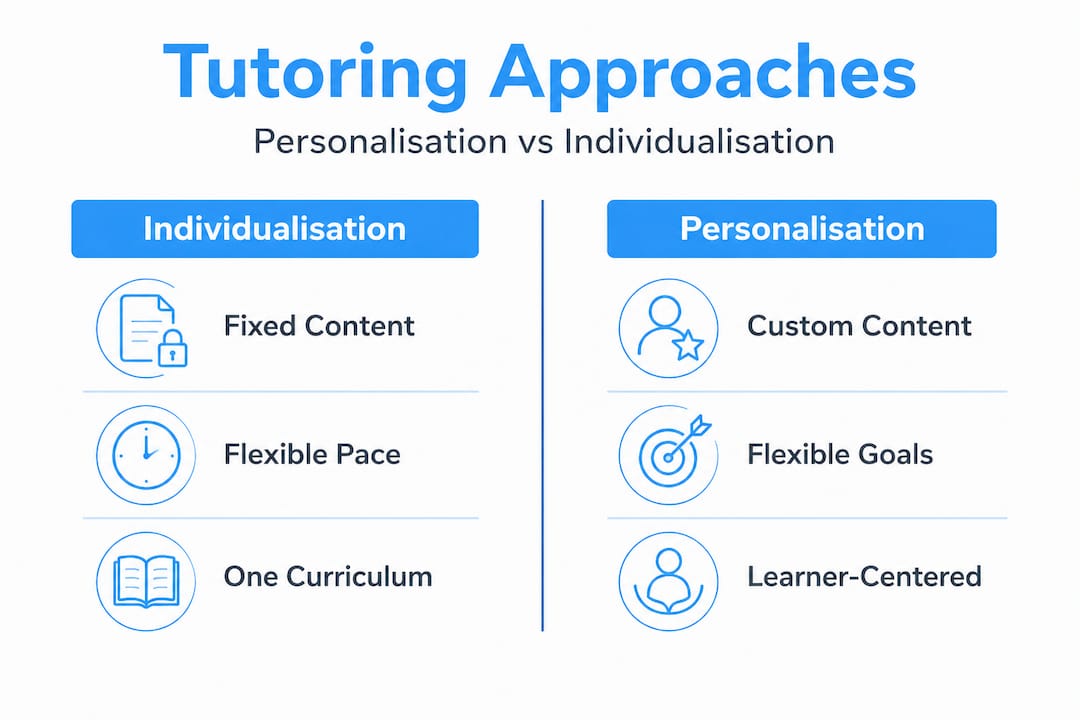
Personalisation goes much further. It means adapting the goals, materials, methods, and pace together to reflect each learner's unique context. Your tutor is not just slowing down or speeding up. They are fundamentally reshaping what you learn, how you learn it, and why each lesson exists.
The Brookings Institution highlights that many platforms only individualise by changing pace, without genuinely personalising content or approach to the learner's needs. This is a critical distinction for anyone evaluating a language tutoring platform or programme.
True tailoring changes what you learn, how you learn it, and why it matters for your specific goals. It is not simply about moving faster or slower through a fixed plan. It is about building a plan that only ever existed for you.
When you explore options for flexible tutoring progress, you want to confirm that the tutor or platform is offering genuine personalisation, not just a self-paced version of a generic course.
Use this checklist to evaluate any tutoring offer before you commit:
- Does the tutor conduct a diagnostic assessment before your first lesson?
- Are lesson materials chosen specifically for your goals, or are they generic textbook content?
- Does the tutor ask about your target context, such as travel, work, or exams?
- Are lesson methods adapted based on how you respond in session?
- Is there a regular review process where the curriculum is updated as you progress?
- Can you request different material if something is not working for you?
If the answer to most of these is "no," you are likely looking at individualisation at best, not the genuine personalisation that drives real results.
Tailoring curriculum for different language learning goals
The concepts above only become truly useful when you see them applied to real situations. Language learners come to tutoring with vastly different goals, and a tailored curriculum looks meaningfully different depending on what you are trying to achieve.
Consider four common scenarios:
- Travel: A learner preparing for a trip to Spain needs conversational fluency, common cultural expressions, and the vocabulary of everyday situations like transport, dining, and accommodation. Grammar accuracy is helpful but secondary to confident speaking and listening comprehension.
- Exam preparation: A student sitting the DELF French proficiency exam needs test-specific strategies, timed writing practice, formal register, and targeted work on the exact task types that appear in the exam. Conversational fluency is not the goal here.
- Professional use: An engineer working with French-speaking clients needs technical vocabulary, formal email conventions, and the communication norms of their specific industry. Generic business French may not address the precision they require.
- Academic study: A student writing research papers in English needs discipline-specific academic vocabulary, citation conventions, and the formal register expected in scholarly writing.
Research confirms that discipline-specific language demands require specialised vocabulary and communication strategies, not just generic grammar instruction. A science student and a business student may both be learning English, but their language needs are genuinely different and require different materials, tasks, and teaching focus.
This is where tutors who understand language exam preparation prove their worth. They know that passing a JLPT N2 requires very different skills than holding a casual conversation in Japanese, and they build the curriculum accordingly.
Equally, understanding effective tutoring styles helps learners match not just the content but the instructional approach to their learning personality. Some learners thrive with structured grammar tables and written exercises. Others make faster progress through immersive conversation and real-world tasks. Both needs are valid, and both deserve a curriculum shaped around them.
Pro Tip: Ask your tutor to include at least one domain-specific practice task in every lesson. If you are learning Spanish for travel, practise ordering from a menu, negotiating accommodation, or asking for directions. If you are preparing for an exam, practise with authentic past paper tasks rather than invented exercises.
Why most language learners waste time with wrong-fit tutoring
Here is something most language learning content will not tell you directly. The majority of learners who invest in tutoring are not getting a truly tailored curriculum. They are receiving something that looks personalised on the surface but is actually a slightly customised version of the same programme every other student receives.

This matters because the hidden cost of wrong-fit tutoring is substantial. It is not just wasted money. It is the plateau that settles in around month three or four, when you feel like you are practising endlessly but not progressing. It is the frustration of preparing for a French exam by having polite conversations about your weekend. It is the professional who books English lessons for months and still cannot write a confident email to a client.
We have seen, through working with over 386,000 tutors and the learners they serve, that progress accelerates sharply when three things align: the curriculum matches the learner's actual goals, the instructional methods suit the learner's style, and the content is recalibrated regularly as the learner grows. When any one of those elements is missing, progress stalls.
The uncomfortable truth is that many learners do not ask the right questions before they start. They assume that hiring a tutor guarantees personalisation, when what they are often receiving is a personalised manner from a tutor delivering a generic curriculum. Warmth and enthusiasm are wonderful qualities in a tutor, but they do not replace genuinely tailored content.
The learners who see the fastest results treat tutoring as a collaborative process from day one. They ask about unlocking language potential before the first lesson begins. They request a diagnostic. They share their specific goals clearly. And they hold their tutor accountable for updating the curriculum as they progress.
Next time you evaluate a tutor or a platform, make curriculum adaptation your first question, not an afterthought.
Find the right tailored tutoring for your language goals
If you are ready to move beyond generic lessons and reach your language goals faster, the next step is finding a tutor who genuinely builds and adapts curriculum around your needs.
TUTOROO connects learners with over 386,000 private language tutors worldwide, covering languages from Spanish and French to Arabic, Mandarin, Japanese, and more. Whether you want to find your language tutor for conversational travel practice, rigorous exam preparation, or professional language development, our platform makes it simple to search by language, location, and availability. You can even find a Malay tutor specialising in your exact proficiency level and goals. Browse qualified tutors today, discuss your learning goals directly through our messaging system, and start building the tailored curriculum your progress deserves.
Frequently asked questions
How is tailored curriculum different from standard tutoring?
A tailored curriculum adapts lessons, goals, and methods to each individual learner, while standard tutoring typically follows a fixed plan suited to a general audience. Curriculum-aligned and personalised content consistently produces stronger outcomes than generic tutoring materials.
Is it possible to tailor a curriculum for travel or exam prep?
Yes, a skilled tutor can adapt curriculum to focus entirely on travel conversation, exam techniques, or professional language use. Discipline-specific and domain-specific goals require specialised vocabulary and targeted practice, which a tailored approach delivers directly.
What questions should I ask a tutor to ensure their curriculum is tailored?
Ask about diagnostic assessments, how they set and update goals, what materials they use, and how often they adjust the curriculum based on your progress. Effective tailored tutoring always includes a structured process of diagnosis, goal-setting, and regular recalibration.
Does a tailored curriculum guarantee faster language improvement?
Research shows that students tutored with aligned materials made over a month more progress compared to those receiving generic tutoring, making tailored curriculum one of the most effective investments a language learner can make.