

Choosing the right tutoring style can transform your language learning journey, yet most learners struggle to identify which approach suits their goals. Whether you're preparing for travel, aiming for exam success, or building conversational fluency, understanding different tutoring methods helps you make informed decisions. This article explores six popular tutoring styles, their strengths, and how to match them with your learning preferences and objectives for maximum effectiveness.
Table of Contents
- How to choose the right tutoring style for your language learning
- Understanding learning style categories with the VARK model
- Six popular tutoring styles: methods explained with pros and cons
- Compare tutoring styles: features, goals, and suitability
- Find your ideal language tutor with Tutoroo
Key takeaways
| Point | Details |
|---|---|
| Match style to goals | Different tutoring methods excel at exam prep, travel readiness, or conversational fluency depending on their focus |
| VARK preferences matter | Visual, auditory, reading/writing, and kinesthetic learners benefit from different tutoring approaches |
| Six major methods | Grammar-Translation, Communicative, Audio-Lingual, Task-Based, and AI tutoring each offer unique advantages |
| Hybrid approaches work | Combining multiple tutoring styles often delivers superior results compared to single-method instruction |
| Personalisation accelerates progress | Adapting tutoring activities to your learning style and language goals significantly improves retention |
How to choose the right tutoring style for your language learning
Selecting an effective tutoring style starts with clarifying your primary language goal. Are you preparing for standardised exams, planning overseas travel, pursuing conversational fluency, or developing academic reading skills? Each objective demands different instructional priorities and practice activities.
Your learning preferences play an equally crucial role in tutoring effectiveness. Some learners absorb information best through visual materials like charts and videos, whilst others prefer listening to conversations or engaging in physical activities. Identifying whether you respond better to reading, listening, watching, or doing helps narrow suitable tutoring approaches.
Effective tutoring often combines multiple methods rather than adhering strictly to one philosophy. Research-backed techniques like spaced retrieval outperform traditional drills for vocabulary retention by spacing review sessions over increasing intervals. Input flood techniques, where learners encounter target vocabulary in varied contexts repeatedly, similarly boost long-term memory formation.
Review how each tutoring style aligns with your identified goals and preferences. Grammar-focused methods suit exam preparation, whilst communicative approaches excel at building practical speaking skills. Task-based learning works brilliantly for travel preparation through simulated real-world scenarios.
Pro Tip: Test different tutoring approaches during initial sessions to discover which methods feel most engaging and productive for your unique learning profile before committing to long-term lessons.
Understanding learning style categories with the VARK model
The VARK model provides a practical framework for understanding how individuals absorb and process new language information. VARK categorises learners into Visual, Auditory, Reading/Writing, Kinesthetic styles, each requiring different tutoring adaptations for optimal language acquisition.

Visual learners thrive when tutors incorporate videos, infographics, colour-coded grammar charts, and illustrated vocabulary cards into lessons. These learners benefit from seeing word spellings, watching subtitle films, and studying visual mind maps that connect related concepts spatially.
Auditory learners excel through conversations, audio recordings, podcasts, and spoken repetition exercises. They absorb pronunciation naturally by listening to native speakers and benefit from discussing grammar rules verbally rather than reading written explanations. Recording and replaying their own speech helps these learners identify improvement areas.
Reading/Writing learners prefer traditional grammar explanations, translation exercises, written assignments, and vocabulary lists. They consolidate learning through note-taking, journaling in their target language, and reading authentic texts like news articles or literature.
Kinesthetic learners require movement and interaction for effective language acquisition. Role-plays, gesture-based vocabulary learning, language games, and real-world practice sessions suit these learners best. They remember words better when physically acting out meanings or engaging in hands-on activities.
Pro Tip: Most learners exhibit a dominant VARK preference alongside secondary styles, so effective tutoring incorporates activities across multiple categories whilst emphasising your primary learning mode for accelerated fluency development.
Six popular tutoring styles: methods explained with pros and cons
Language tutoring encompasses diverse methodological approaches, each with distinct philosophies about how learners acquire new languages most effectively. Understanding these six major styles helps you identify which aligns best with your goals.
The Grammar-Translation Method focuses on grammar rules, translation exercises, and reading/writing skills whilst largely ignoring spoken communication. This traditional approach excels at preparing learners for written exams and developing reading comprehension but offers limited speaking practice. Students master grammatical structures systematically but often struggle with real-world conversations.
Communicative Language Teaching emphasises real-life interaction and conversational fluency over grammatical perfection. Tutors prioritise meaningful communication through discussions, debates, and information-gap activities where learners exchange genuine information. This method builds confidence and practical speaking skills rapidly but may leave some grammatical gaps requiring later attention.
The Audio-Lingual Method uses drills and repetition focusing on oral skills whilst avoiding native language use. Based on behaviourist psychology, this approach builds language habits through pattern practice and mimicry. It develops strong pronunciation and listening skills but can feel repetitive and fails to prepare learners for spontaneous conversation.
Task-Based Language Teaching employs simulated real-life tasks like planning trips, solving problems, or completing projects entirely in the target language. Learners acquire vocabulary and grammar naturally whilst accomplishing meaningful objectives. This method excels at developing practical communication skills and suits learners of all ages preparing for travel or work abroad.
Intelligent Tutoring Systems use AI with natural language processing and speech recognition to deliver adaptive, personalised instruction. These systems adjust difficulty based on performance, provide immediate feedback, and offer unlimited practice opportunities. Whilst excellent for self-paced learning and pronunciation practice, current AI struggles with nuanced speech accuracy and cultural context.
Immersion-based tutoring surrounds learners exclusively with the target language, often incorporating cultural elements and authentic materials. Tutors avoid translation entirely, using gestures, images, and context to convey meaning. This intensive approach accelerates acquisition but requires significant commitment and works best with adequate foundational knowledge.
Compare tutoring styles: features, goals, and suitability
Comparing tutoring methods side-by-side reveals how each approach targets different language skills, learner types, and achievement goals. This comparison helps you select or combine methods strategically.
| Method | Primary Focus | Best For | Strengths | Limitations |
|---|---|---|---|---|
| Grammar-Translation | Reading, writing, grammar rules | Exam preparation, academic reading | Systematic grammar mastery, strong literacy | Poor speaking skills, limited practical use |
| Communicative | Speaking, listening, fluency | Conversational ability, travel | Rapid speaking confidence, real-world readiness | Potential grammar gaps, less exam-focused |
| Audio-Lingual | Pronunciation, listening, oral habits | Accent improvement, listening skills | Strong pronunciation, automatic responses | Repetitive, limited spontaneous speech |
| Task-Based | Practical communication, problem-solving | Travel, work, real-world use | Engaging, practical, natural acquisition | Requires guidance for grammar consolidation |
| AI Tutoring | Personalised practice, adaptive learning | Self-paced study, pronunciation | Unlimited availability, immediate feedback | Speech recognition limits, lacks cultural nuance |
| Immersion | All skills, cultural competence | Advanced learners, intensive study | Fastest acquisition, cultural understanding | Demanding, requires foundational knowledge |
GTM suits exam preparation and reading excellently but proves inadequate for travel and speaking contexts where communicative and task-based approaches deliver superior practical acquisition. Learners preparing for standardised tests benefit from grammar-focused methods, whilst those planning overseas trips require conversational practice.
Age and technological comfort influence method suitability significantly. Younger learners often thrive with task-based and game-like approaches, whilst adults may appreciate systematic grammar instruction. AI tutoring systems prove effective for personalisation but remain limited by speech accuracy issues, making immediate corrective feedback from human tutors preferable for pronunciation refinement.
Most successful language learners combine multiple approaches strategically. You might use grammar-translation for exam preparation whilst supplementing with communicative practice for speaking skills. Task-based activities provide practical application, whilst AI tools offer convenient daily practice between human tutoring sessions.
Consider your available time, budget, and learning environment when selecting methods. Online tutoring accommodates communicative and task-based approaches effectively through video calls, whilst AI systems offer flexibility for learners with irregular schedules. In-person sessions enable kinesthetic activities and immersive cultural experiences that digital platforms struggle to replicate fully.
Find your ideal language tutor with Tutoroo
Having explored diverse tutoring styles and identified your learning preferences, the next step involves connecting with a professional tutor who adapts their approach to your specific goals. Tutoroo offers private language tutors across numerous languages with flexible online or in-person session options.
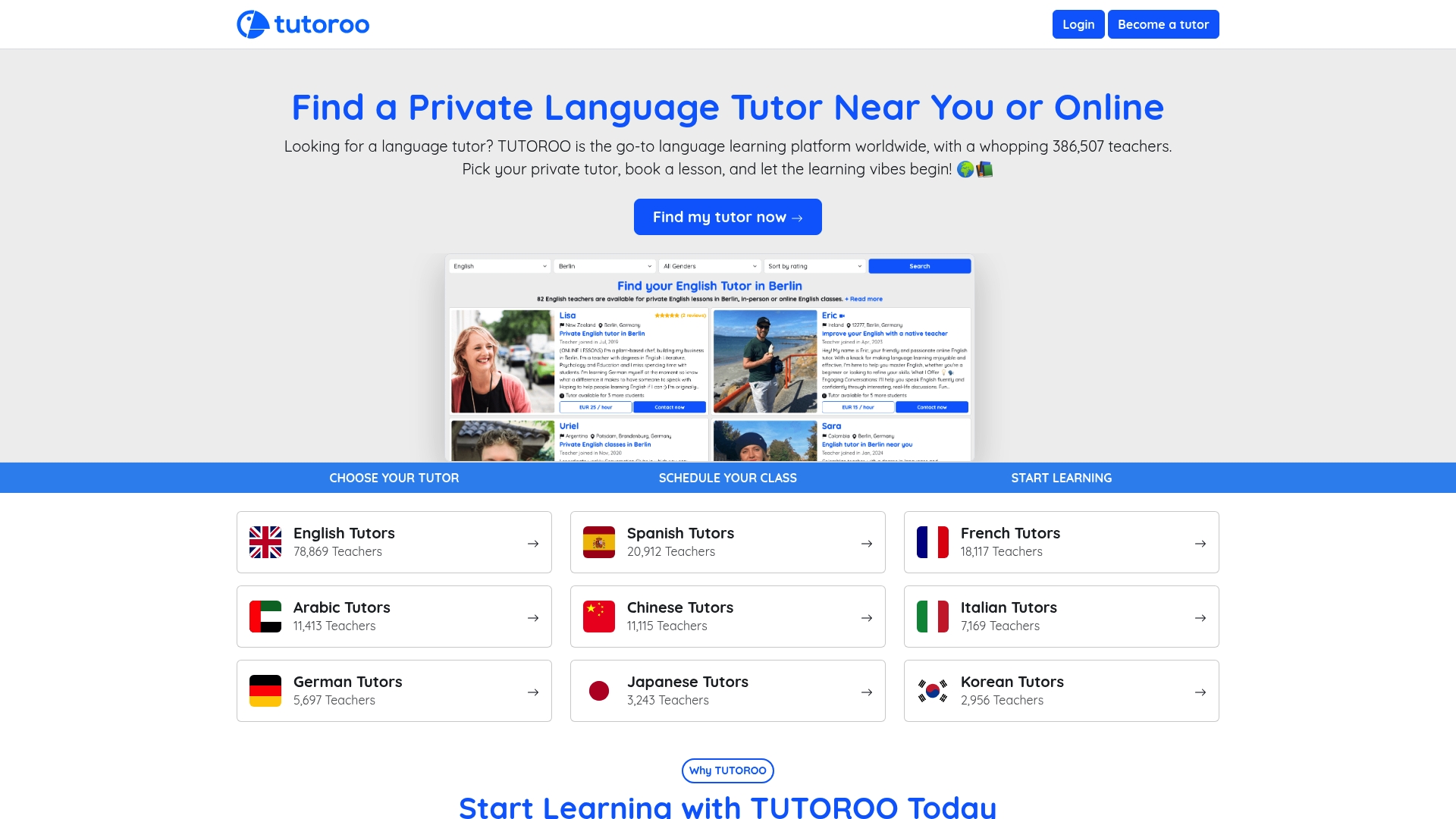
Whether you need Malay tutors for business communication, Japanese tutors for travel preparation, or instructors in dozens of other languages, Tutoroo's platform simplifies finding qualified professionals who match your preferred tutoring style. Tutors tailor lessons to your objectives, whether that's exam success, conversational fluency, or cultural immersion, ensuring every session advances your language goals efficiently.
FAQ
What is the best tutoring style for exam preparation?
Grammar-Translation Method suits exam preparation exceptionally well due to its systematic focus on grammar rules, vocabulary memorisation, and reading comprehension. However, combining it with communicative methods boosts overall language competence and prevents the common pitfall of passing exams whilst struggling with real conversations.
How do AI tutoring systems personalise language learning?
AI Intelligent Tutoring Systems employ speech recognition and natural language processing to analyse your performance continuously and adapt lesson difficulty accordingly. They identify weak areas automatically and provide targeted practice, though current technology still struggles with accent recognition accuracy compared to human tutors who adjust instruction based on subtle cues.
Which tutoring style is best for learning to speak a language quickly?
Communicative Language Teaching and Task-Based Language Teaching prioritise speaking practice and real-life language use, making them superior for rapid conversational fluency development. These methods outperform traditional grammar-focused approaches for learners who need practical speaking skills quickly, such as those preparing for imminent travel or work assignments abroad.
Can I combine different tutoring styles effectively?
Absolutely, and most successful language learners do precisely that. Combining grammar instruction for structural understanding with communicative practice for fluency and task-based activities for practical application creates a comprehensive learning experience. Your tutor can blend methods strategically based on your evolving needs and progress.
How does the VARK model influence tutoring effectiveness?
Matching tutoring activities to your dominant VARK learning preference significantly accelerates language acquisition and retention. Visual learners progress faster with diagram-heavy materials, auditory learners with conversation practice, reading/writing learners with text-based exercises, and kinesthetic learners with interactive role-plays. Effective tutors assess your preference early and adapt their teaching approach accordingly.