
TL;DR:
- Private tutoring offers faster, personalized language learning through real-time feedback and targeted techniques.
- It benefits beginners, shy learners, and exam candidates most, but higher costs and reliance are potential drawbacks.
- Matching the right tutor to specific goals and combining tutoring with immersion maximizes progress.
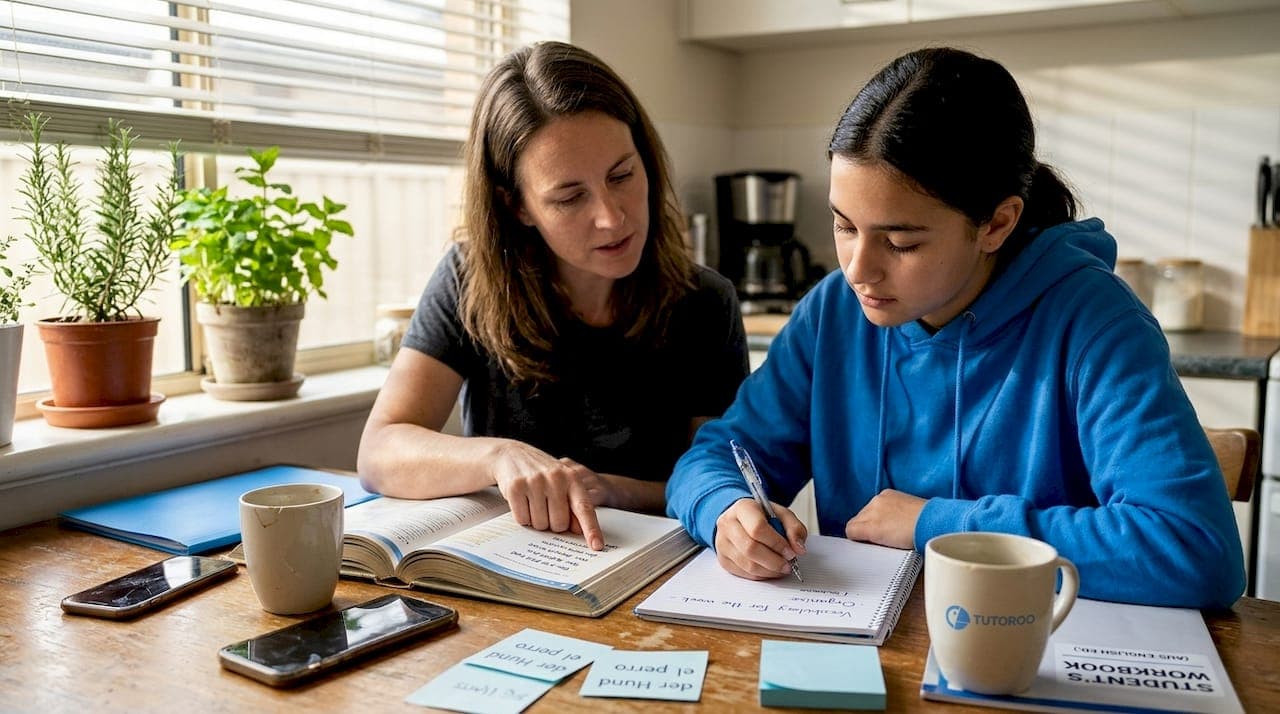
Most language learners assume that a popular app or a weekly group class is the fastest way to fluency. It feels logical. Apps are cheap, group classes are social, and both are widely available. But private tutors accelerate language acquisition much faster than traditional classroom learning, and the gap is larger than most people expect. Whether you are preparing for an overseas trip, sitting a language exam, or building professional communication skills, this guide breaks down exactly how private tutoring works, who benefits most, what it costs, and how to get the best results from the experience.
Table of Contents
- What makes private tutors unique for language learning
- How private tutoring accelerates language progress
- Who benefits most and potential drawbacks
- Private tutors vs alternatives: cost, speed and fit
- Our perspective: when private tutoring is a game-changer (and when it's not))
- Find your ideal private tutor for faster language learning
- Frequently asked questions
Key Takeaways
| Point | Details |
|---|---|
| Personalised learning | Private tutors tailor lessons and pace to your unique goals, learning style, and skill level. |
| Faster results | Empirical studies show private tutoring accelerates language progress, with up to a 27% test increase in weeks. |
| Best for focus areas | Tutoring is especially powerful for travel, exams, and professional language needs—where customisation really pays off. |
| Consider cost and fit | While tutors are an investment, their speed and flexibility often justify the cost for serious learners. |
| Blend approaches for best outcomes | The greatest long-term gains come when tutoring supplements self-study, immersion, or group practice. |
What makes private tutors unique for language learning
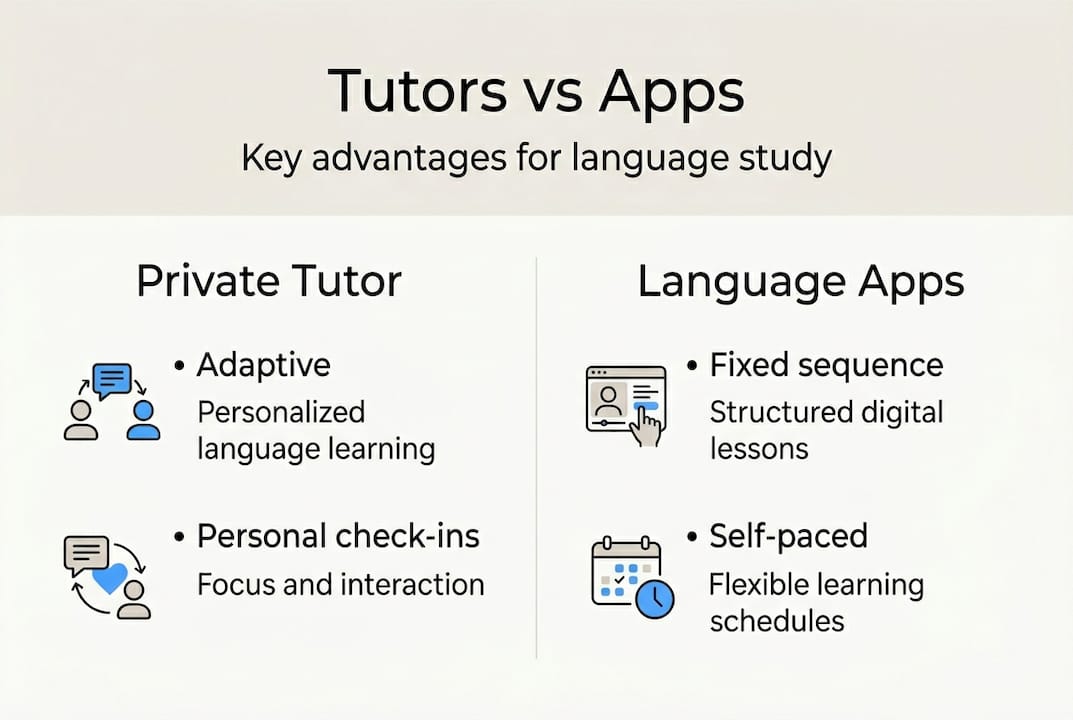
Private tutoring in a language context means working one-on-one with a qualified or native-speaking tutor who shapes every lesson around your specific goals, pace, and learning style. This is fundamentally different from what apps and group classes offer.
Language apps deliver pre-built content in a fixed sequence. They cannot notice when you are struggling with a particular grammar pattern, and they cannot pivot mid-lesson to address a real communication gap. Group classes move at the pace of the majority, which means advanced learners wait and beginners fall behind. Private tutors sit in a different category entirely.
The private tutoring benefits that learners report most often are not just about speed. They include confidence, cultural context, and the ability to practise real-world scenarios in a safe, supportive space. A tutor can roleplay a job interview in French, walk you through the nuances of formal versus informal Japanese, or correct your Spanish pronunciation in real time. No app replicates that.
The types of language lessons available through private tutoring are also far more varied than most learners realise. Tutors draw on a wide range of common tutoring techniques to keep sessions dynamic and effective:
- Real-time feedback corrects errors the moment they occur, preventing bad habits from forming
- Scenario-based practice builds practical communication skills for travel, work, or social settings
- Multisensory learning uses visual, auditory, and movement-based activities to reinforce vocabulary
- Active recall strengthens memory by prompting learners to retrieve information rather than passively review it
- Spaced repetition revisits material at strategic intervals, which improves recall by up to 90%
"Private tutors provide hyper-personalised instruction using real-time feedback, scenario-based learning, and spaced repetition, creating a learning environment that adapts to you rather than asking you to adapt to it."
Flexible scheduling is another major advantage. You can book lessons around work, study, or family commitments, and shift the focus of each session based on what you need that week. This kind of responsiveness simply does not exist in a classroom setting.
How private tutoring accelerates language progress
The results from private language tutoring are well documented, and they are genuinely impressive. Learners who work with private tutors can achieve a 27% test score jump in as little as six weeks, with language skills developing up to 50% faster than in group classes.

For English Language Learners specifically, private tutoring shows a 0.30 to 0.46 SD effect size and up to an 18% proficiency gain. These are not marginal improvements. They represent a meaningful shift in how quickly learners reach functional fluency.
The one-on-one learning gains differ depending on where a learner starts:
| Learner level | Key benefit | Typical outcome |
|---|---|---|
| Beginner | Confidence building, correct foundations | Faster early fluency, fewer ingrained errors |
| Intermediate | Targeted gap-filling, vocabulary expansion | Breaks through the plateau more quickly |
| Advanced | Accent refinement, professional or exam prep | Measurable improvement in high-stakes contexts |
For exam candidates, private tutoring is particularly powerful. A tutor who knows the IELTS, DELF, or JLPT format can focus every session on the exact skills being assessed. For travellers, a few weeks of scenario-based lessons can mean the difference between ordering confidently at a restaurant and struggling to communicate. For professionals, the personalised teaching benefits extend to industry-specific vocabulary and formal register, which group classes rarely address.
When you look at tutoring effectiveness data across multiple studies, a consistent pattern emerges: the more targeted the instruction, the faster the progress. Private tutoring is the most targeted form of language instruction available.
The flexible language progress that comes from working with a private tutor also supports confidence in ways that are hard to quantify but easy to feel. Learners report being more willing to speak, more comfortable making mistakes, and more motivated to continue.
Pro Tip: Match your tutor to your specific goal, not just your language. An exam-focused tutor and a conversational tutor have different strengths. Choosing the right fit from the start saves time and money.
Who benefits most and potential drawbacks
Private tutoring is not a one-size-fits-all solution, and it is worth being honest about that. Certain learner profiles see outsized gains, while others may find the investment less worthwhile.
Low-achievers, shy learners, and neurodivergent students tend to benefit the most from private instruction. The reduced social pressure, the ability to move at their own pace, and the tutor's undivided attention create conditions where these learners can genuinely thrive. High-achievers, by contrast, often face diminishing returns because they have already developed strong learning habits and may need peer challenge more than individual coaching.
| Learner type | Likely gains | Key risks |
|---|---|---|
| Shy or anxious learner | High confidence gains | May avoid group practice entirely |
| Neurodivergent learner | Strong engagement, tailored methods | Dependency on structured support |
| Exam candidate | Targeted score improvement | Narrow focus may limit broader fluency |
| High-achiever | Accent and advanced skills | Lower return on investment |
| Casual learner | Enjoyable, flexible progress | Cost may outweigh the pace of learning |
The risks of private tutoring are real and worth naming clearly. Tutored students often outperform initially but can face setbacks if they become over-reliant on tutor guidance and struggle to learn independently. A mismatch between tutor style and learner needs can also slow progress rather than accelerate it.
Equity is another important consideration. Private tutoring is not equally accessible to all learners, and its widespread use can reinforce educational inequality. Learners from lower-income backgrounds may not be able to afford consistent sessions, which means the benefits are unevenly distributed.
Common pitfalls to watch for include:
- Choosing a tutor based on price alone rather than fit and experience
- Treating tutoring as a substitute for independent practice and immersion
- Failing to set clear goals before starting, which leads to unfocused sessions
- Sticking with a mismatched tutor out of loyalty rather than switching
Knowing how to find a compatible tutor from the outset dramatically reduces these risks and sets learners up for genuine, sustained progress.
"The tutor-learner relationship works best when both parties are clear on the goal, the method, and the timeline. Ambiguity is the enemy of progress."
Private tutors vs alternatives: cost, speed and fit
Cost is often the first objection to private tutoring, and it deserves a direct answer. Tutoring can cost $5,400 over nine months compared to around $1,200 over three years for a language app. On the surface, that looks like a significant premium. But the ROI calculation changes when you factor in speed: private tutoring delivers results up to 250% faster, meaning you reach your goal in a fraction of the time.
For someone learning a language for a specific purpose, such as a job opportunity, an overseas move, or a professional certification, the faster timeline has real financial and personal value. Spending nine months to reach fluency rather than three years is not just more efficient. It can be genuinely life-changing.
Apps and group classes remain viable options for learners with flexible timelines and limited budgets. They are also useful for building vocabulary and maintaining skills between tutoring sessions. The key is understanding what each tool does well.
Here is a practical approach to choosing the right learning method:
- Define your goal clearly. Are you aiming for conversational fluency, exam readiness, or professional communication? The answer shapes everything.
- Set a realistic timeline. If you need results in three to six months, private tutoring is almost certainly the fastest route.
- Assess your budget honestly. If cost is a significant constraint, consider a blended approach with fewer tutoring sessions supplemented by self-study.
- Try before you commit. Most tutors offer trial sessions. Use them to assess fit before booking a long-term schedule.
- Review progress regularly. Set milestones every four to six weeks and adjust your approach if you are not hitting them.
Deciding between local vs online tutoring is another factor worth considering. Online tutoring opens access to a far wider pool of tutors and is often more affordable, while local tutoring can offer a more immersive, in-person experience.
Pro Tip: Use private tutoring as a focused boost for your most important skills, then maintain progress through self-study and immersion. A balanced approach to one-on-one language results consistently outperforms either method used in isolation. Pair your sessions with fast personalised learning tips to make every hour count.
Our perspective: when private tutoring is a game-changer (and when it's not)
After looking at all the evidence, one thing stands out clearly: the conventional wisdom that private tutoring is a luxury for struggling students fundamentally misunderstands what it offers. For language learning specifically, private tutoring is most powerful when the learner has a clear, meaningful goal and a genuine commitment to putting in the work between sessions.
The biggest gains do not come from simply booking a tutor. They come when tutoring complements immersion and self-study rather than replacing them. A tutor who helps you prepare for a real conversation, then sends you out to have that conversation, creates a learning loop that no app can replicate.
We are also honest about the limits. For casual learners without a specific goal or deadline, the cost-to-benefit ratio may not justify the investment. And for high-achievers who already learn efficiently, unlocking language success through tutoring may deliver smaller gains than expected.
The real game-changer is tutor-learner fit. When the match is right, the progress feels almost effortless. When it is wrong, even excellent tutors struggle to move the needle. Choose carefully, set clear goals, and treat every session as an investment in a specific outcome.
Find your ideal private tutor for faster language learning
If you are ready to accelerate your language learning, practical support is only a click away. TUTOROO connects learners with over 386,000 private language tutors across the world, covering languages from Spanish and French to Arabic, Chinese, and beyond.
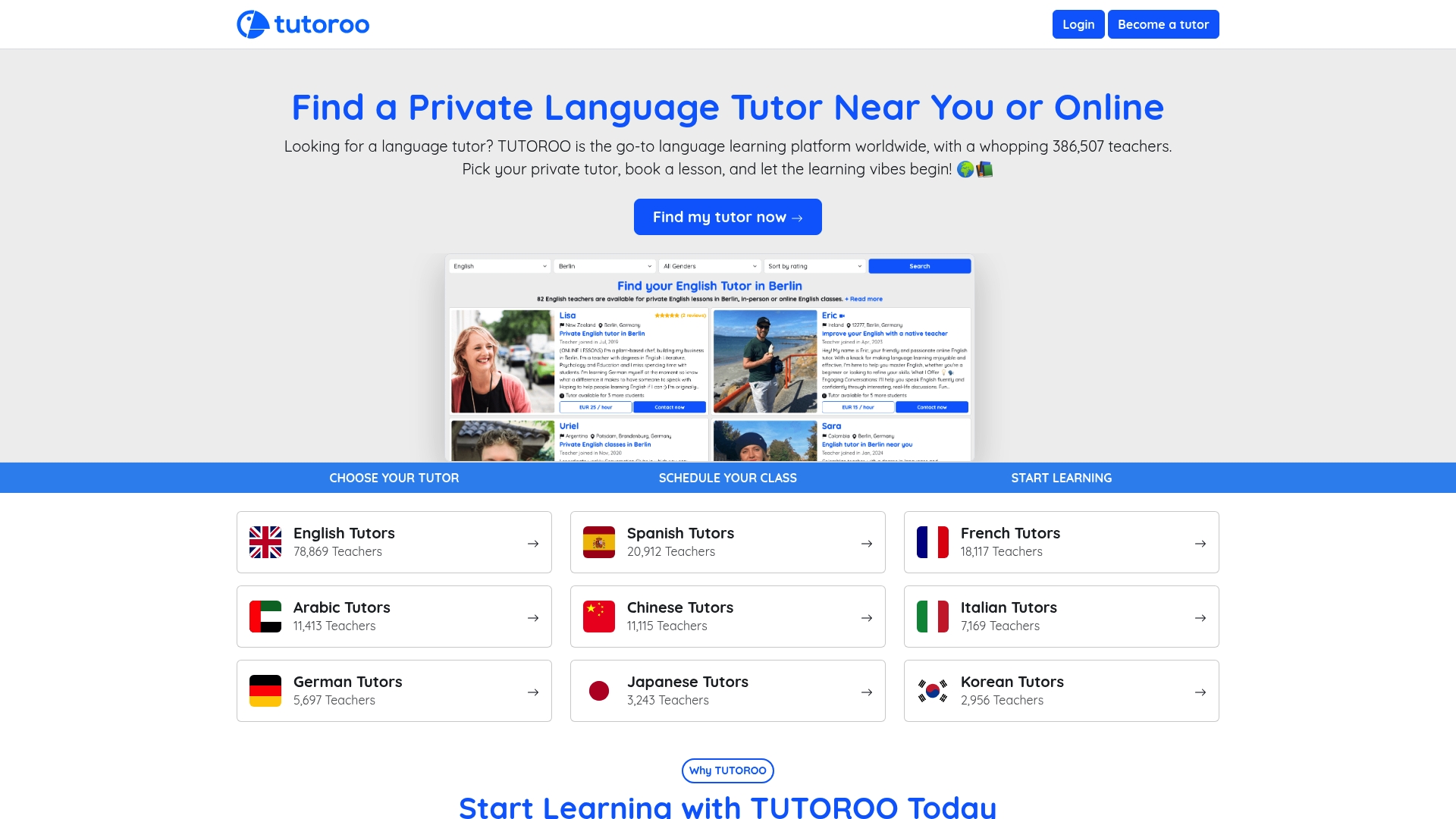
Whether you are searching for a Malay tutor to prepare for travel, an English tutor for professional development, or a specialist in any other language, TUTOROO makes it straightforward to find the right match for your goals, schedule, and budget. Explore your private language tutor options today, book a trial session, and experience the difference that truly personalised instruction can make.
Frequently asked questions
How do I choose the right private tutor for my language needs?
Successful tutor-learner pairing maximises results, so look for tutors with experience in your specific language goal, a teaching style that suits how you learn, and availability that fits your schedule. Matching platforms simplify this process considerably.
Are private tutors only for beginners, or do advanced learners benefit as well?
Advanced learners gain targeted support with accent refinement, fluency, and professional or exam preparation, while beginners build confidence and correct foundational skills. Tutors adapt content for all levels, from basic vocabulary to polished, native-like expression.
Can private tutoring be more effective than language learning apps?
Private tutoring is typically faster and more adaptive than apps, delivering up to 250% faster ROI than app-based learning. Combining tutoring with self-study and immersion consistently produces the best overall results.
What are potential drawbacks of using private tutors?
The main risks include higher upfront cost, the potential for overreliance on tutor guidance, and the fact that private tutoring can increase inequality when access is limited to those who can afford it. Choosing the right tutor and maintaining independent study habits helps mitigate these risks.
Does private tutoring suit all learning styles?
Yes. Tutors use multisensory techniques to match visual, auditory, and kinaesthetic learners, adjusting their methods in real time to ensure each session is as effective as possible for the individual student.