
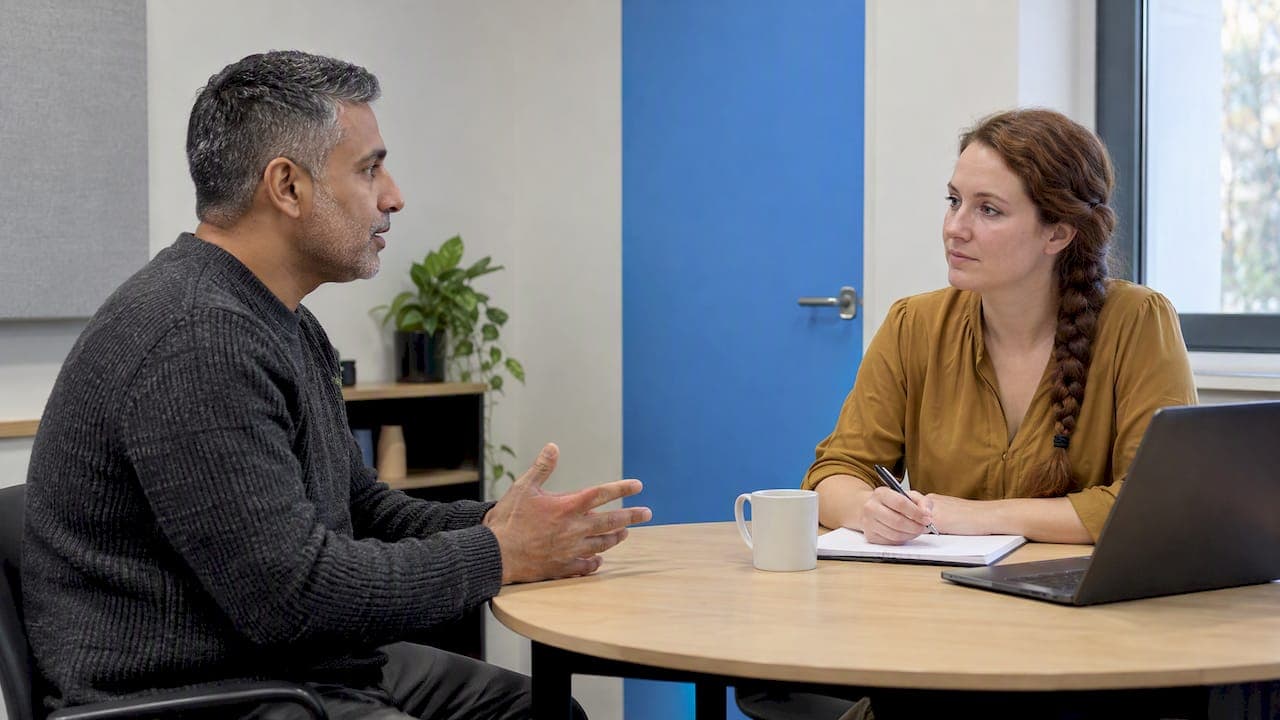
OPI tutoring is worth it when your speaking is close to the level you need and the gap is about stamina, spontaneity or interview habits. It is not worth it if you hope a few lessons will lift you a whole level, because the interview rewards proficiency built over months, not preparation done in the final week. The sections below show how to tell which situation you are in, what the test costs, and how to spend your money sensibly.
TL;DR
- The ACTFL OPI measures spontaneous speaking. ACTFL says cramming and last-minute practice will not improve a rating.
- Tutoring pays off when you are within roughly one sublevel of your target and need practice sustaining longer, unscripted conversation.
- It pays off less when you are still building vocabulary and grammar, or when your target is several sublevels away.
- Book a diagnostic conversation first, then buy a fixed block of lessons (six to ten weeks is a sensible planning window) and re-check your level before paying for the official test.
- Choose a tutor who talks with you, interrupts naturally and pushes you into harder topics, not one who hands you scripted answers.
Table of Contents
- What the OPI actually measures
- The case for and against OPI tutoring
- What the test costs, so you can weigh the tutoring
- OPI or OPIc: pick the format that suits your practice
- A realistic plan if you decide to hire a tutor
- How to choose the right tutor
- Our perspective at TUTOROO
- Finding a tutor for OPI-style practice
- Other ways to prepare without a tutor
- Be careful with score comparisons
- A worked example
- Questions to ask yourself before you pay
- FAQ
- Sources
What the OPI actually measures
The ACTFL Oral Proficiency Interview is a standardised, global assessment of functional speaking ability. Hundreds of institutions, government agencies and employers use it to credential people for work and study. It is a live, structured conversation of about 15 to 30 minutes, held with a certified tester by phone or by video.
Two features of the format matter for anyone deciding whether coaching is worth the money.
It is not a pass or fail quiz. The interview is a procedure designed to find your functional floor, the level where you can sustain performance, and your ceiling, the level where your language begins to break down. Stronger speakers tend to have longer interviews because they produce more language for the tester to rate. The rating is a snapshot of what you can do without preparation.
The tester will not coach you. According to ACTFL's guidance, testers keep a neutral manner and do not correct you or encourage you, because the aim is to gather a ratable sample of language, not to teach. Learners used to a friendly teacher who nods along can find this disorienting. Practising with someone who behaves more like an interviewer is one of the few things tutoring can genuinely rehearse.
The case for and against OPI tutoring
The honest answer depends on where you start and what the rating is for. Here is how the trade-off looks in practice.
| Your situation | Is a tutor worth it? | Why |
|---|---|---|
| Comfortable in conversation, unsure of your rating, nervous about the format | Usually yes | A few mock interviews remove surprises and build stamina |
| One sublevel short of a job, degree or certification requirement | Often yes | Targeted correction on the habits that cap your rating can move you up |
| Two or more sublevels short | Only as ongoing lessons | A short prep block will not close a gap that size |
| Still at early beginner stage | Not for the OPI | Build core vocabulary and grammar first; the interview can wait |
| Score already meets the requirement | No | Save the money |
When a tutor earns their fee
A good tutor is most useful for problems you cannot easily see yourself:
- Fossilised errors. Mistakes you repeat so often that you no longer hear them.
- Avoidance. Many learners stay in the present tense or dodge hard topics. A tutor can notice what you never say.
- Paragraph-length speech. Higher ratings depend on connected, organised speech, not strings of short sentences. Practice with feedback helps here.
- Handling the unexpected. Testers deliberately change topics. A tutor can do the same, in real time.
- Nerves. Simply having sat through a few unscripted interviews lowers the stress on test day.
When it is probably not worth it
Be wary if a package promises a guaranteed rating. Proficiency develops over time, and ACTFL is clear that last-minute practice does not change it. Be wary too if the lessons consist of memorising model answers. ACTFL's tips note that relying on rehearsed speech is a common pitfall that keeps learners stuck at the Novice level, and if a tester detects memorised responses they will introduce new prompts to find out whether your ability is truly spontaneous. A tutor who trains you to recite is spending your money on the very thing the test is built to expose.
A second case: if your real goal is to speak with confidence rather than to hold a certificate, the OPI may be an expensive way to measure something you could simply improve through regular conversation. In that situation, ordinary lessons are the better investment.
What the test costs, so you can weigh the tutoring
Any tutoring budget should be set against the price of the official interview, since the aim is to sit it once and sit it ready.
Prices change, vary by language and by who is ordering, so check before you book. On one Language Testing International ordering page, the live OPI was listed at $176.00 and the computer-delivered OPIc at $114.00. ACTFL's own page for certification candidates also mentions a standard price of $145 for an official OPI plus a proctoring fee, which shows how much the figure can differ depending on the route.
The practical takeaway is that a retake costs real money, plus the wait. If you are borderline, a short block of practice can be cheaper than a second attempt. If you are far from the target, the retake is not the main cost; the months of study are.
For a wider picture of what lessons cost, our guide to online language tutor costs walks through monthly budgets.

OPI or OPIc: pick the format that suits your practice
Both formats assess speaking against the same proficiency scale, but the experience differs. The OPI is a conversation with a person. The OPIc is delivered by computer, with an avatar presenting prompts based on your interests and experiences, and you can take it when it suits you. Some people speak more freely to a person, others find a screen less intimidating.
Whichever you choose, practise in that format. If you will face a human interviewer, rehearse with a human. If you will answer a recorded prompt, rehearse speaking at length to a microphone, too. Check which version your employer, university or agency accepts before you book; not every body accepts both.
A realistic plan if you decide to hire a tutor
Here is a sequence that keeps your spending proportionate.
- Find out what you need. Confirm the exact rating required and the deadline. Ratings are written as levels such as Intermediate, Advanced or Superior, each with sublevels. Our explainer on language proficiency levels helps you read them.
- Run a diagnostic. In the first lesson, ask your tutor to hold an unscripted 20-minute conversation, then tell you honestly where you sit and what holds you back. If the answer is "far from the target", take that seriously.
- Set a block of lessons. Plan on a fixed number of weeks, one or two sessions each, with a clear aim for every session.
- Work on the right tasks. Ask for narrating in the past and future, describing a situation in detail, handling a complication, and giving and defending an opinion. ACTFL points learners towards tasks tied to its proficiency guidelines and Can-Do Statements.
- Practise between lessons. Record yourself answering a prompt for three minutes, listen back, and note where you stall.
- Run a mock interview. About a week before the test, ask the tutor to simulate the format, with a neutral manner and no corrections mid-answer.
- Then decide. If the mock result sits at or above your target, book the official test. If not, consider more lessons first.
The point of the block is to leave the lessons with a rating estimate you trust, not to buy a promise.
How to choose the right tutor
Certification as an OPI tester is a specific credential. ACTFL says certified testers have been trained to elicit and rate interviews with a high degree of reliability, but your practice tutor does not need that credential to be useful. What matters more is how they teach. Look for these signs:
- They speak mostly in the target language and let you do most of the talking.
- They ask follow-up questions that you cannot predict.
- They can explain, in plain terms, why a sample of your speech sits at one level and not the next.
- They do not offer model answers to memorise.
- They are willing to describe what you cannot yet do, not only what you can.
Native speakers often make excellent conversation partners, but fluency and the ability to diagnose a learner's gaps are separate skills. Ask about experience with learners preparing for assessments, and judge the first lesson by whether you leave knowing something concrete about your speech. Our notes on private tutoring best practices cover how to get more from each session.
Our perspective at TUTOROO
We connect learners with private language tutors, and we think about this question from the learner's side of the table. A tutor can't give you a rating. What a good tutor does is make your speaking more flexible, so the interview finds you at your best.
That is why we suggest treating OPI preparation as a conversation project, not a test project. Learners who talk regularly, in varied situations, about topics that stretch them tend to arrive at any speaking assessment with more to draw on. The tutors on our platform set their own schedules and are paid directly by students for ongoing lessons, which means you can agree a rhythm that fits your deadline, whether that is a weekly hour or something more frequent. You can message a tutor before committing, and we encourage you to use that to ask how they would structure your preparation.
We also encourage you to be sceptical of anyone, including us, who treats a certificate as the whole goal. The best reason to study with a tutor is the ability to talk to people. A rating then becomes a useful record of progress, not a finish line.
— TUTOROO
Finding a tutor for OPI-style practice
If you have decided that practice with a real conversation partner is the right step, you can browse private tutors by language and lesson format on TUTOROO, including Spanish, French, German, Italian, Portuguese, Chinese and Japanese teachers, with lessons online or in person where available. Start with a short trial conversation, share your target rating and your date, and ask the tutor to describe how they would use your first sessions. If you are preparing in English, English tutors online are a place to begin.
Other ways to prepare without a tutor
Tutoring is one route among several, and some learners reach their target without it. Consider these, alone or alongside lessons:
- Familiarisation material. ACTFL publishes an OPI familiarisation guide that describes the interview, and it also offers an online course on the format. Knowing the structure lowers anxiety.
- Language exchange or conversation groups. Free, and good for volume, but feedback is usually thin.
- Daily speaking habits. Narrate your day aloud, summarise articles you read, or leave voice messages to a friend.
- Immersion where possible. Time with speakers in real situations builds the flexibility the interview looks for.
Self-study works best for learners who can already judge their own mistakes. If you cannot tell whether an answer was at the right level, a tutor's ear is what you are paying for. For more on matching tools to goals, see our overview of tools for language exam preparation.
Be careful with score comparisons
If you have taken another speaking test, you may be tempted to assume the result converts neatly into an OPI rating. Researchers advise caution. ETS guidance on comparing speaking scores to other assessments, published as a score user's guide, explains that the relationship between two different tests needs careful, evidence-based treatment. In practice, treat any conversion table as a rough guide, check whether it rests on independent research, and never rely on it for a high-stakes decision. A mock interview in the OPI format tells you far more.
A worked example
Imagine a nurse who needs a particular rating in Spanish for a workplace requirement. She has studied for years, reads comfortably and chats easily about daily life, but her last practice interview stalled when asked to describe a problem at work and how she would solve it. She speaks in short, present-tense sentences when stretched.
For her, tutoring looks promising. The gap is specific: connected speech about unfamiliar situations, in more than one time frame. A tutor can build exactly that, with prompts, recordings and feedback, over a block of weeks. A mock interview near the end tells her whether to book the official test.

Now imagine a second learner, six months into a new language, who wants a high rating for a job application next month. A tutor can help him speak more, but no coaching will turn six months of study into advanced proficiency by next month. He is better off checking whether the employer accepts a lower rating, or moving the deadline, than buying a prep package.
Questions to ask yourself before you pay
- What exact rating do I need, and who is asking for it?
- Do I know my current level from a recent, honest assessment?
- How far away is the deadline, and how many hours can I really practise each week?
- Would a retake cost me more than a tutoring block?
- Do I want the rating, or do I want the skill?
If your answers point to a small gap and a firm date, tutoring is a reasonable bet. If they point to a large gap, invest in steady lessons across a longer period. And if the language is also needed for travel, our step-by-step travel language preparation guide shows how to structure that learning.
FAQ
Can I cram for the OPI with a tutor?
Not effectively. ACTFL states that proficiency develops over time and that last-minute practice will not improve a rating. A tutor can help you get used to the interview format and polish how you organise answers, but the underlying ability needs months of regular speaking.
Does an OPI tutor need to be a certified tester?
No. Certified testers are trained to conduct and rate official interviews, but practice tutors are not part of that process. Look instead for someone who talks with you naturally, explains your level clearly and gives specific feedback you can act on.
How long does the interview take?
The OPI is typically 15 to 30 minutes. The length varies with your proficiency, because stronger speakers generally produce more language for the tester to rate. The OPIc, taken by computer, is listed at 20 to 40 minutes on one ordering page.
Should I memorise answers to common questions?
No. Testers are looking for spontaneous speech, and ACTFL notes that if they detect memorised responses they will introduce new topics to test your real ability. Practise talking about a wide range of subjects instead of polishing a few scripted answers.
Sources
- ACTFL: Tips for OPI and OPIc test takers
- ACTFL: Oral Proficiency Interview (OPI)
- ACTFL: OPI Tester Certification
- ACTFL: OPI Familiarization Guide
- ACTFL: Certification candidate personal OPI process
- Language Testing International: select a test
- ETS: Best practices for comparing speaking test scores