

Yes, private TOEFL tutoring is worth it when you have a clear score goal, a tight deadline, or weaknesses in speaking and writing that self-study hasn't fixed. It's a weaker investment for beginners with months to spare, who often gain more from structured group classes or disciplined solo practice first. The right call depends on where you sit against the TOEFL iBT test structure and how close your current score is to your target.
TL;DR:
- Private TOEFL tutoring is most effective for advanced students hitting a score plateau or those with urgent deadlines, especially in speaking and writing.
- Effective tutoring involves diagnostic assessments, targeted feedback, strategy coaching, and timed practice to address individual weaknesses efficiently.
- Score improvements are more significant for students with a solid foundation, typically achievable within 8 to 12 weeks of structured tutoring, depending on the deadline.
- Cost varies from hourly lessons to packages and group classes, with the highest ROI for those applying to institutions with strict score requirements who already have a baseline score.
- Choosing a TOEFL-specific tutor with proven exam coaching experience and testing their fit with a diagnostic lesson maximizes investment value.
Table of Contents
- Who benefits most from TOEFL tutoring
- What effective TOEFL tutoring actually does
- What score improvement and timeframe are realistic
- Cost, formats and return on investment
- How to choose a tutor or prep option
- How to structure tutoring weeks for measurable gains
- Where private TOEFL tutoring falls short
- Publisher perspective on the value of TOEFL tutoring
- Tutoroo as an option for TOEFL tutoring
- Sources
- FAQ
Who benefits most from TOEFL tutoring
Private tutoring earns its price tag fastest for a few specific profiles. Advanced students who've plateaued, those staring down an application deadline, and candidates whose speaking or integrated writing scores lag behind their reading and listening are the clearest cases for paid, one-on-one help.
That's because tutoring solves problems self-study genuinely struggles with. A tutor can hear a repeated pronunciation slip or a structural habit in your writing that you can't catch yourself, no matter how many practice tests you grind through. Speaking, in particular, needs a human ear and immediate correction. Written feedback from an app rarely matches what a tutor notices in real time.
Tutoring also helps when time is short. A candidate with six weeks until an application deadline doesn't have the luxury of trial and error, and a tutor can triage the highest-impact fixes first rather than working through a generic syllabus.
- Advanced students stuck on a score plateau benefit from precision correction that generic drilling can't offer.
- Test-takers with a hard deadline benefit from a tutor's ability to prioritise the fixes that move the score fastest.
- Students weak specifically in Speaking or Writing benefit from high-frequency, corrected practice that's hard to replicate alone.
If you're a beginner with a wide skills gap and several months of runway, a cheaper path, such as structured self-study paired with a group class for listening and vocabulary exposure, usually delivers better value per dollar. Save the one-to-one budget for when you're closer to your ceiling and need someone to find the last few points.
What effective TOEFL tutoring actually does
Good tutoring isn't just extra practice with a person watching. It's a structured process that should look something like this across your first few sessions and beyond:
- A diagnostic session that pinpoints repeatable errors, whether that's a grammar habit, a timing problem, or a consistent misreading of task instructions.
- A feedback loop on Speaking, where you record responses, compare them against model answers, and drill the specific gap rather than repeating the same mistake.
- The same loop applied to Writing, particularly the integrated task, where a tutor can flag where your summary drifts from the source material.
- Strategy coaching for integrated tasks specifically, since these combine reading, listening and either speaking or writing under time pressure.
- Simulated, timed practice that mimics the real test experience, including the adaptive format now used in the TOEFL iBT.
The value sits almost entirely in that feedback loop. Without it, a lesson is just supervised practice, and you could do that alone for free.
Pro Tip: Ask your tutor to turn every corrected error into a short, repeatable drill with a clear pass or fail criterion, not just a one-off comment.
What score improvement and timeframe are realistic
Score gains depend heavily on where you start. Students in the mid-range, roughly those who are clearly below their target but have a working foundation in English, tend to see the largest movement from structured, corrected practice, because there's more low-hanging fruit to fix. Advanced students near the top of the scale typically see smaller gains, since the remaining errors are subtler and take longer to iron out.
One of the most useful planning tools is the ETS score display guidance, which explains that through January 2028, scores will show in the newer 1 to 6 band format alongside a comparable 0 to 120 estimate. Institutions are adopting the new format at different speeds, so check what your target schools actually require before you set a numeric goal.
A realistic timeline for measurable change is a diagnostic session followed by 8 to 12 weeks of structured, mixed tutoring and independent work. Students on a tighter deadline sometimes compress this into 4 to 6 weeks of intensive sessions, though the trade-off is less time to consolidate new habits before test day.

What tutoring cannot do is replace effort. A tutor amplifies the work you put in between sessions: the drills, the recorded practice, the review of past mistakes. Treating lessons as the entire preparation plan, rather than the correction mechanism for a plan you're already running, is the most common reason students feel tutoring "didn't work."
Cost, formats and return on investment
TOEFL tutoring pricing generally comes in three shapes: hourly private lessons, multi-hour packages bought in bulk, and group classes charged per course or per block of sessions. Hourly private lessons offer the most flexibility and the most personalised correction, but cost more per hour than a package or a group seat. Packages often bring the per-hour rate down in exchange for commitment, and group classes are the cheapest route per hour but offer far less individual speaking and writing feedback.
To judge whether tutoring is worth it for you, treat it as a return on investment problem with a concrete benefit metric. Say your target university requires a TOEFL score of 100, and you're currently diagnosing at 88. If reaching that score unlocks an admission offer or a scholarship, the value of closing a 12-point gap is whatever that offer is worth to you, set against the cost of the sessions it takes to get there. ETS notes that a "good" score is relative to the institutions you're applying to, since TOEFL iBT results are accepted by many institutions worldwide with varying thresholds.
If the full private package feels like a stretch, a few budget-friendly options still preserve much of the effectiveness:
- A single diagnostic lesson to identify your biggest gaps, followed by targeted self-study using that feedback.
- A mixed plan combining a cheaper group class for listening and vocabulary with a handful of 1:1 sessions reserved for Speaking and Writing.
- A short package focused purely on the integrated tasks, where feedback matters most and generic practice helps least.
How to choose a tutor or prep option
Picking the right tutor matters almost as much as deciding to hire one at all, since the ROI argument collapses fast with a mismatched or inexperienced tutor.
- Ask for a sample diagnostic task before committing to a full package, so you can see how the tutor identifies and explains errors.
- Ask what evidence they have of past students' score movement, and be wary of vague claims with no specifics attached.
- Ask how a typical lesson is structured, since a good tutor should describe a feedback loop, not just "practice and chat."
- Check for TOEFL-specific coaching experience rather than general English teaching, since the test's integrated tasks and timing need targeted familiarity.
- Treat the first lesson as a trial. A single diagnostic session or a short, low-commitment package is the cheapest way to test fit before buying bulk hours.
Our guide to evaluating private language teachers walks through more of these questions in detail, and it's worth reading before you commit to a longer package. One useful external checklist on spotting a serious, reliable tutor rather than one who just lists credentials covers similar ground and is a handy cross-check.
How to structure tutoring weeks for measurable gains
An eight-week plan is a workable default for most students who aren't facing an immediate deadline.
- Week one: diagnostic lesson across all four skills, building a prioritised list of repeatable errors.
- Weeks two to four: skills rotation, with sessions alternating between Speaking drills, Writing revisions and integrated-task strategy.
- Weeks five to six: timed, simulated practice sections to build stamina and test the drills under exam conditions.
- Week seven: a full mock test, reviewed in detail with the tutor to catch any remaining patterns.
- Week eight: final review, light drilling on weak points only, and rest before test day.
Session length should match the skill. Speaking benefits from short, frequent micro-sessions of 20 to 30 minutes, since the goal is repetition and correction rather than endurance. Integrated tasks, which combine reading or listening with speaking or writing, suit longer combined sessions of 60 to 90 minutes that mirror the real test's pacing.
Between sessions, daily independent practice should mirror whatever the tutor flagged, not a generic study plan pulled from elsewhere. If a lesson focused on summarising a lecture accurately, that night's homework should be more summarising, not an unrelated vocabulary list. Our tutor-led exam readiness plan offers a longer version of this structure for students working toward a bigger score jump.

Where private TOEFL tutoring falls short
Tutoring isn't risk-free, and it's worth knowing the limitations before you commit a budget to it.
The most common issue is dependency. Students who rely entirely on their tutor to flag mistakes can struggle to self-correct on test day, when there's no one there to catch a slip. Guard against this by building in independent, unsupervised practice that mimics the pressure of the real exam.
Tutor quality also varies considerably. Not every fluent English speaker is a skilled exam coach, and general English teaching experience doesn't automatically translate into TOEFL-specific strategy, particularly for the integrated tasks. A tutor with no track record of exam-focused coaching may leave you no better prepared than a good self-study app.
There's also a risk of mistaking activity for progress. Sitting through lessons without a structured feedback loop, where errors are tracked, drilled and rechecked, can feel productive while producing little actual score movement. The fix is the same one that makes tutoring work in the first place: insist on a diagnostic, a narrow error list, and objective checkpoints, rather than open-ended conversation practice billed as test prep.
Publisher perspective on the value of TOEFL tutoring
Our editorial view is that TOEFL tutoring earns its cost when it's used diagnostically, not as a substitute for disciplined independent work. The students who see the clearest gains are the ones who treat lessons as the correction mechanism for a plan they're already running, not the entire plan itself.
Some platforms suggest that structured one-to-one tutoring leads to faster progress compared with self-study alone, consistent with trends observed in large communities of language tutors. Our practical recommendation is simple: book one diagnostic lesson before you buy a full package, and let that session tell you whether a tutor's approach actually matches your gap.
— TUTOROO
Tutoroo as an option for TOEFL tutoring
If you've decided tutoring is worth the investment, the next question is where to find a tutor who actually specialises in TOEFL rather than general conversation practice. TUTOROO gives you direct access to a large, global pool of language tutors, with one-to-one lessons available online or locally, so you can match with someone who knows the test's integrated tasks and timing pressures specifically.
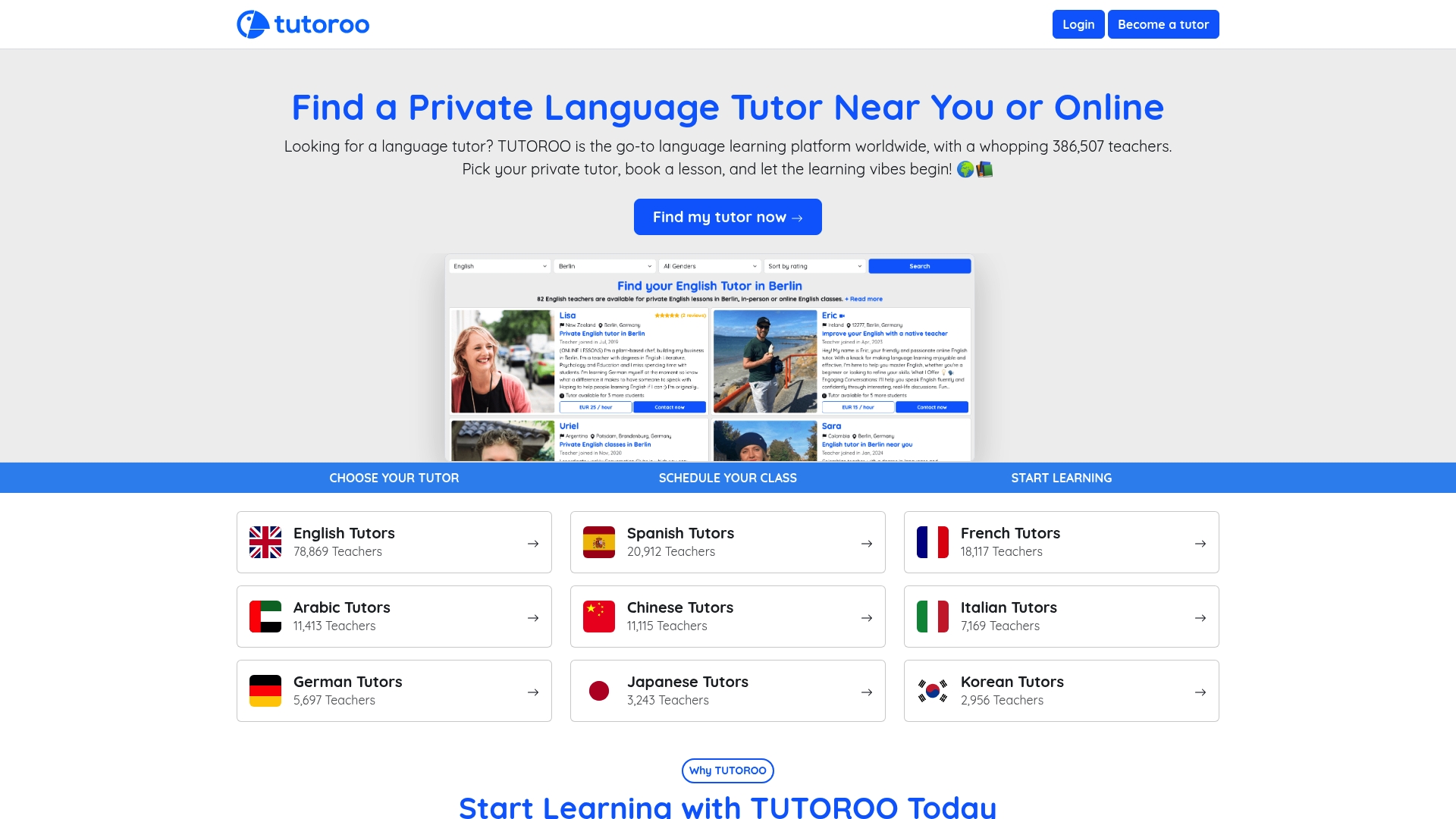
The simplest way to test fit without committing to a full package is to book a single diagnostic lesson first. Use it to see how the tutor identifies your gaps and structures a feedback loop, the same criteria covered earlier in this guide, before deciding whether to invest in more sessions.
- Browse English tutors online to find someone with TOEFL-specific coaching experience.
- Start with one diagnostic lesson to judge fit before buying a bulk package.
- Use the platform's messaging system to ask about exam experience before booking.
Head to TUTOROO to find a tutor and book that first diagnostic lesson.
FAQ
Is two weeks enough time to prepare for the TOEFL?
Two weeks is workable for a student already close to their target score who mainly needs timing practice and a few targeted drills. For anyone with a wider skills gap, particularly in speaking or integrated writing, it's a tight window that limits how much correction and repetition can actually sink in.
Is the TOEFL harder than the SAT?
The two tests measure different things, so "harder" depends on your background. The TOEFL focuses specifically on academic English proficiency across reading, listening, speaking and writing, while the SAT tests broader reasoning and maths skills typically built over years of schooling in English.
Is the TOEFL changing in 2026?
The test's adaptive format and task structure remain as described in the official TOEFL iBT content and structure page. The more notable change for 2026 is on the scoring side, where ETS is displaying scores in both the updated 1 to 6 format and a comparable 0 to 120 estimate through January 2028.
Is a TOEFL score of 5.0 considered good?
Whether a score is "good" depends entirely on the requirements of the institutions you're applying to, since ETS itself notes that score expectations vary by institution. Check your target school's published threshold under the new display format rather than relying on a generic benchmark.