

Standardised language proficiency levels are the frameworks and terms used internationally to describe how well a person can use a language across listening, speaking, reading, and writing. The most widely recognised of these is the Common European Framework of Reference for Languages (CEFR), which organises ability into six levels from A1 through to C2. Other established scales include the American Council on the Teaching of Foreign Languages (ACTFL) guidelines, the Interagency Language Roundtable (ILR) scale, and the United Nations Language Framework. Each serves a distinct purpose, whether for curriculum planning, workplace certification, or immigration assessment.
Understanding this terminology opens doors in education, employment, and migration. Here is a quick reference to the core terms and frameworks:
- Language proficiency: the ability to use a language accurately and effectively across real-world contexts
- Language fluency: often used informally to suggest ease of communication, but avoided by most formal frameworks in favour of measurable competency descriptors
- Basic User (CEFR A1–A2): can handle simple, predictable interactions and familiar topics
- Independent User (CEFR B1–B2): can communicate with reasonable confidence in a range of everyday and professional situations
- Proficient User (CEFR C1–C2): can express ideas with precision, nuance, and near-native ease
- ACTFL: an American framework assessing spontaneous, real-world communicative ability across Novice, Intermediate, Advanced, Superior, and Distinguished levels
- ILR: a professional scale used by US government agencies, ranging from no proficiency to functionally native proficiency
- CLB (Canadian Language Benchmarks): twelve benchmarks across Basic, Intermediate, and Advanced stages, used in Canadian immigration and education
- UN Language Framework: four competence levels (I–IV) tailored to workplace communication within the United Nations
How the CEFR framework organises language ability levels
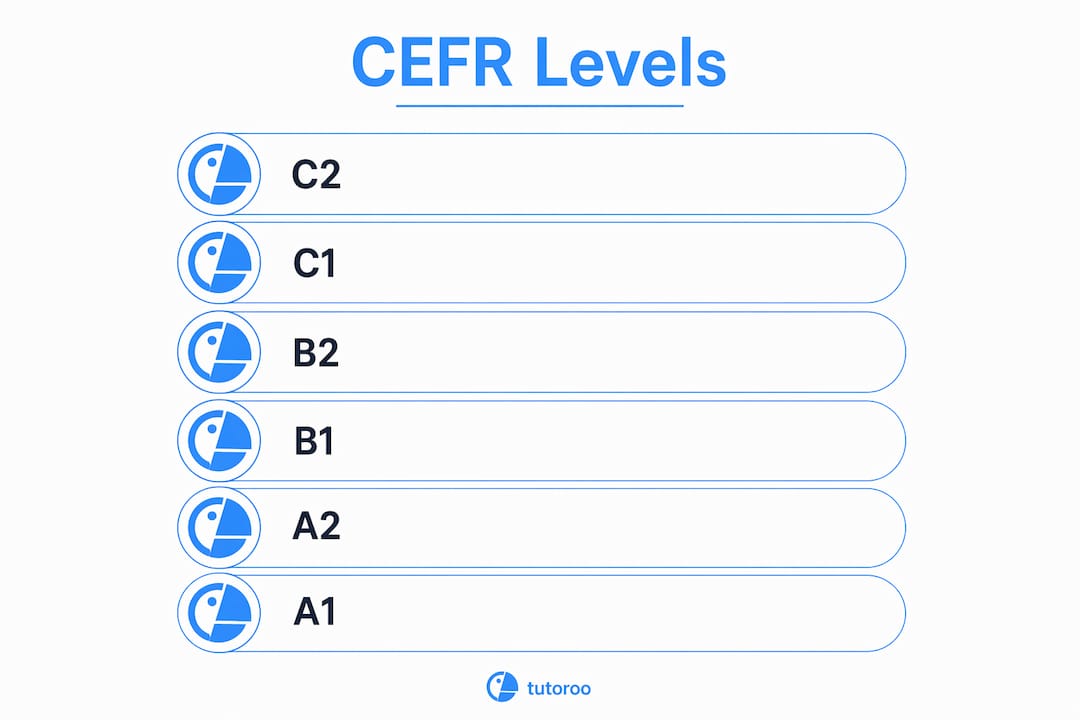
The CEFR is built around one central idea: describing what a learner can do with a language, not just what they have studied. Its six levels are grouped into three broad user categories, each reflecting a meaningful leap in communicative ability.
Basic User (A1–A2) covers learners who can manage simple, routine interactions. At A1, a person handles very basic exchanges such as introducing themselves or asking for directions. A2 extends this to familiar everyday situations, like shopping or describing their immediate environment.
Independent User (B1–B2) marks the point where communication becomes genuinely functional. B1 learners can hold conversations on familiar topics, travel without major difficulty, and write straightforward texts. B2 represents a significant step up: the ability to understand complex texts, interact with native speakers with reasonable fluency, and produce clear, detailed writing on a range of subjects.

Proficient User (C1–C2) describes advanced and near-native ability. C1 users can express themselves flexibly and effectively for academic, social, and professional purposes. C2 is the highest level, where a person can understand virtually everything they hear or read and express themselves with precision across even complex or nuanced situations.
The CEFR's can-do descriptors apply across all languages, which is what makes the framework so broadly useful. Curriculum designers, assessment bodies, and certification providers worldwide rely on it, and Australian universities and employers increasingly reference CEFR levels when evaluating language skills.
CEFR levels at a glance
| Level | Category | Typical ability |
|---|---|---|
| A1 | Basic User | Understands and uses familiar everyday expressions; introduces themselves |
| A2 | Basic User | Communicates in simple, routine tasks on familiar topics |
| B1 | Independent User | Handles most travel situations; produces simple connected text |
| B2 | Independent User | Understands complex texts; interacts with fluency on a wide range of topics |
| C1 | Proficient User | Uses language flexibly for social, academic, and professional purposes |
| C2 | Proficient User | Understands virtually everything; expresses with spontaneity and precision |
Key competencies assessed at each stage include:
- Listening: from understanding slow, clear speech (A1) to following any kind of spoken language at native speed (C2)
- Speaking: from producing memorised phrases (A1) to arguing opinions skilfully in demanding situations (C1–C2)
- Reading: from recognising familiar words (A1) to interpreting complex literary and professional texts with ease (C2)
- Writing: from filling in simple forms (A1) to producing well-structured, nuanced documents on complex subjects (C1–C2)
Pro Tip: If you are preparing for a language certification such as IELTS, Cambridge, or DELF, check which CEFR level the qualification maps to. Most major certificates publish their CEFR equivalencies, which makes it straightforward to communicate your result to employers or universities.
How to list language proficiency on your resume
Presenting language skills clearly on a resume is more than a formatting choice. Vague claims like "fluent in French" tell an employer very little, whereas "French B2 (CEFR)" or "French: Professional Working Proficiency (ACTFL Advanced)" communicates something precise and verifiable. Using recognised framework terminology improves both clarity and credibility, and tracking your progress with a structured approach makes it easier to identify exactly where you sit.
Best practices for listing language skills on a resume:
- Name the framework: always specify whether you are using CEFR, ACTFL, or another recognised scale, so the reader can interpret the level accurately
- Be specific about the level: write "Spanish B1 (CEFR)" rather than just "intermediate Spanish"
- Separate skills if they differ: if your reading is stronger than your speaking, list them individually rather than giving a single overall level
- Include certification where relevant: if you hold a formal qualification such as DELF, IELTS, or OPI, name it alongside the level
- Avoid standalone "fluent": without a framework reference, "fluent" is ambiguous and can undermine your credibility with a discerning employer
- Acknowledge partial skills honestly: "Basic conversational Mandarin (A2 CEFR)" is more useful to a recruiter than an inflated claim
Intermediate levels are worth listing, particularly for roles where even partial language ability adds value. A B1 speaker of Arabic in a customer-facing role, for example, may be exactly what an employer needs, even if C1 is the eventual goal.
Pro Tip: Tailor your language proficiency descriptions to the job. A role requiring written reports calls for you to specify your writing level separately; a customer service role values spoken interaction. Matching your descriptors to the position's actual demands makes your application far more relevant.
Common misconceptions about language fluency levels and proficiency terms
The word "fluency" causes more confusion than almost any other term in language assessment. Most people use it to mean "speaks well," but formal frameworks avoid it as a standalone descriptor precisely because it is too vague to be useful. The UN Language Framework and the ILR scale both favour precise competency descriptors such as "Advanced Professional Proficiency" because these terms reflect actual language use in specific contexts, whether social, professional, or academic.
"Fluency" as a standalone term is avoided by professional institutions, which prefer precise competency descriptors that better fit different language use domains such as social or professional contexts. The UN Language Framework and ILR scale both use graded, context-specific language to describe what a person can actually do, rather than how smoothly they appear to speak.
How CEFR, ACTFL, ILR, and CLB compare
These four frameworks are not interchangeable, and understanding their differences helps you choose the right one for your context.
The CEFR is primarily a pedagogical tool. It describes what learners can do at each stage of development and is widely used in curriculum design, self-assessment, and certification across Europe, Australia, and beyond. The ACTFL Proficiency Guidelines take a different approach: they assess what a person can do spontaneously and without rehearsal in real-world communication, making them better suited to certifying functional ability than measuring classroom progress. CEFR and ACTFL are not directly equivalent; mapping between them is approximate, not a technical conversion.

The ILR scale runs from Level 0 (no proficiency) to Level 5 (functionally native proficiency), with plus levels in between to capture nuanced progression. It is used primarily by US government agencies and professional bodies where workplace language performance is the measure. Professional scales like ILR often require functional ability that exceeds what an equivalent CEFR level might indicate in an academic setting.
The Canadian Language Benchmarks (CLB) use twelve benchmarks across three stages: Basic (CLB 1–4), Intermediate (CLB 5–8), and Advanced (CLB 9–12). The CLB is the standard for English as a Second Language assessment in Canada, and it is directly relevant to Australians navigating immigration pathways that involve Canadian institutions or cross-border professional recognition.
The UN Language Framework defines four competence levels (I–IV) specifically for the United Nations workplace context, covering personal, public, and professional domains. It is not a general-purpose scale, but it illustrates how specialised organisations adapt proficiency frameworks to their own communication needs.
Key terminology clarifications and misconceptions to keep in mind:
- "Fluent" is not a level: it describes a quality of communication within a level, not a standalone benchmark
- Proficiency describes spontaneous ability: the ACTFL guidelines distinguish proficiency (real-world, unrehearsed) from performance (controlled, instructional settings)
- Sub-levels matter: frameworks like ACTFL use Low, Mid, and High sub-divisions within major levels to capture developmental accuracy more precisely
- CEFR and ACTFL are not equivalent: a B2 CEFR level and an ACTFL Advanced designation are broadly comparable but not technically the same
- CLB and CEFR serve different contexts: CLB is designed for ESL learners in Canadian immigration and education; CEFR is a broader international standard
- ILR measures workplace function: a high ILR rating reflects professional performance, which may exceed what a CEFR equivalent predicts in academic contexts
For Australians, language proficiency levels carry real weight in visa and immigration applications. The Department of Home Affairs requires standardised language assessment results for many visa categories, and using correct, recognised terminology can directly influence application outcomes. A 2026 language learning checklist can help you identify which framework applies to your specific pathway and what level you need to demonstrate.
One subtlety worth noting: a learner's skills across the four areas rarely sit at exactly the same level. The CLB explicitly acknowledges this, noting that a learner might be at Listening Benchmark 6, Speaking Benchmark 4, Reading Benchmark 7, and Writing Benchmark 5 simultaneously. The same is true across CEFR and ACTFL. Reporting a single overall level can mask real strengths and gaps, which is why separating skills in formal documents and applications tends to give a more accurate picture.
Key takeaways
The CEFR's six levels from A1 to C2 remain the most widely recognised language proficiency scale for education, employment, and immigration in 2026, and using precise framework terminology rather than vague terms like "fluent" is what makes a language claim credible and useful.
| Point | Details |
|---|---|
| CEFR is the global benchmark | Six levels from A1 to C2 cover Basic, Independent, and Proficient user categories across all four skills. |
| "Fluent" is not a formal level | Professional frameworks use specific competency descriptors; "fluent" alone is too vague for resumes or applications. |
| Frameworks serve different purposes | CEFR suits curriculum and self-assessment; ACTFL and ILR certify real-world professional ability. |
| Sub-levels capture real progression | ACTFL Low/Mid/High divisions and CLB's twelve benchmarks reflect nuanced skill development within major categories. |
| Immigration requires precise terminology | Australian visa applications depend on recognised assessment results; correct framework language can affect outcomes. |
Ready to move up a level? Tutoroo can help
Knowing where you sit on the language proficiency scale is the first step. Getting to the next level is where a great tutor makes all the difference. Tutoroo connects learners with private language tutors across more than 386,000 teachers worldwide, covering languages from English and Spanish to Arabic, Mandarin, French, and beyond. Whether you are preparing for a CEFR-aligned certification, building skills for an Australian visa application, or simply want to move from B1 to B2, you can find a tutor who fits your schedule, your goals, and your learning style. Lessons run online or in person, one-on-one, and entirely on your terms. If English is your focus, explore Tutoroo's English tutors online and start building the proficiency that opens real doors.