

One-on-one language tutoring suits many learners with ADHD because the lesson can be shaped around their attention, energy and goals, which a full classroom rarely allows. The research is encouraging: a 2026 study of 154 adults found no evidence that an ADHD diagnosis changes how well people learn the patterns of an additional language. What matters is the format: short chunks, movement, quick feedback and a tutor who adjusts in real time. Through TUTOROO you can message tutors directly, choose online or local lessons and agree on all of this before you begin.
TL;DR
- ADHD is not a barrier to learning a language. Studies find no consistent difference in learning outcomes, though attention, confidence and conversation flow can need support.
- Lessons work best when they are broken into small steps, use movement and images, and give immediate, specific feedback.
- One-on-one sessions let a tutor change pace and activity on the spot, which is hard in a group class.
- Before the first lesson, agree on session length, goals, routines and how progress will be checked.
- You can browse tutors across many languages on TUTOROO and message them directly to discuss your needs.
Table of Contents
- Does ADHD make learning a language harder?
- Lesson methods that suit learners with ADHD
- Why one-on-one lessons fit
- Setting goals and pacing with a tutor
- For parents and educators
- What to agree with a tutor before the first lesson
- Tracking progress and adjusting
- Finding a tutor on TUTOROO
- Our perspective
- Frequently asked questions
- Sources
Does ADHD make learning a language harder?
Short answer: not in the way many people fear. The 2026 study by Ridchenko and Morgan-Short, published in Studies in Second Language Acquisition, compared adults with and without an ADHD diagnosis on a language-learning task and found no differences in how well they learned. Working memory, the mental notepad that holds new words and rules for a few seconds, helped with one type of rule for everyone.
A 2020 study of 43 adults with ADHD and 43 without, reported by Medical News Today, found no significant differences in grammar, speaking, listening, reading or writing. Where the groups differed was in how the experience felt. Adults with ADHD reported lower confidence, more silences in conversation and more difficulty keeping their attention on the task.
That is useful, because it points to where a lesson can help. Skill is not the issue. Confidence, focus and the structure of the session are, and all three can be shaped by a good tutor.
Experiences also vary a great deal. A 2024 questionnaire study of 59 adults with ADHD found highly varied language-learning experiences, and many respondents had built their own strategies to improve. Two learners with the same diagnosis can need very different lessons, which is a strong argument for individual tuition over a one-size-fits-all course.
What about bilingualism and attention?
Parents often ask whether adding a language will overload a child with ADHD. A 2022 review of nine studies and 2,071 participants found no systematic advantage or disadvantage of bilingualism on thinking skills or behaviour in people with attention difficulties. The authors concluded that families should not worry that learning additional languages will make ADHD functioning worse. A 2026 review adds that researchers have not reached a consensus on bilingual effects on executive functions, so nobody should promise a cognitive boost. Learn a language because you want the culture, the travel, the career option or the exam result.
Lesson methods that suit learners with ADHD
The teaching research is consistent on a handful of principles. A tutor who applies them will usually make lessons easier to follow, whatever the language.
Break the lesson into small steps
A 2023 chapter on optimising language learning for students with ADHD recommends chunking complex tasks into smaller sequential steps, with explicit guidance, clear routines and regular movement breaks. A BYU tutorial for educators suggests shorter instructions and intentional pauses of around ten seconds after a question, so the learner has time to think before answering.
In practice, a 50-minute lesson might become five or six short blocks: a warm-up, a few new words, a quick game or role-play, a listening clip, a speaking task and a two-minute recap.

Use movement, images and multiple senses
Total Physical Response (TPR) links new words to physical actions. A 2025 study in Frontiers in Education found that combining TPR with activities that draw on language, movement, music and interaction helps learners with ADHD stay focused, release energy productively and build stronger memory links. A 2022 thesis on a virtual Spanish class with an adolescent with ADHD found that gestures and images helped him remember vocabulary.
Examples a tutor might use:
- Acting out verbs (stand up, walk, point) while saying them in the new language.
- Flashcards with pictures rather than translations.
- Describing what is on screen or in the room.
- Short songs or rhythm patterns for phrases.
Give feedback quickly and specifically
Research on digital and classroom learning stresses immediate feedback and simple instructions so learning is not lost within working-memory limits. The BYU authors also note that frequent, specific positive feedback, such as a thumbs-up when a student is on task, gives more positive attention than constant correction. For a learner whose confidence in conversation is already low, this matters. A tutor who says what went well, then fixes one thing, keeps the lesson moving.
Keep routines predictable and novelty alive
Predictability and variety sound like opposites, but they work together. A familiar lesson shape (same warm-up, same closing recap) reduces the effort of working out what happens next. Inside that shape, changing the activity keeps interest up. The 2024 Norwegian study suggests teachers use a wide range of methods to meet novelty-seeking preferences.
For more on how a lesson plan can be built around the individual, see our guide to tailored curriculums in tutoring and our explainer on adaptive learning in language education.
Why one-on-one lessons fit
In a group class, the pace is set for the average student. With a private tutor, the pace is set for you. The 2024 Norwegian study suggests that in individual sessions teachers should hold regular conversations with the student to develop and adjust a learning plan around their strengths, challenges and preferences, with particular attention to motivation. Its authors also say one-on-one sessions are a good fit for people who prefer minimal distractions while still benefiting from interaction with another person.
External accountability helps too. A fixed weekly session with a tutor gives you an appointment that someone else is expecting you to keep, which many people with ADHD find easier than self-study alone. Our overview of personalised learning gains in one-on-one tutoring covers the general case in more detail.

Online or in person?
Both can work, and the right choice depends on the learner.
| Consideration | Online lessons | Local, in-person lessons |
|---|---|---|
| Distractions | You control the room, lighting and noise, but notifications and other tabs are close by | The tutor's space or a library may have its own noise |
| Movement | Easy to stand, pace or use objects at home | Easier for whole-body activities and games |
| Scheduling | Wider choice of tutors and times | Limited to tutors near you |
| Visual tools | Shared screens, images and timers built in | Paper, whiteboards and real objects |
| Travel | None | Travel time to fit into the routine |
On TUTOROO you can search by location, language and availability, so you can compare both options and try whichever suits your routine.
Setting goals and pacing with a tutor
Good goals are small, specific and tied to something the learner cares about. "Get better at Spanish" is vague. "Order a meal and ask two follow-up questions on holiday in March" is concrete and gives the lesson a purpose.
A few ways to personalise:
- Start from motivation. A teenager preparing for a school exam and an adult planning a trip need different lessons. Teenagers can take a larger part in goal-setting; CHADD notes that teenagers should be more involved than younger children in planning goals and carrying out interventions.
- Match the session to energy. Some learners focus best early in the day, others after exercise. Agree a time that works and let the tutor swap a demanding grammar task for a game when energy dips.
- Revisit often. Spaced repetition, returning to older words at growing intervals, and short recall quizzes keep vocabulary from fading without long revision sessions.
- Plan for speaking confidence. If silences in conversation are the worry, practise a few go-to phrases for "say that again", "give me a moment" and "how do you say...". These make pauses feel normal.
Our step-by-step language tutoring process walks through how a first lesson, goal-setting and review usually fit together, and the practical guide to language tutoring for adults suits grown-up learners who are balancing study with work.
For parents and educators
Children with ADHD can succeed in language classes. A 2025 essay in Studies in Second Language Acquisition argues that most students with ADHD or specific learning disabilities can pass foreign language classes and questions the habit of automatically excusing them from language study. If your child wants to learn a language, a private tutor is a reasonable way to start.
Some practical points:
- Work as a team. The 2023 chapter recommends building an individualised plan with parents and support professionals, covering things like flexible seating, fidget tools and assistive technology. Share any adjustments that already work at school with the tutor.
- Keep sessions short for younger children. Short sessions of around 8 to 12 minutes, with movement beforehand, are one suggestion in the research. Many families start with brief, frequent lessons and lengthen them as stamina grows.
- Watch the whole picture of language. If you are also unsure about your child's first-language development, a plain checklist such as how to recognise speech delays can help you decide whether to raise it with your paediatrician or school before adding another language.
- Choose a format that fits the child. Our guide to online language lessons for kids lists plans to think through before booking.
A diagnosis, medication and school support are matters for your child's doctor and school team. A tutor works alongside them and is not a replacement.
What to agree with a tutor before the first lesson
A short conversation before you book saves several weeks of trial and error. On TUTOROO, students and tutors can message each other directly, so you can raise these points up front.
- Your goal and deadline. An exam date, a trip or a work need shapes everything.
- Session length and frequency. Would two 30-minute lessons a week work better than one 60-minute lesson? Many learners find shorter, more frequent sessions easier to sustain.
- What helps you focus. Movement, visuals, music, a visible timer, a camera on or off, standing during the lesson. Say what has worked in the past.
- How you like feedback. Some people want corrections straight away, others prefer them gathered at the end.
- Routine. Ask whether the lesson can follow the same shape each time, with a short recap at the end.
- Between-lesson tasks. Agree the size of homework. A five-minute daily task usually beats an hour once a week.
- Cancellations and rescheduling. Tutors set their own schedules on the platform, so agree on how changes will be handled.
You do not need to share a diagnosis if you would rather not. Describing what helps is enough for a good tutor to adapt.
Tracking progress and adjusting
Progress with ADHD is rarely a straight line, so it helps to measure it in a simple way and review it on a schedule.
- Pick one or two measures. For example, the number of new words recalled at the start of each lesson, or the length of a spoken answer. The Children's Hospital of Philadelphia suggests agreeing on one problem to work on first, using brief checklists and meeting periodically to review and modify the plan.
- Make progress visible. CHADD describes visual progress tracking with points or tokens that can be exchanged for rewards, with children helping choose the routines and rewards. A sticker chart for a young learner or a streak counter for an adult can do the same job.
- Review at set points. A short check-in every month, comparing recent lessons with the goal, shows whether the plan needs a change. ADDitude advises that vague goals can be carried forward unchanged because there is no data to prompt a revision, so make yours specific and measurable.
- Adjust, do not abandon. If a method is not working, change the activity, the time of day or the lesson length before concluding the language is the problem.
Our article on flexible language tutoring and progress and the guide to private tutoring best practices offer further routines for keeping momentum.
Finding a tutor on TUTOROO
TUTOROO connects learners with private language tutors across the world, for lessons held locally or online. You can choose from English, Spanish, French, Japanese, Chinese/Mandarin, German, Italian and Portuguese teachers, among other languages, and filter by location, language and availability. Once you are connected, you talk to the tutor directly through the messaging system to agree on goals, pacing and routines, and tutors receive payment for ongoing lessons directly from students.
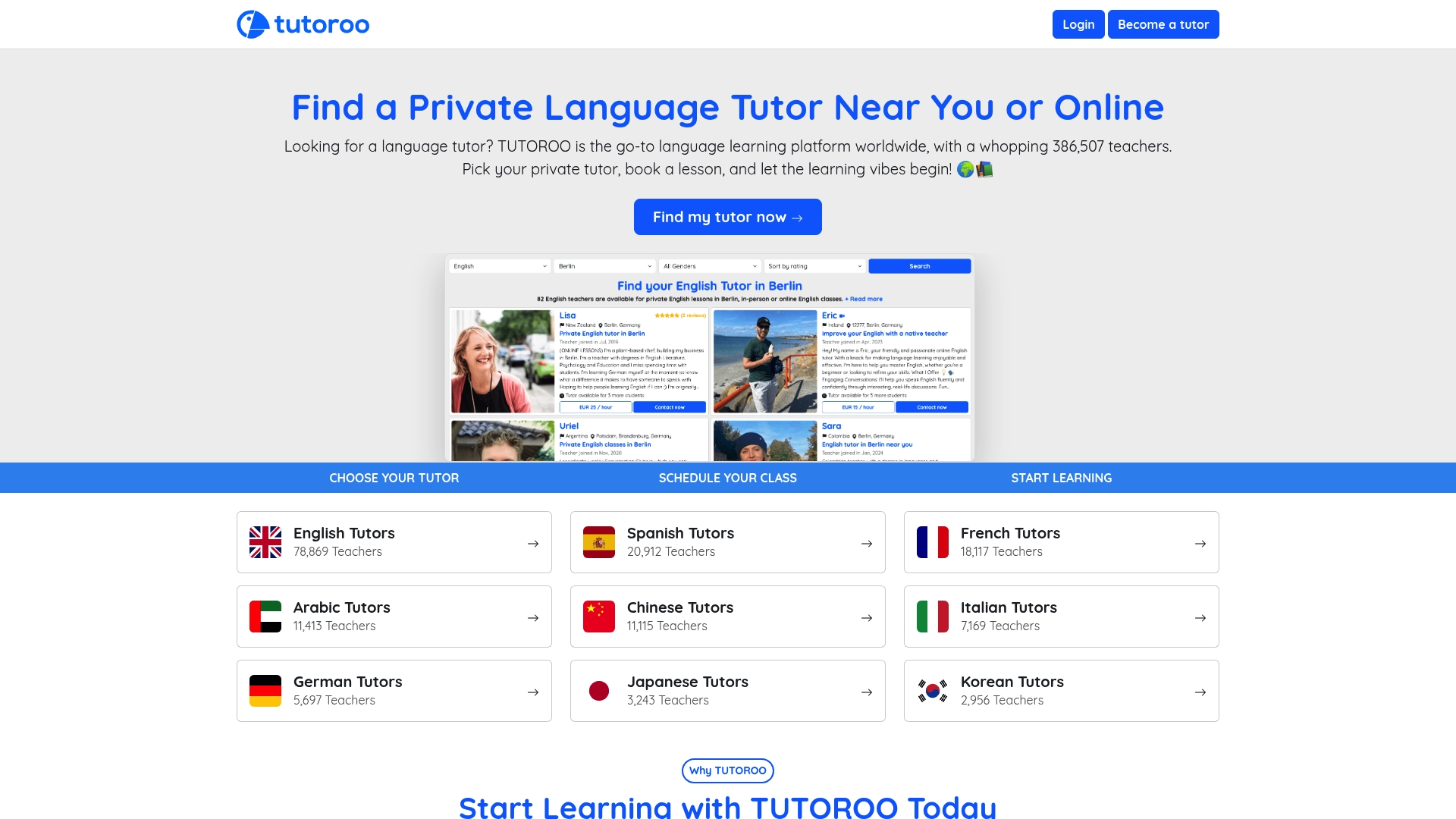
Ready to look? Start from the TUTOROO tutor search, pick your language and send a message describing what helps you learn.
Our perspective
Language learning is about connection: ordering coffee in a new city, joining a family conversation, understanding a film without subtitles. Those goals belong to every learner, including those with ADHD.
We believe the most useful thing a learner can have is a personal relationship with a tutor who listens. The research points the same way: learners with ADHD vary widely, and the strategies that help are individual ones, from chunked tasks to movement to quick, kind feedback. A one-on-one lesson is where those adjustments can happen in the moment.
That is why we built TUTOROO around direct communication. Students can search for tutors by language, location and availability, then talk to them before lessons begin about how they like to learn. Tutors set their own schedules, so learners can look for times that match their energy and routine. We want learners to feel welcome, curious and in control of how their lessons run.
TUTOROO
Frequently asked questions
Can a person with ADHD learn a second language?
Yes. A 2026 study of 154 adults found no difference in learning between participants with and without ADHD on a language-learning task. Learners with ADHD may notice differences in confidence and attention, which the right lesson structure can address.
Is private tutoring better than a group class for ADHD?
Many learners find it a good fit. A private tutor can adjust pace, activity and feedback in real time and keep distractions low. Researchers note that one-on-one sessions suit people who want minimal distractions but still value personal interaction.
How long should a lesson be?
There is no single answer. Younger children often do well with very short sessions, with suggestions in the 8 to 12 minute range, while teenagers and adults can usually handle longer lessons broken into small blocks with a movement break. Agree a length with your tutor, then adjust after a few weeks.
Will learning a second language make a child's ADHD worse?
No evidence suggests it will. A review of nine studies found no systematic disadvantage of bilingualism for people with attention difficulties. Talk to your child's doctor or school team about any concerns specific to your child.
Sources
- Learning second/additional languages with ADHD, Studies in Second Language Acquisition (2026)
- ADHD and language learning: Challenges and tips, Medical News Today
- Learning and using multiple languages: Experiences of adults with ADHD (2024)
- The effects of bilingualism on cognition and behaviour in attention deficits, Frontiers in Psychology (2022)
- When, How, and for Whom? A narrative review, Frontiers in Language Sciences (2026)
- Optimising Language Learning for Students with ADHD, IntechOpen (2023)
- Recognizing and Supporting Students Who Have ADHD, BYU
- Supporting English language learning for ADHD, Frontiers in Education (2025)
- Estrategias para el aprendizaje de vocabulario en una clase virtual de español (2022)
- Challenges and Strategies for Second Language Acquisition, Scitepress (2025)
- School Interventions, CHADD
- Disability and foreign language learning: Countering systemic ableism (2025)
- Parent-Teacher Partnerships to Help Children With ADHD, Children's Hospital of Philadelphia
- Managing Inattentive ADHD with Psychosocial Treatments, CHADD (2019)
- IEP Goals: How to Set Educational Aims for ADHD Learning, ADDitude (2025)