

The quickest way to find a native tutor online is to search a large tutor network by language, availability and lesson goal, then message two or three people and book a short first lesson with each. On TUTOROO you can search by language, location and availability across a community of more than 386,000 language teachers, and message tutors directly before you decide. The harder part is choosing well, because a native speaker is not automatically a good teacher. This guide shows you how to search, what to read in a profile, how to use a first lesson, and when a native speaker is the right pick for your level.
TL;DR
- Start with your goal (travel, an exam, work, school, family) and your current level, then filter tutors by language, availability and lesson type.
- Treat "native" as one useful quality, not the whole checklist. Look for teaching experience, a clear lesson structure and specific feedback.
- Shortlist two or three tutors, message each, and book a single trial lesson before you buy a block of lessons.
- Beginners often gain most from a tutor who explains clearly. Advanced learners gain most from a native speaker's natural phrasing.
- Judge a trial by how much you spoke, how you were corrected and whether you left with a next step.
Table of Contents
- What "native tutor" really means
- Step 1: Know your goal and level before you search
- Step 2: Search where the choice is wide
- Step 3: Read the profile like a teacher would
- Step 4: When native matters most for your level
- Step 5: Message two or three tutors first
- Step 6: Use the trial lesson well
- Step 7: Start small, then settle into a routine
- What affects the price of an online tutor
- Our perspective on finding a native tutor
- Find your tutor on TUTOROO
- FAQ
- Sources
What "native tutor" really means
A native tutor is someone who grew up speaking the language you want to learn. That brings real advantages: natural pronunciation, everyday idioms, a feel for what sounds right and wrong, and a window into how people live and speak in the places where the language is used. For many learners, that cultural connection is the reason to choose a native speaker in the first place. If you want a deeper look, our guide to what a native-speaking tutor is and the benefits covers it.
Being native is not the same as being a teacher, though. Explaining why a past tense is used, spotting the mistake you keep repeating and pacing a lesson to your level are teaching skills. The best tutors combine both: a native ear and a method. So the search below has two parts. Find native speakers, then find the ones who teach well.
Step 1: Know your goal and level before you search
A search for "Spanish tutor" returns thousands of people. A search shaped by your goal returns the right dozen. Before you open a single profile, write down three things.
Your goal. Be specific. "Hold a conversation with my partner's family at Thanksgiving" is a better brief than "get better at Italian". Common goals include:
- Travel: practical phrases, listening to fast speech, handling restaurants, transport and directions.
- Exams: a tutor who knows the test format and can mark your writing and speaking against it.
- Work: industry vocabulary, meetings, emails and presentations.
- School: support alongside a class, homework help and steady confidence-building for a child or teenager.
- Pure speaking confidence: mostly conversation, with gentle correction.
Your level. Teachers often describe learners as beginner, intermediate or advanced. The American Council on the Teaching of Foreign Languages describes these bands by what you can do: at the Intermediate level you can handle short conversations on predictable topics, while at Advanced level you can narrate and describe in past, present and future and deal with a situation that has a complication. Use that as a self-check. If you can order a meal but not explain what went wrong with a hotel booking, you are around Intermediate.
Your schedule and budget. Note the days and times you can really commit to, including your time zone. Tutors on a global platform live all over the world, so a 7 pm lesson for you might be morning or midnight for them. Decide how many lessons per week you can keep up. Two shorter, regular sessions usually beat one long, irregular one.
Step 2: Search where the choice is wide
The size of the pool matters when you want a native speaker of a specific variety. Maybe you want Mexican rather than Castilian Spanish, Parisian rather than Québécois French, or Mandarin from a teacher who grew up in Beijing. A larger network makes that possible.
On TUTOROO, you can browse by language and narrow by location or by online availability. We list tutors for languages such as English, Spanish, French, Japanese, Chinese/Mandarin, German, Italian and Portuguese, among many others. Good places to begin:
- Spanish, French, German and more on our main page
- French tutors online
- Japanese tutors online
- English tutors online
When you search, use the filters that match your brief: the language, whether you want lessons online or in person, and the days you are free. Then open profiles rather than judging by a photo and a headline. If you are weighing screen-based lessons against meeting a tutor in your own city, our comparison of local and online language tutoring helps you decide which suits your routine.
Step 3: Read the profile like a teacher would
A good profile answers questions before you ask them. Here is what to look for, and what each signal tells you.
| What to read | A strong sign | A thin sign |
|---|---|---|
| Native language and variety | States where they grew up and which variety they teach | Just says "native speaker" |
| Teaching experience | Years teaching, learner levels, any formal training | No mention of teaching at all |
| Who they teach | Names levels and goals (beginners, exam prep, business) | "I teach everyone" |
| Lesson approach | Describes how a lesson runs and what materials they use | Only a greeting |
| Availability | Clear days and times in your time zone | Vague or none |
| Lesson types | Conversation, grammar, exam practice, kids | One format only, unexplained |
Several points deserve extra attention.
Teaching experience beats the label. A tutor with a teaching qualification or a language-related degree has usually thought about how people learn. That is a plus, not a requirement: plenty of excellent tutors have learned by teaching hundreds of hours. What you want is evidence that they have taught learners like you, whether that is in the profile text, the lesson descriptions or what they say in their first message.
Consider fluent non-native teachers too. A tutor who learned your target language as a second language often remembers exactly what is hard about it, and can explain it step by step. If you are a beginner, include them on your shortlist. Our article on native and non-native English teachers looks at where each shines.
Check that the lesson types match your goal. A tutor who runs conversation practice may not be the person to mark an exam essay. Look for the format you need, and for sensible lesson lengths. Our piece on language lessons that build real speaking skills explains what a speaking-focused session looks like.
Step 4: When native matters most for your level
The right balance changes as you progress.
Beginners. You need clarity, patience and a clear path from one lesson to the next. A native speaker who explains simply, speaks at a measured pace and knows how to build a first month of lessons is ideal. A native speaker with no teaching habits can leave a beginner lost in fast, natural speech. A fluent non-native teacher with strong method can also be an excellent fit.
Intermediate learners. This is where a native speaker starts to pay off. You can follow along, so you benefit from natural rhythm, common expressions and corrections of the small errors that make you sound textbook. Look for a tutor who talks with you rather than at you.
Advanced learners. Natural accuracy is the prize here: collocations, register, humour, regional expressions, the gap between correct and idiomatic. A native tutor is the strongest choice, ideally one who can tell you why something sounds odd, not just that it does.
Exam candidates. Choose a tutor who knows the test. A native speaker helps with listening and speaking, but format knowledge, timing practice and marking criteria matter just as much.
Children and teenagers. Parents should look for warmth, structure and experience with young learners, and shorter sessions that hold attention. If you are also wondering whether a child's speech is developing as expected, a parent's guide to signs of speech delays can help you tell the difference between a language-learning question and something to raise with your paediatrician.

Step 5: Message two or three tutors first
Do not book the first tutor you like. Shortlist two or three, and send each a short, specific message. Direct messaging on the platform makes this easy, and the replies tell you a lot.
A good message includes:
- Your language and current level in a sentence.
- Your goal and timeline (for example, a trip in four months).
- When you can have lessons, with your time zone.
- One question about their approach, such as "How would you plan my first month?"
Notice how they respond. A tutor who answers your question, suggests a plan and proposes times is showing you how they work. A generic reply is also information. Our step-by-step guide to hiring the right language tutor includes more on this stage.
Step 6: Use the trial lesson well
A first lesson is your best evidence. You are not being polite, you are collecting information. Go in with a plan, and keep it short enough to compare tutors fairly. Our guide to choosing a tutor with a 25 minute trial gives you a structure and templates, and trial lesson etiquette covers what to do before, during and after.
During the trial, watch for:
- Speaking time. Did you talk for a good share of the session, or did the tutor lecture? In a speaking lesson, you should be doing a lot of the speaking.
- Correction style. Were mistakes fixed in a way that kept you talking, and were the corrections specific? Look for a tutor who tells you what to change, not just "good".
- Structure. Was there a warm-up, a focus and a wrap-up? Could you name what you practised?
- Fit for your level. Was the language pitched slightly above where you are, without leaving you lost?
- Pronunciation and accent. Did they model sounds clearly and help you hear the difference?
- A next step. Did you leave with a small task or a plan for the next lesson?
A few questions that are worth asking in the lesson itself:
- How would you structure lessons for my level and goal?
- Which materials do you use, and why?
- How do you handle pronunciation and accent?
- What would you want me to do between lessons?
The answers show whether the tutor has a method. Afterwards, ask yourself how you felt: energised and a little stretched is a good sign.
Step 7: Start small, then settle into a routine
Book a single lesson, or a short run, with the tutor you liked best before you commit to a larger block. Once you are happy, build a rhythm: the same day and time each week makes lessons stick. Agree on lesson length, how to reschedule and how you will pay before the first full lesson, so there are no surprises. On TUTOROO, tutors set their own schedules and are paid directly by their students for lessons, which keeps arrangements simple between you and your tutor.
Between lessons, ten minutes of daily review beats an hour once a week. Ask your tutor for a short task: record yourself describing your day, learn five phrases from the lesson, or write three sentences to be corrected next time. For ideas on structuring that practice, see our conversation lesson formats and routines and these online tutoring examples for fluency.
What affects the price of an online tutor
Tutor rates in the United States vary widely, and no single figure fits every language and level. What tends to move the price:
- The language. Widely taught languages usually have more tutors and a wider range of rates than less common ones.
- Experience and qualifications. Tutors with formal training or long track records often charge more.
- Specialism. Exam preparation and business language are typically priced differently from general conversation.
- Lesson length and frequency. Longer lessons and regular schedules change the cost per hour you agree on.
- Where the tutor lives. Online tutors can be based anywhere, which widens the range of rates available to you.
Each tutor sets their rate on their own profile, so you can compare like with like before you message anyone. Decide your weekly budget first, then filter for tutors who fit it.
Our perspective on finding a native tutor
We believe the best language tutor is the one you will actually want to talk to every week. That sounds simple, but it is the heart of how people learn: regular, personal conversation with someone who listens, corrects kindly and shares the culture behind the words.
A native speaker opens doors that a textbook cannot. Idioms, humour, the rhythm of everyday speech and the way people really greet each other all come alive in a conversation. That is why we built TUTOROO around a very large community of language teachers, so a learner can search by language, location and availability and message a tutor directly.
Our advice is to pair that authenticity with a clear method. Say what you want to achieve, talk to a few tutors, and let a first lesson show you who explains well and keeps you speaking. Tutors keep control of their schedules and are paid directly by their students, which means the relationship stays personal, between you and the person teaching you.
TUTOROO
Find your tutor on TUTOROO
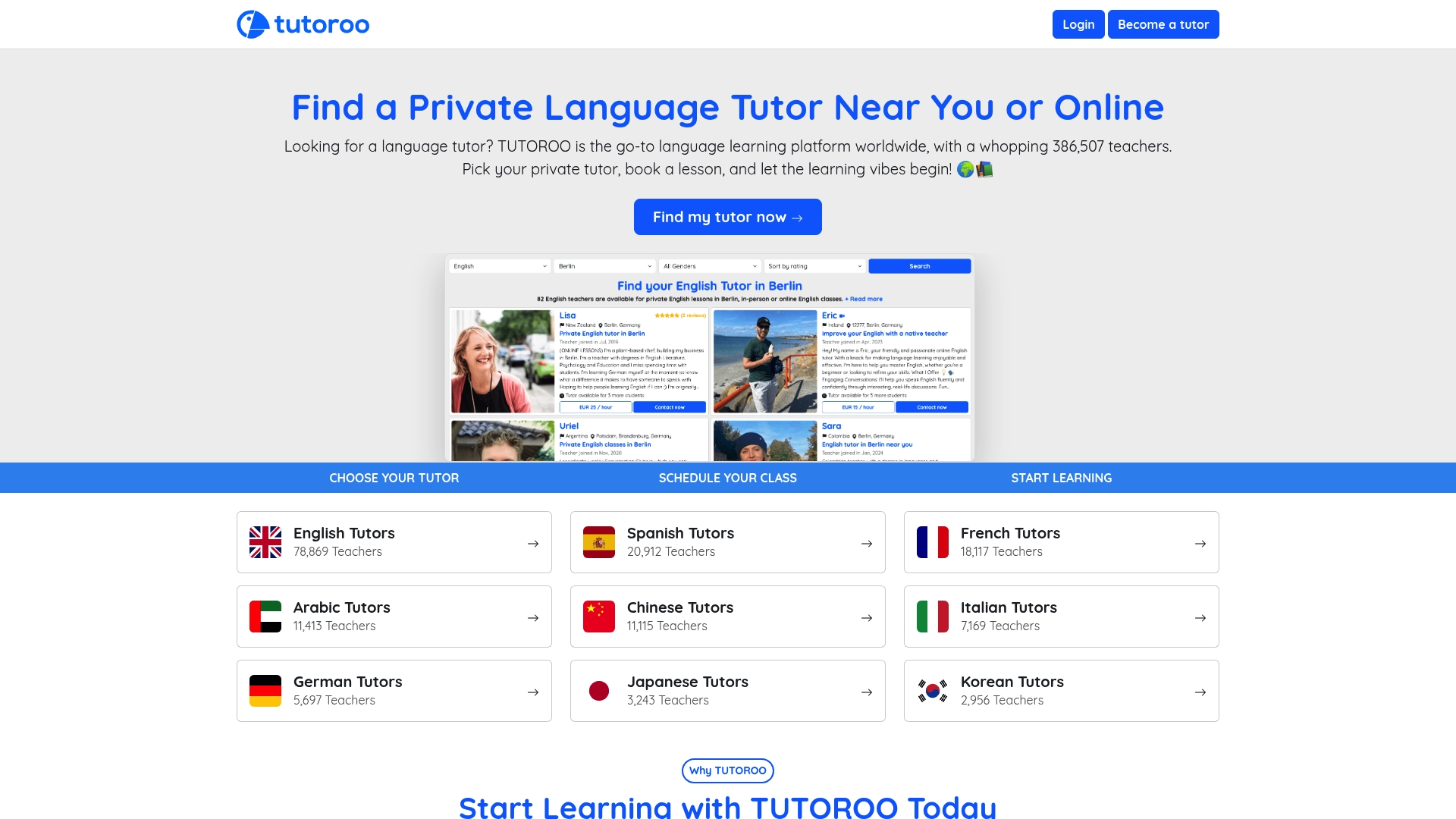
If you are ready to start, search our tutors by language and availability. You can browse teachers of English, Spanish, French, Japanese, Chinese/Mandarin, German, Italian and Portuguese, read profiles, and message the ones who suit your goals. Shortlist two or three, book a first lesson with each, and keep the one who leaves you speaking more than you thought you could.
If you teach a language yourself and want flexible work, tutors register on the platform, set their own schedules and receive payment directly from students.
FAQ
Do I need a native tutor, or is a fluent teacher enough?
It depends on your level and goal. Beginners often do very well with any tutor who explains clearly and plans lessons well, while advanced learners usually gain most from a native speaker's natural phrasing. If you can, shortlist both kinds and let a trial lesson decide.
How do I find a native tutor for a specific variety, such as Mexican Spanish or Canadian French?
Search by language, then read profiles for where the tutor grew up and which variety they teach. Mention the variety in your first message and ask for a sample of the vocabulary or accent you want to learn. A large tutor community makes it far likelier that you find the match you are after.
How long should I try a tutor before deciding?
A single trial lesson is enough to judge speaking time, correction style and structure. If it went well, book a short run of regular lessons before committing to a larger block. After three or four lessons you should already notice a clearer plan and some progress.
What should I prepare for a first online lesson?
Bring your goal, your rough level and two or three things you want to say in the language. Check your internet connection, headphones and a quiet space beforehand. Afterwards, note what you practised and what the tutor suggested for next time.
Can I find a tutor for my child?
Yes. Look for a tutor with experience of young learners, a warm manner and a clear lesson structure, and ask for shorter sessions that keep attention. Message the tutor first so you can describe your child's level and interests, and sit in on the first lesson if you wish.