

TL;DR:
- Tailored language courses increase knowledge retention by up to 57% compared to group classes and focus on your specific goals. They provide personalized curricula, rapid start, and real-time adjustments, improving speaking confidence and fluency faster. Investing in customized instruction supports career growth by developing industry-specific vocabulary and intercultural skills.
Most learners assume a group class is "good enough" until they plateau. The truth is, why prefer tailored language courses becomes obvious the moment you realise that custom learning programs can increase knowledge retention by up to 57% compared to generic group classes. That is not a small margin. If you are studying a language to advance your career, hold real conversations, or connect with a new culture, a one-size-fits-all approach may actually be holding you back. This guide breaks down precisely what sets tailored courses apart, how they are built around your goals, and why they deliver faster, more lasting results.
Table of Contents
- What makes tailored language courses more effective
- How tailored courses adapt to your personal goals and level
- One-on-one immersion: faster progress and real-world speaking confidence
- Why investing in tailored language training benefits your career
- Human-taught tailored courses versus AI tools: what really works best for speaking
- The overlooked power of tailored language courses to accelerate fluency
- Discover tailored language courses with TUTOROO
- Frequently asked questions
Key Takeaways
| Point | Details |
|---|---|
| Improved retention | Tailored courses increase knowledge retention by focusing on your specific needs and goals. |
| Faster speaking progress | One-on-one immersion accelerates conversational skills much faster than group classes. |
| Career advantages | Language training can boost salaries and job prospects through better communication and international opportunities. |
| Human guidance matters | Real-time feedback from tutors reduces anxiety and improves productive language skills like speaking. |
| Personal goal clarity | Being clear about your language goals ensures your course is precisely adapted for maximum impact. |
What makes tailored language courses more effective
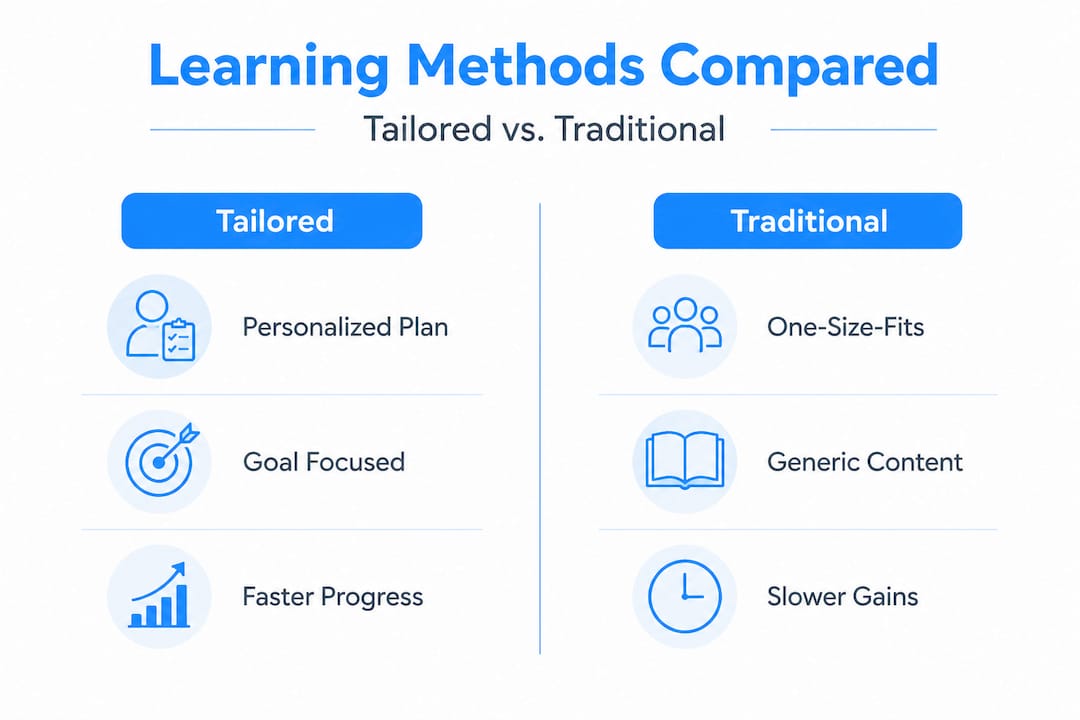
Traditional language classes are designed to serve the average learner. That means if you already know basic vocabulary, you sit through revision you do not need. If you are a professional needing specific workplace vocabulary, you practise restaurant dialogues instead. Neither scenario moves you forward efficiently.
Tailored courses work differently. A tailored curriculum in tutoring strips away everything irrelevant and focuses only on the language you actually use. A nurse learning French for patient care will never spend time on travel idioms. A business analyst learning Mandarin for client calls will practise presentation language from day one.
Here is why the advantages of personalised language learning translate directly into better outcomes:
- Relevance drives retention. When content connects to your real life, your brain forms stronger memory pathways. Irrelevant content is forgotten quickly.
- Pacing matches your ability. You move faster through material you already understand and slower through areas that genuinely challenge you.
- Gaps are targeted, not guessed. A tutor identifies exactly where your comprehension breaks down, rather than following a fixed syllabus.
- Short, spaced sessions build lasting recall. Focused lessons spread over time outperform marathon group sessions for long-term memory.
"Custom learning programs like tailored language courses can increase knowledge retention by up to 57% compared to generic group classes." — World Business Outlook
If you want to explore what personalised one-on-one lessons look like in practice, the contrast with group instruction becomes even more striking. The benefits of customised language classes are not theoretical. They show up in how quickly learners begin speaking with confidence.
How tailored courses adapt to your personal goals and level
Understanding why tailored courses are effective now lets us see how they are customised exactly for you.

Every strong tailored course begins before the first lesson. An intake process, usually a short interview or written consultation, identifies your current level, your goals, and the specific contexts in which you need the language. Tailored language courses begin with a no-strings-attached intake interview to define personal objectives, followed by a clear offer and quick course start in multiple languages. That structure is deliberate. Without it, tutors are guessing.
Here is how a well-run tailored course typically comes together:
- Intake interview. You describe your goals, current level, time constraints, and preferred learning style. This takes 20 to 30 minutes and shapes everything that follows.
- Needs analysis. The tutor identifies the vocabulary, grammar, and speaking contexts most relevant to your situation.
- Custom syllabus creation. A plan is built around your specific contexts, whether professional, social, academic, or travel-focused.
- Rapid course launch. Because there is no waiting for a class to fill, sessions can begin within days of your intake.
- Ongoing adjustment. As you progress, the syllabus shifts. Topics you master drop off. Areas needing work get more attention.
Pro Tip: Be specific during your intake interview. Saying "I want to improve my Spanish" produces a very different course than "I need to negotiate contracts in Spanish with clients in Mexico City." Vague goals produce generic plans. The more precise you are, the more targeted your learning becomes. The one-on-one lessons benefits become most visible when your goals are clearly defined from the outset.
One-on-one immersion: faster progress and real-world speaking confidence
Having explored personalised plans, let us see how private immersion programmes bring your language skills to life quickly.
Immersion is the most talked-about method in language learning, and for good reason. But there is a significant difference between full-group immersion and private one-on-one immersion. In a group setting, you wait your turn. You observe. You listen. In a private setting, you speak. Constantly. One week of concentrated private immersion matches months of weekly group classes for conversational confidence and comprehension improvements. That finding should reshape how you think about your study time.
The core benefits of this approach include:
- Continuous speaking time. You are the only student, so every minute is active. No downtime while others practise.
- Real-time adaptation. If you struggle with a particular sound or phrase, the lesson pivots immediately.
- Cultural context built in. Lessons incorporate real-world scenarios, ordering food, navigating a workplace, making small talk, so you practise language that actually comes up.
- Lower anxiety, higher output. One-on-one settings reduce the social pressure of group classes, helping learners speak more freely and take more risks.
| Feature | Private one-on-one | Group class |
|---|---|---|
| Speaking time per session | High (entire lesson) | Low (shared between students) |
| Lesson adaptability | Real-time | Fixed syllabus |
| Pacing control | Learner-centred | Average of the group |
| Cultural immersion | Personalised scenarios | Generic examples |
| Progress speed | Fast | Moderate |
Pro Tip: Ask your tutor to include at least one real-world role-play scenario per session. Simulating a job interview, a phone call, or a social event forces you to think in the target language rather than translate from your first language. This is how tailored courses improve language skills at the deepest level. For further reading, explore why learning one-on-one consistently outperforms group instruction for adult learners.
Why investing in tailored language training benefits your career
Beyond learning speed, tailored courses also offer significant career advantages worth considering.
Language skills have always opened professional doors. But tailored language training takes this further by ensuring the vocabulary and communication style you develop match your industry. A generic course teaches you to say "I work in finance." A tailored course teaches you to discuss quarterly results, negotiate terms, and build rapport with international colleagues.
The professional return on this investment is measurable. Language training can add 10%–15% to employee salaries by enabling fluent international communication and promotions. That figure reflects a real shift in workplace value.
Consider these career-specific advantages:
- Access to international roles. Employers actively seek candidates who can communicate across borders. Tailored fluency makes you a genuine candidate, not just a checkbox.
- Stronger workplace relationships. Speaking a colleague's or client's language, even partially, builds trust and goodwill that generalist courses rarely develop.
- Cultural competence. Tailored courses often incorporate cultural nuance alongside language, helping you avoid missteps in cross-cultural settings.
- Demonstrating initiative. Employers notice when employees invest in language development. It signals ambition and adaptability.
"Language training can add 10%–15% to employee salaries by enabling fluent international communication and promotions." — Simon & Simon
Understanding the benefits of language training at this professional level reframes how you think about course costs. This is not an expense. It is an investment with a trackable return.
Human-taught tailored courses versus AI tools: what really works best for speaking
While technology plays a role, tailored human lessons remain the gold standard for developing speaking ability.
AI language tools have improved dramatically. They offer instant feedback on vocabulary, pronunciation scoring, and near-limitless practice opportunities. For receptive skills like reading and listening, they perform well. But speaking is a different challenge. Human-taught tailored instruction excels in speaking skills due to real-time feedback and reduces anxiety compared to group or AI-only learning. That distinction matters enormously for learners whose primary goal is conversation.
Here is how the comparison breaks down in practice:
- AI strengths. Vocabulary drilling, pronunciation practice outside class hours, grammar correction at scale, and reducing anxiety before speaking with a real person.
- Human tutor strengths. Catching errors AI misses, adjusting tone and register for your specific context, responding to emotional cues, and replicating authentic conversation.
- Where AI falls short. It cannot assess whether your phrasing sounds natural in a specific professional context. It does not notice that you hesitate before certain verb forms. It cannot create the interpersonal dynamic that real conversation requires.
- The best approach. Use AI tools between sessions for practice and vocabulary reinforcement, and use your human tutor sessions for output, feedback, and building genuine fluency.
Pro Tip: Record yourself speaking during AI practice sessions, then bring difficult phrases or moments of confusion to your next tutor session. This bridges the gap between solo practice and guided learning effectively. Explore innovative online teaching methods that combine technology with expert human instruction for the strongest results.
The overlooked power of tailored language courses to accelerate fluency
Here is something most articles on language learning get wrong: they treat fluency as the result of vocabulary accumulated over time. It is not. Fluency is the result of thinking directly in a language, without translating through your first language first.
Tailored courses create the conditions for this shift faster than any other method. Because every session is designed around your specific language use, you are not practising abstract sentences. You are practising your conversations. That personal relevance forces deeper cognitive engagement with the language.
What expert tutors consistently observe is that learners in tailored one-on-one settings begin thinking in the target language significantly earlier than those in group classes. Individual classes force constant speaking and include real-life outings, splitting lessons into warm-up, practice, and immersion phases to accelerate fluency. That structure is not incidental. It is designed to push the brain across the translation threshold.
The other overlooked element is what happens outside class. Tailored tutors often assign personalised real-world tasks, listening to a specific podcast, watching a film in the target language, or practising a conversation in a real setting. These are not generic homework tasks. They connect directly to your learning objectives and extend immersion beyond the lesson itself. Explore the full picture of personalised learning gains and why structured personalised approaches consistently outperform self-guided or group-based alternatives.
Most traditional classes lack this immediacy. They teach language about the world rather than language for your world. That distinction is where tailored courses quietly pull ahead, and where fluency begins to feel less like a distant goal and more like a natural outcome.
Discover tailored language courses with TUTOROO
Ready to take the next step? TUTOROO makes tailored language courses accessible and effective to help you reach your goals.
If everything above resonates with where you are in your language journey, TUTOROO is built exactly for this. Whether you are preparing for a career move, building conversational confidence, or simply wanting to connect more authentically with another culture, personalised one-on-one instruction is the most direct path forward.
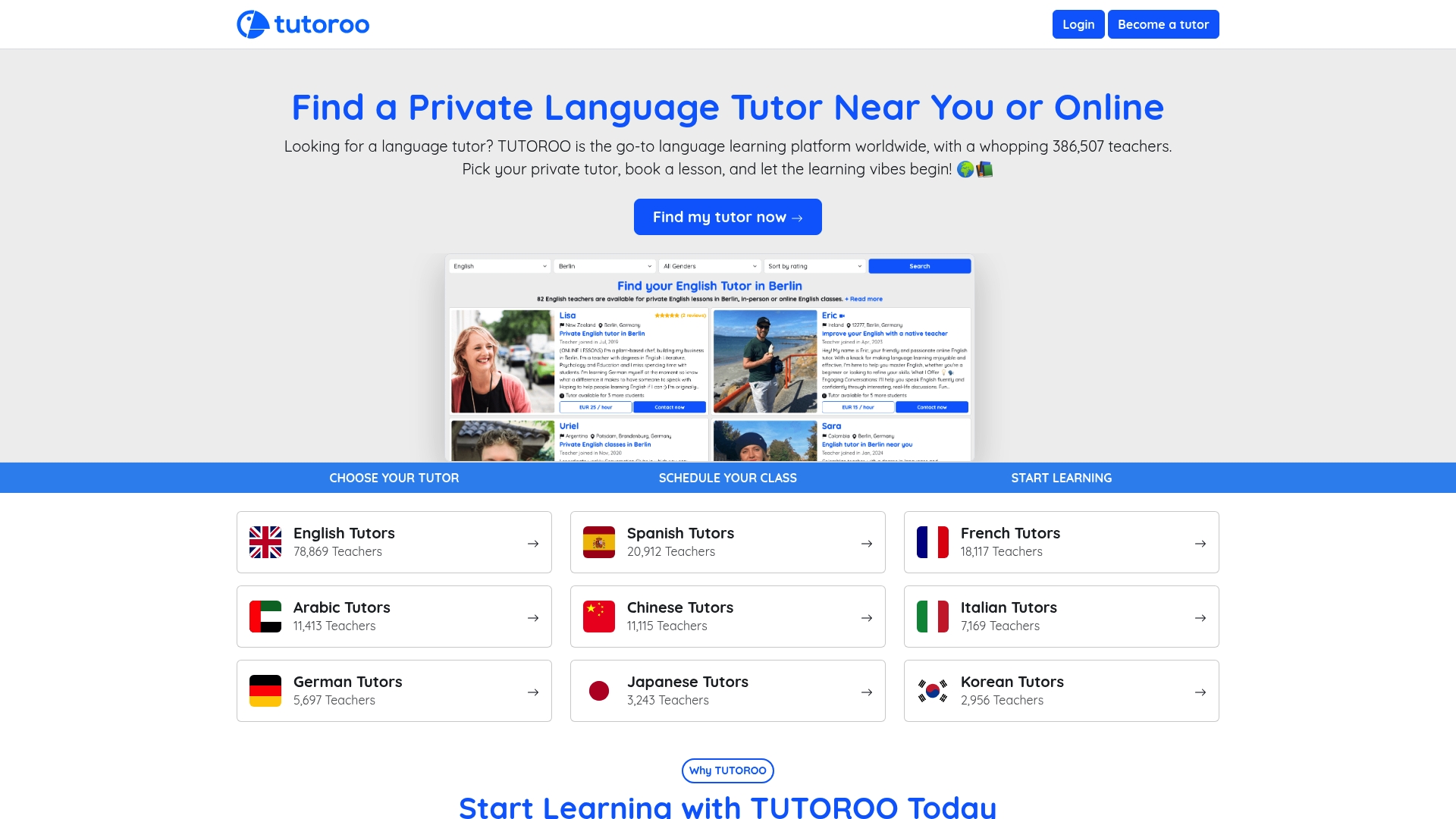
TUTOROO connects you with over 386,000 experienced tutors across dozens of languages, available online or in person, on a schedule that suits you. Lessons are built around your level and objectives from the very first session, with no waiting for a class to fill. You could be speaking with a native-speaking tutor within days. Whether you are after English, Spanish, Mandarin, or even Malay tutors online, the right match is within reach. Start your tailored language learning journey at TUTOROO and discover what genuine personalised tuition feels like.
Frequently asked questions
What are tailored language courses?
Tailored language courses are personalised learning programmes designed around your unique goals, level, and needs to maximise effectiveness and accelerate genuine fluency.
How quickly can I expect to see improvements with tailored courses?
Many learners see measurable progress in conversational skills within weeks, particularly with one-on-one immersion, where one week of private immersion can match months of group class progress.
Do I need to be clear about my learning goals before starting?
Yes, bringing specific personal or professional goals to your intake interview allows tutors to create a precise course plan. As University of Groningen research notes, vague objectives lead to generic plans that deliver far weaker results.
Can AI replace human tutors for language speaking practice?
AI tools support vocabulary and listening practice effectively, but human tutors excel in speaking through real-time feedback and the authentic conversational dynamic that AI cannot replicate.
How can tailored language courses benefit my career?
Tailored courses build the specific vocabulary and communication confidence needed for your industry, and language training adds 10%–15% to salaries by enabling fluent international communication and positioning you for promotion.