

TL;DR:
- The online language tutoring market is valued at $2.8 billion in 2024 and is projected to reach $7.9 billion by 2030, driven by human demand. Private one-on-one instruction offers tailored content, immediate feedback, and personalized motivation, making it the fastest-growing segment. Emotional trust, genuine connection, and adaptability remain crucial factors sustaining demand for human tutors despite technological advancements.
The online language tutoring market is valued at US$2.8 billion in 2024 and projected to reach US$7.9 billion by 2030, yet many learners still struggle to understand what's actually driving this remarkable growth. It's easy to assume that a flood of new apps and platforms is pushing the numbers, but the real story is far more human. Genuine demand comes from real people with real goals: professionals chasing promotions, students sitting high-stakes exams, migrants building new lives, and travellers wanting to connect authentically. This guide breaks down who drives language teaching demand, why personalised instruction sits at the heart of it all, and how you can benefit directly.
Table of Contents
- The rise in language teaching demand explained
- How technology fuels personalised tutoring demand
- Why one-on-one language teaching stands out
- Who benefits most from today's language teaching demand
- The hidden truth about language teaching demand
- Find your perfect language tutor
- Frequently asked questions
Key Takeaways
| Point | Details |
|---|---|
| One-on-one demand surges | Personalised online tutoring grows rapidly as exams, business, and migration drive global interest. |
| Technology expands access | Platforms and AI make private lessons more flexible, but human tutors remain essential for success. |
| Personal goals shape demand | Learners seeking exams, work opportunities, or travel benefit most from private instruction. |
| Multiple pathways exist | Choosing the right blend of self-study and tutor support leads to the fastest and most confident progress. |
The rise in language teaching demand explained
"Demand" in language education simply means the number of learners actively seeking instruction to reach a specific goal. It's not about how many apps exist or how many tutors are registered on a platform. Demand is shaped by what people need to accomplish and how urgently they need to accomplish it.
The drivers are both broad and deeply personal. Globally, one-on-one instruction is preferred by professionals, students, and migrants preparing for exams like IELTS and TOEFL, advancing in business, planning international travel, or pursuing personal growth. These are goal-oriented learners who want rapid progress and immediate feedback. They don't have time to sit through classes pitched at the average student. They need lessons tailored precisely to their situation.
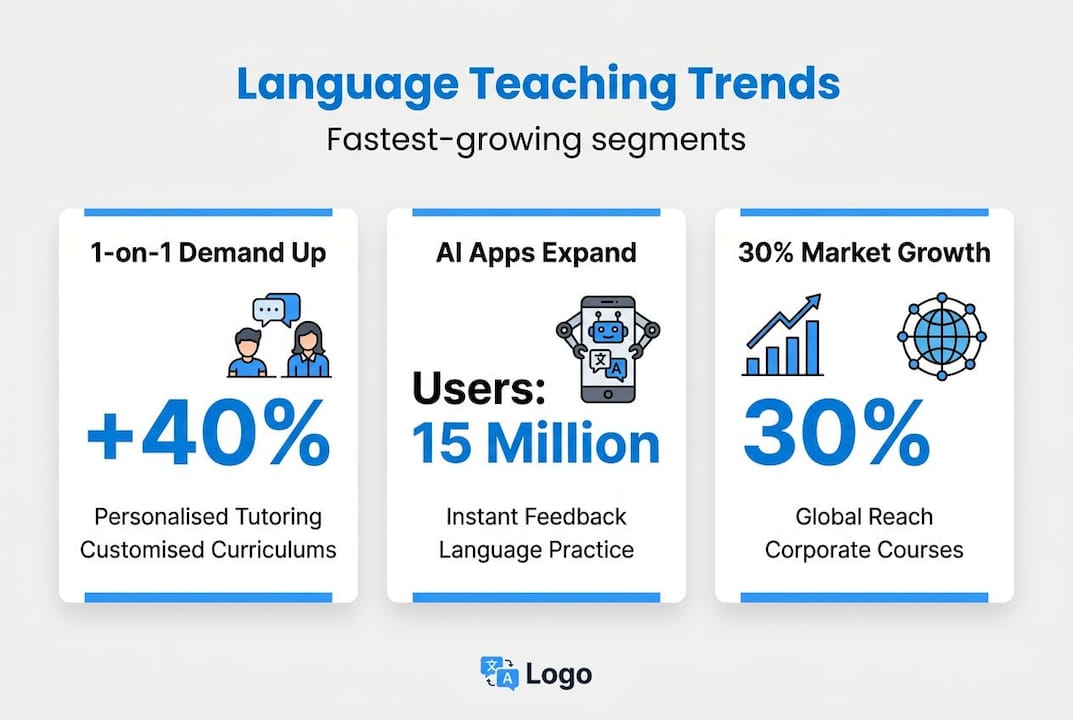
The numbers back this up. 64% of students in the US use private tutoring, with 61% of those sessions happening online. Globally, 65% of parents prefer individualised support for their children's language learning over group settings. Language learning accounts for 34 to 38% of the entire private tutoring market, making it the single largest subject category worldwide.
The main demand groups break down like this:
- Students preparing for English proficiency exams such as IELTS, TOEFL, and Cambridge qualifications
- Working professionals who need business language skills to operate in global markets
- Migrants and expats learning the language of their new country to settle, work, and connect socially
- Travellers wanting basic conversational fluency before visiting another country
- Hobbyists and heritage learners reconnecting with a language for personal or cultural reasons
Understanding which group you belong to is the first step. The tutoring benefits available to each group differ significantly, and recognising your own goals shapes every decision about how, when, and with whom you study. For online education for goal-oriented learners, the research consistently shows that clarity of purpose accelerates progress faster than any particular method alone.
How technology fuels personalised tutoring demand
Technology hasn't replaced the human tutor. It has expanded the audience for human tutors enormously. Online platforms, live video tools, and interactive whiteboards mean that a learner in regional Australia can now connect with a native Spanish speaker in Madrid or a certified Mandarin teacher in Shanghai. Geography is no longer a barrier.
Here's how tutor-led instruction compares to self-paced digital tools:
| Learning mode | Key strengths | Market growth |
|---|---|---|
| Tutor-led live sessions | Real-time feedback, conversation practice, personalised goals | 21.25% CAGR through 2031 |
| Self-paced learning apps | Convenience, vocabulary reinforcement, low cost | Holds 56% of market share |
| Hybrid (tutor + app) | Maximises both depth and flexibility | Fastest-growing user preference |
The tutor-led segment is growing faster than any other, driven by demand for real-time conversation practice and meaningful, personalised lessons. Self-learning apps hold the largest current share because they're cheap and accessible, but their limitations become obvious the moment a learner needs to hold an actual conversation or navigate a nuanced grammar point.
Artificial intelligence adds genuine value as a supplementary tool. AI-powered apps can identify pronunciation errors, generate practice sentences, and track vocabulary retention over time. However, AI cannot replicate the trust built between a learner and a skilled human tutor. It cannot read the subtle frustration on your face when a grammar rule refuses to click, adjust its pacing mid-lesson because you seem distracted, or celebrate with genuine warmth when you finally nail that tricky tense. Exploring personalised learning apps alongside live tutoring sessions creates a powerful hybrid model. For those who want to understand how expert-guided success works in online education, the evidence points clearly to human expertise as the irreplaceable ingredient.

Pro Tip: Use self-study apps for daily vocabulary review and pronunciation drilling, but schedule regular live sessions with your tutor to practise real conversation and tackle grammar challenges. This combination accelerates progress faster than either approach alone.
Why one-on-one language teaching stands out
Private instruction isn't just popular. It's the fastest-growing segment in a market already growing quickly. The Language Learning Live Tutoring market reached USD 7.8 billion in 2024 and is expected to grow to USD 23.6 billion by 2033 at a 13.2% CAGR, with one-on-one tutoring leading the charge for learners working towards specific goals like exam preparation and professional communication.
Here's a practical comparison of the main learning formats:
| Format | Personalisation | Feedback speed | Typical cost | Best for |
|---|---|---|---|---|
| One-on-one private tutoring | Very high | Immediate | Medium to high | Exams, business, fast results |
| Group classes | Low | Delayed | Low | General exposure, social learners |
| Self-study apps | Medium | Automated | Very low | Supplementary review |
"One-on-one tutoring offers unmatched personalisation and rapid progress for learners with specific goals, delivering real-time feedback that group settings simply cannot replicate."
The top three reasons why one-on-one instruction drives language teaching demand are:
- Tailored content. Every lesson centres on your specific goals, gaps, and preferred learning style. A tutor preparing you for IELTS will focus entirely on the skills that exam demands, not on topics irrelevant to your score.
- Immediate, precise feedback. Mistakes are corrected in real time, preventing bad habits from forming. This is critical for pronunciation, grammar, and the kind of nuanced vocabulary choices that separate competent speakers from confident ones.
- Consistent motivation and accountability. Having a scheduled session with a real person who knows your progress creates a level of commitment that no app can manufacture.
The personalised learning gains available through private tutoring are well documented, and learners who commit to regular one-on-one sessions report reaching conversational fluency far faster than those relying solely on group classes or apps. Research supporting 3x faster results with private instruction reflects what thousands of learners experience in practice. The ability to focus entirely on the skills that matter most to you, at the pace that suits your life, is a genuine competitive advantage. If you want to see how faster language skill building works in a practical setting, the evidence points consistently in the same direction: personalised attention produces measurably better outcomes.
Who benefits most from today's language teaching demand
Not every learner needs the same thing, but some situations practically demand private instruction. Understanding where you fit in the demand picture helps you make smarter decisions about how to invest your learning time and budget.
Consider these real-world scenarios where private tutoring delivers the clearest value:
- An international student sitting the IELTS exam in three months who needs targeted speaking and writing feedback every week
- A mid-career professional preparing to lead meetings with overseas clients, needing to master business vocabulary and professional register quickly
- A skilled migrant who has arrived in Australia and needs everyday conversational English to find work, navigate services, and build friendships
- A traveller planning a two-month stay in Japan who wants enough Japanese to get around, order food, and make connections beyond the tourist circuit
- A heritage learner who grew up hearing Arabic or Italian at home and wants to develop the reading and writing skills their grandparents spoke of with pride
- A university student studying in a second language who needs intensive grammar and composition support to keep up with native-speaking peers
The common thread across all of these is urgency combined with specificity. These learners have a clear goal, a timeline, and real consequences if they don't improve. That's precisely why demand driven by professionals and students continues to accelerate, because the stakes are real and the one-on-one format delivers the results they need.
Choosing the right tutor matters as much as choosing the right format. Personalised one-on-one lessons with a tutor who has direct experience with your specific goal, whether that's exam coaching, business English, or conversational fluency, will always outperform a general approach. Expert tutors who understand how to unlock language potential will tailor their methodology to your pace, your gaps, and your communication style from the very first session.
Pro Tip: When searching for a tutor, look specifically for experience with your goal type. An exam specialist, a business communication expert, and a conversational tutor each bring different strengths. Match the tutor's background to your actual objective.
The hidden truth about language teaching demand
Market reports are compelling reading. Billion-dollar figures and impressive compound annual growth rates tell a story of scale and opportunity. But they leave out the most important part: why individual human beings actually pick up the phone, open a platform, and search for a tutor at 10pm on a Tuesday.
The answer is almost never purely rational. It's confidence. It's the quiet fear of sounding foolish in a meeting where everyone else moves fluidly between languages. It's the longing to speak to a grandmother before it's too late. It's the professional anxiety of watching a promotion slip to a bilingual colleague. These emotional drivers are what sustain long-term demand, not just market conditions.
Conventional wisdom in this space tends to reduce everything to access and convenience. Cheaper platforms, more tutors, faster matching. These things matter. But the real engine of demand is trust. Learners return to tutors they trust. They refer friends to tutors who made them feel genuinely supported, not just corrected.
After years of connecting learners and tutors worldwide, we've observed that the platforms and approaches which hold learner loyalty are the ones that treat the relationship between student and teacher as something worth cultivating carefully. AI tools improve every year, and they'll keep improving. But the learner sitting nervously before an IELTS speaking test isn't looking for an algorithm. They're looking for someone who truly knows their strengths, anticipates their weaknesses, and believes they can succeed. That's what the key to faster mastery has always been, and what no technology has yet come close to replacing. Adaptability, empathy, and genuine human connection are what keep demand for private language tutors rising year after year, regardless of what the market cycle is doing.
Find your perfect language tutor
Understanding the demand landscape is one thing. Taking action is another entirely. TUTOROO connects learners worldwide with over 386,000 private language tutors, making it straightforward to find exactly the right match for your goals, schedule, and budget.
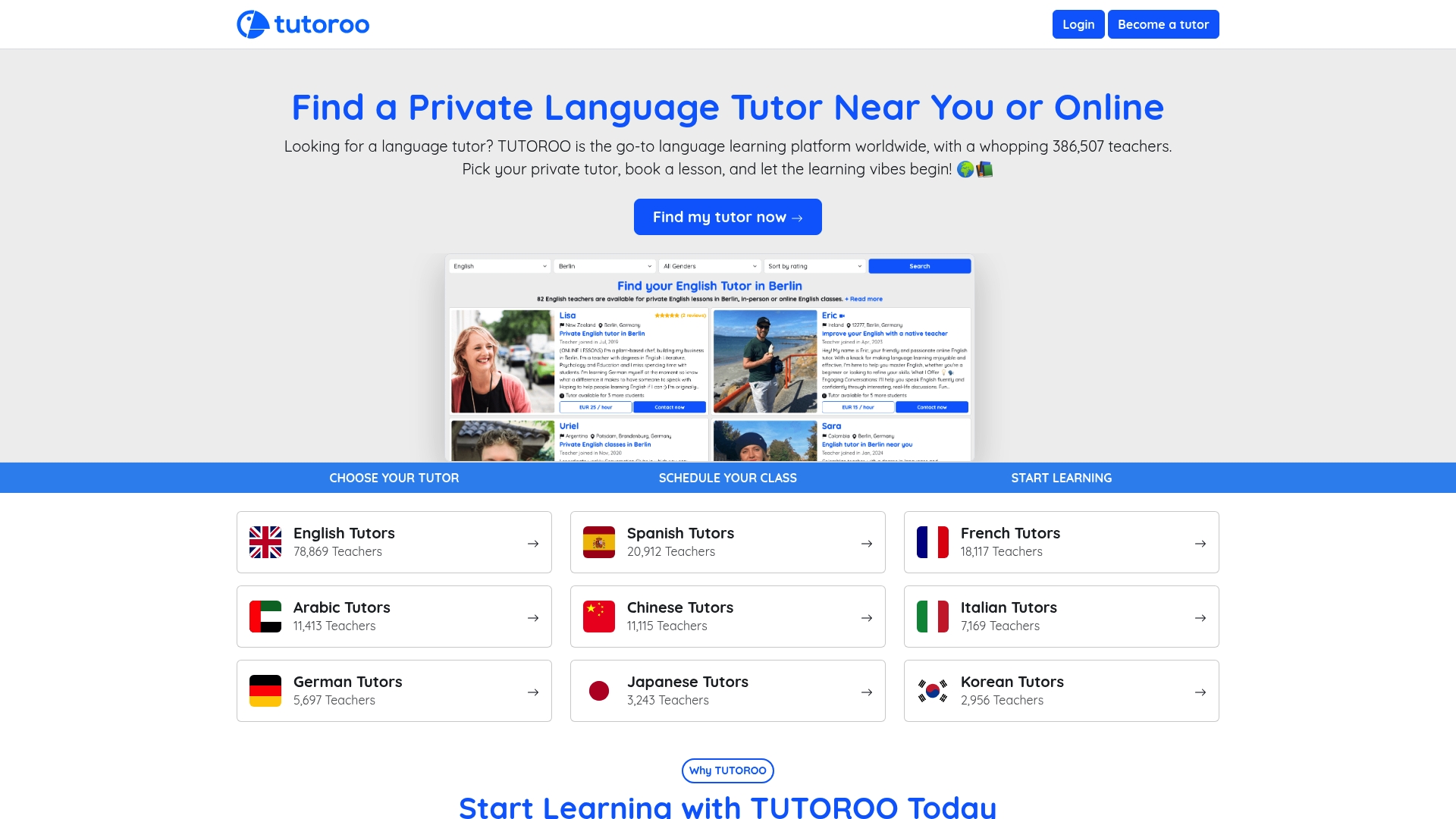
Whether you're preparing for a high-stakes exam, advancing your career, settling into a new country, or simply opening a door to a new culture, flexible private lessons make every goal achievable. Explore the full range of private tutor options and filter by language, location, and availability to find someone who fits your life. If English is your focus, find an English tutor with the specialisation you need, from academic writing to conversational fluency. And if you're exploring less common languages, browsing options such as Lebanese tutors online shows just how diverse and accessible the TUTOROO community truly is. Your language journey starts with one well-matched lesson.
Frequently asked questions
Why is demand for language tutors rising so quickly?
More people worldwide need personalised language support for career advancement, migration, and high-stakes exams, and technology has made private tutoring far more accessible than ever before. The live tutoring market is growing to USD 23.6 billion by 2033, reflecting genuine learner need rather than hype.
Does online tutoring work better than language learning apps?
Live tutor-led sessions deliver stronger real-time conversation skills and genuine personalisation, while self-study apps work best for daily review and convenience. Tutor-led instruction grows at 21.25% CAGR, outpacing app-based learning for meaningful skill development.
Who needs one-on-one language lessons the most?
Exam takers, business professionals, migrants, and dedicated hobbyists benefit most from truly personalised language teaching. One-on-one instruction is specifically preferred by learners who need rapid progress and precise, timely feedback.
Can AI tutors replace human language teachers?
AI tools complement practice and provide useful automated feedback, but human tutors remain essential for building confidence, navigating nuance, and delivering the kind of genuine personalisation that keeps learners motivated and progressing.
Recommended
- Flexible work for language tutors: unlock global reach
- TUTOROO Blog - Learn and Teach Irish in Dublin | Irish Lessons & Tutors with TUTOROO
- TUTOROO Blog - Language and Culture: How They Shape Each Other | Learn a Language with TUTOROO
- TUTOROO Blog - Teach English in Jeddah | Become a Tutor with TUTOROO
- Automate Your Forex Teaching: Step-by-Step Guide