

Yes, you can learn two languages at the same time. The catch is that it costs more time, steadier habits and clearer goals than learning one. Most learners who stall do so because they split a single study session in half, choose two languages that look alike, or never decide what "good enough" means for each. This guide shows how to avoid all three, with sample weekly schedules, the research behind them and advice on when a private tutor makes the biggest difference.
TL;DR
- Learning two languages at once is realistic, but expect it to take longer than learning one and plan for roughly double the study time.
- Pick two languages that differ from each other, or give one a head start, so similar words and grammar do not blur together.
- Give each language its own time, place and goal. Do not halve a session you already do for one language.
- Mixing languages inside a session can help in some schedules and not in others, so keep your routine simple and adjust by results.
- A private tutor for your main language keeps that language moving while you build the second.
Table of Contents
- Can you really learn two languages at once?
- Choose your pair with care
- Protect study time for each language
- Should you mix the languages or keep them apart?
- Manage the two real challenges
- Set separate goals and track both
- Sample plans for common goals
- Where a private tutor fits
- Our perspective
- Find a tutor for one or both of your languages
- FAQ
- Sources
Can you really learn two languages at once?
Yes, and there is evidence to back it. A 2020 study of Chinese students learning English and Russian together found they reached similar English proficiency to students studying English alone. Learners who are already bilingual may do even better: a 2017 study in Bilingualism: Language and Cognition, reported in the same article, suggests bilinguals pick up new languages faster than monolinguals.
The honest picture is more nuanced than a simple yes. The same research summary notes that doing both at full speed takes twice the discipline, time and motivation, and that it can be easier to build basic grammar and vocabulary in one language before adding another. Think of it as a trade: you gain a second language, and in return each language arrives a little later than it would on its own.
That is a good trade for many people. Maybe you are moving for work and want Spanish now, and you have always wanted Japanese. Maybe you are a parent helping a teenager with school French while you pick up Italian for a holiday. Maybe you simply enjoy languages and get bored with only one. Each of these is a legitimate reason, and each calls for a slightly different plan.
Choose your pair with care
The pair you choose shapes how hard the next twelve months feel. Two questions matter most.
How similar are the two languages?
Closely related languages share vocabulary and grammar patterns, which sounds helpful but often causes confusion. Spanish and Portuguese are the classic example: a word you know in one slips into a sentence in the other, and you are never quite sure which is which. If you love both, consider starting one first and adding the other once the first feels steady. If you want to start them together, pairing languages from different families, such as Spanish and Japanese or French and Mandarin, tends to keep them separate in your head.
How long will each one take?
Not all languages ask the same of an English speaker. Spanish, French and Portuguese are among the easiest, needing roughly 600 to 750 hours of class or immersion to reach professional proficiency. Languages such as Arabic and Mandarin can take up to 2,200 hours. Put one of each in the same plan and you will progress at very different speeds. That is fine, as long as you expect it and do not read the slower language as failure.
A sensible starting rule: pair one language that is relatively quick for you with one that is demanding, or two that are both gentle, and be wary of two heavyweights at once unless you have a lot of free time.
Protect study time for each language
The biggest mistake is arithmetic. If you currently study 30 minutes a day and decide to do 15 minutes of each language, you have not doubled your languages, you have halved your input. Fifteen minutes is often too short to settle into a language, warm up and actually produce anything.
A better approach is to add time. If you want to keep your current pace in your first language, plan on roughly twice the total study hours. If you cannot, choose which language is your priority and accept slower progress in the other.
Here are three ways to organise a week, depending on how much time you really have.
| Your situation | Suggested pattern | Why it works |
|---|---|---|
| About an hour a day | Alternate days: Language A on Monday, Wednesday and Friday, Language B on Tuesday, Thursday and Saturday, light review of both on Sunday | Each session is long enough to be useful and the languages never compete within a day |
| Two short windows daily | Language A in the morning, Language B after work, in different places | Time and place act as a cue for which language you are in |
| A deadline in one language | Temporarily lean on the priority language, for example around 70% of effort for one to two weeks, and keep the other ticking over | Protects your deadline without letting the second language go cold |
These are planning suggestions rather than fixed rules, so adjust them to your life. The principle underneath is the same: keep sessions long enough to matter and keep the two languages apart.
Give each language its own place and time
Context helps your memory sort things out. Try German at the kitchen table over breakfast and Spanish on the train or the couch after dinner. Use a different notebook, a different app folder, even a different playlist. Over a few weeks, the setting itself starts to tell your brain which language to switch on.
For more ideas on building habits that last, our guide to effective language study routines walks through simple structures you can adapt.
Should you mix the languages or keep them apart?
Researchers are still working this out, and the findings are a useful reminder not to over-engineer your schedule.
A University of Wisconsin–Madison study, reported in October 2025, taught English-speaking participants German and Polish vocabulary. When there was no rest between sessions, interleaving the two languages worked better than studying them in separate blocks. But when a rest period was placed between blocked sessions, blocked and mixed study were about equally effective. So mixing is not automatically superior.
A separate 2023 peer-reviewed paper on language-switching and retrieval-based learning found weaker performance when learners switched languages, and switching particularly hurt retrieval practice such as testing yourself from memory. The authors link this to how memories are tied to the language in which they were learned.
What does this mean for you? Three practical points:
- Rest between languages helps. If you study both in one evening, take a real break between them instead of jumping straight across.
- Do your self-testing in one language at a time. Flashcard recall and speaking drills are where switching hurts most.
- Do not worry about perfect design. The studies used vocabulary lists in a lab. Your own consistency matters more than the exact order.
Manage the two real challenges
Most difficulties come down to two things: divided time and interference between similar words and structures.
For divided time, the fix is to protect minimum sessions, as above. For interference, make the contrast deliberate. When you notice a pair of words from your two languages that keep colliding, write them side by side and say each in a full sentence. You are teaching your brain that they live in separate drawers.
It also helps to build one language to a solid base first. A common suggestion among language teachers is to get comfortable with basic vocabulary, core grammar and simple sentences in the first language before adding the second. You do not have to wait until you are fluent. Reaching a point where you can hold a short, simple conversation is often enough for the second language to join the plan without upsetting the first.
Set separate goals and track both
"I want to be fluent in both" is a wish, not a goal. Fluency in two languages is a long road, and without a smaller target you cannot tell if your plan is working.
Try setting a separate goal for each language over six to twelve months, and tie each to a real purpose:
- Spanish: hold a ten-minute conversation about your day with a neighbour or colleague.
- Japanese: read a menu and order a meal on your next trip.
- German: write a short, clear email to a landlord or colleague.
- French: follow a podcast episode aimed at learners and explain it back in your own words.
To see progress, keep a simple log for each language. Note the date, what you did (listening, reading, speaking, flashcards, a lesson), how long, and one line on what felt easy or hard. Review it weekly and look at the bigger picture monthly. The second language usually looks slower at first, so a log shows you it is moving even when it does not feel that way.
Sample plans for common goals
Travel in six months
You have two destinations ahead, say Italy and Japan. Give the more demanding language, Japanese, the longer sessions, and focus on survival phrases, numbers and reading basic signs. Keep Italian light but daily: greetings, ordering food, asking directions. Aim for useful, spoken phrases, not grammar tables.
Work plus personal interest
You need Spanish at work and want to learn Mandarin for pleasure. Make Spanish the priority, with three or four focused sessions a week, ideally with a tutor who understands your workplace vocabulary. Treat Mandarin as a steadier, slower project of a few shorter sessions, with a focus on tones and spoken sounds before characters.
Student with exams
You have school French and want to add German. Keep French as the main language and protect its exam preparation. Start German with small, regular sessions, and avoid two similar-looking tasks on the same night, such as verb conjugation in both.
Where a private tutor fits
A tutor is not a requirement for learning two languages, but it is one of the easiest ways to make the limited hours you have go further. A tutor shapes your lesson around your goal, corrects errors as they happen and gives you speaking practice you cannot get from a screen alone. When you are splitting your attention, that focus matters more.

A common pattern is to work with a tutor on the language that matters most or feels hardest, and handle the other with self-study, then swap the roles when your goals change. Our posts on language lessons that build real speaking skills and the benefits of private tutoring explain what to expect from lessons. If you are unsure whether to meet in person or online, the overview of types of private language lessons will help you choose.
Choosing a German tutor in Seattle
Seattle learners have good options. The University of Washington Libraries' conversation guide points learners to the UW Language Learning Center's Paid Tutor Board, online tutoring platforms, or local private classes and tutors, and advises reading testimonials and checking teaching experience or credentials before committing.
Before you contact anyone, write a short brief:
- Your goal: conversation, work, travel, school or a named exam.
- Your level: complete beginner, can order a coffee, can hold a basic chat, or lapsed intermediate.
- Your schedule: how many sessions a week and whether you want in-person lessons around the city or online.
Then use the first lesson as a check on fit. A good tutor asks about your goals, listens to your current level, explains how the lessons will progress, and corrects your mistakes in a way you can follow. Beginners often need more explicit grammar support, intermediate learners tend to gain from structured conversation, and advanced learners benefit most from conversation plus work on the errors that keep returning.
If German is one of your two languages, remember that it is a demanding language for English speakers, so it makes a strong candidate for the tutor-led slot in your week, with a gentler or more different language alongside it.
Our perspective
We see the same pattern again and again among learners who want two languages. The ones who keep going are not the most talented. They are the ones who gave each language a clear job and a regular slot in the week.
That is where personalised tuition earns its place. A tutor who knows you are juggling two languages can pace your lessons around it, set small goals you can meet before the next session, and keep your speaking confidence growing while the rest of your life is busy.
We also believe language learning is about more than vocabulary. It opens doors to culture, connection and opportunity, and it is easier to keep up when you are talking with a real person who shares that culture. That is why we built TUTOROO to connect learners with tutors across the world, whether you want local lessons or an online session from your living room.
Our advice: start with one tutor for the language you care about most, set a six-month goal, and let the second language grow alongside it at its own pace.
TUTOROO
Find a tutor for one or both of your languages
TUTOROO connects learners with private language tutors for one-on-one lessons, in person or online, in languages including English, Spanish, French, Japanese, Chinese/Mandarin, German, Italian and Portuguese. You can search by language, location and availability, message tutors directly and agree a lesson schedule that fits your plan.
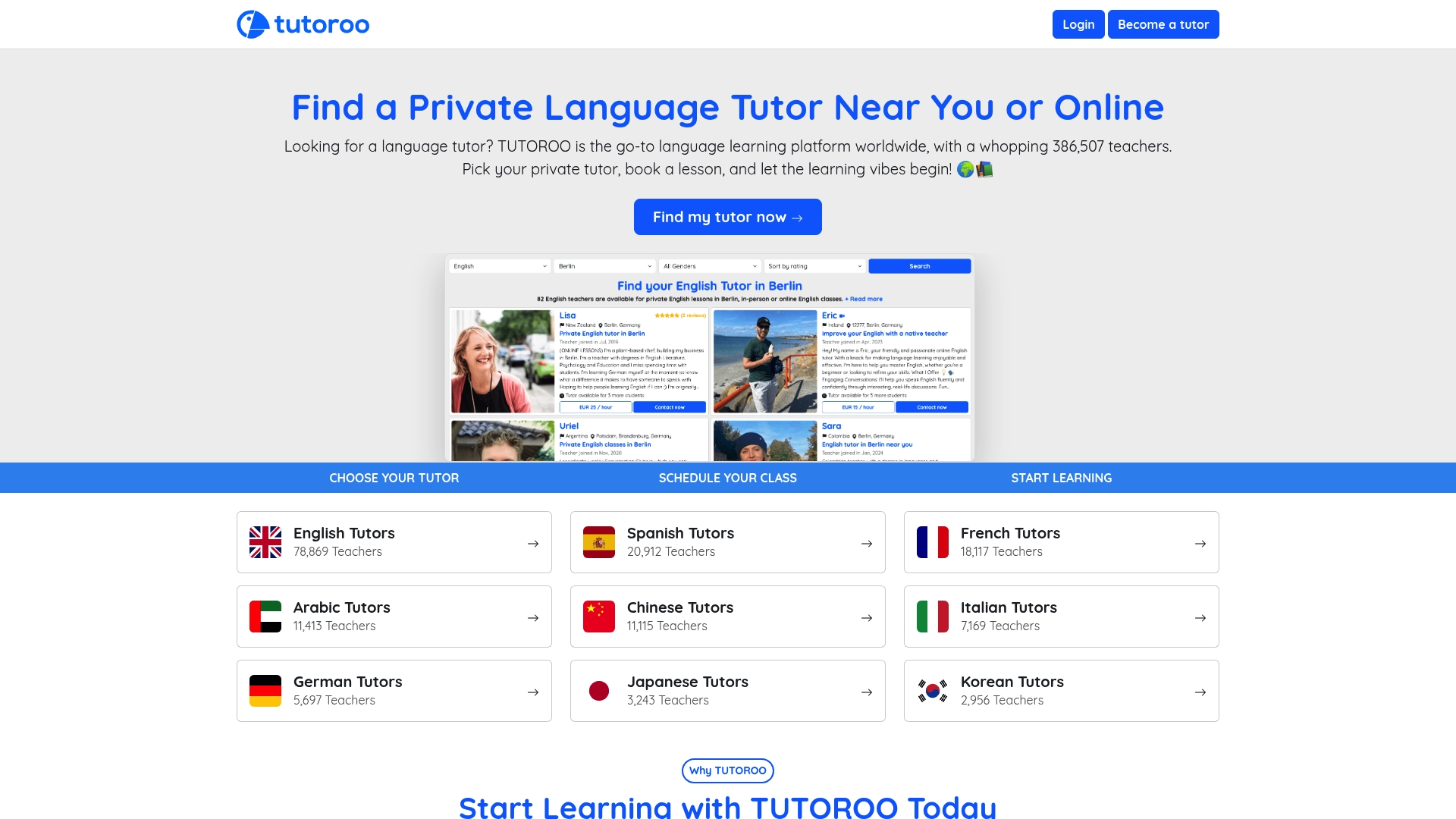
If you are ready to start, browse tutors on the TUTOROO homepage, or go straight to French tutors, Japanese tutors or Chinese/Mandarin tutors. For tips on getting the most from lessons once you begin, read our private tutoring best practices.
FAQ
Is it better to learn two languages at once or one after the other?
Both work, and the right answer depends on your time and goals. Learning one after the other lets you reach a comfortable level before adding another, which suits busy schedules or two similar languages. Learning together suits people with a lot of study time, or two very different languages they are keen to start now.
How much time do I need each day?
There is no single number, but protecting sessions long enough to be useful matters more than splitting a short one. If you already study for 30 minutes daily in one language, plan on adding roughly the same again for the second, or alternate days so each session stays full length.
Which two languages are easiest to combine?
Choose languages that look and sound different from each other, such as Spanish and Japanese, or French and Mandarin, so words and grammar are less likely to blur. Closely related pairs such as Spanish and Portuguese work better if one is already established before you add the other.
Can a tutor help if I am learning two languages?
Yes. A tutor can focus your lessons on the language that matters most to you, set short-term goals and give you the speaking practice that is hard to get alone. Many learners book regular lessons for one language and study the second on their own, then switch the focus later.
Sources
- How to learn two languages at once, Popular Science
- New research suggests mixing languages during study sessions might be a more effective learning method, UW–Madison Waisman Center
- Language-switching and retrieval-based learning, PubMed Central
- Conversation: Learn German, University of Washington Libraries