

TL;DR:
- Learning multiple languages strengthens the brain, improves cognitive control, and helps slow age-related decline. It also provides academic, social, and career advantages, including higher employability and richer cultural connections. Active, consistent use of languages is essential to unlock these long-term benefits.
Learning multiple languages strengthens the brain, opens career doors, deepens cultural connections, and protects cognitive health as you age. The evidence is compelling: a large-sample Nature Aging study analysing more than 86,000 adults across 27 European countries found regular multilingual use associated with measurably slower biological brain ageing. The Kroll et al. review on PMC links bilingual experience with stronger attention, faster task-switching, and greater resistance to cognitive decline across the lifespan. ACTFL documents employer demand for multilingual staff and shows language skills ranking among the top attributes hiring managers seek.
Here is a quick scan of what the research shows:
- Cognitive: Stronger executive control, better memory, more systematic decision-making, and slower brain ageing.
- Academic: Improved metalinguistic awareness, higher literacy outcomes, and faster acquisition of additional languages.
- Social and cultural: Deeper empathy, richer travel experiences, stronger community ties, and greater confidence.
- Professional: Higher employability, access to international roles, and measurable wage advantages in multilingual sectors.
The sections below unpack each group with the studies behind them. If you want the research first, jump straight to the evidence section.
Table of Contents
- 1. Multilingualism reshapes your brain in measurable ways
- 2. Language learning gives children and students a real academic edge
- 3. Speaking another language deepens how you connect with the world
- 4. Multilingual skills give your career a genuine advantage in Australia
- 5. What the research actually shows
- 6. How to actually capture these benefits: a practical roadmap
- 7. The economic case for multilingualism goes beyond your salary
- Key takeaways
- What learners consistently underestimate about multilingualism
- Tutoroo: find a private language tutor and start building real skills
- Useful sources
1. Multilingualism reshapes your brain in measurable ways
The cognitive benefits of learning multiple languages are not vague or theoretical. Research by Kroll et al. shows that managing two or more languages within a single integrated brain system strengthens the executive control network, the same mental circuitry responsible for attention, inhibition, and task-switching. Every time a multilingual speaker selects one language while suppressing another, that network gets a workout.
The practical results show up in everyday life. Bilinguals tend to perform better on tasks requiring divided attention, are quicker to shift between competing demands, and show stronger problem-solving under pressure. Interestingly, ACTFL summarises studies showing that decisions made in a second language are more reason-driven and less influenced by emotional bias than those made in a first language. That has real implications for workplaces, negotiations, and any situation where clear thinking matters.
Statistic to know: The Nature Aging study of more than 86,000 healthy adults found regular multilingual use associated with halved signs of biological brain ageing on measured indicators.
One persistent myth is that growing up with multiple languages confuses children or slows development. Neuroscience rejects this. The brain does not keep languages in separate, competing compartments. It manages them in an interactive, integrated system, and the regulation required to navigate that system is precisely what builds cognitive strength over time. Code-switching, far from being a sign of confusion, is a rule-governed, sophisticated communicative strategy that reflects advanced linguistic control.
Pro Tip: If you want to feel the cognitive benefit quickly, try making a difficult decision by mentally framing the problem in your second language first. The slight distance from emotional first-language associations can sharpen your reasoning.

2. Language learning gives children and students a real academic edge
Multilingual exposure typically improves metalinguistic awareness, which is the ability to think about language as a system, not just use it. That awareness transfers directly to literacy, grammar comprehension, and the capacity to learn additional languages faster. Bilingual children often show advantages on non-verbal cognitive tasks and outperform monolingual peers on measures of executive function and reading readiness.
The benefits vary by age group, and understanding those differences helps parents and educators make better decisions:
- Infants and preschoolers are in a period of heightened neural sensitivity. Exposure to two or more languages during these years shapes phonological processing and lays a foundation for accent accuracy and intuitive grammar.
- Primary school children gain measurable literacy advantages. Knowing how one language works makes it easier to understand the structure of another, and that cross-language awareness supports reading comprehension and writing skills.
- Teenagers and adults benefit most from explicit learning strategies. They acquire vocabulary faster, transfer grammar knowledge across related languages, and, once they have two languages, typically pick up a third more quickly than they learned the second.
UNESCO's research on multilingual education shows that mother-tongue-based multilingual instruction improves learning outcomes and reduces dropout rates, particularly for students whose home language differs from the language of schooling. In Australia, this has direct relevance for First Nations communities, newly arrived migrant families, and schools in linguistically diverse suburbs.
Parents can support multilingual development without harming school progress by maintaining consistent home-language use, reading aloud in both languages, and connecting children with community speakers. For a deeper look at programme types and teaching approaches, Tutoroo's guide to advantages of multilingual education covers immersion, bilingual schooling, and mother-tongue-based models in practical detail.
3. Speaking another language deepens how you connect with the world
Multilingualism expands who you can connect with and fundamentally changes how you understand cultures, not just observe them. When you speak someone's language, even imperfectly, the quality of the interaction shifts. You access humour, nuance, and warmth that translation simply cannot carry.
For Australians, this is especially vivid. Australia is home to speakers of more than 300 languages, including over 250 Indigenous languages and dialects. In cities like Sydney, Melbourne, and Brisbane, speaking Mandarin, Vietnamese, Arabic, or Greek opens genuine community connections that go well beyond polite small talk. Travelling through Southeast Asia, Japan, or the Pacific with even basic local-language skills transforms a tourist experience into something far more personal.
"Language is the road map of a culture. It tells you where its people come from and where they are going." — Rita Mae Brown
ACTFL's expert analysis consistently highlights that language learning builds empathy and cultural understanding through direct interaction and reason-driven thinking. That empathy is not a soft side-effect; it changes how you interpret behaviour, resolve conflict, and build trust across cultural lines.
There are social factors worth acknowledging. Community attitudes, family support, and the social status of a language all influence how confidently learners use it. A language spoken by a stigmatised community may be harder to maintain even when a learner is motivated. Recognising those pressures, rather than ignoring them, is part of developing genuine cultural competence.

The emotional benefits are equally real. Learners consistently report stronger self-confidence, a richer sense of identity, and greater resilience when navigating unfamiliar environments. Speaking another language is not just a skill; it becomes part of who you are.
4. Multilingual skills give your career a genuine advantage in Australia
Multilingualism increases employability, workplace value, and access to roles that are simply unavailable to monolingual candidates. ACTFL documents employer demand for multilingual staff and describes language skills among the top attributes hiring managers actively seek. In Australia's increasingly trade-oriented and culturally diverse economy, that demand is concrete.
Sectors where language skills translate directly to opportunity include:
- Healthcare and aged care: Clinicians and support workers who speak community languages, particularly Mandarin, Cantonese, Vietnamese, Arabic, and Greek, are in high demand across metropolitan and regional services.
- Education: Bilingual teachers and TESOL-qualified educators are sought in both public and independent schools, particularly in areas with high migrant enrolment.
- Tourism and hospitality: Operators serving Asian and European visitors actively recruit staff who can communicate in guests' home languages.
- Government and community services: Federal and state agencies, including the Department of Home Affairs and community legal centres, rely on multilingual staff for client-facing roles.
- Export, trade, and international business: Companies with supply chains or customers in Asia, the Middle East, or Europe value staff who can negotiate and build relationships without relying entirely on interpreters.
For practical CV presentation, list languages with a recognised proficiency level, such as CEFR (A1 through C2) or ACTFL ratings, rather than vague descriptors like "conversational." Pair language skills with technical or sector-specific skills to show how they combine. On LinkedIn, add languages to your profile's dedicated language section and mention them in your summary when they are relevant to your target roles.
For a broader view of how multilingual skills matter in global business, including HR and team-level advantages, that resource covers the workplace case in detail.
5. What the research actually shows
The overall direction of research on multilingualism is clear: the benefits are real, cumulative, and span the entire lifespan. The strongest evidence comes from large-sample studies and systematic reviews rather than small lab experiments.
| Study / Source | Data type | Key finding | Practical implication |
|---|---|---|---|
| Nature Aging (2025) | 86,000+ adults, 27 countries | Regular multilingual use associated with halved signs of biological brain ageing | Multilingual habits may protect the ageing brain at a population scale |
| Kroll et al., PMC | Systematic review | Bilingualism linked to stronger attention, task-switching, and cognitive reserve | Benefits accumulate over a lifetime of language use |
| ACTFL | Advocacy synthesis | Language skills rank among top employer-sought attributes; second-language decisions are more systematic | Multilingualism has measurable professional and cognitive value |
| Bilingual Minds | Review monograph | Bilingual children show advantages on non-verbal tasks and metalinguistic awareness | Early multilingual exposure supports academic readiness |
| UNESCO | Policy and field data | Mother-tongue-based multilingual education improves outcomes and reduces dropout | Programme design matters as much as language exposure |
Limitations are worth stating plainly. Much of the research is correlational: people who speak multiple languages may differ from monolinguals in education, socioeconomic background, or cognitive baseline, making direct causal claims difficult. The "bilingual advantage" debate has been contested in the literature, with some studies failing to replicate specific executive function effects in controlled settings. What the evidence does consistently support is that sustained, active multilingual use, not just passive exposure, is associated with cognitive and social benefits.
Neuroscientist Viorica Marian, whose work is summarised in The Power of Language, argues that language learning is accessible at any age and that the cognitive engagement it requires is itself beneficial, regardless of whether every specific effect survives replication. National Geographic's coverage of the Nature Aging findings echoes that view, noting that everyday multilingual habits, including conversation, revisiting a childhood language, and community engagement, are what drive the protective effect.
6. How to actually capture these benefits: a practical roadmap
The benefits of multilingualism do not come from passive exposure. They come from consistent, active use across meaningful contexts. Here is a realistic pathway structured around three time horizons.
30-day foundation
- Choose one language and set a specific, measurable goal (e.g. hold a five-minute conversation on a familiar topic).
- Book two to three sessions per week with a private tutor for structured input and immediate feedback.
- Label objects around your home in the target language and spend 10 minutes daily on spaced-repetition vocabulary review.
- Find one piece of media, a podcast, a TV series, or a YouTube channel, in the target language and listen daily.
90-day consolidation
- Join a local language meetup or community group in your city. In Australia, most capital cities have active Meetup.com language exchange groups.
- Set a milestone: write a short journal entry or send a message to a language partner entirely in the target language.
- Ask your tutor to introduce structured conversation practice, not just grammar correction.
- Track your progress with a simple weekly log: new vocabulary retained, topics you can discuss, and confidence rating out of 10.
180-day expansion
- If you want to add a second new language, wait until you have reached a conversational baseline (roughly B1 on the CEFR scale) in the first. Learning two languages simultaneously from zero is possible but requires distinct contexts for each, separate study sessions, and clear goals to avoid interference.
- Seek an immersion opportunity: a short trip, a cultural festival, a community volunteering role, or an online language exchange with a native speaker abroad.
- Consider formal certification (DELF for French, DELE for Spanish, HSK for Mandarin) to document your level for employers or universities.
For step-by-step daily routines, Tutoroo's guide on how to learn a new language is a practical companion to this roadmap. If you are weighing up learning outside the classroom, that resource covers community practice and immersion formats that complement formal lessons.
Pro Tip: Separate your languages by context, not just by time. Use one language for cooking, another for exercise, another for reading. Distinct environmental cues reduce interference and strengthen each language's neural pathways independently.
7. The economic case for multilingualism goes beyond your salary
Career benefits are the most visible economic payoff of multilingualism, but they are not the whole picture. Language skills create economic opportunities that extend well beyond a higher starting salary.
Multilingual individuals can access foreign-language media, legal documents, and financial services directly, without paying for translation or interpretation. For Australians with family ties overseas, this means managing inheritance matters, property transactions, or business dealings in another country without intermediaries. That practical independence has real monetary value.
Entrepreneurs and small business owners who speak the language of a target customer base can enter markets that are effectively closed to monolingual competitors. In Australia, the Chinese-speaking community represents one of the country's largest consumer markets, and businesses that communicate authentically in Mandarin or Cantonese consistently report stronger trust and loyalty from those customers.
At a broader level, multilingual workers tend to be more mobile across international labour markets. An Australian professional who speaks Japanese, Indonesian, or Korean can pursue roles in those countries, access regional headquarters of multinational firms, or work remotely for overseas employers, all of which expand the effective size of their labour market. Research on wage premiums for bilingual workers varies by language pair and sector, but the pattern across studies is consistent: language skills add measurable economic value when they are paired with relevant technical expertise.
There is also a less-discussed benefit for older adults. Viorica Marian's research notes that language learning is one of the most accessible tools for ageing well, offering cognitive engagement and social connection that can reduce reliance on costly health interventions over time. Staying cognitively active through language use is not just personally rewarding; it has genuine long-term economic implications for individuals and healthcare systems alike.
Key takeaways
Learning multiple languages delivers cognitive, academic, social, and professional benefits that compound over a lifetime of active use.
| Point | Details |
|---|---|
| Brain protection is real | The Nature Aging study of a very large number of adults found regular multilingual use associated with substantially reduced signs of biological brain ageing. |
| Benefits start early | Bilingual children show stronger metalinguistic awareness and executive function advantages compared with monolingual peers. |
| Career value is documented | ACTFL research places language skills among the top attributes employers actively seek, with advantages across healthcare, education, trade, and government. |
| Active use drives outcomes | Passive exposure is not enough; consistent conversation, structured practice, and community engagement are what produce measurable gains. |
| Tutoroo connects you with tutors | Tutoroo matches learners with private language tutors online or in person, giving you the personalised, active practice that research shows drives real results. |
What learners consistently underestimate about multilingualism
The research on cognitive and career benefits is well documented, and most people who investigate language learning encounter it quickly. What gets far less attention is the identity shift that comes with genuine fluency, and how profoundly that shift changes motivation.
Learners who reach a conversational level in a second language frequently describe something unexpected: they feel like a slightly different version of themselves in that language. More direct, or more formal, or more playful. That is not an illusion. Languages carry different cultural scripts for politeness, humour, and emotional expression, and inhabiting those scripts reshapes how you relate to people and situations. For many learners, this is the benefit that keeps them going long after the novelty of vocabulary drills has worn off.
There is also a social network effect that rarely appears in research summaries. Learners who reach conversational level gain access to an entirely new social world: community events, online forums, cultural organisations, and friendships that would have been inaccessible before. That expanded network is not just personally enriching; it creates professional connections, business introductions, and opportunities that no job board surfaces.
The practical implication is this: if you are learning a language purely for the cognitive or career payoff, you will likely plateau when the initial motivation fades. The learners who sustain progress are the ones who find a community, a relationship, or a cultural passion that makes the language feel alive. Tutoroo's model of connecting learners with native-speaking tutors is built around exactly that kind of authentic, human-led interaction.
Tutoroo: find a private language tutor and start building real skills
Private tuition is the fastest way to move from passive knowledge to active fluency, and that active fluency is what the research shows drives the cognitive, social, and career benefits described above.
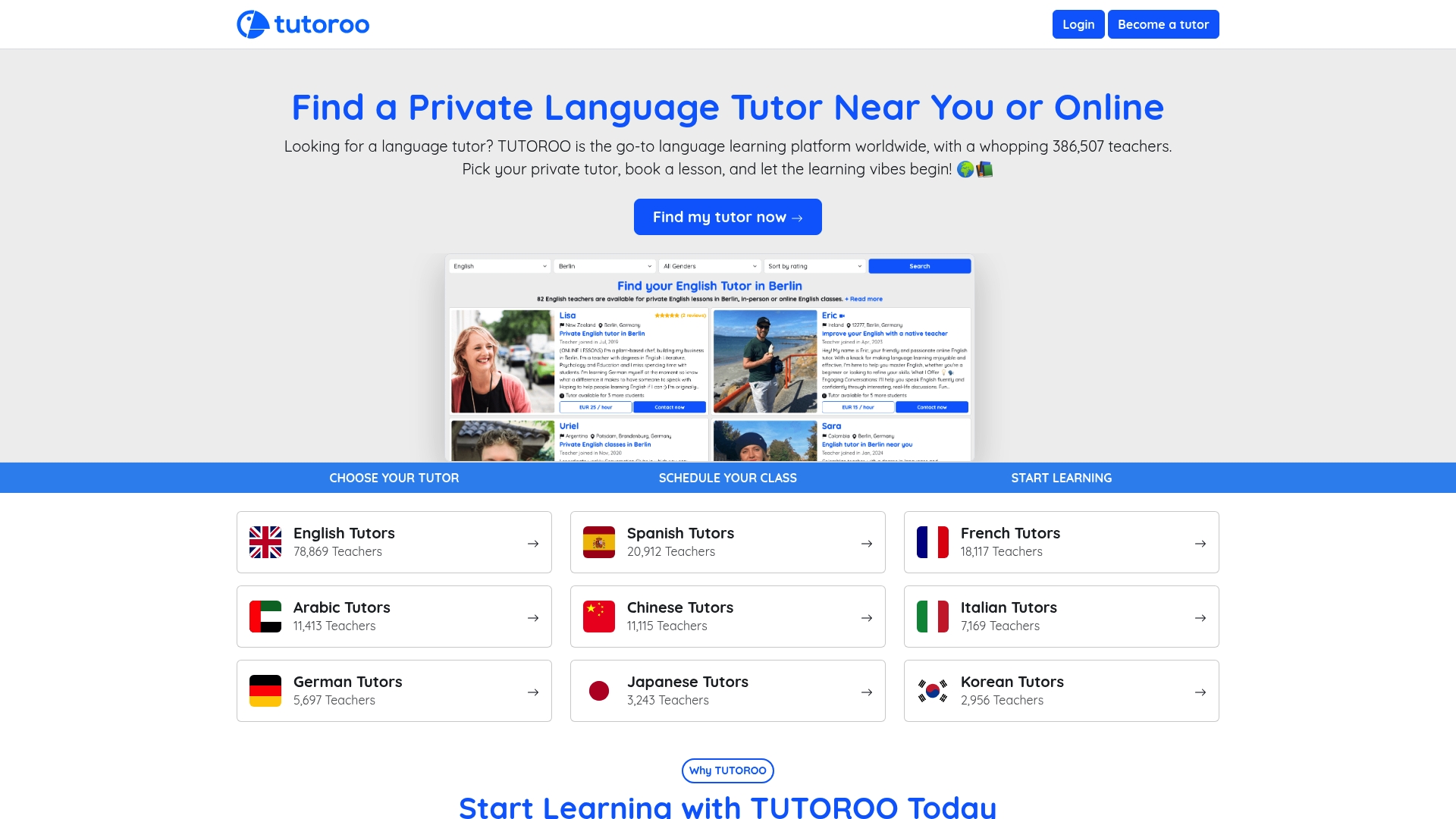
Tutoroo connects learners across Australia with private language tutors for one-on-one lessons, delivered online or in person, in over 50 languages. The community includes more than 386,000 tutors worldwide, covering everything from Mandarin and Arabic to French, Spanish, and Japanese. You choose your tutor based on language, location, availability, and teaching style, then communicate directly via the platform's messaging system to arrange your first session.
Flexible scheduling means lessons fit around work, study, or family commitments. Whether you are a complete beginner building a 30-day foundation, a professional preparing for a certification exam, or a heritage speaker reconnecting with a family language, Tutoroo's matching process finds a tutor suited to your specific goal.
For English learners, the dedicated English tutors page is the fastest entry point. For every other language, the main platform search filters by language and location in seconds.
Browse tutors and book your first lesson at tutoroo.co.
Useful sources
-
Kroll et al., PMC — "The benefits of multilingualism to personal and professional development": A systematic review linking bilingual experience to stronger executive control, attention, and cognitive reserve across the lifespan. The most comprehensive academic starting point for understanding the cognitive case.
-
Tutoroo blog — Advantages of multilingual education: 2026 guide: Tutoroo's own deep-dive into educational programme types, research, and policy implications for Australian learners.