
Most US families pay somewhere between $20 and $75 an hour for a child's private language tutor, with about $40 the typical figure in CostGuide's 2026 national data. Where your child lands in that range depends mostly on the language, the tutor and whether lessons happen online or in person. Online lessons are usually the cheapest way in, and on TUTOROO you can browse private teachers across English, Spanish, French, Japanese, Chinese/Mandarin, German, Italian and Portuguese, then message them directly to agree a schedule that suits your child.
This guide turns those hourly figures into monthly budgets, explains why two tutors for the same language can charge very differently, and shows what to check before you commit.
TL;DR
- Expect roughly $20 to $75 an hour for a child's language tutor in the US, with about $40 typical, according to 2026 national data.
- Online lessons usually cost 30% to 50% less than in-person, because your family can choose a teacher living anywhere.
- One lesson a week costs roughly $120 to $320 a month in-person, or less online, so a few quick sums beat guessing.
- Mandarin, Japanese and Arabic sit at the top of the price range; Spanish sits lower because teachers are plentiful.
- Short, regular sessions usually suit children better than one long lesson, so budget for frequency, not just the hourly rate.
Table of Contents
- Is $40 an hour normal for a child's language tutor?
- What affects the price
- From hourly rate to monthly budget
- Spending where it counts
- What to check before you book
- Find a tutor on TUTOROO
- Our perspective
- FAQ
- Sources
Is $40 an hour normal for a child's language tutor?
Yes. It is close to the middle of the market. CostGuide's 2026 figures put the national typical rate for a language tutor at about $40 an hour, with a fair range of $20 to $75. A separate tutoring rate guide lists language tutoring at $25 to $60 an hour as a market benchmark, and notes that rates shift with subject, experience, student level, location and delivery format.
That range is wide for a reason. Language tutoring is not regulated in the US, so there is no fixed scale. Rates are set by how many teachers are available for a given language, their credentials and the lesson format. A child learning Spanish in a city full of Spanish speakers has plenty of choice. A child learning Japanese in a small town has far fewer local options, and prices reflect that.
So $40 is not a ceiling or a floor. It is a useful midpoint to measure quotes against. If you see $15 to $30 online, that is within the normal online range. If you see $70 or more, you should expect a specialist language, a very experienced teacher or a high-cost city.

What affects the price
Five things move a child's lesson price more than anything else.
The language
Supply drives the price. A 2026 rate guide from Zutor lists these US hourly ranges:
| Language | Typical hourly range |
|---|---|
| Spanish | $35 to $65 |
| French | $40 to $70 |
| ESL (English as a second language) | $35 to $70 |
| Mandarin and Japanese | $45 to $80 |
Another July 2026 price guide reports in-person Spanish at $30 to $60 an hour thanks to deep teacher supply, with Mandarin, Japanese and Arabic at $40 to $80. If your child is starting a widely taught language, you have the most room to find a good price. For deeper detail on individual languages, see our guides to Spanish tutor prices and French tutor costs.
The tutor's experience
Zutor's guide says a tutor with three years of results can charge two to three times what a first-year tutor does. Native speakers and certified instructors tend to sit at the higher end. For a young beginner, the most valuable trait is often patience and the ability to keep a seven-year-old engaged, not the longest CV. A friendly, reliable teacher at a mid-range rate often does more for a child than an expensive one the child dreads.
Where you live
City matters even for the same language. CostGuide shows lower-cost cities such as Brownsville, TX averaging about $31 an hour, while Cambridge, MA averages $57, with San Francisco and New York around $50 to $51. Zutor puts big-city rates at roughly double small-city rates. Families in expensive metros gain the most from looking beyond their postcode.
Online or in person
Online lessons shave the price. Zutor estimates online comes in 10% to 20% below in-person rates, while handld.org puts the gap at 30% to 50%. A Tutorbase 2026 guide shows Spanish, French or Mandarin at $45 to $70 online against $55 to $80 in person. The sources disagree on the size of the gap, but all agree on the direction. Online also removes travel time and lets you pick from a far bigger pool of teachers. Our comparison of local versus online tutoring walks through the trade-offs.
Your child's age and level
Zutor lists student level as one of its four main rate drivers. Younger children typically need shorter, more playful sessions, which suits a lower-cost, shorter-lesson format. Older students preparing for exams may need a more specialised tutor at a higher rate.
From hourly rate to monthly budget
Hourly rates are only half the story. What matters is what leaves your account each month. The July 2026 handld.org guide gives these benchmarks for language lessons:
| Format | Hourly range | Typical hourly |
|---|---|---|
| In person | $30 to $80 | $50 |
| Online | $15 to $55 | $30 |
For a month of one-hour weekly lessons, it reports $120 to $320, with $200 typical. A 10-lesson package runs $300 to $800, with $500 typical.
A worked example
Say your eight-year-old is learning Spanish and you want 30 minutes twice a week, one hour in total.
- Online at the typical $30 an hour: about $30 a week, so roughly $120 over four weeks.
- In person at the typical $50 an hour: about $50 a week, so roughly $200 over four weeks.
- Online at the $15 low end: about $60 a month.
The gap between the first two is $80 a month, or about $960 over a year. Short sessions also tend to hold a child's attention better. For a family plan built around that rhythm, see our look at two short sessions a week for homeschool learners, and our guide to online language lessons for kids.
If you want the adult-side picture for comparison, our online language tutor cost guide and US language tutor rates show how monthly budgets scale up with more lessons.

Spending where it counts
The cheapest hourly rate is not always the best value, and neither is the dearest. A few principles help families spend wisely.
Frequency beats length. The handld.org guide cautions that one weekly lesson gives children exposure, not fluency. Kids need regular contact with the language, through media, games, a speaking parent or immersion, to hold on to it. This is where a modest lesson budget works hardest: a lower-priced online tutor twice a week, plus daily play at home, often serves a child better than a single expensive lesson.
Practice at home counts too. Language grows from everyday exposure as much as from lessons. If you are curious how early habits build, this age-by-age guide to toddler language development shows how much children absorb from the conversation around them, which is the same principle that makes songs, stories and chats in the target language so valuable between lessons.
Match the teacher to the goal. A child who wants to chat with grandparents needs a warm conversationalist. A child heading for a school exam needs structure. Decide which, then look for a teacher whose profile fits.
Agree homework upfront. The handld.org hiring advice includes agreeing homework expectations at the start, so you and the tutor are not guessing about what happens between lessons.
What to check before you book
Price comparisons only make sense once you know you are comparing like with like.
- Trial lesson. The same hiring guide suggests trying one lesson before buying a package. Package prices look attractive, but a single lesson tells you quickly whether the teacher and child click.
- Credentials. Decide what matters for your goal. Some families want a certified teacher; others want a native speaker who is simply good with children.
- Safety for in-person lessons. For in-person lessons with minors, handld.org advises asking for a background check. Whatever the format, stay nearby or within earshot for younger children, and keep communication through the platform's messaging.
- Cancellation terms. Ask how missed or rescheduled lessons are handled before the first session.
- Total, not hourly. Multiply the hourly rate by the lessons you actually plan to book each month.
Find a tutor on TUTOROO
TUTOROO connects families with private language teachers for one-on-one lessons, delivered online or locally. You search by language, location and availability, message teachers directly and agree lesson times between you. Students pay a one-off introduction fee when they connect with a tutor they have chosen, and after that tutors are paid directly by students for ongoing lessons, with no further platform charges on those lessons. That keeps the cost of the lessons themselves a matter between you and the teacher.
The platform's network spans a large worldwide community of language teachers covering English, Spanish, French, Japanese, Chinese/Mandarin, German, Italian and Portuguese and more, so you are not limited to whoever lives down the road.
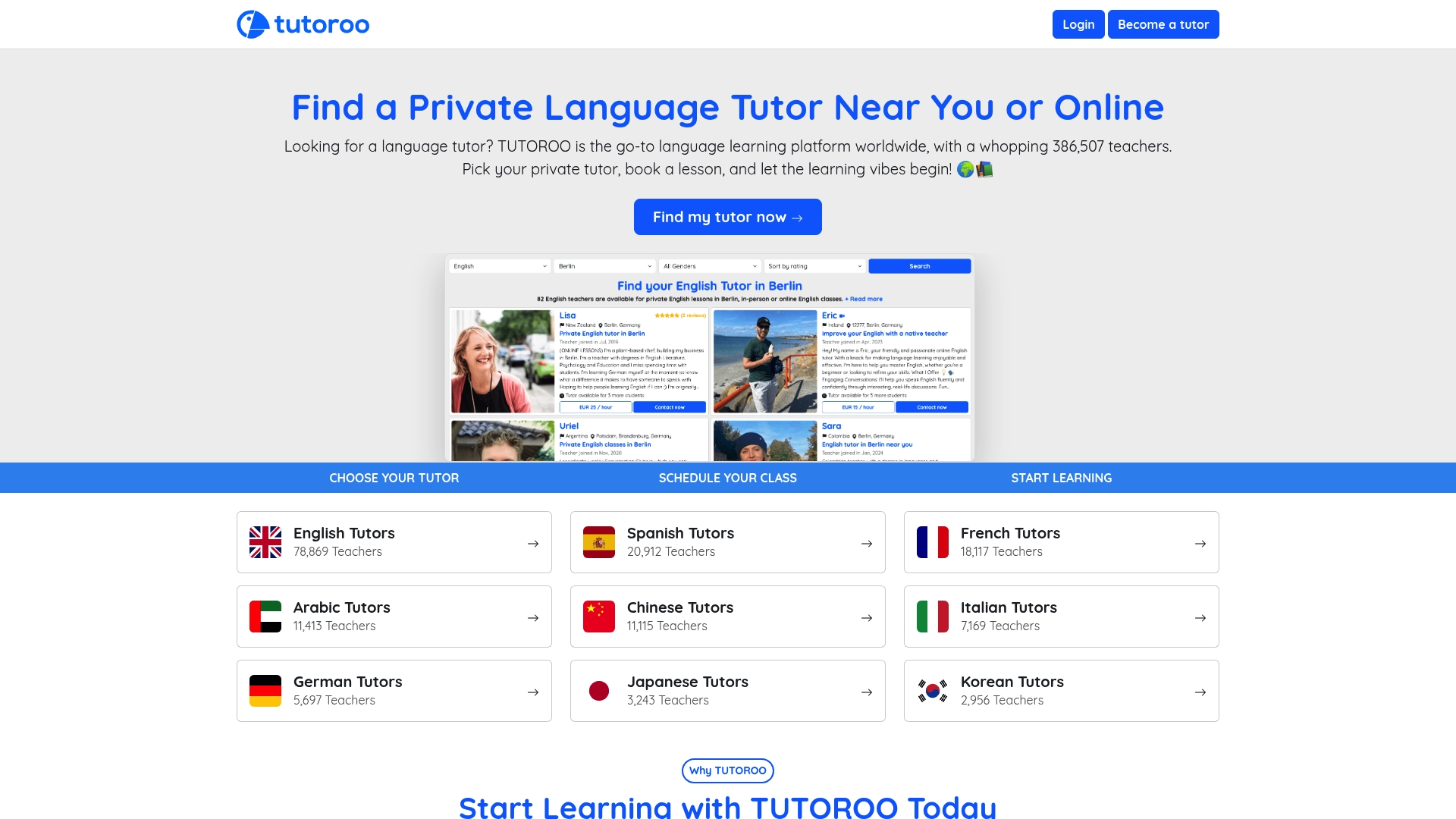
Ready to compare teachers? Browse language tutors on TUTOROO and message the ones whose profiles suit your child.
Our perspective
Parents often start by asking what an hour costs. We think the better question is what a month of lessons costs and how often a child will actually speak the language in that month.
That is why we built TUTOROO around direct contact between families and tutors. You find a teacher by language, location and availability, talk to them in the messaging system, and decide together how often to meet. Because tutors set their own schedules and receive payment directly from students for ongoing lessons, families and teachers can shape a rhythm that suits a child, such as short sessions several times a week, instead of fitting into a fixed package.
A large, worldwide network matters for children in particular. When your child can choose from teachers in many places, you can look for the right personality and teaching style at a price that works for your household, and you can pursue languages that are hard to find locally, from Mandarin to Portuguese.
Language learning opens doors to culture, connection and opportunity. A patient tutor who makes a child look forward to lesson day is worth far more than any line on a price list.
TUTOROO
FAQ
How much should I pay for a child's language tutor per hour?
Budget about $20 to $75 an hour, with roughly $40 typical in the US, based on CostGuide's 2026 data. Online lessons often sit at $15 to $55, while in-person lessons run higher. Your final rate depends on the language, the tutor and your city.
Are online lessons good value for young children?
Online lessons usually cost less, and they let you choose from teachers in many places. Many families find short sessions, such as two 30-minute lessons a week, hold a child's attention better than one long one. Our guide to online language lessons for kids covers plans for different ages.
How much does a month of weekly lessons cost?
One hour a week typically costs $120 to $320 a month, with about $200 typical in the July 2026 handld.org guide. Online lessons at the lower hourly range cost less. A 10-lesson package runs $300 to $800 in the same guide.
Which languages cost the most?
Mandarin, Japanese and Arabic generally sit at the top, at $40 to $80 an hour in person, according to handld.org. Spanish tends to be cheaper because many teachers offer it. French and ESL fall in between.
Should I book a package straight away?
It is wiser to start with a single lesson to see whether your child gets on with the teacher, then book more once you are happy. Packages can lower the per-lesson price, so they make sense after that first session. Our guide to private language lessons explains how to choose.
Sources
- Language Tutor Cost in the US (2026), CostGuide
- How Much Does Language Lessons Cost in United States? (2026), handld.org
- How Much Does a Tutor Cost Per Hour? Rates by Subject, Zutor
- Your Guide to Average Rates for Tutoring in 2026, Tutorbase
- Average Tutoring Rate Per Hour in USA, Wise
- Common Toddler Language Delay Signs: Age-by-Age Guide