

The fastest, most reliable way to teach a foreign language at home is a tutor-led programme matched to your child's age and goals. Book a trial lesson with a qualified tutor through a platform like Tutoroo, pair it with a practice app such as Mango Languages, and set a weekly goal before you commit to a term. Groups like the Home Educators Association of Virginia are worth a look too, for community classes and vetted recommendations.
TL;DR:
- Online tutors offer flexible, accessible lessons that are ideal for personalized language learning, especially in languages with limited local availability like Mandarin or Cantonese.
- It is essential to verify a tutor's experience with homeschoolers, progress tracking methods, and to conduct trial lessons to ensure a good teaching fit before committing long-term.
- Pricing typically ranges from around $15 for a 30-minute online session, with discounts available for packages or multiple siblings sharing lessons to reduce costs.
- Using apps like Mango Languages between sessions supports vocabulary acquisition and pronunciation practice, especially when combined with a structured curriculum.
- Homeschool record-keeping should include invoices, lesson topics, progress notes, and speaking samples, particularly when claiming foreign language credits or preparing transcripts for college admissions.
Table of Contents
- What are your options for homeschool language tutoring?
- How do you choose the right language tutor?
- What does language tutoring cost, and how do you keep it affordable?
- What curriculum and resources pair well with tutoring?
- How do you fit tutoring into your homeschool schedule?
- Why does tutor-led learning work so well for homeschoolers?
- What are the legal and record-keeping rules for homeschool language tutoring?
- A homeschool parent's quick checklist
- How Tutoroo helps you get started
- Sources
- FAQ
What are your options for homeschool language tutoring?
Homeschool language tutoring comes in four main shapes, and each suits a different kind of family. Online one-to-one lessons connect your child with a native or fluent speaker over video, and this format wins on flexibility and access to languages that might have no local speaker for hundreds of kilometres. In-person private lessons suit younger children who need more physical cues and hands-on correction, and they work well if you already have a tutor nearby.
Small-group or co-op classes split the cost across several families and add peer motivation, which matters for teenagers who'd rather not be the only one conjugating verbs out loud. Blended self-study with periodic tutor check-ins suits highly independent learners who use an app daily and see a tutor weekly to fix pronunciation and test comprehension.
Guides on outsourcing language instruction consistently point to a mix of private tutors, co-ops and online platforms as the most practical setup for most households, rather than picking one and sticking rigidly to it.
Common language choices among US homeschoolers include:
- Spanish — widely available, strong for future practical use, easy to find tutors online and locally.
- French — popular for classical or literature-based curricula and strong for older students aiming at AP or dual-credit study.
- Mandarin — best started young given the tonal system, almost always taught online given limited local supply.
- American Sign Language (ASL) — often taught in-person or via video, and frequently accepted for foreign language credit by US colleges.
Most tutors offer 30-minute sessions for younger children and 45 to 60 minutes for teens, since attention span dictates far more than curriculum ambition ever will.
How do you choose the right language tutor?
A good tutor for a homeschooled child needs more than fluency. Look for genuine proficiency in the target language, real experience working with kids or homeschoolers specifically, a clear approach to lesson planning, and some method for checking progress beyond "they seem to be getting it."
Ask these seven questions before you hire anyone:
- How do you structure a first lesson with a new student?
- What's your experience teaching homeschooled or otherwise non-classroom kids?
- Can you show me a sample lesson plan or unit outline?
- How do you track and report progress?
- What happens if my child needs to reschedule or pause for a few weeks?
- Do you offer a trial lesson before I commit to a package?
- Can you provide a reference from another parent or student?
A tutor who answers question 4 with something specific, recorded speaking samples, vocabulary checklists, periodic mini-assessments, is worth more than one who talks fluency percentages without a plan to measure them.
Walk away if a prospective tutor won't offer a trial lesson, gives vague answers about goals or pacing, is unclear about pricing until after the first session, or can't point you to a single reference. These aren't small quibbles. They're the same red flags you'd watch for hiring any contractor into your home and your child's education.
Pro Tip: Book trial lessons with two tutors close together, not weeks apart. Comparing them side by side while the impressions are fresh makes the difference far clearer than judging each one in isolation.
What does language tutoring cost, and how do you keep it affordable?
Private online language tutoring for kids in the US commonly runs in a moderate price range per session, with in-person tutors often costing more once travel and local demand are factored in. Full 60-minute sessions typically cost more per hour but less per minute, which matters if you're comparing packages rather than one-off bookings.
Pricing usually falls into a few structures:
- Per-session — pay as you go, good for testing fit before committing.
- Package pricing — a block of 10 or 20 lessons at a discounted rate.
- Sibling or family pricing — reduced per-child rates when more than one kid joins.
- Small-group rates — lower per-student cost than one-to-one, higher than self-study.
Some tutoring services let multiple siblings join the same session for a single fee, which keeps lessons personalised while cutting your per-child cost meaningfully. Combine that with a co-op class or a library-backed app subscription like Mango Languages for daily practice, and a family of three can often halve the cost of three separate weekly lessons without losing the one-to-one correction that actually builds fluency.
What curriculum and resources pair well with tutoring?
The right curriculum depends on your child's age and how they learn. Boxed programmes with built-in workbooks suit families who want structure and less lesson-planning of their own. Sound and phonics-first approaches work particularly well for younger children starting a new alphabet or tonal system, since they build listening accuracy before written grammar. Conversational series suit teens who want to speak sooner rather than parse verb tables.
Apps fill the gap between lessons rather than replacing the tutor. Mango Languages is a common choice because many US libraries offer it free with a card, and its bite-sized lessons make good five-minute warm-ups before a tutoring session or homework after one.
To get the most from both:
- Share your curriculum outline with your tutor so lessons build on what your child already knows.
- Use the app for vocabulary drilling and pronunciation practice between sessions with tools like AtListen's AI listening and feedback to support accurate language use.
- Join a local or online co-op for conversation practice your child can't get from a screen alone.
- Revisit the pairing every term. What worked for a seven-year-old rarely still fits at eleven.
How do you fit tutoring into your homeschool schedule?
Beginners generally do best with two 30-minute sessions a week rather than one long one, since spaced repetition beats cramming for vocabulary retention. Sustained learners who already have a base can move to one 45 to 60 minute session weekly, backed by daily app practice. High schoolers working toward foreign language credit for a transcript typically need a consistent weekly session plus a documented body of work across the year.
- Beginners (ages 5 to 9): two 30-minute tutor sessions weekly, plus 10 minutes daily on an app.
- Sustained learners (ages 10 to 14): one 60-minute session weekly, plus 15 to 20 minutes daily practice.
- High school / credit-bearing: one 60-minute session weekly year-round, with recorded speaking samples and a written portfolio for transcript documentation.
Track progress with short recorded speaking samples every four to six weeks, a running vocabulary log, and a brief milestone check at each curriculum unit's end. Online tutoring examples can give you a sense of what a well-paced session actually looks like before you commit to a schedule.
Pro Tip: Record a 60-second speaking sample every month, same prompt, same conditions. Six months of these clips is more convincing proof of progress than any test score, and it's something colleges and transcript reviewers actually respond to.
Why does tutor-led learning work so well for homeschoolers?
Homeschool families consistently choose private tutors, co-ops, and online platforms in combination rather than relying on any single method, because each solves a different gap in speaking practice, structure, and accountability. Online tutor platforms connect families with tutors across global communities, giving homeschoolers access to native speakers in languages that would otherwise be impossible to find locally.
One-to-one speaking practice remains the single hardest thing to replicate through an app or a workbook alone, and it's exactly where private tutoring shows its clearest benefit: real-time correction, real conversation, and a person who adjusts to how your child actually learns.
The tutors you'll find through such platforms range from certified classroom teachers to native speakers with informal tutoring experience, so checking qualifications and requesting a trial lesson still matters every time.
What are the legal and record-keeping rules for homeschool language tutoring?
Homeschool regulation in the United States is set state by state, not federally, so your recordkeeping obligations depend entirely on where you live. Some states, like Texas, require almost no documentation. Others, like New York and Pennsylvania, expect annual assessments, attendance logs, or portfolio reviews that an evaluator or school district checks.
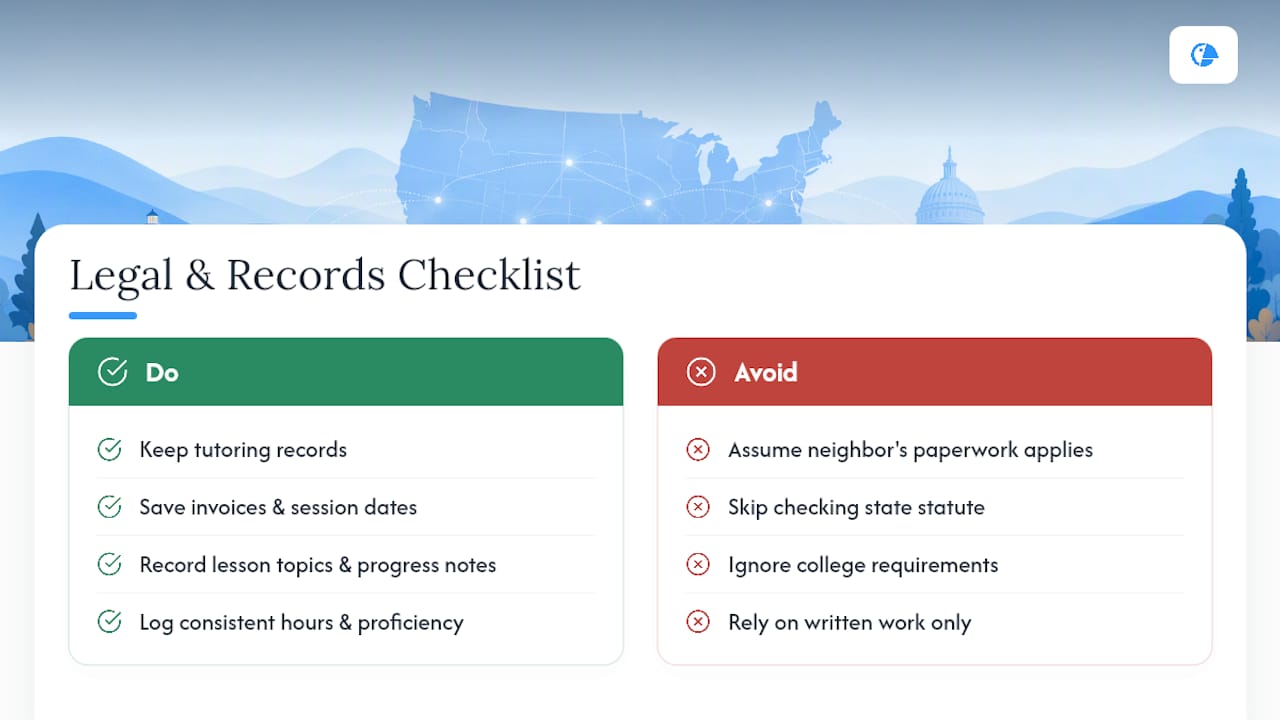
Whatever your state requires, keep tutoring records regardless. A simple folder with tutor invoices, session dates, lesson topics covered, and periodic progress notes protects you if a district ever asks questions, and it becomes invaluable if your child later applies to a private school or college that wants proof of foreign language study.
For high schoolers, colleges reviewing homeschool transcripts generally want to see consistent hours logged, a rough sense of proficiency level (often expressed informally against ACTFL-style stages such as novice, intermediate, or advanced), and some evidence of speaking ability, not just written work. A tutor who provides periodic written progress notes or a simple rubric-based assessment gives you exactly the paper trail transcript reviewers respond to.
If you're claiming foreign language credit for graduation or dual enrolment, check your state's specific homeschool statute and your target colleges' stated requirements before finalising a curriculum. Requirements vary enough between states that assuming your neighbour's paperwork applies to you is a genuinely common and avoidable mistake.
A homeschool parent's quick checklist
Here's what I'd do this week: pick one clear goal, book a trial lesson, shortlist two tutors, pencil in a weekly slot, choose one supporting app or curriculum, and set a six-week check-in. More frequent sessions cost more but build fluency faster, so weigh that trade-off against your actual budget, not your ambitions.
— TUTOROO
How Tutoroo helps you get started
Online platforms can be practical starting points for homeschool families who want a qualified tutor without months of local searching or a rigid contract locking them in. These platforms connect users directly with tutors across large communities of language teachers, so whether you need a conversationalist for a nine-year-old or an advanced tutor for a homeschooled teenager pursuing transcript credit, you can filter by language, availability, and format, online or local, and message tutors directly before booking anything.
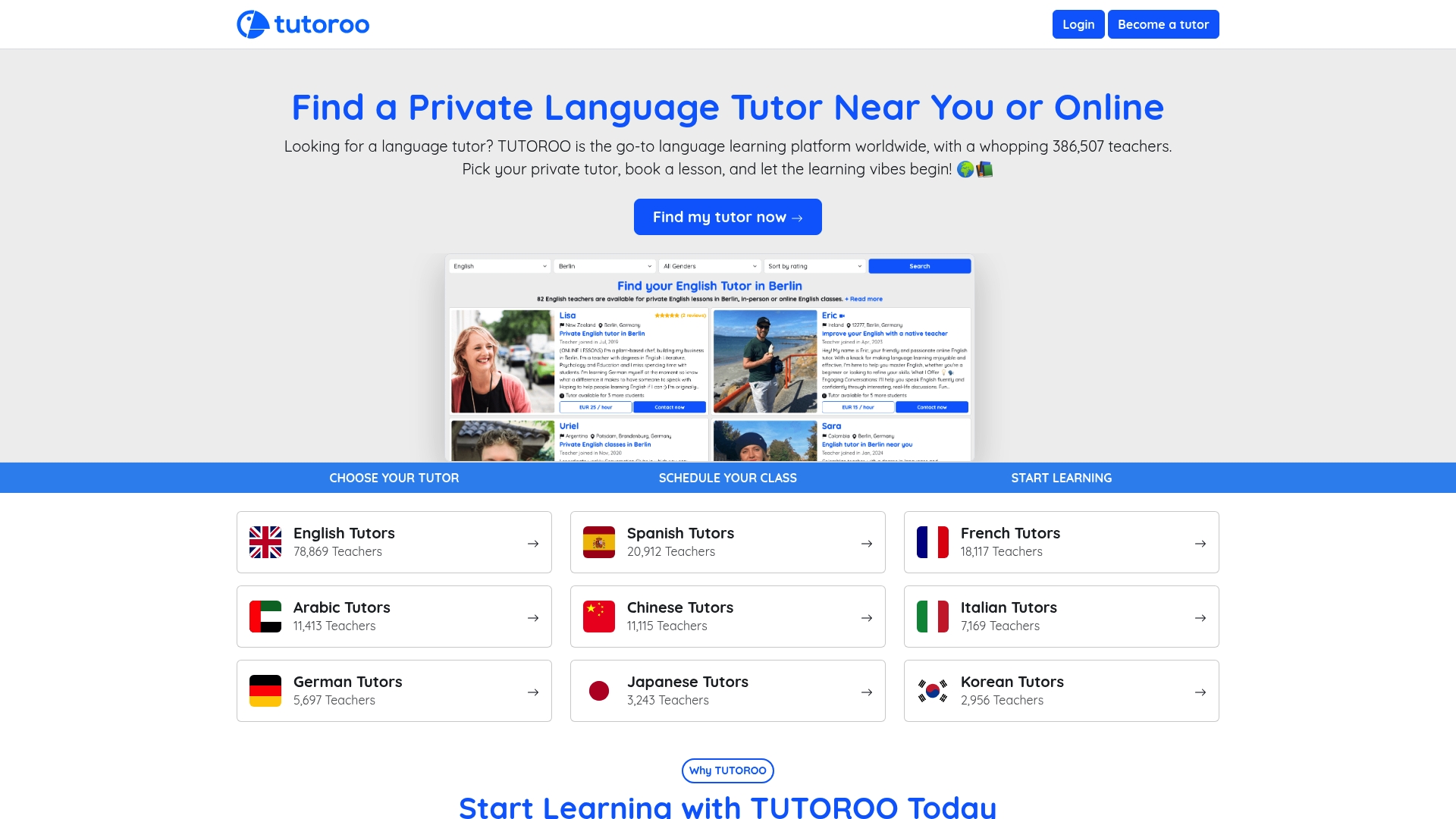
A trial lesson is the natural first step. It costs you one session's worth of time to find out whether a tutor's pace, personality, and teaching style actually fit your child, before you commit to a term of lessons or a sibling package. Messaging happens directly on the platform, so you can ask the same seven interview questions covered earlier and get real answers before booking a second session.
If you're ready to see who's available, browse tutors and languages on Tutoroo and book a trial lesson this week. If English support or a specific language like Cantonese is what your household needs first, Tutoroo's English tutor and Cantonese tutor pages show exactly how the matching process works for a specific search.
Sources
- Foreign Language | Home Educators Association Of Virginia
- How to Outsource Foreign Languages in Your Homeschool
- Mango Languages — Speak it like you mean it.
FAQ
What is the best language learning program for homeschoolers?
There's no single best program. Most successful homeschool families combine a tutor-led programme, matched through a platform like Tutoroo, with a daily practice app such as Mango Languages for repetition between lessons.
How much should you pay a language tutor per hour?
Expect roughly $15 for a 30-minute online session in the US, with in-person tutors often at the higher end; full hour-long sessions cost more overall but less per minute.
What is the best foreign language curriculum for homeschoolers?
It depends on age and learning style: sound and phonics-first programmes suit younger beginners, boxed curricula suit families wanting built-in structure, and conversational series suit teens who want to speak sooner rather than drill grammar first.
Did Taylor Swift do homeschool?
Yes, Taylor Swift was homeschooled for part of her teenage years while pursuing her music career, an often-cited example of how flexible homeschool scheduling can support specialised pursuits alongside core academics.
How do you know if a tutor is a good fit before committing to a package?
Book a trial lesson and ask about lesson planning, progress tracking, and experience with homeschoolers specifically; a tutor who can't answer clearly or won't offer a trial is a fair reason to keep looking.