

Private language lessons put you and one tutor in the same lesson, with the pace, topics and materials built around your goals. In the United States, CostGuide's 2026 data puts the national average language tutor rate at about $40 per hour. That makes a weekly lesson a realistic habit for most learners rather than a luxury. The real question is how to find a tutor who fits your level, your goal and your schedule. At TUTOROO, our platform connects you with private tutors across a very large worldwide community, locally or online, and lets you message them directly before you commit.
TL;DR
- Private (one-on-one) lessons give you the tutor's undivided attention and let you set the pace, aims and materials.
- The national average US rate is about $40 per hour, with a fair range of $20 to $75 depending on language, city, format and experience.
- Online lessons usually cost less than in-person lessons and open up tutors from anywhere, which matters most for less common languages.
- Choose on evidence of teaching at your level and fit with your goal, then confirm with a short conversation before booking a block of lessons.
- Travellers, exam candidates and expats each need a different lesson plan, so say so in your first message.
Table of Contents
- What private language lessons are
- Why one-on-one lessons work
- What private language lessons cost in the US
- Online or in person: choosing a format
- How to choose a private language tutor, step by step
- Lessons for travel, exams and life abroad
- Our perspective
- Find your tutor on TUTOROO
- FAQ
- Sources
What private language lessons are
A private language lesson is a session between one learner and one tutor. It can happen in your home, a library or café, or on a video call. You may also see it called a private language class, a one-on-one lesson or simply a language tutor. The idea is the same in each case: the whole session is about you.
In a group class, the course sets the syllabus and the timetable. In a private lesson, you do. The British Council's TeachingEnglish guidance on one-to-one teaching describes the main differences. The learner receives the teacher's undivided attention. They have more control over aims, pace and materials. They also take a more equal role in decisions about what happens in class. Lesson length can be timed around learning aims instead of an institution's term structure.
In practice, that means:
- You speak more. In a group of ten, you might talk for a few minutes an hour. In a private lesson, most of the hour is yours.
- Corrections arrive when they matter. Your tutor hears your specific mistakes, such as a verb ending you keep dropping or a sound you cannot yet produce, and fixes them on the spot.
- The content is yours. A nurse preparing for Spanish-speaking patients, a student heading to Tokyo and a manager rehearsing a negotiation in German need different vocabulary from week one.
- The schedule bends. Lessons can run at 7 am before work or on a Sunday afternoon, and can be paused for a trip.
All of this suits learners from complete beginners to advanced speakers polishing accents or professional vocabulary.
Why one-on-one lessons work
The attraction is not only convenience. Research on individual instruction points to real gains in speaking, which is the skill most learners find hardest to practise alone.
A 2024 to 2025 quasi-experimental study of intermediate non-native Arabic learners at the Sultan Qaboos Institute in Oman compared one-on-one instruction with the traditional method. It found a statistically significant difference in speaking skills at the 0.05 level, with a 10.90-point mean difference favouring one-on-one teaching. The researcher concluded that the one-on-one approach creates a better environment for speaking because it maximises interaction and oral communication. The one-on-one group's results were also more consistent from learner to learner.
That is one study of one language group, so treat it as an illustration rather than a promise. But it matches what learners report: when you must speak, listen and respond for an entire hour, speaking improves. If you want a deeper look at the idea, our guide on why personalised one-on-one lessons accelerate language learning goes through it.
What private language lessons cost in the US
Prices vary more than most learners expect, so it helps to know the ranges before you message anyone.
The headline figure: CostGuide's 2026 US data gives a national average of about $40 per hour for a language tutor. Its fair range runs from $20 to $75 per hour, with about $31 in the lowest-cost cities and $45 in the highest-cost cities. It lists native-speaker status, platform, group versus private format, curriculum and certifications as factors that move the price.
Other published guides show the same spread:
| Source | What it covers | Hourly range |
|---|---|---|
| CostGuide, 2026 | US national figure for language tutors | $20 to $75, average about $40 |
| Kapdec, 2025 | Spanish and French lessons | $25 to $35 typical |
| Kapdec, 2025 | Mandarin | Up to $75 |
| Kapdec, 2025 | Online versus in person | $25 to $50 online, $40 to $100 in person |
| Northwestern University English Language Programs | Basic English support | About $25 to $50 |
| Northwestern University English Language Programs | Academic or specialised English | About $50 to $80 |
| Northwestern University English Language Programs | Advanced communication coaching | About $75 to $150 or more |
A few patterns stand out. Location matters: Kapdec's guide gives Kansas at about $35 per hour and Seattle at $55 to $65. Language matters: widely taught languages such as Spanish and French sit at the lower end, while Mandarin can reach $75. And the kind of help matters: general conversation practice costs less than coaching for an academic or professional goal. Northwestern's page notes that providers set their own rates based on their experience and expertise.
A worked example
Say you want one Spanish lesson a week for three months before a work posting. At $40 per hour that is about 12 lessons, or $480 in total. If you find an online tutor at $30 per hour, the same plan comes to $360. If you choose an advanced specialist at $75 per hour, it is $900. The plan is the same, but the total changes with the tutor. Our guides on language tutor rates in the USA and online language tutor costs break the monthly numbers down further.

Published averages are a starting point. Your own quote, from a tutor whose experience you can see, is the figure that counts.
Online or in person: choosing a format
Both formats are private lessons. The difference is where you meet and what that changes.
Online lessons run on a video call. You need a quiet spot and a steady connection, and your tutor can be in another city or on another continent. That matters if you are learning a language with few local teachers, such as Japanese, Arabic or Portuguese outside a big city. Lower hourly rates are common, as the Kapdec figures above show, and there is no travel time. Online also makes scheduling easier across time zones, which helps expats and travellers.
In-person lessons suit learners who like to write by hand, practise real-world situations such as ordering food or asking for directions, or simply focus better face to face. They are also a good option for younger students whose parents prefer a tutor nearby. The cost is higher and the choice of tutors is limited to your area.
Some learners mix the two: in-person lessons while a tutor is nearby, then online lessons when they travel or move. Because TUTOROO lists tutors for local and online lessons, you can search by location and language and switch format later with the same tutor if you both agree. Our comparison of local versus online language tutoring helps you weigh the trade-offs for your situation.

How to choose a private language tutor, step by step
A good match is the biggest factor in whether lessons stick. These steps take you from goal to first lesson.
1. Write down your goal and your level
Be specific. "Hold a 15-minute conversation with my partner's family by June" or "pass the speaking part of my exam" gives a tutor something to plan around. "Get better at French" does not. If you are unsure of your level, describe what you can do: order a meal, follow a podcast, write an email.
2. Decide your budget and format
Use the ranges above. Decide how many hours a week you can commit to and whether online or in person suits you. Regular, shorter lessons usually work better than occasional long ones, because you remember more between sessions.
3. Search by language, location and availability
On TUTOROO you can find tutors by language, location and availability, and see who has time slots that fit your week. The platform covers many languages, including English, Spanish, French and Japanese. Where a search by city gives few results, widening to online tutors opens up the choice. Being a very large community of tutors, it gives you real options instead of a single name.
4. Look for teaching experience at your level
A certificate such as CELTA or TESOL can be a good sign, but a tutor's experience with learners like you tells you more. Someone who mostly teaches beginners may not be the best guide for an advanced learner trying to sound more natural, and the reverse is also true. Read the profile for the levels, goals and exam types the tutor mentions. Our guide to evaluating private language teachers lists what to look for.
5. Talk before you book
Use the direct messaging on TUTOROO to introduce yourself, state your goal and ask how the tutor would structure the first few lessons. You will quickly learn whether the tutor listens, asks about your aims and explains clearly. This is also the moment to agree the lesson length, cancellation practice and how you will pay.
6. Pay the tutor directly for lessons
On TUTOROO, you pay an introduction fee to be matched with the tutor you select. After that, the tutor receives payment directly from you for lessons, with no further platform charges. That keeps ongoing costs simple: what you agree with your tutor is what you pay for each lesson.
7. Review after the first month
After four or five lessons, ask yourself whether you can do something now that you could not before. If your goal has shifted, tell your tutor so the plan shifts too. Good tutors expect this.
Lessons for travel, exams and life abroad
Private lessons earn their place when you have a deadline or a specific use for the language.
Travel. A few weeks of lessons focused on survival situations (greetings, transport, food, directions, emergencies) are more useful than a general course. Ask your tutor to role-play these scenes and to teach you the phrases you will actually hear, not only those in a textbook.
Exams. Tell your tutor the exam name and the date. They can build practice around the format, time you on speaking tasks and correct the habits that cost marks. Because lessons are one-on-one, every minute goes to your weak points rather than to a whole class's.
Expats and newcomers. If you have moved abroad, you need the language of daily life quickly: the doctor, the landlord, the school gate, the workplace. A tutor who lives where you do can also explain local expressions and etiquette, which no app teaches well. Many expats start with a few intensive weeks, then settle into one lesson a week. Because the lessons are private, you can bring real documents, emails and letters from your own life to the session. If your move is to Germany, a complete guide to the German language gives useful background on what you will be learning, and a German tutor on TUTOROO can turn it into spoken practice.
Children and teenagers. Parents often choose private lessons for school support or to build confidence. Short, regular sessions and a tutor who makes the lesson enjoyable matter more than intensity. Parents can message tutors first and sit in on early lessons where the format allows.
Our perspective
We built TUTOROO around a simple belief: language lessons work best when they feel like a conversation between two people who want the same result. That is why we focus on connecting learners directly with private tutors, whether they meet locally or online, and why we give both sides a messaging system so they can get to know each other before the first lesson.
Our community includes over 386,000 language teachers, teaching languages from English, Spanish, French and Chinese to Arabic and many more. That range matters. It means a learner in a small town can still find a tutor for a less common language, and a learner in a big city can choose between many different teaching styles.
We also think tutors deserve flexibility. On TUTOROO, tutors set their own schedules and receive payment directly from students for their lessons. Happy tutors teach better, and that benefits every learner who works with them.
Authentic lessons open doors to culture, connection and opportunity. Our job is to help you find the person who opens that door for you.
TUTOROO
Find your tutor on TUTOROO
If you are ready to start, TUTOROO lets you browse private tutors for English, Spanish, French, Japanese, Chinese or Mandarin, German, Italian, Portuguese and more. Search by language, location and availability, read the profiles, and message the tutors who suit your goal.
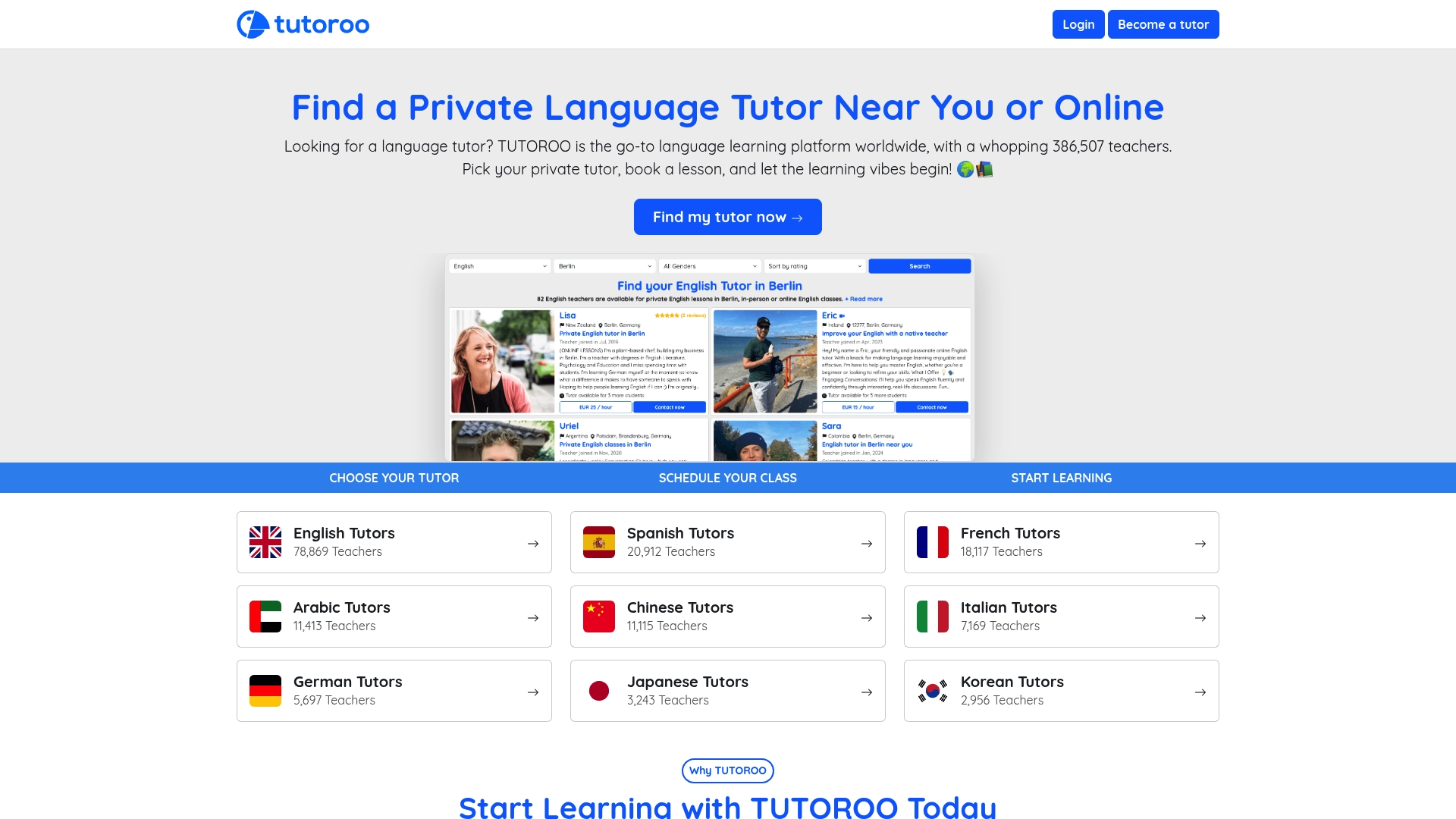
Start at tutoroo.co and choose your language. If you are a tutor who wants to teach on your own schedule, you can register there too and receive payment directly from your students.
FAQ
How much do private language lessons cost?
In the US, CostGuide's 2026 figures give a national average of about $40 per hour, with a fair range of $20 to $75. Your price depends on the language, your city, whether lessons are online or in person, and the tutor's experience. Always ask the tutor for their rate before the first lesson.
How often should I have private lessons?
One or two lessons a week suits most learners, because it leaves time to practise between sessions. If you have a trip or exam coming up, a short burst of more frequent lessons can help. Agree a rhythm with your tutor and review it after a month.
Are private lessons better than group classes?
They are different. A group class follows a set syllabus, while a private lesson follows your goals, pace and materials, and gives you the tutor's undivided attention, as the British Council's TeachingEnglish guidance describes. If your priority is speaking, or you have a specific deadline, private lessons give you more time speaking with direct feedback.
Can I find a language tutor as an expat?
Yes. Many expats choose a tutor in their new city for in-person lessons, or an online tutor who can teach around work and family hours. Tell the tutor what you need day to day, such as appointments, school or work, so the first lessons go straight to useful language.
Do I need a certified tutor?
Not necessarily. Qualifications can be a good sign, but a tutor's teaching experience with learners at your level and a clear plan for your goal matter just as much. Message the tutor first and judge how well they listen and explain.
Sources
- Teaching one-to-one, TeachingEnglish, British Council
- Language Tutor Cost in the US (2026), CostGuide
- Private Instruction, English Language Programs, Northwestern University
- How Much Does Private Tutoring Cost In The U.S. (2025), Kapdec
- The Effect of the Individualized Instruction Strategy on Developing Speaking Skills of Non-Native Arabic Learners, Sultan Qaboos Institute
- The German language: a complete learner's guide