

TL;DR:
- Choosing the right language teacher enhances your progress, cultural connection, and fluency.
- Verifying credentials, identifying clear goals, and trial lessons ensure a good teaching fit for learners.
Choosing the wrong language teacher can quietly cost you months of progress and a great deal of money, while choosing the right one opens doors to culture, connection, and genuine fluency. Many learners rush into lessons with the first available tutor, only to find themselves stuck in repetitive exercises that never quite match what they actually need. This guide walks you through a clear, practical framework for evaluating private language teachers from the very first search to ongoing progress tracking. Whether you're preparing for a language exam, planning an extended trip abroad, or simply seeking meaningful connection through a new language, these steps will help you make a confident, well-informed choice.
Table of Contents
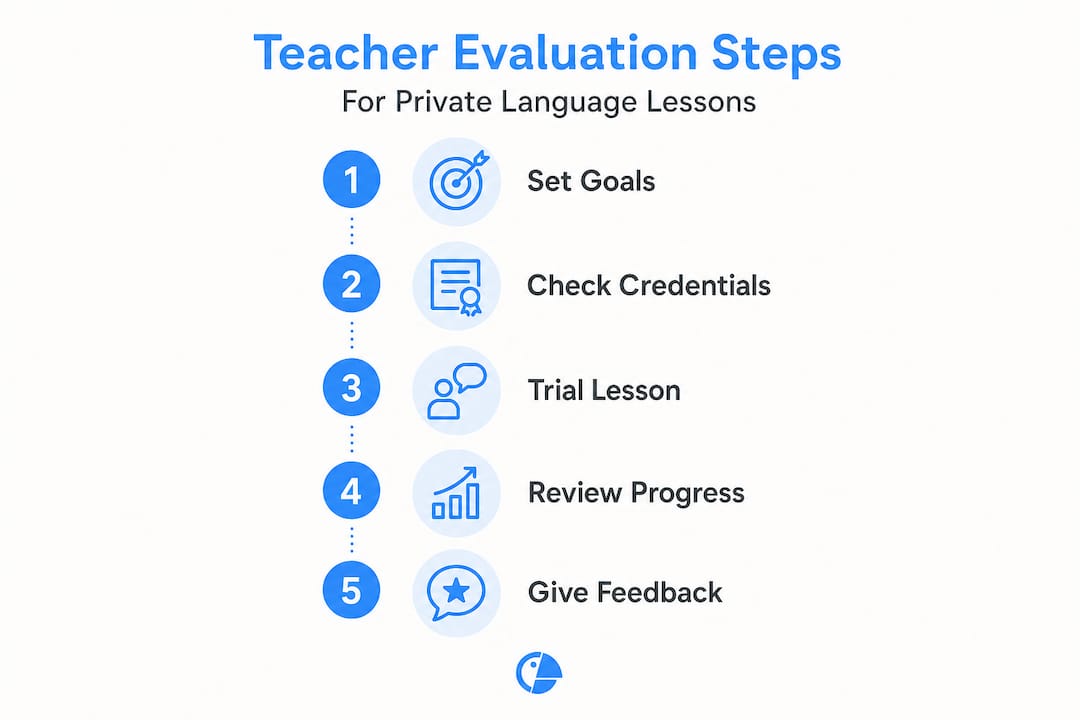
- Define your learning needs and goals
- Check essential teacher qualifications and experience
- Test for teaching style and learning fit
- Evaluate learning effectiveness and consistency
- Red flags and troubleshooting common pitfalls
- A realistic perspective: what most language learners overlook
- Find your ideal private language teacher with TUTOROO
- Frequently asked questions
Key Takeaways
| Point | Details |
|---|---|
| Define goals first | Clarifying your purpose and starting level ensures the right tutor match and progress. |
| Check proper credentials | Qualified teachers show proof of certification and genuine experience in your focus areas. |
| Always test lessons | Trial sessions reveal if the teaching style and personality suit your learning best. |
| Prioritise consistency | Regular lessons with the same tutor accelerate skills more than occasional, inconsistent sessions. |
| Stay alert for red flags | Avoid tutors with vague profiles, no proof of skill, or claims that seem too good to be true. |
Define your learning needs and goals
To start evaluating teachers, you first need a map of where you want to go. The single biggest mistake learners make is approaching the search before they've clearly defined what success looks like for them personally. A traveller who wants to order food and ask for directions in Italian has very different needs from a professional sitting a DELF French exam or a student seeking conversational Mandarin for business meetings in Shanghai.
Start by identifying your core reason for learning. Then consider the following:
- Your current level. Are you a complete beginner, or can you hold a basic conversation? Knowing this helps you filter for teachers experienced with your stage.
- Your target skill. Is the focus reading, speaking, listening, writing, or a mix? Be specific.
- Your timeline. A two-month sprint before a holiday requires a different lesson pace than a long-term fluency journey.
- Your preferred learning style. Some learners thrive with structured grammar explanations, while others progress best through immersive conversation practice.
The CEFR framework offers a reliable tool here. It categorises proficiency from beginner A1 through to advanced C2, allowing you to communicate your level clearly to any prospective teacher and helping tutors design lessons that are genuinely aligned with where you are. Exploring different lesson types for personal needs is a great early step that many learners skip entirely.
Pro Tip: If a tutor doesn't ask about your goals during your very first conversation, that silence is telling. A skilled teacher wants to understand where you're headed before suggesting a single lesson plan.
Clarity here also makes comparison so much easier. When you contact multiple teachers, you can ask each one the same questions about their approach to your specific goals and weigh the answers side by side.
Check essential teacher qualifications and experience
With your goals in mind, the next step is verifying whether a teacher has the real skills and credentials to support you. This is where many learners feel uncertain, especially when searching online platforms where anyone can create a profile.

Understanding what to look for removes the guesswork. The importance of tutor certifications is well established, and tutor credentials genuinely do predict teaching quality in most cases. Reputable tutoring organisations recommend that you verify tutor qualifications including formal certifications, subject-specific experience, and background checks as a baseline.
Here is a quick reference table to help you assess potential teachers:
| Credential or factor | Why it matters | What to look for |
|---|---|---|
| Teaching certification | Validates formal training in language instruction | CELTA, DELTA, TEFL, DELF examiner status |
| Language proficiency proof | Confirms they can actually teach the target language | Formal test scores, native speaker status |
| Subject-specific experience | Ensures alignment with your skill focus | Exam prep, business language, conversational practice |
| Background check | Ensures safety, especially for younger learners | Verified by platform or supplied independently |
| Introductory video | Gives a real impression of style and personality | Look for clarity, warmth, and professionalism |
Key red flags to watch out for include:
- No certifications listed or verifiable. A teacher who can't demonstrate any formal training is a risk.
- Vague profile descriptions. Phrases like "I love languages" without supporting detail are not credentials.
- No introductory video. Legitimate tutors invest in showing who they are.
- Overclaiming. Profiles claiming expertise in five or more languages with no explanation are a common warning sign.
- Guarantees of fluency in unrealistic timeframes. No ethical teacher promises fluency in 30 days.
Pro Tip: Ask tutors directly for evidence of their qualifications if it's not visible on their profile. A professional teacher will share this without hesitation. If they resist or deflect, take note.
Using reputable platforms that verify teachers before listing them significantly reduces your risk. It shifts some of the vetting responsibility to the platform itself, giving you a safer starting point.
Test for teaching style and learning fit
Qualifications are only half the story; real compatibility is revealed in live lessons. A teacher can carry the most impressive credentials and still communicate in a way that simply doesn't resonate with how you learn. This is why trial lessons are not a luxury but an essential part of the evaluation process.
Trial lessons help you observe teaching style, pronunciation accuracy, engagement level, and genuine fit with your personal learning preferences. They also give the teacher a chance to understand your strengths and gaps. Think of it less as an interview and more as a live test drive.
During a trial lesson, work through this checklist mentally:
- Did the teacher ask about your goals and current level before diving into content?
- Did they adapt their explanation when you showed confusion or asked a question?
- Was the lesson structured with a clear opening, middle, and close?
- Did they engage you actively rather than simply lecturing at you?
- Did they offer genuine feedback rather than vague encouragement?
To understand why this matters, consider two contrasting teaching styles:
| Teaching style | Description | Best suited to |
|---|---|---|
| Lecture-based | Teacher explains grammar rules, learner listens and notes | Learners who prefer structure and theory |
| Communicative/task-based | Teacher facilitates conversation, roleplay, and real-world tasks | Learners who need speaking confidence and practical use |
Neither style is universally superior. The question is which one helps you progress faster. Some learners genuinely need a grammar foundation before they can speak confidently; others stall completely if forced through grammar drills before they practise real sentences. Looking at evidence around learning improvements with trial lessons reinforces just how much a single well-structured trial lesson can reveal.
Pro Tip: Use the trial lesson deliberately. Bring a specific topic or goal you'd like to address. This gives you a direct comparison point across multiple trial lessons and a clear sense of how each teacher approaches the same challenge.
Evaluate learning effectiveness and consistency
After you've started lessons, ongoing evaluation and adjustment is key for measurable results. Many learners assume their teacher is responsible for tracking progress, but the most effective learners take an active role in monitoring their own development.
Here's how to track your improvement meaningfully:
- Keep a simple weekly log noting new vocabulary, structures, and skills practised.
- Record one or two speaking samples each fortnight and compare them over time.
- Ask your teacher for honest, specific feedback every few sessions, not just general praise.
- Use a short self-assessment checklist aligned with CEFR descriptors to check your growth.
- Revisit your original goals every month and adjust them as needed.
Research consistently supports the value of high-frequency lessons. High-dosage tutoring of three or more sessions per week with the same tutor produces statistically significant gains of 0.15 to 0.30 standard deviations in learning outcomes, according to University of Chicago studies.
"Consistency with one tutor across multiple weekly sessions builds a feedback loop that accelerates language acquisition far beyond what irregular lessons can achieve."
The benefits of sticking with one teacher are particularly strong in language learning because the tutor develops an accurate picture of your specific error patterns, vocabulary gaps, and pronunciation tendencies. They can tailor each lesson to your precise needs rather than resetting with new material. Regular private lessons genuinely accelerate language mastery in ways that sporadic study simply cannot replicate.
If you feel progress has stalled, the right move is honest communication with your teacher rather than quiet disengagement. Explain exactly what isn't clicking. A skilled tutor will welcome this feedback and adjust. The broader private tutoring benefits are well documented, but they depend on an active, ongoing dialogue between learner and teacher. Exploring personalised learning gains through one-on-one instruction gives further insight into why this model outperforms group classes for most learners. It also helps to review best practices for language success and bring those habits into every session.
Red flags and troubleshooting common pitfalls
Empowered with verification strategies, you're far less likely to choose badly. Still, even careful learners can miss early warning signs, especially when enthusiasm for a new language clouds judgement. Here are the most important red flags to watch for at any stage of your search or lessons:
- No verifiable certifications or teaching background. Enthusiasm for a language is not the same as knowing how to teach it effectively.
- Vague or incomplete profiles. Limited information often means limited accountability.
- No introductory video. Absence here frequently correlates with lower-quality engagement during lessons.
- Claiming to teach too many languages at once. Overclaiming language expertise across five or six languages without supporting evidence should prompt serious scepticism.
- No verified reviews or testimonials. Any experienced tutor will have a trail of genuine student feedback.
- Unrealistic promises about timelines. Fluency in 60 days for a complete beginner is not a goal; it's a sales pitch.
- Consistently late or unprepared for lessons. One missed session happens; a pattern signals disorganisation.
"A tutor who cannot show you what they know and how they teach is asking you to take all the risk in the relationship."
If you find yourself mid-lessons and unhappy, trust that instinct. Switching teachers is not a failure; it's a smart adjustment. Compare the experience of working with different tutors across local vs online language tutoring contexts, since sometimes the format itself is a better fit than the actual teacher change.
Report serious issues (misleading credentials, inappropriate behaviour) through the platform where you connected with the tutor. Reputable platforms take this feedback seriously and use it to improve their verification standards. And remember, if something feels off early in a trial lesson, it's perfectly reasonable to politely end the session and decline a follow-up.
A realistic perspective: what most language learners overlook
With practical steps covered, it's worth stepping back and examining what actually drives repeated student success beyond formal checklists and credential reviews.
Here's an honest observation we've gathered from years of watching learners thrive and stall: most learners dramatically overvalue certifications and undervalue rapport, consistency, and their own engagement. A teacher with a CELTA and a warm, adaptive teaching style will almost always outperform a heavily credentialled tutor who lectures rigidly without reading the room. Credentials matter, but they're a floor, not a ceiling.
No checklist can fully substitute for the honest, sometimes uncomfortable process of trial and error. You might book a teacher who looks perfect on paper and find the chemistry simply isn't there. That's normal. The learners who make the fastest progress are the ones who test, reflect, and adjust without taking a mismatch personally.
There's also an uncomfortable truth about progress that almost no one wants to acknowledge: your own commitment is half the equation. Showing up regularly, completing any between-session practice, and giving your teacher clear, honest feedback are equally as important as finding the "right" person. Following private tutoring best practices means taking ownership of your side of the learning relationship.
The most overlooked secret in private language learning is the feedback loop. When you tell your teacher precisely where you're confused and what you want more of, you compress the time it takes to reach your goals. Teachers, even excellent ones, cannot read minds. Your voice in the lesson is a learning tool in itself.
Pro Tip: Don't be afraid to test two or three teachers simultaneously in the early stages, then commit fully to the one who genuinely fits. It's a short-term investment that pays off enormously over a longer journey.
Find your ideal private language teacher with TUTOROO
If you're ready to take the next step and apply what you've learnt, here's where to find your ideal match.
TUTOROO connects language learners with over 386,000 vetted private tutors across the world, covering dozens of languages from Spanish and French to Arabic, Mandarin, and beyond. Every teacher profile includes experience details, student reviews, and introductory videos so you can apply the evaluation steps in this guide with real confidence. Lessons are available online or face-to-face, giving you the flexibility to learn in the format that suits your schedule and style.
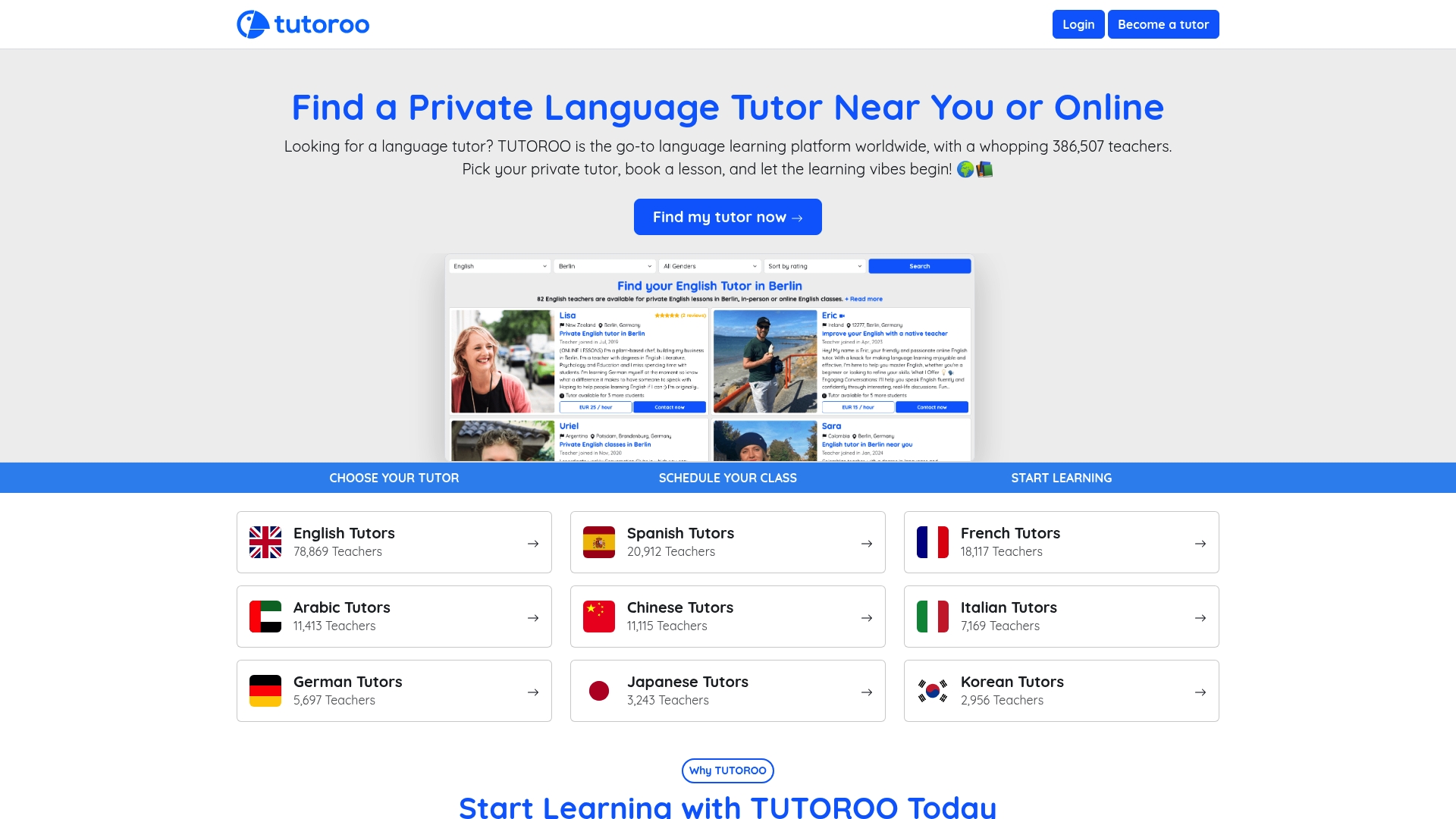
Browse private tutors on TUTOROO and filter by language, location, availability, and teaching focus to find a genuine match for your goals. If English is your target language, you can also find an English tutor from a wide selection of qualified, experienced teachers ready to support your progress from day one. Your next meaningful step in language learning is closer than you think.
Frequently asked questions
What qualifications should a private language teacher have?
Look for formal language teaching certifications such as CELTA or TEFL, proof of language proficiency, and specific experience aligned with your skill or exam needs. As recommended by the National Tutoring Authority, you should always verify tutor qualifications including formal certifications, subject-specific experience, and background checks.
How many sessions per week produce the best results?
Aim for at least three sessions per week with the same tutor for faster, more durable progress. Research supports high-dosage tutoring of three or more sessions weekly, showing gains of 0.15 to 0.30 standard deviations in learning outcomes according to University of Chicago studies.
Why are trial lessons recommended before committing?
Trial lessons allow you to observe how the teacher communicates, adapts, and engages before you invest fully. It's essential to trial lesson observation to assess teaching style, pronunciation, engagement, and fit with your personal learning preferences.
How can I tell if a tutor isn't right for me?
Watch for missing credentials, vague or incomplete profiles, no introductory video, and overclaiming language expertise across too many languages simultaneously. Unrealistic promises about progress timelines are also a strong warning sign worth taking seriously.
Does my own commitment matter as much as the teacher's?
Yes, absolutely. Regular attendance, honest communication, and readiness to practise between sessions are equally crucial for meaningful language gains. The best teacher in the world cannot compensate for a learner who disengages between lessons.