

TL;DR:
- Certified tutors have proven training that improves language learning success.
- Certification ensures personalized, goal-oriented teaching, leading to faster progress and better exam results.
- Choosing certified tutors results in higher achievement, especially in formal assessments and real-world language use.
Not every fluent speaker makes an effective teacher. It's a common assumption that native speakers automatically qualify as great tutors, yet the reality is far more nuanced. Certified teachers produce positive short- and long-term achievement gains compared to their uncertified counterparts, and this distinction shapes everything from your exam results to your everyday conversational confidence. Whether you're learning a language for travel, a career move, or a formal qualification, understanding what certification truly means for your tutor can be the difference between slow frustration and genuine, lasting progress.
Table of Contents
- What makes a language tutor certified?
- The proven impact of certified tutors on language learning
- Personalised progress: How certified tutors tailor lessons
- Certification in practice: Real-world tutor outcomes
- Why certification is the real game-changer for language learner success
- Discover certified tutors for your language journey
- Frequently asked questions
Key Takeaways
| Point | Details |
|---|---|
| Certification builds trust | Certified tutors are proven to be more trustworthy and skilled, accelerating learner progress. |
| Measurable learning gains | Research shows certified tutors consistently boost achievement and exam scores compared to uncertified tutors. |
| Personalised lesson advantage | Credentialled tutors can tailor lessons to individual goals, helping you progress faster and with greater confidence. |
| Bilingual and exam success | Certification is especially crucial for bilingual tutoring and exam preparation, giving measurable advantages in outcomes. |
What makes a language tutor certified?
Certification is more than a piece of paper on a wall. It represents a structured journey through formal training, observed teaching practice, and rigorous examination standards. A certified language tutor has demonstrated not just knowledge of the language itself, but the ability to teach it effectively to learners at different stages and with different goals.
So what specific skills does certification build? The most impactful ones include:
- Active listening: Certified tutors are trained to identify exactly where a learner is struggling, not just what they're saying wrong.
- Rapport-building: Formal training emphasises the human side of teaching, helping tutors create an environment where learners feel safe to make mistakes.
- Exam-specific strategies: Whether you're preparing for the IELTS, DELF, or JLPT, certified tutors know the format, the marking criteria, and the techniques that move the needle.
- Lesson customisation: Trained tutors adapt their approach based on your learning style, pace, and objectives rather than following a one-size-fits-all script.
Certified tutors establish credibility and assure clients of their professional capabilities, validating their abilities in teaching methods and student psychology. This matters because language learning is deeply personal. A tutor who understands how motivation, anxiety, and memory interact with language acquisition will simply get better results than one who doesn't.
Pro Tip: When evaluating a tutor, ask directly about their certification and what it covered. A confident, detailed answer is a strong signal of genuine professional preparation.
The private tutoring benefits of working with a certified professional extend well beyond the lesson itself. Certified tutors bring a level of self-awareness about their own teaching that uncertified tutors often lack. They reflect, adjust, and improve continuously. If you want to understand the broader picture of what qualifications mean for your tutor choice, the Tutoroo Blog offers a wide range of insights on finding the right fit. You can also explore what it means to work with a native-speaking tutor guide to see how nativeness and certification complement each other.
The proven impact of certified tutors on language learning
The research is clear and the numbers are compelling. Teacher Quality and Student Achievement confirms that teacher preparation and certification are the strongest correlates of student achievement across subjects and age groups. In language learning specifically, this translates into measurable gains that uncertified tutors simply cannot replicate consistently.
Consider the correlation data:
| Tutor type | Achievement correlation range |
|---|---|
| Certified tutors | +0.36 to +0.57 |
| Uncertified tutors | -0.36 to -0.63 |
These figures aren't marginal. A negative correlation means students taught by uncertified tutors can actually regress in measurable ways. That's a sobering reality for anyone investing time and money into language learning.
The benefits show up across specific milestones too:
- CEFR benchmarks: Learners working with certified tutors advance through Common European Framework of Reference levels more reliably.
- DELF and TOEFL results: Exam-specific coaching from a certified tutor translates directly into higher scores.
- Long-term retention: Certified instruction builds habits and frameworks that learners carry forward, not just short-term test performance.
"Certified teachers produce positive short- and long-term achievement gains compared to uncertified ones." This isn't anecdotal. It's backed by peer-reviewed research that should inform every learner's choice of tutor.
For learners preparing for formal assessments, the exam preparation transformation that a certified tutor enables is significant. And for those who simply want to progress faster, the evidence supporting faster progress guaranteed through structured, credentialled instruction is equally strong. Certification isn't a bonus feature. It's the foundation of reliable learning outcomes.
Personalised progress: How certified tutors tailor lessons
One of the most powerful things a certified tutor brings to the table is the ability to truly personalise instruction. This isn't just about adjusting the pace. It's about understanding your specific goal, whether that's ordering confidently in a restaurant in Tokyo, passing a CEFR B2 exam, or presenting fluently in a second language at work, and building every lesson around that target.

Here's how certified and uncertified approaches typically differ:
| Teaching element | Certified tutor | Uncertified tutor |
|---|---|---|
| Lesson planning | Goal-driven, structured | Ad hoc, topic-based |
| Error correction | Strategic, timed | Immediate, inconsistent |
| Progress tracking | Milestone-based | Informal or absent |
| Exam readiness | Format-specific coaching | General practice |
The process a certified tutor follows typically looks like this:
- Initial assessment: Identify your current level, learning style, and specific goals.
- Lesson design: Build a curriculum that targets your gaps while reinforcing your strengths.
- Active feedback loops: Use structured correction techniques that build confidence rather than undermine it.
- Progress reviews: Regularly revisit goals and adjust the plan as you improve.
- Exam or real-world simulation: Practise in conditions that mirror your actual target scenario.
One-on-one tutoring accelerates proficiency, with 1 in 3 learners gaining a full CEFR level in just 12 weeks, up to 3 times faster than classroom learning. That kind of acceleration is only possible when instruction is genuinely personalised.
Pro Tip: Before your first lesson, write down your single most important language goal. Share it with your tutor and ask how their lessons will specifically address it. A certified tutor will have a clear, structured answer.
The personalised learning gains from one-on-one certified instruction are well documented. If you're curious about why individual lessons outperform group settings so consistently, explore why one-on-one teaching benefits learners at every level. Whether you prefer local vs online tutoring, a certified tutor can deliver the same quality of personalised instruction in either format.
Certification in practice: Real-world tutor outcomes
Theory is compelling, but real-world outcomes make the case undeniable. Across primary schools, bilingual classrooms, and international language programmes, certification consistently produces visible, measurable results.
Let's look at some specific examples:
- Primary school French outcomes: Primary teachers' French proficiency and training levels are strongly linked to Year 7 language outcomes. Students whose primary teachers had higher proficiency and formal training arrived at secondary school with noticeably stronger foundations.
- Bilingual education gains: Why bilingual Hispanic teachers make a big difference for English learners shows that Hispanic English learners score significantly higher when taught by Hispanic teachers holding bilingual certification. Cultural familiarity combined with formal credentials creates a uniquely effective learning environment.
- TEFL placement advantage: Why in-person TEFL certification still beats online programs reveals that in-person TEFL certification leads to 40% faster job placement, and 73% of schools actively prefer it. This preference reflects what schools already know: certified tutors deliver better results for their students.
Key statistic: 73% of schools prefer tutors with in-person TEFL certification, and those tutors secure positions 40% faster than their online-only certified peers.
These outcomes aren't confined to formal school settings. Private learners benefit just as much. When a tutor has been formally observed, assessed, and credentialled, they bring a level of accountability and skill to every session that simply can't be replicated through experience alone. You can see this in action through online tutoring examples that highlight how certified tutors help learners reach fluency milestones faster and with greater confidence.
Certification in practice means consistent progress, not occasional breakthroughs.
Why certification is the real game-changer for language learner success
Most learners focus on finding a tutor who speaks the language fluently. That's understandable, but it misses the deeper question: can they teach it? Fluency and pedagogy are different skills entirely.
We've seen this pattern repeatedly. A learner works with an enthusiastic native speaker for months, enjoys the conversation, but plateaus. They switch to a certified tutor and suddenly start advancing. The difference isn't the language knowledge. It's the structured methodology.
Certifications equip tutors with proven methodologies including active listening, rapport-building, and exam-specific strategies that casual tutors simply haven't been trained to apply. These aren't soft skills. They're the technical tools of effective teaching.
The uncomfortable truth is that choosing an uncertified tutor to save money or time often costs more in the long run. You spend more sessions covering the same ground, lose motivation from slow progress, and may need to relearn habits formed incorrectly. Investing in language success with tutors who hold genuine credentials is the smarter, more efficient path to the results you actually want.
Discover certified tutors for your language journey
You now understand why certification matters and what it delivers in practice. The next step is finding a tutor who brings those credentials to your specific goals.
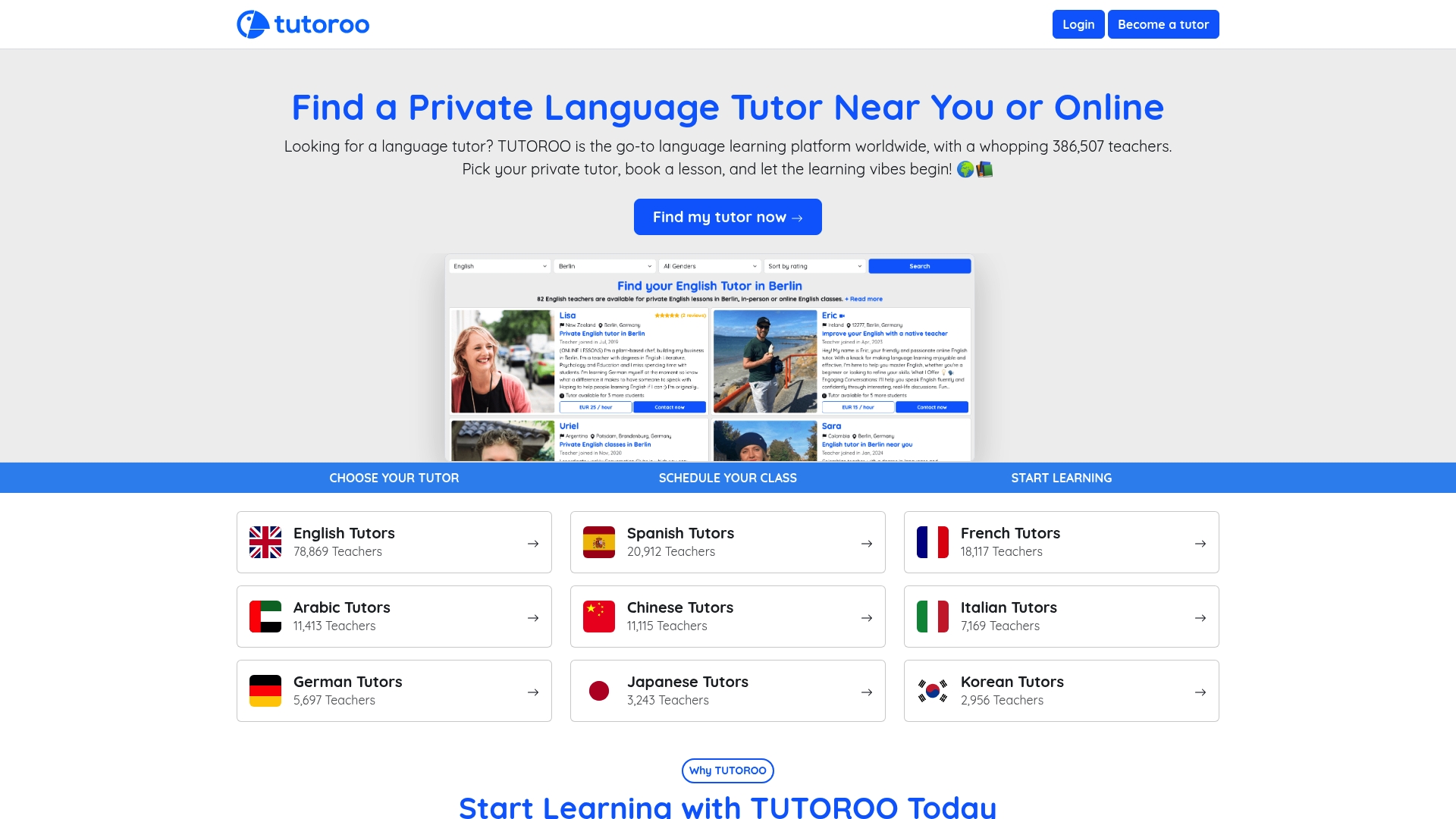
TUTOROO connects you with over 386,000 certified language tutors across dozens of languages, from Spanish and French to Mandarin, Arabic, and beyond. Whether you're preparing for an exam, building conversational confidence, or pursuing professional fluency, our platform makes it easy to find a credentialled tutor who fits your schedule and learning style. Looking for something specific? Explore Malay tutors or Tamil tutors for personalised, culturally rich instruction. Start your journey today, online or in person, with a tutor who is qualified to get you there.
Frequently asked questions
What are the signs of a truly certified language tutor?
Look for formal teaching credentials, observed teaching experience, exam preparation skills, and active listening methods. Certified tutors establish credibility and assure clients of their professional capabilities through validated training in both teaching methods and student psychology.
Do certified tutors really guarantee faster progress?
Certified tutors consistently deliver measurable progress, with many students advancing up to 3 times faster through personalised lessons. One-on-one tutoring accelerates proficiency, with 1 in 3 learners gaining a full CEFR level in just 12 weeks.
What role does certification play in exam and career preparation?
Certified tutors use proven, format-specific strategies for exams and are strongly preferred by schools for job placement, giving learners confidence in their outcomes. Why in-person TEFL certification still beats online programs confirms that 73% of schools prefer certified tutors and that certification leads to 40% faster placement.
Is certification important for bilingual or primary school tutors?
Yes, certified tutors support higher test scores and greater progress in both bilingual and primary school settings. Why bilingual Hispanic teachers make a big difference for English learners shows that bilingual certification combined with cultural familiarity produces significantly stronger student outcomes.