

TL;DR:
- Payment structures like pay-per-lesson, packages, and subscriptions influence flexibility and commitment in language tutoring.
- Lower-cost language tutors often offer more flexible, pay-as-you-go options compared to higher-priced exam prep tutors.
- Transparent policies and trial lessons are essential for establishing trust and ensuring an effective learning relationship.
Most people assume tutoring costs are broadly similar across subjects. That assumption can be costly. Language tutoring averages $38 per hour compared to $62 per hour for SAT prep, a gap of 63% based on an analysis of more than 3,600 tutors. This price difference is more than interesting trivia. It shapes which payment models tutors use, how lessons are structured, and ultimately whether learners find the right fit. Understanding how payment systems work puts you in the driver's seat when choosing a tutor for language acquisition, exam preparation, or travel-readiness.
Table of Contents
- Why payment systems matter in language tutoring
- Comparing payment structures: language vs test prep tutoring
- The impact of payment methods on your learning experience
- Choosing the best payment system for your language goals
- What most guides miss about payment systems in tutoring
- Find the perfect tutor and payment system for you
- Frequently asked questions
Key Takeaways
| Point | Details |
|---|---|
| Payment systems influence outcomes | How you pay impacts not just costs, but your access and satisfaction with tutoring. |
| Flexibility matters | Choosing the right payment style can allow easy tutor switching for a better fit. |
| Compare before you commit | Understanding options lets you align payment with your true language goals. |
| Transparency is key | Look for clear terms, refund policies, and upfront pricing when selecting a tutoring platform. |
Why payment systems matter in language tutoring
Payment is rarely the first thing people think about when starting a language learning journey. Most learners focus on finding a tutor with the right accent, the right availability, or the right personality. But the payment system sitting quietly in the background has a powerful influence on every part of that experience.
There are three main types of payment structures you will encounter in language tutoring:
- Hourly pay-as-you-go: You pay for each lesson individually, with no upfront commitment. This is the most flexible option and works well for casual or exploratory learners.
- Lesson packages: You pay for a bundle of lessons upfront, often at a slight discount. This model suits learners who are committed to a regular schedule and want to lock in a rate.
- Subscription models: A monthly fee that covers a set number of lessons per week. This suits intensive learners with a structured routine.
Each model comes with trade-offs around flexibility, commitment, and cost predictability. Language tutor payment options vary significantly across platforms and individual tutors, which is why it pays to understand these differences before committing.
Security and transparency are also shaped by the payment system. A tutor who asks for direct bank transfers with no platform oversight creates a very different experience from one operating through a structured marketplace with receipts, refund policies, and dispute resolution. The benefits of private tutoring are well-established, but those benefits are only fully realised when the financial arrangement is clear and fair for both sides.
Pro Tip: Always ask a tutor about their cancellation and rescheduling policy before booking. A flexible payment system means nothing if lessons cannot be rearranged without penalty.
Comparing payment structures: language vs test prep tutoring
With the basics in mind, it helps to see how payment systems differ in practice across common tutoring types. The gap between language tutoring and test prep tutoring is sharper than most people realise.
SAT prep tutors charge 63% more than language tutors on average, and this difference shapes the payment structures tutors in each category tend to favour. SAT prep tutors often use premium packages with fixed start dates and structured lesson plans tied to exam timelines. Language tutors, on the other hand, are much more likely to offer flexible pay-as-you-go options, because language learning is open-ended rather than deadline-driven.
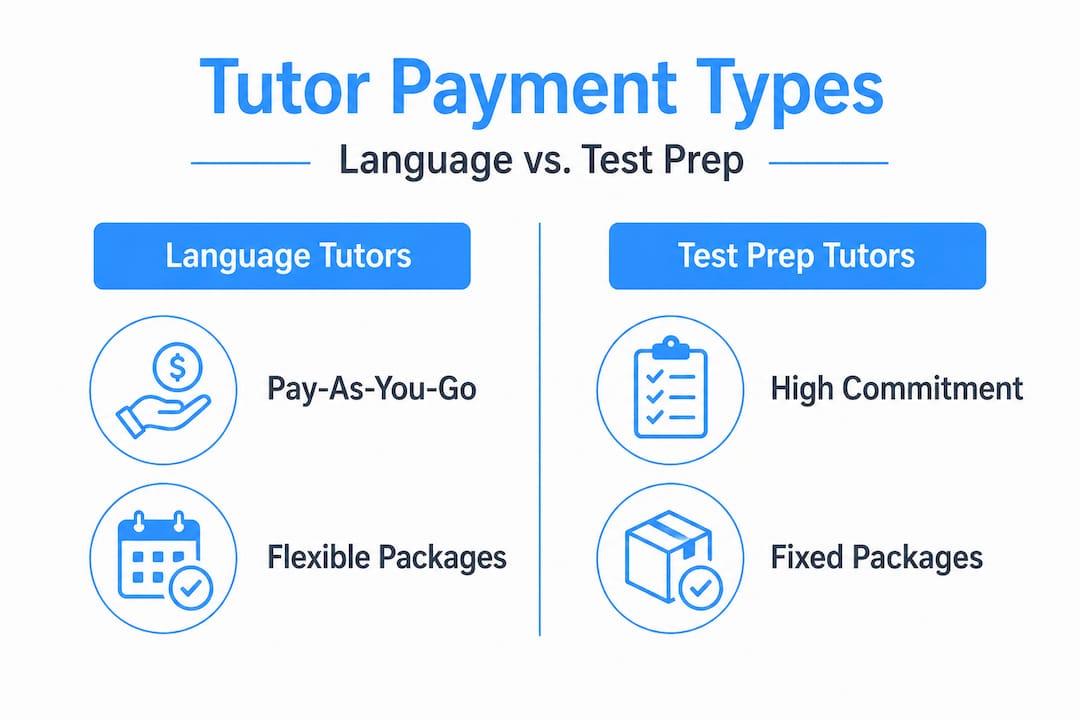
| Feature | Language tutoring | SAT prep tutoring |
|---|---|---|
| Average hourly rate | $38/hour | $62/hour |
| Common payment model | Pay-per-lesson or package | Premium package or bundle |
| Flexibility | High | Moderate to low |
| Refund availability | Often negotiable | Less common |
| Lesson commitment | Casual to intensive | Usually intensive |
| Timeline | Open-ended | Exam-deadline driven |
This comparison matters because it shows that the subject you are studying directly influences what payment options will be available to you. If you are preparing for a language exam rather than learning conversationally, you may find yourself entering a hybrid zone where language tutoring prices are lower but package commitments resemble test prep structures.
"Language tutoring sits at a uniquely accessible price point compared to other forms of tutoring. That accessibility opens doors to culture, connection, and opportunity for a far wider range of learners."
The benefits of private tutors in language learning include personalised pacing, cultural context, and real conversational practice. These advantages are most fully experienced when the payment model does not create financial stress or scheduling rigidity. Exploring local versus online tutoring is also worth considering, as online tutors often have lower overheads and may pass those savings on through more competitive rates or flexible payment terms.
The impact of payment methods on your learning experience
Understanding the differences between payment structures is one thing. Feeling those differences in your weekly lessons is another matter entirely.
Pre-paid packages can be powerful motivators. When you have already committed money to ten lessons, you are more likely to show up, prepare, and stay engaged. That built-in accountability can accelerate progress. However, packages also carry a risk. If the tutor's teaching style does not suit you after the second lesson, or your schedule changes unexpectedly, you may feel trapped. The sunk cost of unused lessons can lead to frustration rather than inspiration.
Flexible pay-as-you-go arrangements remove that pressure. They allow you to:
- Try multiple tutors before settling on the best match
- Adjust your lesson frequency as life demands change
- Pause learning during busy periods without financial loss
- Switch languages or learning goals without penalty
The average language tutoring rate of $38 per hour is genuinely accessible for many learners, which means even pay-as-you-go arrangements are a reasonable long-term investment. The key is finding a system that keeps you motivated without creating pressure that undermines the learning experience itself.
Transparency matters enormously. When both learner and tutor are clear about rates, cancellation terms, and payment schedules, disputes are rare and the relationship stays focused on learning. Opaque systems, where fees shift or policies are unclear, breed mistrust and distraction. Reviewing private tutoring best practices before starting with a new tutor can help set the right expectations from day one.
One often overlooked factor is tutor availability and how payment systems interact with it. A tutor who operates strictly on a package model may hold reserved slots only for package clients, while pay-as-you-go learners are slotted into whatever time remains. Understanding this dynamic helps you negotiate access to the best lesson times.

Pro Tip: Before committing to a package, request a single trial lesson at the per-lesson rate. Most reputable tutors will accommodate this. It protects your investment and lets you assess chemistry before committing.
Choosing the best payment system for your language goals
Now that you see how payment styles affect your progress, the next step is selecting the right system for your specific language journey. There is no one-size-fits-all answer, but a structured approach helps considerably.
Follow these steps to identify your ideal payment model:
- Define your learning goal clearly. Are you aiming for conversational fluency, travel-ready basics, or exam preparation? Each goal has a different intensity level and timeline that will influence which payment model suits you.
- Assess your commitment level honestly. Casual learners who study once a week benefit more from pay-as-you-go flexibility. Intensive learners doing three or more sessions per week will likely find packages more cost-effective.
- Calculate the real cost of each option. A package offering 10 lessons at $35 each sounds appealing, but if you only complete seven, the effective cost per lesson rises. Do the maths before signing up.
- Verify the refund and rescheduling policy in writing. Verbal assurances are not enough. A clear written policy protects both you and your tutor.
- Look for transparent platforms. Marketplace platforms that display total fees, including any service charges, before checkout are a sign of a trustworthy environment.
- Start with a trial lesson. This is the single most valuable step regardless of which payment system you ultimately choose.
The table below offers a quick-reference guide to match your learning goal with the most suitable payment model:
| Learning goal | Recommended payment model | Key reason |
|---|---|---|
| Casual conversational learning | Pay-per-lesson | Maximum flexibility, no pressure |
| Exam preparation (e.g. DELF, IELTS) | Package of 10 or more lessons | Structured timeline, cost savings |
| Travel-ready basics in 6 to 8 weeks | Short package of 5 to 8 lessons | Focused and time-bound |
| Long-term fluency building | Monthly subscription | Routine, consistency, best value |
| Testing a new language for the first time | Single trial lesson | Low risk, honest assessment |
If you are preparing for a specific exam, exploring tutors for exam preparation will help you understand how expert tutors structure lesson sequences to match official exam criteria. This kind of specialist support is best secured through a package commitment where both tutor and learner are aligned on the end goal.
Language tutoring at $38 per hour on average remains one of the most affordable forms of private instruction available, which means even a modest budget can support meaningful progress when paired with the right payment structure.
What most guides miss about payment systems in tutoring
Most articles on this topic stop at the surface. They compare hourly rates, list the pros and cons of packages, and remind you to read the fine print. That is useful advice, but it misses something important.
The real risk in tutoring payment systems is not financial. It is relational. When money changes hands upfront, power dynamics shift. A learner who has pre-paid for twenty lessons is less likely to speak up when lessons feel unproductive, when the tutor repeatedly cancels, or when the teaching style simply does not resonate. Nobody wants to feel like they are wasting a lesson they have already paid for. So instead of addressing the problem, many learners quietly endure sessions that are not working. That silence costs progress.
This is why trial lessons are not just a nice feature. They are a safeguard. A system that makes trial lessons easy to access, affordable, and refundable if expectations are not met is genuinely serving the learner's interests. Some platforms make trial lessons difficult to find or charge the same rate as regular lessons with no refund option. That is a warning sign worth heeding.
There is also a persistent myth that cheaper payment structures indicate lower quality. In language tutoring, the opposite can often be true. A native-speaking tutor who charges $30 per hour on a pay-as-you-go basis may deliver richer cultural immersion and more authentic conversational practice than a premium-packaged tutor at twice the price. Value in language learning is not measured in dollars per hour. It is measured in meaningful connections made, confidence gained, and real-world language skills built.
Unlocking language potential is rarely about spending more. It is about choosing smarter, asking the right questions upfront, and ensuring the payment system you enter into supports your learning rather than constraining it. The most productive tutor-learner relationships are built on mutual trust and clarity, and payment transparency is where that trust begins.
Find the perfect tutor and payment system for you
Armed with this knowledge, it is time to take action and find the tutor and payment system that fits you best.
TUTOROO brings together more than 386,000 language tutors from across the globe, offering personalised, one-on-one lessons in languages ranging from Spanish and French to Arabic, Mandarin, and beyond. Whether you are searching for a casual conversation partner, a focused exam preparation specialist, or a cultural guide who brings a language to life, TUTOROO makes it easy to find your match. Browse tutor profiles on TUTOROO with transparent rates, flexible payment arrangements, and clear lesson terms so you can start your journey with confidence. Filter by language, location, availability, and budget to find the right fit without guesswork. Your next language learning chapter is ready to begin.
Frequently asked questions
Why are SAT prep tutors more expensive than language tutors?
SAT prep tutors typically charge higher rates due to specialised content demands and intense competition tied to exam outcomes, with SAT prep averaging $62 per hour compared to $38 for language tutoring. The high stakes nature of standardised testing creates a premium market where results are closely tied to tutor reputation.
Is it better to pay per lesson or by package when selecting a language tutor?
Paying per lesson offers the flexibility to trial multiple tutors and adjust your schedule freely, while lesson packages often secure better per-session rates for learners with a clear long-term commitment. The best choice depends on how defined your learning goal and timeline are at the outset.
Do payment systems affect how quickly learners progress?
Yes, flexible payment systems can make it easier to switch tutors quickly if the teaching style is not working, which prevents weeks of unproductive lessons from slowing your progress. Transparent systems also reduce stress, allowing learners to focus fully on language acquisition rather than financial uncertainty.
What safeguards should I look for in a tutoring payment system?
Look for platforms that display all fees clearly before checkout, offer written refund and rescheduling policies, and provide secure payment processing through a trusted channel. The ability to request a trial lesson before committing to a package is one of the strongest indicators that a platform genuinely prioritises learner satisfaction.
Are language tutoring rates the same worldwide?
No, rates vary significantly by region, language, tutor experience, and lesson format, though the global average sits around $38 per hour for one-on-one language lessons. Online tutoring has helped level the playing field, with many learners accessing highly experienced tutors at competitive rates regardless of geographic location.