

TL;DR:
- Tutor availability, including schedule and reliability, directly influences language learning progress.
- Online platforms use matching tools and ratings to ensure learners access tutors aligned with their schedules.
- Consistent lessons with available tutors accelerate fluency, emphasizing routine and committed relationships.
Many language learners begin their search for a tutor with one assumption: that the right person is just a click away, ready to teach at a moment's notice. The reality is a little more layered than that. Tutor availability shapes everything from how often you practise to how quickly you progress, and overlooking it can quietly derail even the most motivated learner. Tutored learners gain 2.1 CEFR levels in six months compared to 1.2 levels through self-study, which tells us that consistent, guided learning is powerful. Understanding how availability works puts you in control of your own language journey.
Table of Contents
- What does tutor availability mean?
- Why tutor availability matters for language progress
- Comparing tutor types: human vs. AI and flexibility
- How top platforms manage and improve tutor availability
- A different take on tutor availability: what most people overlook
- Find your ideal language tutor with flexible availability
- Frequently asked questions
Key Takeaways
| Point | Details |
|---|---|
| Tutor availability defined | Tutor availability means when and how often you can book lessons with a specific tutor. |
| Regular access drives progress | Learners with consistent tutor access typically progress faster than self-study. |
| Platforms shape your options | Major online platforms use ratings and matching systems to improve tutor accessibility. |
| Balance flexibility and fit | Choosing a tutor is about their availability and how well they support your needs. |
What does tutor availability mean?
Tutor availability is, at its simplest, the times and frequency at which you can book lessons with a particular tutor. But it goes well beyond a shared calendar. It captures the full picture of when a tutor is accessible, how reliably they show up, and whether their schedule aligns with yours over the long term.
Several factors shape a tutor's availability at any given time:
- Time zone differences: An online tutor based in Madrid may only overlap with an Australian learner for a narrow window each day.
- Personal commitments: Many tutors teach part-time alongside other work or study, which limits their open slots.
- Platform rules: Some platforms cap the number of lessons a tutor can offer per week, or require advance notice for bookings.
- Location: In-person tutors are constrained by geography, transport, and local demand in ways that online tutors are not.
- Lesson type: Trial lessons, recurring sessions, and one-off bookings may each have different availability rules.
Online platforms handle this complexity through smart matching tools. Platforms prioritise availability in matching for learners at all levels, using algorithms that surface tutors whose open slots align with a student's preferred times. This is a significant advantage over the traditional approach of cold-calling local tutors and hoping for a match.
In-person tutoring, by contrast, is shaped by physical proximity. A local tutor may be highly skilled but only available on Tuesday evenings, which could be a dealbreaker for a learner with a shifting work roster. Online tutoring opens the door to a far wider pool, giving you genuine choice rather than just whoever happens to live nearby.
Understanding the tutor matching process helps you ask better questions before committing to a tutor. Does this person have recurring slots free? Are they available during public holidays? What happens if they need to cancel? These details matter more than most learners initially realise.
Pro Tip: When browsing tutors, filter by time zone first. A tutor who looks perfect on paper is far less useful if their only free slots fall at 3am your time.
Why tutor availability matters for language progress
Understanding the definition is only half the story. Here is why tutor availability makes such a difference to your success.
Language learning is a skill built through repetition and regular exposure. Miss a week, and you lose momentum. Miss a month, and you may find yourself revisiting ground you already covered. Consistent access to a tutor is not a luxury; it is the engine behind steady progress.
"Students who maintain weekly booked sessions with the same tutor progress nearly twice as fast as those who book ad hoc." This pattern holds across languages and levels, reinforcing that routine is one of the most powerful tools a learner has.
Here is how availability directly shapes your outcomes:
- Regular practice builds retention: Spaced repetition, which is the practice of revisiting material at increasing intervals, works best when lessons happen on a predictable schedule.
- Consistency reduces anxiety: Knowing your next lesson is already booked removes the mental friction of having to organise each session from scratch.
- Progress tracking becomes meaningful: When you meet regularly, your tutor can track patterns in your errors and adjust their approach in real time.
- Motivation stays high: Gaps between lessons often coincide with drops in motivation. A reliable schedule keeps the momentum alive.
- Cultural nuance is absorbed gradually: Language is more than grammar. Regular sessions allow tutors to weave in cultural context, idioms, and authentic usage over time.
Tutored learners outperform self-study by a significant margin, but that advantage only compounds when lessons happen consistently. Real-life disruptions such as peak periods, public holidays, and tutor illness are unavoidable. The learners who plan around these interruptions, by booking ahead or identifying a backup tutor, are the ones who maintain their edge.
Exploring language learning with a tutor gives you a clearer sense of just how much the human element accelerates fluency. For those curious about how different platforms compare, platform speed comparisons offer useful context.
Comparing tutor types: human vs. AI and flexibility
With the importance of availability in mind, it is worth comparing your options for who or what provides your tutoring.
The choice between a human tutor and an AI-powered learning tool is increasingly relevant. Both have genuine strengths, and the right choice depends on what you value most.
| Feature | Human tutor | AI tutor |
|---|---|---|
| Availability | Variable, schedule-dependent | 24/7, always on |
| Personalisation | High, adapts to your goals | Moderate, rule-based |
| Cultural insight | Deep, authentic connection | Limited |
| Emotional support | Yes, builds rapport | Minimal |
| Cost | Varies, often higher | Often lower or subscription-based |
| Feedback quality | Nuanced and contextual | Consistent but formulaic |
| Flexibility | Depends on tutor's schedule | Fully flexible |
Human tutor availability is variable compared to AI tutors, which are available around the clock but offer less personalised feedback and no real cultural connection. For learners who need to practise at unpredictable hours, an AI tool can fill the gaps between human sessions effectively.

However, for learners who want to hold a genuine conversation, receive nuanced corrections, and feel genuinely supported, a human tutor is irreplaceable. The warmth of a real exchange, where a tutor notices your hesitation and encourages you forward, is something no algorithm replicates.
The smartest approach for many learners is a blended one: a human tutor for structured, weekly sessions and an AI tool for low-stakes daily practice. This maximises both consistency and flexibility without sacrificing depth.
Weighing up online vs. local tutoring is another useful step in finding the right fit for your lifestyle and learning goals.
How top platforms manage and improve tutor availability
So, how do major platforms make tutor availability work for you, even when demand is high?
Leading language learning platforms have invested heavily in systems that keep tutor access reliable and transparent. Here is a snapshot of how the best platforms approach this:
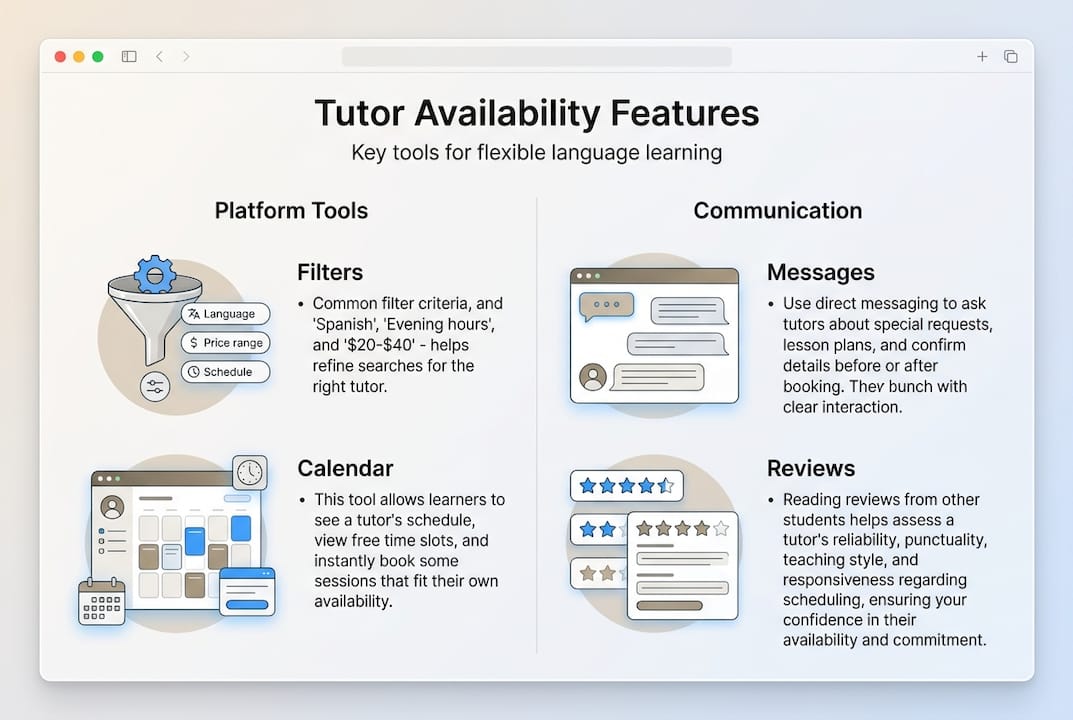
| Platform feature | How it helps learners |
|---|---|
| Rating and review systems | Reward tutors who show up consistently and penalise no-shows |
| Automated calendar tools | Give real-time visibility into open slots |
| Waitlists and notifications | Alert students when a preferred tutor becomes available |
| Recurring lesson booking | Lock in a regular time slot before it fills |
| Tutor booking history | Shows reliability before you commit |
High-rated tutors maintain consistent availability, with platforms like italki tracking attendance rates and surfacing tutors with strong records in search results. This transparency is genuinely useful. A tutor with a 98% attendance rate tells you far more than a glowing written review.
As a student, you can take practical steps to protect your own access:
- Book recurring lessons: A standing weekly slot is far more reliable than hunting for availability each time.
- Use reminders and calendar sync: Most platforms allow you to connect your booking to your personal calendar.
- Check a tutor's recent activity: Tutors who have logged in and taught recently are more likely to be actively available.
- Have a backup option: Identifying a second tutor with a compatible style means disruptions do not derail your progress.
Pro Tip: Look at a tutor's response time in their profile. Tutors who reply within a few hours are typically more organised and reliable than those who take days to respond.
For more on making the most of your sessions, practical tutoring examples and insights into flexible tutoring benefits are well worth exploring. The private tutoring advantages of one-on-one sessions become even clearer when you pair them with smart booking habits.
A different take on tutor availability: what most people overlook
Beyond the practical, it is worth rethinking how you approach the availability conversation when searching for the right tutor.
Most learners scan for tutors with the widest open calendars, assuming more availability equals more opportunity. But a tutor who is always free is not necessarily the right tutor for you. What actually drives progress is routine, and routine is built on commitment and connection, not just an open schedule.
A tutor who is available three evenings a week and genuinely invested in your goals will outperform a tutor who is technically free at any hour but brings no consistency to the relationship. Personalised learning methods thrive when there is trust and familiarity between student and tutor. That takes time to build, and it builds fastest when sessions are regular.
Platform support and clear communication between tutor and student also play a quiet but important role. A tutor who messages you ahead of a lesson, checks in on your goals, and adjusts their approach based on your feedback is worth far more than a wide-open calendar with no real engagement behind it.
Find your ideal language tutor with flexible availability
Ready to put this knowledge into action? Finding a tutor whose schedule genuinely fits yours is easier than ever when you know what to look for.
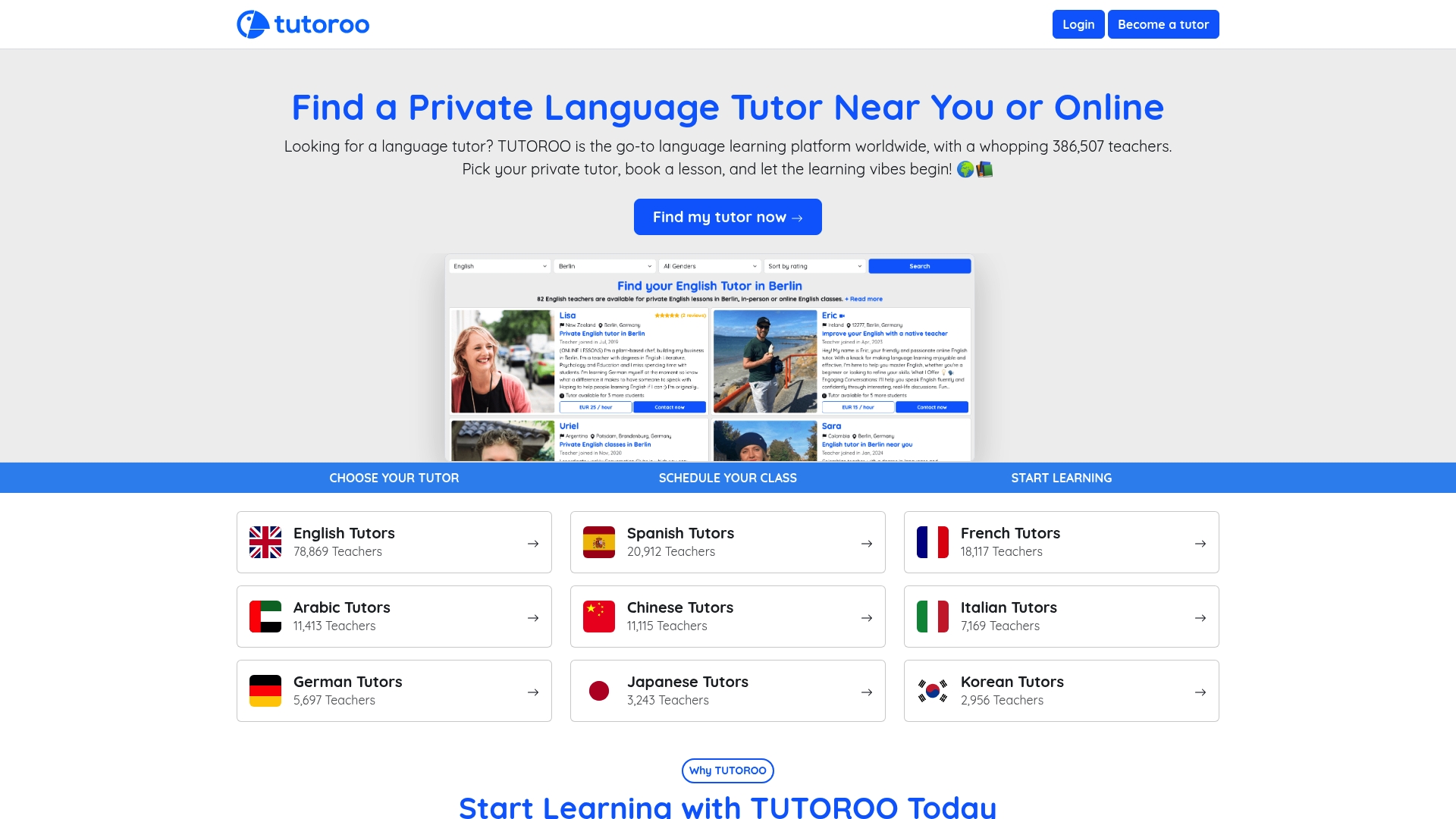
TUTOROO connects learners with over 386,000 language tutors worldwide, offering flexible scheduling across time zones, languages, and learning styles. Whether you are looking to find a language tutor for general conversation practice, or you want to work with specialist English tutors or Lebanese tutors, the platform makes it straightforward to filter by availability, location, and language. Browse tutor profiles, check booking histories, and message your shortlist directly. Your next lesson could be closer than you think.
Frequently asked questions
How do online tutor platforms handle high demand periods?
Top platforms use waitlists, notifications, and a large tutor pool to give students more options when tutors are busiest. High availability drives platform success, with tutored students consistently outperforming self-learners when access is maintained.
Can I book language tutors for lessons at any time of day?
AI tutors are available 24/7, but human tutors' availability depends on their time zones and personal schedules. Human tutor availability is variable compared to AI options, so checking your platform's filter tools is the best first step.
Is tutor availability more important than tutor skill?
Both matter, but regular lessons with a consistent tutor often have a greater impact on progress than simply chasing the most available option. High-rated tutors with strong attendance records tend to deliver the best learning outcomes over time.
What should I do if my preferred tutor is unavailable?
Try booking lessons further in advance, join a waitlist if the platform offers one, or explore other tutors with similar profiles and strong positive reviews. Having a backup option ready means your progress never has to pause.