

Duolingo is a good way to build a daily habit and a base of vocabulary. A private tutor is the better choice once you want to speak, be corrected as you go and keep progressing past the beginner stage. For most learners with a real goal, the strongest plan is a tutor for live conversation, with an app for short daily practice in between. Here is how the two compare on lessons, results and cost, and how to choose for your situation.
TL;DR
- Duolingo suits casual, low-pressure practice: short sessions, a free tier and a streak that keeps you coming back.
- A private tutor suits speaking confidence, grammar explanations, exam preparation and anyone who has plateaued.
- A 2026 study of beginner French found app-only, classroom-only and combined groups all improved, so a beginner can start with either.
- Researchers who have studied the app point to missing grammar explanations and limited pronunciation feedback as the gaps a tutor fills.
- Using both is a sensible plan: the app for daily repetition, one-on-one lessons for speaking and correction.
Table of Contents
- How the two actually differ
- What the research says
- Speaking: the deciding factor for most learners
- Cost: free to start, but compare cost per outcome
- Which fits your goal
- Using both well
- Finding a tutor on TUTOROO
- Our perspective
- FAQ
- Sources
How the two actually differ
The difference is not that one is serious and the other is a game. They are built to do different jobs.
Duolingo delivers short, structured exercises you can do any time. You translate, match, listen and tap answers, and the app tells you whether you were right. Its practice sessions revisit older material so it stays fresh, and the streak system rewards showing up every day. That is genuinely useful for vocabulary and for building the habit of studying.
A private tutor works with you, not with a course. They listen to how you actually speak, hear the mistake you make every time, and stop to explain why. A lesson is typically a scheduled block of 45 to 60 minutes, and a good tutor builds it around what you need: the phrases for your trip, the vocabulary of your job, the exam format you are facing. Next week they check whether the point stuck.
If you want a longer look at how one-on-one lessons are structured, our guide to private language lessons walks through formats, cost and choosing a tutor.

What the research says
The honest summary is that apps do teach, and that they have predictable gaps.
Beginners can improve with an app
A study published in March 2026 in the journal Studies in Second Language Acquisition followed beginner French learners for 16 weeks. Learners using only Duolingo, only a classroom, or a classroom plus Duolingo all improved significantly, by similar amounts. The one area where the combined group pulled ahead was pragmatic use of French, such as choosing between the informal tu and the formal vous.
That is encouraging for a true beginner, and it matches what many learners find: the first weeks of any language are largely about vocabulary and basic patterns, which an app handles well. It also shows where human instruction adds something: knowing which form to use with whom, which depends on context and not on a right-or-wrong answer.
Where researchers see the limits
Researchers at Radboud University in the Netherlands, writing in 2024, point out that Duolingo does not explain grammar when you make an error and does little to teach formal versus informal register. One of them also expressed the view that a Duolingo course will not take you much beyond the A2 level, the second step on the six-level European scale (A1 to C2) that language courses commonly use. A2 is roughly where you can handle simple everyday exchanges.
A March 2025 report from Singapore's National Institute of Education reaches a similar place. Unlike formal classes, apps lack in-depth explanations of grammar such as word order, and perfecting pronunciation on an app is a challenge.
Both points have the same practical meaning. When you get an answer wrong on an app, you learn that it was wrong. When you get it wrong with a tutor, you learn why, hear it said correctly, and try again straight away.
Why live feedback matters
Correction that makes you fix your own error, rather than simply showing you the right answer, is especially valuable. A tutor can do this naturally: pause, repeat your sentence back with a question in the tone, and let you spot the slip. An app can score a recording, but it cannot read your hesitation or choose the next question based on what you just struggled with.
Speaking: the deciding factor for most learners
Most people who search this comparison want to talk to someone. That is where the gap is widest, for a simple reason: speaking is a skill you build by speaking, with a person who responds.
In an app, your speaking is mostly short repeated phrases and prompts. In a one-on-one lesson, you spend a large part of the hour producing language yourself: asking, answering, explaining, getting stuck and finding a way round it. That is the rehearsal for a real conversation in a restaurant, a meeting or a classroom abroad.

A tutor also hears things an app cannot reward or catch: a vowel you flatten, a word you stress wrongly, a sentence that is grammatical but sounds unnatural. Those are the details that separate being understood from sounding confident.
Our article on why one-on-one lessons deliver faster results covers the reasons in more depth.
Cost: free to start, but compare cost per outcome
Duolingo has a free tier supported by ads, with paid subscriptions that remove ads and add features. Subscription prices vary by plan and change over time, so check the app's own pricing screen for the current figure. In any case, it is the cheapest way to study a language by a wide margin, and that is a fair reason to start there.
Private tutoring costs more per hour, and the rate depends on the language, the tutor's experience, and whether lessons are online or in person. Our guides to language tutor rates in the USA and online language tutor costs show the ranges and how to build a monthly budget around one or two lessons a week.
The useful way to compare is not price per hour but cost per result. An app that you open for five minutes and then drop costs little and delivers little. A weekly lesson with a fixed time in your diary tends to keep you studying because someone is expecting you. If a regular tutor feels out of reach, one lesson a week, or one every two weeks, alongside free app practice is a practical middle path.
Which fits your goal
| Your goal | Starting point | Why |
|---|---|---|
| Curious, no deadline | Duolingo | Low cost and low pressure, and you find out whether you enjoy it |
| Holiday or short trip | App for vocabulary plus a few tutor lessons | The tutor drills the exact situations you will face: ordering, directions, small talk |
| Work or a move abroad | Private tutor | Tailored vocabulary, grammar explained, a steady schedule |
| Exam preparation | Private tutor | A tutor knows the exam format and marks your speaking and writing the way an examiner would |
| Stuck at intermediate | Private tutor | Plateaus usually come from habitual errors an app does not flag |
| Child or teenager | Private tutor, with app games as a supplement | Lessons adapt to age and school requirements, and a parent can see the schedule |
The table is a guide, not a rule. Learners with a clear deadline, such as a trip in three months or an interview in six, gain most from a tutor because lessons can be built backwards from that date.
Learners preparing for travel
Travel is the easiest case for a hybrid. Use an app on your commute to pick up greetings, numbers and food vocabulary, then book a few lessons focused on the conversations you will actually have. A tutor can role-play checking into a hotel or asking for a table, and correct your pronunciation of place names, which an app will rarely do.
Learners preparing for exams
Exams test things an app does not train directly: producing a spoken answer on demand, writing in a set format, and managing time. A tutor who knows the exam can set practice tasks, mark them and show you which errors cost the most points.
Parents and educators
For children, the value of a tutor is also relational: a patient adult who adjusts pace, links the language to school work or interests, and gives parents a clear picture of progress. Many families keep an app for fun between lessons, which works well. Our comparison of group versus private lessons helps if you are weighing a class as well.
Using both well
You do not have to choose. A simple routine looks like this:
- Daily, 10 minutes of app practice. Use it for vocabulary and listening repetition. Its strength is frequency.
- Weekly, one lesson with a tutor. Spend it on speaking, and bring the mistakes and questions the app raised.
- After each lesson, note three things. A word, a grammar point and a phrase to reuse. Practise them in the app and in your own sentences.
- Every month, check your goal. If you are not getting closer to speaking, give more of your time to conversation.
This keeps what each does best. The app builds repetition cheaply, and the tutor turns that raw material into speech and fixes what the app cannot explain. If you are choosing between formats for the tutor side, see the types of private language lessons and our comparison of local versus online tutoring.
Finding a tutor on TUTOROO
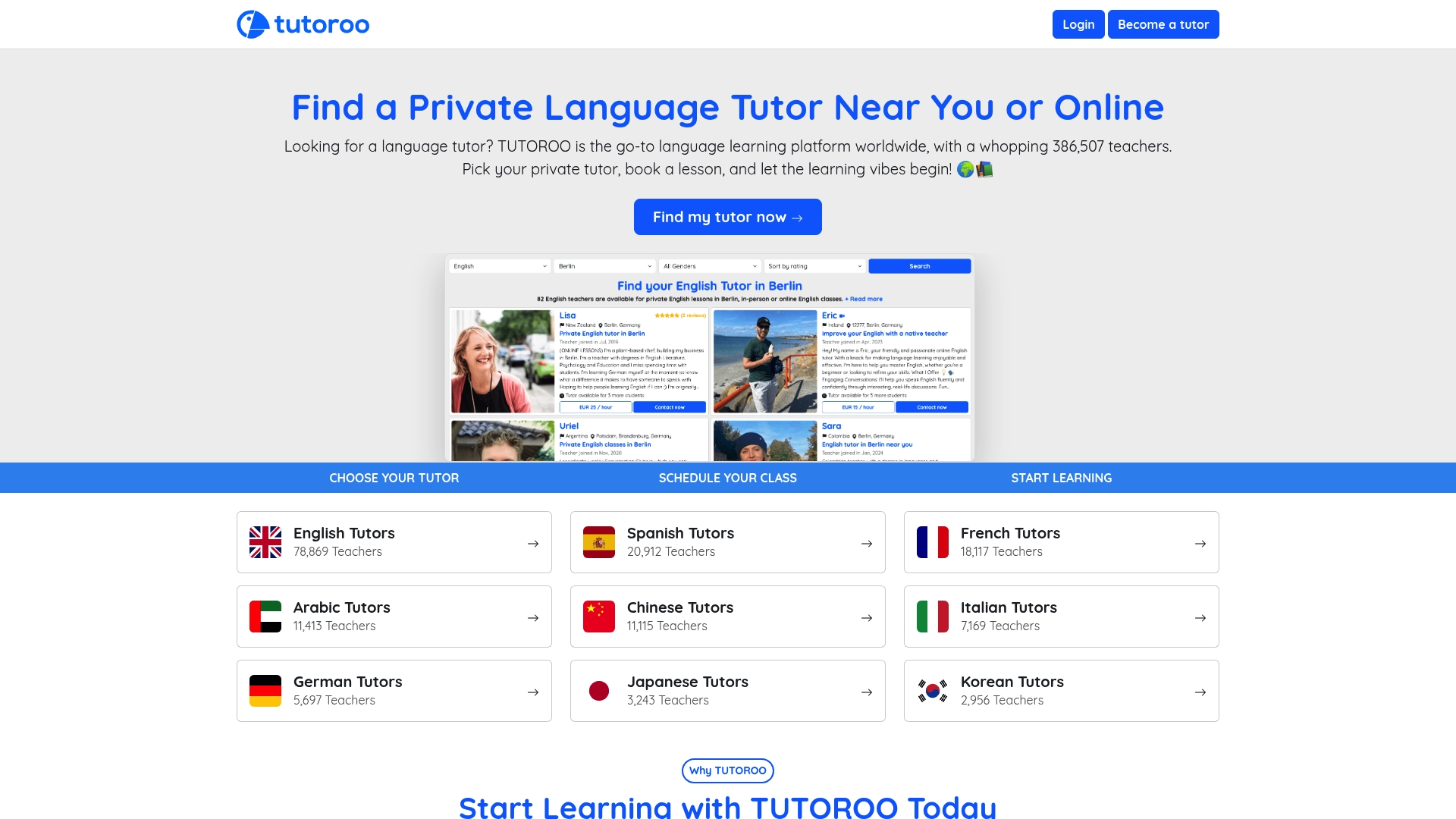
TUTOROO connects learners with private language tutors, with a community of over 386,000 teachers. You can search by language, location and availability, and choose lessons in person or online. Tutors are available in English, Spanish, French, Japanese, Chinese/Mandarin, German, Italian and Portuguese, among many other languages. You message tutors directly through the platform to agree a schedule, and you pay your tutor directly for ongoing lessons.
That direct contact matters for the reasons above: you can tell a tutor your goal, whether it is a trip, an exam or a job, before the first lesson, and they can shape the first session around it.
Browse teachers for your language at TUTOROO, or go straight to English tutors, French tutors, German tutors or Chinese/Mandarin tutors.
Our perspective
We think of the app and the tutor as two different tools, and we think the tutor is the one that gets people speaking. Language opens doors to culture, connection and opportunity, and those doors open through conversation with another person.
What a one-on-one lesson gives you is personalised tuition: a teacher who hears you, answers your questions and adapts to your goal. Whether you are preparing for an exam, a move or a first trip, that attention shapes your progress in a way a fixed course cannot.
That is why TUTOROO is built around choice and direct contact. Learners can find expert tutors by language, place and availability, and message them to agree what suits them. Tutors set their own schedules, and learners get a human guide to authentic usage and cultural immersion.
Keep the app for your daily habit if you enjoy it. When you are ready to talk, find a tutor.
TUTOROO
FAQ
Can you become fluent with Duolingo alone?
Researchers who have studied the app describe it as most useful at the beginner level, with limited grammar explanation and limited help with pronunciation and formal versus informal speech. Fluency means holding real conversations, which needs speaking practice with a responsive partner. Most learners aiming for fluency add a tutor.
Is a private tutor worth it if I am a complete beginner?
Yes, if you have a clear goal or a deadline. A tutor sets good pronunciation habits from the first lesson and explains why the language works as it does. If you are only exploring, starting with an app for a few weeks is a reasonable way to find out how much you want to commit.
How often should I have lessons?
One lesson a week is a common rhythm, because it gives you time to practise between sessions and keeps the language fresh. Learners with a near deadline, such as an exam, often add a second weekly lesson. Our guide to the benefits of private tutors covers how to set a schedule.
Can I use Duolingo between tutor lessons?
Yes, and it works well. Use the app for short daily vocabulary and listening practice, and bring the questions it raises to your tutor. Your lesson time then goes on speaking and correction.
Is a tutor better for children?
For most children, a tutor adds a patient adult who adapts to age, school work and personality. Parents can also see the schedule and discuss goals with the tutor. Apps can still be a fun supplement between lessons.
Sources
- Comparing the effectiveness of Duolingo, classroom instruction and combined conditions on beginner-level French (Studies in Second Language Acquisition, 2026)
- Can you learn to speak fluent French, German or Spanish with Duolingo? (Radboud University, 2024)
- Speak easy: Can AI and language learning apps really help you achieve fluency? (NTU Singapore, National Institute of Education, 2025)