

TL;DR:
- A structured conversation practice workflow combines daily repetition with AI tools and human tutors to build speaking fluency. Learners should follow a five-step cycle of listening, shadowing, roleplaying, personalizing, and reviewing sessions lasting 5 to 15 minutes. Balancing practice types and focusing on safe topics help build confidence, especially for shy learners.
A conversation practice workflow is a structured sequence of steps designed to build speaking fluency through consistent, interactive practice. Without a repeating system, most learners plateau after basic phrases and never reach the natural back-and-forth that real communication demands. The good news is that conversational language practice does not require hours of daily study. Research points to a five-step daily cycle as the most effective method for building automaticity, and tools ranging from AI chatbots to private tutors on platforms like Tutoroo make that cycle accessible to learners at every CEFR level.
What does an effective conversation practice workflow need?

The right tools and a clear starting point separate learners who progress from those who spin their wheels. Before any dialogue practice strategy takes shape, two prerequisites matter most: knowing your current CEFR level (A1 through C2) and setting a specific goal, such as holding a five-minute conversation on a familiar topic without pausing to translate.
Core tools for structured practice
Three categories of tools support a well-built workflow.
- AI conversation partners. These generate natural replies, flag grammar errors, and produce session summaries. They work best for low-stakes repetition and late-night practice when a human tutor is unavailable.
- Recording devices. A smartphone voice memo app is enough. Recording yourself and listening back reveals pronunciation patterns you cannot hear in real time.
- Script templates. Pre-written dialogue frameworks for common scenarios (ordering food, giving directions, discussing weekend plans) give learners a scaffold before free conversation begins.
Human tutors sit above all three categories for one reason: they adapt in real time. An AI chatbot follows a prompt; a skilled tutor reads hesitation, adjusts vocabulary, and models natural rhythm. For learners building real speaking skills, combining AI tools with regular tutor sessions produces faster results than either approach alone.
Pro Tip: Balance voice and text practice. Text-based AI exchanges build reading fluency and grammar awareness, but voice practice is the only way to train pronunciation and speaking pace. Aim for at least two voice sessions for every text session.
| Tool category | Best use case | Limitation |
|---|---|---|
| AI conversation partner | Daily repetition, error drills | Cannot read emotional cues |
| Human tutor | Adaptive feedback, cultural nuance | Requires scheduling |
| Self-recording | Pronunciation review | No external feedback |
| Script templates | Scenario preparation | Can feel artificial |
How to implement a daily conversation practice workflow
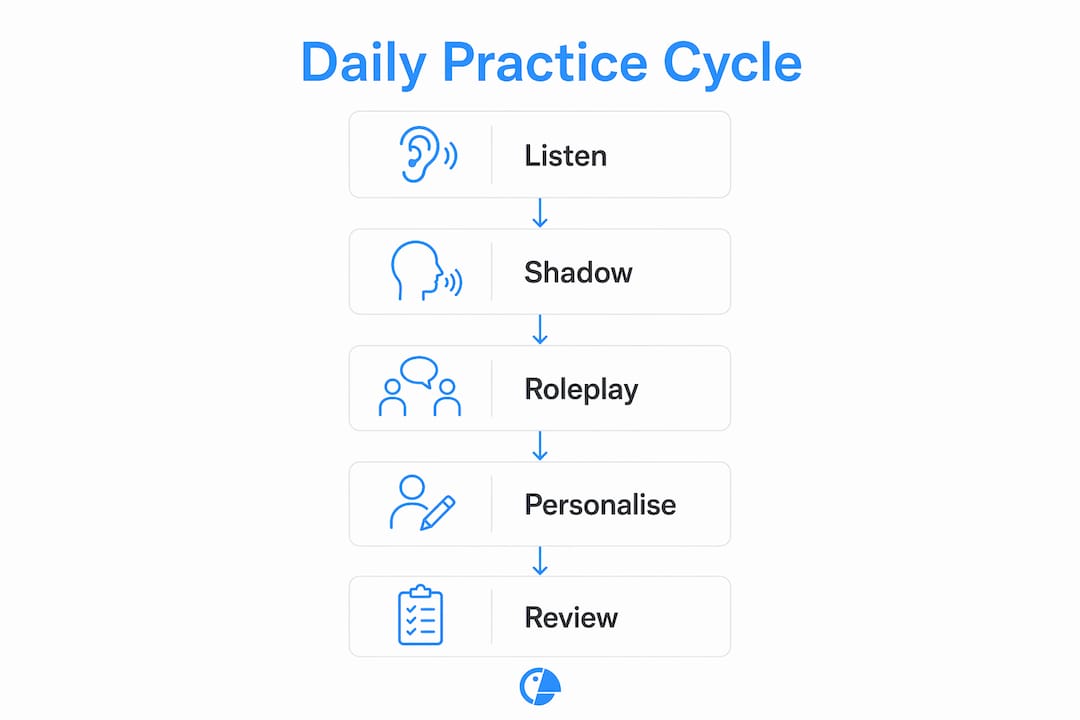
The most effective daily structure runs for 5–15 minutes and follows a five-step repeating cycle. Short, high-intensity sessions build automaticity and reduce anxiety far better than infrequent long sessions. That finding matters because most learners abandon practice when it feels like a chore. Keeping each session under 15 minutes removes that barrier entirely.
The five-step cycle
- Listen or read a short dialogue. Choose a script at your current CEFR level. Read it once for meaning, then again for rhythm. Two minutes is enough.
- Shadow the rhythm. Play the audio and speak along simultaneously. Focus on stress and intonation, not individual words. This trains your mouth to move at native speed.
- Roleplay the scenario. Close the script and act out the dialogue from memory. Swap roles if you are practising with a partner or tutor.
- Personalise the script. Swap out the original names, places, and details for your own. This step converts a memorised phrase into genuine self-expression.
- Record and review. Record your personalised version, play it back, and note one or two errors. Write them down and drill them at the start of the next session.
The five core steps of this cycle (reading, shadowing, roleplaying, personalising, and reviewing) are endorsed by language acquisition research as the fastest path from scripted to spontaneous speech.
Maintaining conversational balance
One structural problem learners hit early is turning practice into an interview. The 2:1 ratio addresses this directly: share two things you have learned about your partner for every one thing you share about yourself. This creates reciprocity and keeps the exchange feeling like a real conversation rather than a questionnaire.
The Two-Turn Follow-Up method adds another layer. After answering a question, ask a related question, then follow up on your partner's answer with a deeper observation. This three-move sequence (answer, question, follow-up) signals genuine listening and builds connection beyond surface talk.
Pro Tip: Use a simple timer. Set it for 12 minutes and divide it: two minutes for listening, three for shadowing, three for roleplay, two for personalising, and two for review. Strict time limits prevent any single step from eating the whole session.
| Step | Time allocation | Goal |
|---|---|---|
| Listen or read | 2 minutes | Comprehension and rhythm awareness |
| Shadow | 3 minutes | Pronunciation and pace training |
| Roleplay | 3 minutes | Memory and spontaneous recall |
| Personalise | 2 minutes | Authentic self-expression |
| Record and review | 2 minutes | Error identification and drilling |
What common challenges arise in conversation practice?
The most common obstacle is anxiety, and it shows up before a single word is spoken. Learners catastrophise about making errors, which freezes output entirely. The solution is not to push through discomfort but to reduce the stakes of the first few exchanges.
Shy learners benefit from starting with opinion-sharing on safe topics before moving into personal stories. Discussing a film, a local restaurant, or a recent news story gives learners a low-risk entry point. Comfort builds gradually, and deeper conversation follows naturally once the initial awkwardness fades.
A second challenge is the correction dilemma. Constant interruptions to fix errors kill conversational flow. Tutors and practice partners get better results by letting a learner complete a thought, then addressing one or two errors at the end of the exchange. This approach protects confidence while still delivering accurate feedback.
Conversational success relies on flow, receptiveness, and balancing listening with sharing. Acknowledging opposing views without using reasoning or minimising language keeps both speakers open and engaged. Avoiding words like "because" or "therefore" in disagreements removes the condescending edge that shuts conversations down.
The H.E.A.R. framework (Hear, Empathise, Acknowledge, Respond) gives learners a practical structure for staying receptive. It is especially useful when practising opinion-based topics where disagreement is likely. Working through this framework with a tutor during language practice activities builds both linguistic and interpersonal skills simultaneously.
Pro Tip: Tutors: scaffold participation by asking open questions that require more than a yes or no answer. "What did you think of that?" works better than "Did you like it?" The longer the learner's response, the more material you have to work with.
How can AI enhance conversation practice workflows in 2026?
AI conversation partners have moved well beyond simple chatbots. The best current tools generate natural language replies, flag grammatical errors mid-conversation, and produce end-of-session summaries that learners can review and drill. AI chatbots with correction features make frequent, flexible speaking practice available at any hour, which removes the scheduling barrier that stops many learners from practising daily.
Reusable prompts are the most underused feature in AI-assisted practice. A well-written prompt specifies the topic, the register (formal or casual), the learner's CEFR level, and the type of correction requested. Saving three or four of these prompts means a learner can start a targeted session in under 30 seconds.
Where AI works best
- Error drilling. Explicit correction after every two or three exchanges, followed by a short drill phase, improves accuracy faster than unstructured chatting. AI tools can automate this cycle reliably.
- Topic-specific vocabulary. Prompting an AI to stay within a single topic (travel, healthcare, business meetings) forces learners to build domain-specific vocabulary without drifting.
- Session tracking. Reviewing error summaries across multiple sessions reveals patterns. A learner who consistently misuses a particular tense can target that structure in the next session.
Where AI falls short
AI cannot replicate the cultural nuance, humour, or emotional attunement of a skilled human tutor. It also cannot detect when a learner is genuinely confused versus simply pausing to think. For that level of responsiveness, human guidance remains irreplaceable. The most effective approach pairs AI tools for daily repetition with regular sessions through a platform like Tutoroo for adaptive, personalised feedback.
| AI feature | Benefit | Human tutor advantage |
|---|---|---|
| Error correction | Immediate, consistent | Contextual and adaptive |
| Session summaries | Trackable progress | Personalised interpretation |
| Reusable prompts | Fast session setup | Tailored to learner goals |
| Availability | 24/7 access | Cultural and emotional nuance |
Key takeaways
A structured conversation practice workflow, combining a five-step daily cycle with AI tools and human tutor feedback, is the fastest path to genuine speaking fluency.
| Point | Details |
|---|---|
| Use a five-step daily cycle | Listen, shadow, roleplay, personalise, and review within 5–15 minutes each day. |
| Apply the 2:1 ratio | Share two things about your partner for every one about yourself to maintain natural flow. |
| Start with safe topics | Build confidence on low-stakes subjects before moving to personal or complex conversations. |
| Combine AI and human tutors | Use AI for daily drills and human tutors for adaptive, culturally aware feedback. |
| Correct after, not during | Address errors at the end of an exchange to protect confidence and maintain flow. |
What I have learned from watching thousands of learners practise
The biggest mistake learners make is treating conversation practice as performance. They prepare, they worry, and then they measure success by whether they sounded fluent. That framing is backwards. The sessions that produce the most growth are the ones where something goes wrong, a word is forgotten, a sentence collapses, and the learner has to find another way through.
Meaningful conversations require a leap of faith, moving gradually from surface topics to deeper ones. That principle applies directly to language learning. Learners who stay in the shallow end (rehearsed phrases, predictable topics) never build the flexibility that real fluency demands. The discomfort of going deeper is exactly where the learning happens.
Structured practice beats free chatting for one concrete reason: it creates feedback loops. Free chatting feels productive because it is enjoyable, but without correction and review, errors become habits. The language tutoring process works because it builds in reflection at every stage. Learners who review their recordings, even briefly, improve faster than those who simply accumulate hours of undirected practice.
Persistence through the early awkward phase is not optional. It is the method.
— Tutoroo
Build your practice with Tutoroo
Tutoroo connects learners with over 386,000 private language tutors worldwide, covering languages from English and Spanish to Arabic, Chinese, and beyond. Whether you prefer online sessions or face-to-face lessons, a Tutoroo tutor can personalise a conversation practice workflow to your exact CEFR level and goals.

Tutors on the platform set their own schedules and work directly with learners, which means sessions adapt to your pace rather than a fixed curriculum. If you are learning a specific language, such as Malay, Tutoroo's Malay tutors online are ready to guide you through authentic, culturally rich conversation practice. For a broader search across all languages, find a private tutor and complement your daily self-practice with expert human guidance.
FAQ
What is a conversation practice workflow?
A conversation practice workflow is a repeating sequence of structured steps, such as listening, shadowing, roleplaying, and reviewing, designed to build speaking fluency through consistent daily practice.
How long should each practice session be?
Sessions of 5–15 minutes each day build automaticity and reduce anxiety more effectively than infrequent longer sessions. Consistency matters more than duration.
How do I stop conversation practice feeling like an interview?
Apply the 2:1 ratio: share two observations about your partner for every one about yourself. This creates reciprocity and keeps the exchange feeling natural rather than one-sided.
Can AI replace a human tutor for conversation practice?
AI tools handle daily repetition, error drills, and session tracking well, but they cannot replicate the cultural nuance and adaptive feedback of a skilled human tutor. The two approaches work best in combination.
How do I build confidence as a shy learner?
Start by sharing opinions on safe, low-stakes topics such as films or local places before moving into personal stories. Comfort and engagement grow gradually with each session.