

TL;DR:
- Conversational language practice involves real-time, structured dialogue to enhance fluency and communication skills effectively. It activates output production and meaning negotiation, leading to faster language acquisition and greater confidence. Regular, purposeful interaction with skilled tutors accelerates progress beyond passive study methods.
Conversational language practice is defined as structured, real-time speaking interaction between a learner and a partner, tutor, or instructor, designed to build fluency and communication skills through active dialogue rather than passive study. Unlike grammar drills or vocabulary memorisation, this approach places you inside a living exchange where meaning is negotiated, mistakes are corrected on the spot, and language becomes a tool rather than a subject. It is the closest thing to immersion that most learners can access without boarding a plane. Whether you are a complete beginner ordering coffee in Spanish or an advanced learner debating climate policy in French, conversation-based learning accelerates progress in ways that textbooks alone cannot replicate.
What is conversational language practice and why does it work?
Conversational language practice works because it activates two cognitive processes that passive study cannot trigger: output production and negotiation of meaning. When you speak, your brain is forced to retrieve vocabulary, apply grammar, and construct meaning in real time. That pressure reveals gaps you did not know existed.

The theoretical backbone here comes from two well-supported frameworks in second language acquisition. The Interaction Hypothesis, developed by Michael Long, argues that misunderstandings during conversation prompt learners to request clarification and reformulate their language, making input comprehensible and locking new forms into memory. The Output Hypothesis, proposed by Merrill Swain, adds that producing language through speaking forces learners to notice the gap between what they want to say and what they can actually say. That noticing moment is where real acquisition begins.
Feedback and repair sequences are equally critical. When a tutor or conversation partner corrects a mispronounced word or rephrases a clumsy sentence, the learner receives what researchers call interactional evidence. This evidence updates their internal language model far more efficiently than reading a correction in a workbook.
"Conversation practice boosts acquisition most when learners actively negotiate meaning, turning breakdowns into learning opportunities."
Pro Tip: Ask your tutor or partner to use recasts, repeating your sentence back with the correct form rather than explicitly pointing out the error. This keeps the conversation flowing while still delivering the feedback your brain needs.
Comprehension checks and clarification requests are not signs of failure. They are the engine of the whole process. Every time you say "Could you repeat that?" or "Do you mean...?", you are practising the exact strategies that fluent speakers use every day.
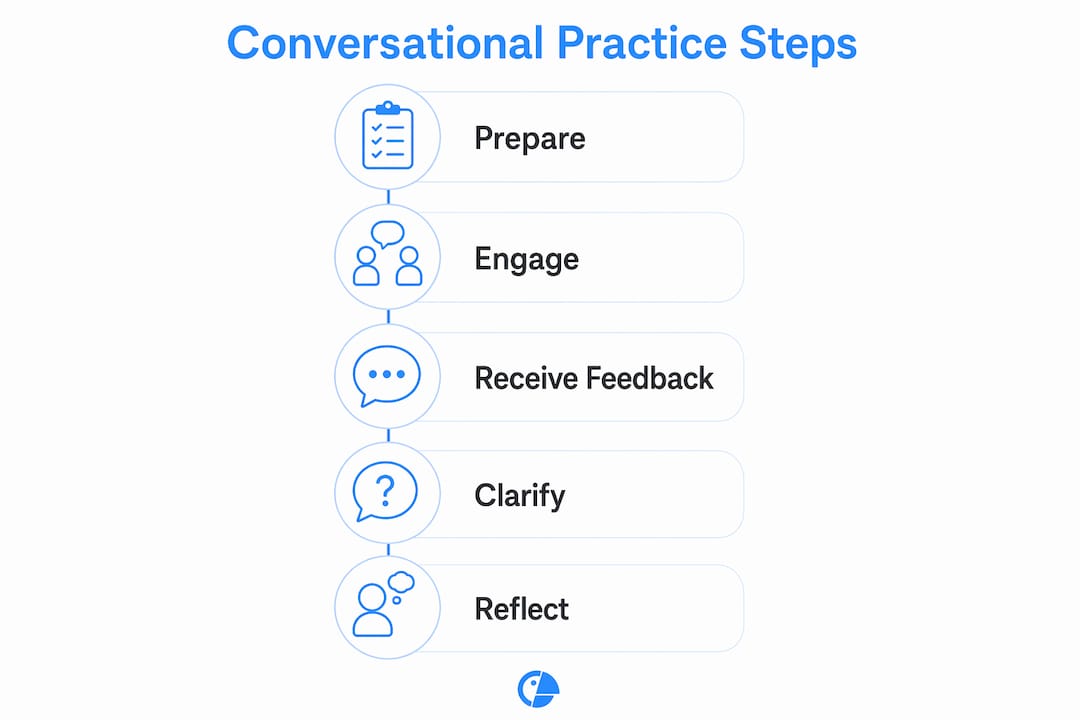
What are the common formats and examples of conversational practice?
Conversational practice takes many forms, and the right format depends on your current level and your specific goals. The table below maps common formats to learner levels and outcomes.
| Format | Best for | Primary outcome |
|---|---|---|
| Guided role-play (e.g., ordering food, asking directions) | Beginner to intermediate (A1–B1) | Situational vocabulary and confidence |
| Discussion topics with prompts | Intermediate (B1–B2) | Fluency and opinion expression |
| Debates and structured arguments | Upper intermediate to advanced (B2–C2) | Interactional competence and persuasion |
| Spontaneous free conversation | Advanced (C1–C2) | Natural turn-taking and topic management |
Level-appropriate prompts and scenarios are the foundation of well-designed conversation lessons. A beginner session might involve a simulated trip to a market, where the learner practises numbers, greetings, and simple requests. An advanced session might involve explaining a news article and defending a position, demanding vocabulary precision and the ability to hold the floor.
The balance between fluency and accuracy shifts as learners progress. Beginners benefit most from fluency-focused tasks where the goal is to keep talking, even imperfectly. Accuracy becomes a higher priority at intermediate and advanced levels, where persistent errors can calcify into habits. Good examples of conversational practice at every level share one quality: they feel purposeful, not performative.
Here are the most effective formats used in structured conversation sessions:
- Role-play scenarios: Simulating real-life situations such as job interviews, medical appointments, or travel conversations builds situational confidence quickly.
- Discussion prompts: Open-ended questions on topics like food, culture, or current events encourage extended responses and natural vocabulary use.
- Storytelling tasks: Describing a past experience or narrating a picture sequence develops narrative grammar and cohesion.
- Debate and opinion exchange: Arguing a position on a topic, even an assigned one, pushes learners to use hedging language, discourse markers, and persuasive structures.
- Information gap activities: Two speakers each hold different information and must exchange it to complete a task, creating genuine communicative need.
You can explore language exchange examples that apply many of these formats in real learner contexts.
What are the key benefits of conversational language practice?
The benefits of conversational practice extend well beyond speaking speed. Regular interaction builds a set of skills that written study simply cannot develop.
- Increased automaticity. Repeating language in real-time contexts trains the brain to retrieve words and structures without conscious effort. This is what separates a learner who knows a language from one who speaks it.
- Expanded active vocabulary. Reading exposes you to words passively. Speaking forces you to use them, which moves vocabulary from recognition to production. Active vocabulary expansion through regular speaking is one of the most consistent findings in language acquisition research.
- Natural response patterns. Conversation trains you to respond to unpredictable input. No script prepares you for a native speaker who changes topic mid-sentence or uses regional slang. Only real interaction does.
- Pragmatic and interpersonal skills. Language is not just grammar and vocabulary. Knowing when to interrupt politely, how to soften a disagreement, or when to stay silent are pragmatic skills that only emerge through practice in authentic exchanges.
- Confidence and reduced anxiety. Learners who practise speaking regularly report significantly lower anxiety in real-world situations. The more familiar the act of speaking feels, the less threatening it becomes.
Human communication requires co-construction of meaning, with constant checking and reformulating. This means fluency is not a destination but a habit built through repeated, meaningful interaction. The learners who progress fastest are those who speak early and often, even when it feels uncomfortable.
At higher proficiency levels, interactional competence becomes the distinguishing skill. This includes managing turn-taking, steering topics, and signalling agreement or disagreement with nuance. These are skills that grammar books do not teach and that only emerge through structured dialogic practice.
How to practise conversation effectively: tips that actually work
Effective conversation practice is not simply talking for an hour and hoping something sticks. Structure, feedback, and intentional challenge are what separate productive sessions from pleasant but forgettable chats.
Effective conversational lessons require clear goals, responsive teaching, and ample student talking time. The tutor or partner should be managing the session, not dominating it. If you are spending more than 30% of a session listening to your tutor explain things, the balance is off.
Here are the practices that consistently produce results:
- Maximise your talking time. The learner should be speaking for at least 70% of each session. Listening to explanations has its place, but it is not conversational practice.
- Prepare prompts, then let go of them. Having two or three topic ideas ready prevents awkward silences, but the goal is natural flow, not a scripted presentation. Prepare to be surprised by where the conversation goes.
- Seek partners slightly above your level. Practising with someone at exactly your level is comfortable but limiting. A partner or tutor who is slightly more advanced creates what researchers call optimal challenge, pushing you to stretch without overwhelming you.
- Use feedback cycles deliberately. After a session, note two or three recurring errors and target them in the next one. Progress is incremental, and tracking it keeps motivation high.
- Avoid scripted monologues. Monologue-style practice without real-time repair inhibits the acquisition processes that make conversation valuable. The back-and-forth is the point.
Pro Tip: Record a two-minute speaking sample at the start of each month on the same topic. Listening back after 90 days reveals progress that is invisible day-to-day and is one of the most motivating things a learner can do.
For a broader set of language learning methods that complement conversation practice, Tutoroo's resource library covers everything from spaced repetition to immersive listening techniques.
Key takeaways
Conversational language practice is the most direct path to fluency because it combines output production, real-time feedback, and negotiation of meaning in a single activity.
| Point | Details |
|---|---|
| Definition and core mechanism | Structured real-time dialogue that activates output production and meaning negotiation to accelerate acquisition. |
| Theoretical support | The Interaction Hypothesis and Output Hypothesis both confirm that speaking, not just listening, drives language learning. |
| Format variety | Role-play, debates, discussion prompts, and information gap tasks each serve different levels and learning goals. |
| Key benefits | Automaticity, active vocabulary growth, pragmatic skill, and reduced speaking anxiety all develop through regular practice. |
| Best practice principles | Maximise talking time, seek optimal challenge, use deliberate feedback cycles, and avoid scripted monologues. |
Why conversation practice is the skill most learners underinvest in
At Tutoroo, we connect learners with over 386,000 tutors across dozens of languages, and the pattern we see most consistently is this: learners who plateau are almost always the ones who have been studying about a language rather than in it. They have strong grammar knowledge, decent reading comprehension, and a respectable vocabulary. But they freeze the moment a native speaker goes off script.
The uncomfortable truth is that most learners avoid conversation practice precisely because it is the most exposing form of study. Grammar exercises have right and wrong answers. Conversation has ambiguity, unpredictability, and the very real possibility of being misunderstood. That discomfort is not a sign that you are doing it wrong. It is a sign that you are doing it right.
What we have observed across thousands of tutoring relationships is that the learners who commit to regular speaking sessions, even short ones of 20 to 30 minutes, three times a week, progress measurably faster than those who study twice as long through passive methods. The research on the Output Hypothesis supports this. Producing language forces the kind of self-monitoring that reading and listening simply do not demand.
The other thing worth saying plainly: structure matters. Free conversation without a skilled partner who can provide feedback and steer the session is better than nothing, but it is not optimal. A tutor who knows how to use recasts, comprehension checks, and targeted prompts turns a pleasant chat into a genuine acquisition event. That is the difference between student-tutor interaction done well and time spent talking without growing.
Commit to speaking. Commit to being corrected. The progress will follow.
— TUTOROO
Start speaking with a private tutor today
Tutoroo connects language learners with private tutors who specialise in structured conversation sessions tailored to your level, goals, and interests. Whether you are building basic confidence in English or refining advanced fluency in Mandarin, a Tutoroo tutor provides real-time feedback, personalised prompts, and the kind of authentic interaction that accelerates speaking skills. Sessions are available online or in person, fitting around your schedule. With over 386,000 tutors across languages including Spanish, French, Arabic, and more, finding the right speaking partner has never been more straightforward. Find your private tutor and start putting conversational practice to work today.
FAQ
What is conversational language practice?
Conversational language practice is structured, real-time speaking interaction between a learner and a partner or tutor, focused on building fluency and communication skills through active dialogue. It differs from grammar drills by prioritising meaning-making, feedback, and natural exchange over rote repetition.
How often should you practise conversation to see results?
Three sessions per week of 20 to 30 minutes each produces measurable improvement in speaking fluency and confidence. Consistency matters more than session length, as regular output opportunities are what build automaticity over time.
What are the best examples of conversational practice for beginners?
Beginners benefit most from role-play scenarios such as ordering food, introducing themselves, or asking for directions, as these situational tasks build practical vocabulary and confidence in a low-pressure context.
Why is feedback important in conversation practice?
Feedback during conversation, particularly through recasts and clarification requests, provides interactional evidence that updates a learner's internal language model. Without it, errors can become ingrained habits that are harder to correct at later stages.
Can advanced learners still benefit from conversational practice?
Advanced learners benefit significantly from structured dialogic tasks that develop interactional competence, including turn-taking, topic management, and nuanced agreement or disagreement. These skills go beyond vocabulary and grammar and are only developed through sustained, purposeful conversation.