

TL;DR:
- Online language tutorials include free courses, AI conversation tools, and live tutoring that help learners achieve fluency. Combining daily practice with AI tools and weekly live sessions provides the most effective pathway to speaking confidence. Free resources are useful for beginners, but live tutoring accelerates progress toward advanced fluency.
Language tutorials online are digital courses, platforms, and live sessions that teach new languages through structured instruction, speaking practice, and real conversation. The best options give you flexibility to learn languages at home at your own pace, or with a live tutor who holds you accountable. Language professionals recommend 15–20 minutes of daily speaking practice for noticeable fluency gains within weeks. That figure matters because it sets a realistic bar. You do not need hours each day. You need consistency, the right format, and a method that gets you speaking early.
1. What types of language tutorials online suit your goals?
The online language learning market splits into four main formats: free self-paced courses, subscription apps, AI conversation tools, and live tutoring with a native speaker. Each format serves a different learner profile and budget.
- Free self-paced courses suit absolute beginners who want structured grammar and vocabulary before committing money. University-backed platforms offer 110+ free courses across more than 70 languages, making them an excellent starting point.
- Subscription apps work well for learners who want short daily sessions. They typically cost $0–$20 per month and deliver bite-sized lessons in grammar, vocabulary, and listening.
- AI conversation tools cost around $8 per month and provide real-time speaking practice with instant pronunciation feedback. They fill the gap between passive study and live conversation.
- Live tutoring with a native speaker delivers personalised feedback and cultural nuance. It costs more, but structured programmes with live interaction produce the fastest results for conversational fluency.
The right choice depends on your goal. Travelling to Japan in three months? Combine a free structured course with live sessions from a Japanese tutor online. Building professional English? Prioritise live practice with an experienced tutor.
Pro Tip: Combine at least two formats. Use a self-paced app for daily vocabulary, then practise speaking with a live tutor or AI tool twice a week. This combination produces faster results than any single method alone.

2. Free and low-cost platforms for high-quality online lessons
Quality free language lessons online do exist, and several platforms deliver genuine academic rigour without a subscription fee.
Class Central aggregates more than 110 university-backed language courses from institutions around the world. Courses cover grammar, vocabulary, reading, and speaking basics across 70+ languages. Ideal for learners who want a structured, academic approach before investing in paid tools.
Transparent Language Online is available through many public library systems at no cost to cardholders. It offers interactive listening, speaking, reading, and writing activities across more than 140 languages, including Mandarin and Arabic with their complex writing systems. If your local library subscribes, this is one of the best free resources available.
YouTube language channels from native speakers and qualified teachers provide free grammar explanations, pronunciation guides, and cultural context. Quality varies, so look for channels affiliated with universities or language schools.
Public broadcaster language programmes from organisations like the BBC and ABC offer structured free lessons in major languages including French, Spanish, Mandarin, and Italian. These are particularly useful for audio learners.
The key limitation of free platforms is accountability. Without a tutor or structured deadline, many learners stall after the beginner stage. Free resources work best as a foundation, not a complete solution.
3. Best AI-powered tutorials for real conversation practice
AI language tutors have changed what affordable speaking practice looks like. They provide real-time corrections, pronunciation feedback, and conversation scenarios at a fraction of the cost of human tutors.
The core advantage of AI tools is availability. You can practise at 11pm on a Tuesday without booking a session. Focusing too much on grammar without speaking creates speaking anxiety, and AI tools solve this by putting you in low-stakes conversations from day one.
Key features to look for in an AI language tutorial:
- Real-time pronunciation feedback that flags specific sounds, not just overall accuracy
- Scenario-based conversations covering travel, work, and everyday situations
- 30+ language options so you are not limited to major European languages
- Progress tracking that shows vocabulary growth and speaking confidence over time
- Certificate options for learners who need proof of proficiency
AI tutors cost around $8 per month, compared to traditional private lessons that can exceed $400 per month. That cost difference makes daily practice genuinely accessible for most learners.
Pro Tip: Use AI tools for daily speaking drills, then bring your questions and mistakes to a live tutor once a week. The AI builds your speaking habit. The human tutor corrects the patterns the AI misses.
4. Why live online tutoring still leads for advanced fluency
AI tools are excellent for building speaking habits, but live interaction with native speakers remains the most effective path to real conversational fluency. A native-speaking tutor catches cultural errors, adjusts to your specific weaknesses, and pushes you past the intermediate plateau that stops most learners.
The intermediate plateau is real. Passive consumption of language drills without active speaking stalls progress at an intermediate level. A live tutor forces you into real-time problem solving, which encodes language patterns more deeply than any app.
Benefits of live online tutoring:
- Personalised lesson plans built around your goals, whether that is travel, business, or cultural connection
- Real-time cultural context that explains why native speakers say things a certain way, not just what they say
- Accountability through scheduled sessions that create a learning rhythm
- Flexible scheduling with tutors across time zones, so you can find sessions that fit your life
- Immediate correction of pronunciation and grammar errors before they become habits
Tutoroo connects learners with over 386,000 language teachers worldwide, covering languages from Spanish and French to Arabic, Mandarin, and beyond. Sessions can be conducted online or in person, depending on your location and preference.
Pro Tip: Schedule at least one live session per week, even if you use free courses and AI tools for daily practice. Weekly live sessions maintain momentum and give you a clear measure of real progress.
5. How to build a daily practice routine that actually works
Consistency beats intensity every time in language learning. Fifteen to twenty minutes of daily speaking practice produces faster results than a two-hour session once a week. The reason is simple: language acquisition relies on repeated exposure and retrieval, not marathon study.
A practical daily routine looks like this. Spend ten minutes on vocabulary review using a self-paced app. Spend ten minutes in a speaking exercise, either with an AI tool or by recording yourself. Once a week, spend 45–60 minutes with a live tutor reviewing what you have practised. This structure keeps the daily commitment low enough to maintain, while the weekly live session adds depth and accountability.
Active practice in real conversation scenarios forces deeper language pattern encoding. This is why speaking out loud, even to yourself, outperforms silent reading and listening alone. Narrate your morning routine in your target language. Describe what you see on your commute. These small habits compound quickly.
The learners who progress fastest are not the ones who study the most. They are the ones who speak the most, make mistakes early, and get corrected often.
6. Choosing the right language for your personal goals
The language you choose shapes which tutorial format works best. Some languages have abundant free resources. Others require more specialised support.
Spanish, French, Mandarin, and English have the widest range of free and paid tutorials available. Learners targeting these languages can build a strong foundation using free university courses and library resources before moving to live tutoring.
Less commonly taught languages, including Malay, Arabic, Japanese, and Swahili, have fewer free resources of consistent quality. For these languages, live tutoring with a native speaker from the start produces better results. Tutoroo offers Malay tutors online and native-speaking tutors for dozens of languages that free platforms underserve.
Travel preparation calls for a different approach than professional development. For travel, focus on spoken phrases, listening comprehension, and cultural etiquette. For professional use, prioritise formal vocabulary, writing, and industry-specific terminology. A live tutor can tailor lessons to either goal far more precisely than a generic app.
Key takeaways
The most effective approach to online language learning combines free structured courses, daily AI speaking practice, and regular live sessions with a native-speaking tutor.
| Point | Details |
|---|---|
| Daily practice is non-negotiable | Fifteen to twenty minutes of speaking practice each day produces faster fluency gains than longer, infrequent sessions. |
| Combine multiple formats | Free courses build foundations; AI tools build speaking habits; live tutors build real fluency. |
| Speaking beats grammar drills | Passive grammar study creates speaking anxiety. Real-time conversation practice, with AI or a human, overcomes it. |
| Free resources have limits | University-backed courses and library tools are excellent starting points but rarely carry learners past intermediate level alone. |
| Live tutoring is worth the cost | Native-speaking tutors provide cultural context and personalised correction that no app can replicate. |
Tutoroo's take: why variety is the real method
After working with learners across dozens of languages and skill levels, one pattern stands out clearly. The learners who plateau are almost always the ones who found one method they liked and stuck to it exclusively. The learners who progress are the ones who treat their practice like a training schedule, mixing formats deliberately and adjusting as they improve.
Free courses are genuinely useful. They give structure to beginners who would otherwise wander through random YouTube videos without a clear progression. But they create a false sense of progress. You can complete every module and still freeze when a native speaker talks to you at normal speed. That gap between course completion and real conversation is where most learners get stuck.
AI tools close that gap faster than anything else at their price point. The willingness to speak badly, to be corrected instantly, and to try again without embarrassment is exactly what builds fluency. AI removes the social stakes and lets you practise that cycle hundreds of times before you sit down with a real person.
Live tutoring is where everything comes together. A good tutor does not just correct your grammar. They tell you why a phrase sounds unnatural, what a native speaker would actually say, and how the culture shapes the language. That layer of human insight is what turns a competent speaker into a confident one.
The best routine is not the most expensive one. It is the one you actually do every day.
— Tutoroo
Find your perfect language tutor with Tutoroo
Tutoroo connects learners with private language tutors worldwide, covering English, Spanish, French, Arabic, Mandarin, Japanese, Malay, and dozens more. With over 386,000 teachers on the platform, you can find a native-speaking tutor who fits your schedule, budget, and learning goals.
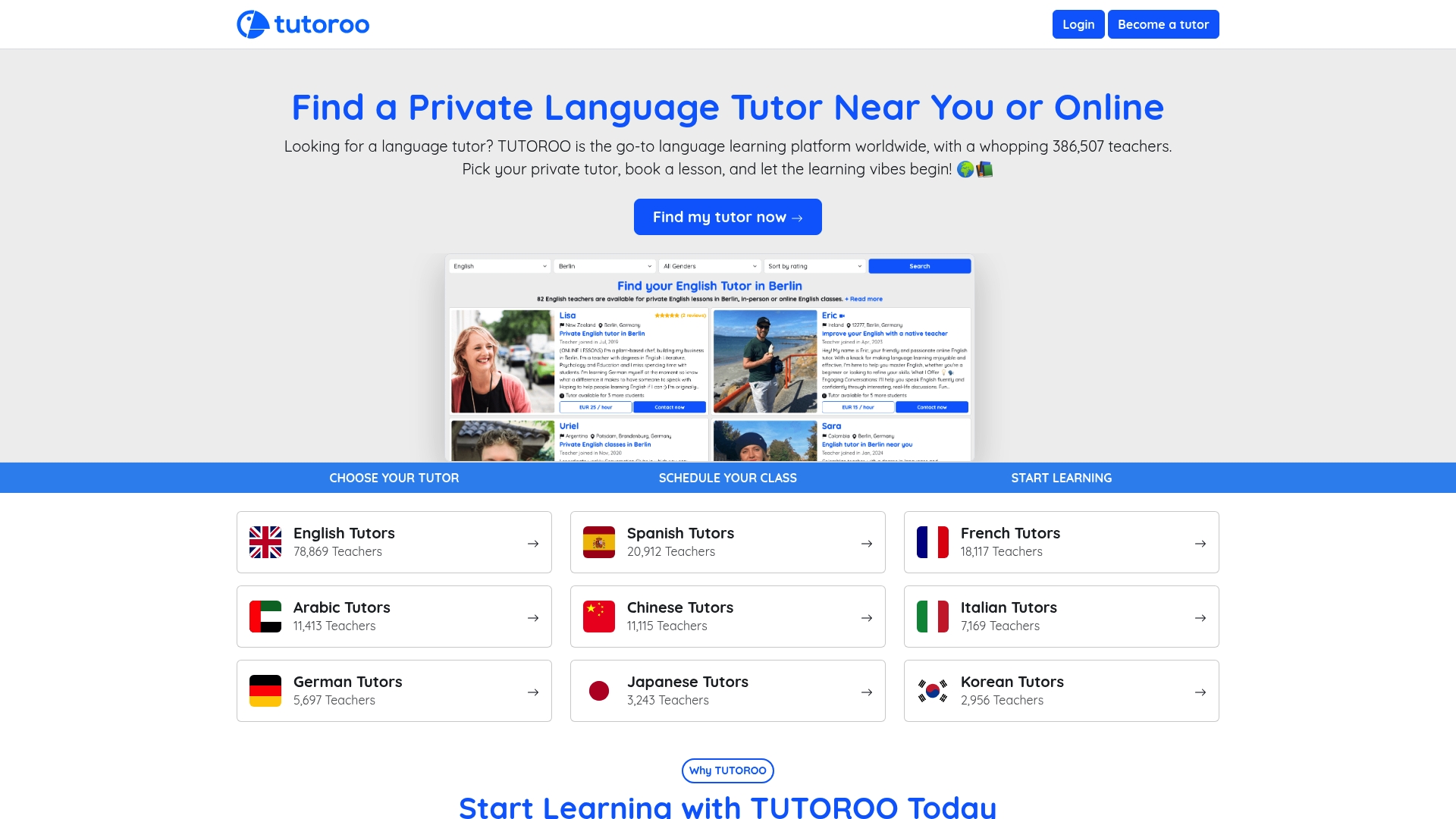
Booking is straightforward. Search by language, location, and availability, then message your chosen tutor directly through the platform. Sessions run online or in person, depending on what suits you. Whether you are preparing for travel, building professional skills, or simply curious about a new culture, Tutoroo matches you with a tutor who makes every session count. Find your English tutor online or browse tutors for any language you want to learn.
FAQ
What are language tutorials online?
Language tutorials online are digital courses, apps, AI tools, and live sessions that teach new languages through structured lessons and speaking practice. They range from free university-backed courses to personalised one-on-one tutoring with native speakers.
How much do online language tutorials cost?
Self-paced apps typically cost $0–$20 per month, AI tutoring tools cost around $8 per month, and live private tutoring can exceed $400 per month. Free options from library resources and university platforms are also widely available.
How long does it take to learn a language online?
Progress depends on the language, your native tongue, and daily practice time. Consistent daily practice of 15–20 minutes produces noticeable fluency improvement within weeks, though reaching conversational fluency typically takes months of regular study and speaking practice.
Are free language lessons online effective?
Free lessons are effective for building vocabulary and grammar foundations, particularly through university-backed platforms offering 70+ languages. They become less effective at intermediate and advanced levels, where live speaking practice with a native tutor is needed.
What is the best way to practise speaking a new language at home?
Combine AI conversation tools for daily low-stakes practice with weekly live sessions from a native-speaking tutor. This pairing builds speaking confidence faster than grammar study alone and helps learners move past the intermediate plateau.