

Business English tutoring is worth it for most working professionals who need to communicate with clients, colleagues or managers in English, particularly when self-study has plateaued or a specific deadline is looming. It delivers the strongest value when goals are concrete, such as a presentation, negotiation or promotion review. It delivers less value when the real gap is confidence rather than skill, or when generic lessons replace focused, task-based practice.
TL;DR:
- Business English tutoring offers faster progress by focusing on real workplace tasks rather than generic lessons, especially for high-stakes goals.
- Cost varies based on experience and specialization, and short, frequent sessions or mixed online and in-person formats maximize budget effectiveness.
- Signs you need tutoring include recurring errors, upcoming deadlines, or being passed over for client-facing work, which self-study struggles to fix.
- Using real work samples and targeting specific tasks during sessions accelerates skill transfer and practical improvement.
- Tutoring is most beneficial for measurable, goal-oriented improvements rather than broad language mastery or confidence issues alone.
Table of Contents
- Main benefits of business English tutoring for professional outcomes
- Cost, pricing shapes and smart budgeting for business English tutoring
- Signs business English tutoring is the right next step for you
- Formats: online vs in-person, synchronous vs blended, which to choose
- What business English tutoring actually teaches
- Measuring value and return: practical ways to see if tutoring worked
- Evidence from the publisher and research: what TUTOROO and studies show
- Alternatives to formal tutoring and how they compare
- Common challenges learners face during business English tutoring
- A starter plan for professionals ready to begin
- How to get started with TUTOROO
- FAQ
- Sources
Main benefits of business English tutoring for professional outcomes
The clearest benefit of one-to-one business English tutoring is speed. Because lessons are built around your actual job, not a generic syllabus, progress shows up in the writing and speaking you do every day rather than in abstract exercises. Personalised, one-to-one teaching lets a tutor correct the specific habits that slow you down, whether that is email phrasing, meeting fillers or pronunciation under pressure.
This kind of focused attention tends to produce several concrete gains:
- Fewer rewrites and less back-and-forth editing on client-facing emails and reports.
- Noticeably steadier delivery in meetings, presentations and negotiations.
- Faster correction of recurring grammar or vocabulary errors that generic courses miss.
- Greater willingness to speak up in discussions rather than staying quiet to avoid mistakes.
The one-to-one format matters here. Group classes have to serve everyone's needs at once, so a tutor working with you alone can spend the whole session on your negotiation language or your next town hall script. That task-based approach, built around real workplace moments, is why one-on-one lessons tend to move faster than classroom learning for career-specific goals.
Pro Tip: Bring the actual email or slide you are working on to the next lesson instead of a textbook exercise. You will remember the correction longer because it is attached to something real.
Cost, pricing shapes and smart budgeting for business English tutoring
Tutoring rates vary with a tutor's experience, specialisation and location, and business English specialists typically charge more than general conversation tutors because the preparation and vocabulary are more technical. Most platforms offer a mix of single lessons and discounted packages, and tutors set their own schedules and rates rather than following a fixed company price list.
A few ways to make the budget work harder:
- Book a single trial lesson before committing to a package, so you are not locked into a tutor who is not the right fit.
- Mix a cheaper group class with occasional one-to-one sessions focused on your highest-stakes task.
- Ask your employer about partial sponsorship, since many companies track language needs internally but do not yet fund training to close the gap, according to an employer-focused report on language skills in the workplace.
- Favour short, frequent sessions over occasional long ones, since consistency matters more than session length for retention.
Before booking, it helps to benchmark two or three tutors on price and specialisation, then negotiate based on commitment: a 10-lesson package is a reasonable place to ask for a small discount, while a single trial lesson rarely is.
Signs business English tutoring is the right next step for you
Self-study is genuinely effective for building vocabulary and grammar, but it tends to plateau once you are already functional and need to sound sharper, not just correct. A few checks can tell you whether tutoring, rather than another app or course, is the right move:
- Record yourself in a real or mock meeting and listen back: if the same hesitations or errors appear every time despite deliberate practice, you have hit a plateau that self-correction will not fix.
- Ask a colleague or manager to review a recent email or report you wrote: repeated edits on tone or clarity, rather than typos, point to a structural gap tutoring can close quickly.
- Check your calendar for an upcoming high-stakes event, such as a client pitch, performance review or conference talk: a looming deadline is a strong reason to choose short-term coaching over a long course.
- Notice whether you are being passed over for client-facing work or international calls: that kind of career friction is a clearer signal than a vague sense you "should improve."
If the issue is a single upcoming task, a handful of focused sessions will usually outperform enrolling in a multi-month course you will not finish in time.
Formats: online vs in-person, synchronous vs blended, which to choose
Online tutoring suits professionals who need flexibility and choice: you can book around work hours, choose from tutors well beyond your city, and often get session recordings to review later. In-person tutoring offers something online cannot fully replace: the pressure and presence of a real room, which matters if your goal is in-person client meetings or conference speaking.
- Online lessons work best when your goal involves video calls, written communication or asynchronous collaboration.
- In-person lessons suit learners preparing for face-to-face negotiations, interviews or local networking events.
- Blended approaches, a mix of online sessions and occasional in-person practice, suit learners with limited time who still want real-room rehearsal before a big event.
- Micro-sessions of 20 to 30 minutes work well for busy professionals who want frequency over length.
A simple checklist helps narrow the choice: how much real-time feedback do you need, what does your calendar actually allow, and what type of task are you preparing for, written, spoken or both? Readers juggling full-time work often find flexible scheduling is the deciding factor rather than format itself.
Pro Tip: If your goal is a specific in-person event, book at least one in-person or video rehearsal close to the date, even if most of your lessons have been online.
What business English tutoring actually teaches
A well-run business English course is built around modules tied to workplace tasks rather than general topics. Expect coverage of email writing, meeting language, presentation delivery, negotiation phrases and teleconferencing etiquette, each practised with real scenarios rather than scripted dialogues.
Typical session activities include:
- Editing a real email you have drafted, line by line, for tone and clarity.
- Role-playing a negotiation or difficult client conversation before it happens for real.
- Rehearsing a presentation script and getting feedback on pacing and stress patterns.
- Practising small talk and interruptions for video calls, which textbooks rarely cover well.
The fastest way to get value from these sessions is to arrive with your own material: an agenda, a draft slide deck or a tricky email thread. Tutors working from your real documents can give feedback that transfers directly to your next working day, which is the core advantage of personalised lessons over generic coursework.
Measuring value and return: practical ways to see if tutoring worked
Short-term signs that tutoring is working show up in process, not test scores: fewer rewrites on reports, quicker approval cycles on emails, or positive feedback after a presentation you rehearsed beforehand. Longer-term signs include being trusted with more client contact, clearer performance reviews, or eventually a promotion where communication was previously flagged as a gap.
Nine out of 10 U.S. employers report relying on staff with skills in languages other than English, and about a third describe that reliance as significant, which gives useful context for why employers often value visible improvement even without formal certification.
A simple before-and-after record works well: save a writing sample or record a short meeting before you start, then repeat the exercise after eight to ten sessions and compare. Asking a manager for informal feedback at that same interval adds a second, independent check.
Evidence from the publisher and research: what TUTOROO and studies show
One platform works with a global community of over 386,000 language tutors, which gives learners a wide pool to match against specific industries and goals rather than settling for a generalist. On one internal benchmark, learners preparing for the HSK exam progressed 1.11 times faster through tutoring than through self-study alone, a pattern consistent with the platform's broader case for one-to-one tutoring over solo study.
The wider research points the same way:
- A meta-analysis of dialogue-based computer-assisted learning found a moderate effect on speaking development, supporting goal-oriented, mixed-format practice alongside tutoring.
- Pearson's workplace research links stronger English skills to higher earnings, while noting many employers still do not offer formal language upskilling.
Together, these findings suggest tutoring is most worth it when it targets a specific, measurable workplace task rather than general fluency.
Alternatives to formal tutoring and how they compare
Language exchange apps, workplace English clubs and self-study platforms all have a place, and none of them are a waste of time. Language exchange partners are useful for casual conversation practice and cost nothing but time, though feedback quality varies wildly since most partners are not trained to correct errors systematically. Self-study apps are excellent for vocabulary drilling and grammar review on your own schedule, but they cannot role-play a negotiation with you or correct your pronunciation in real time.

Formal in-person training, such as courses run by providers like Oxford Training Centre, offers structured curricula and sometimes certification, which suits learners who want a recognised qualification alongside skill gains. The trade-off is less flexibility and a fixed schedule that does not adapt to your specific job tasks.
Business English tutoring sits between these options: more structured and corrective than a language exchange, more personalised and task-specific than an app, and more flexible than a fixed course. For a professional with a narrow, high-stakes goal, such as a single big presentation or a promotion review, that combination tends to close the gap fastest. For broad, long-term fluency building on a tight budget, a blend of apps and occasional tutoring often makes more sense than tutoring alone.
Common challenges learners face during business English tutoring
The most common complaint is a mismatch between a tutor's style and a learner's goals, usually because the learner booked based on price rather than specialisation. Checking a tutor's experience with business or industry-specific English before booking solves most of this.
A second common issue is irregular attendance, which undermines progress far more than people expect, since language skills fade quickly without consistent practice. Scheduling fixed weekly slots, even short ones, tends to work better than booking sessions ad hoc.
A third challenge is bringing generic goals to sessions, like "improve my English," which gives a tutor little to work with. Arriving with a specific document, task or upcoming event turns a vague lesson into a focused one, and is the single biggest factor in how fast personalised tutoring pays off.
Finally, some learners feel embarrassed making mistakes in front of a tutor, which slows speaking practice specifically. This usually fades after a few sessions once a working relationship is established, and a good tutor will normalise errors early rather than letting the fear build.

A starter plan for professionals ready to begin
Start with two sessions a week for eight to twelve weeks, each built around a real task: an email thread, a slide deck, an upcoming call. Ask any prospective tutor how they would structure lessons around your industry. Be wary of generic "fluency fast" offers with no mention of your specific goals.
— TUTOROO
How to get started with TUTOROO
Finding the right business English tutor usually comes down to matching, not luck, and TUTOROO's network of tutors across locations and specialisations makes that matching faster, whether you want local, in-person sessions or fully online ones.
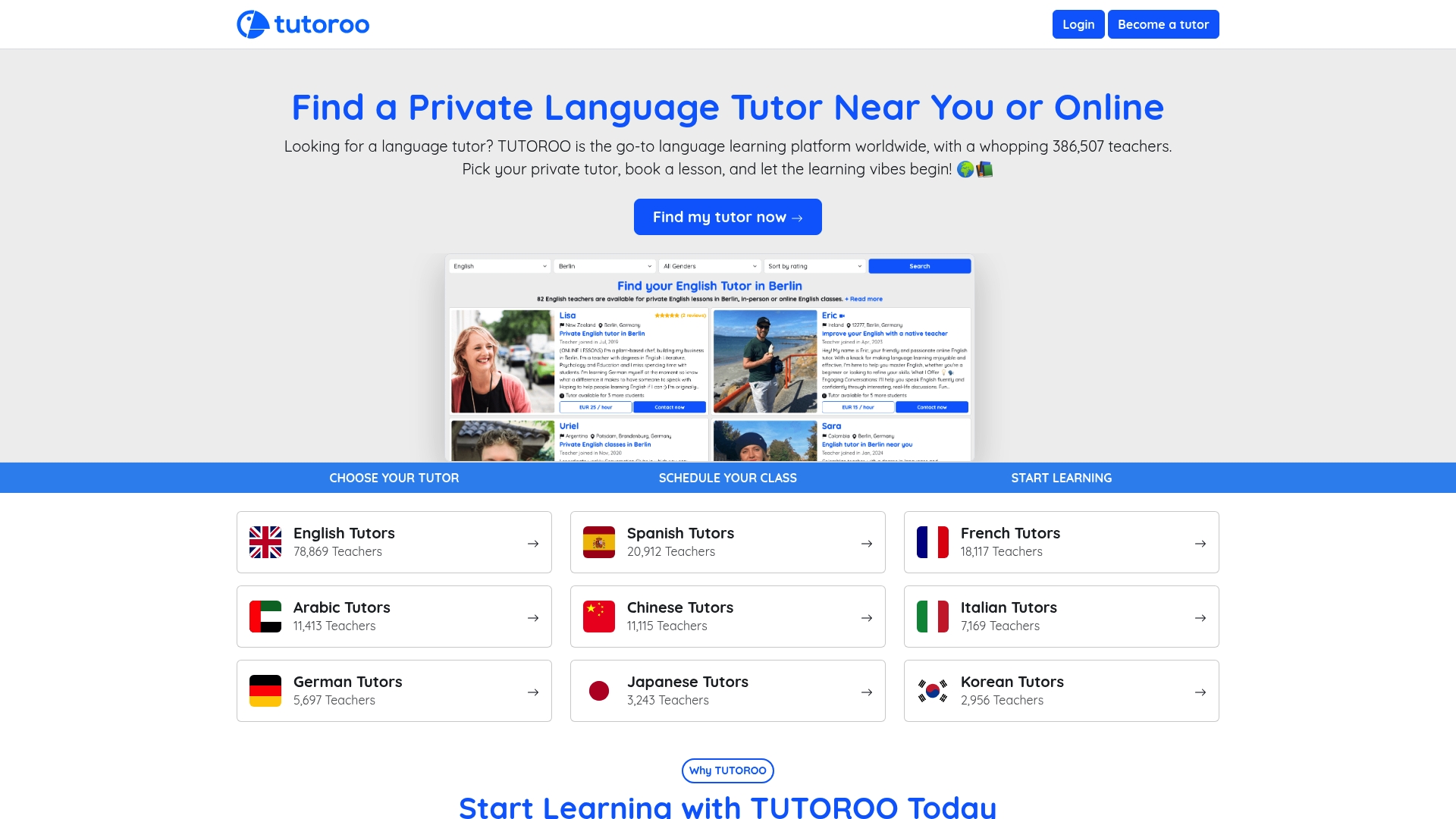
Before reaching out, jot down your main goal, whether that is a presentation, a promotion review or smoother client calls, and gather one or two real work samples to bring to your first lesson. You can browse profiles and message tutors directly through the English tutors page on TUTOROO to find someone who fits your industry and schedule.
FAQ
Is an English tutor worth it?
For most professionals with a specific communication goal, yes, since one-to-one feedback corrects habits faster than self-study alone. It is less worth it if your main gap is confidence rather than skill, in which case practice opportunities may matter more than formal lessons.
What is the 70/30 rule in teaching?
Definitions vary by context, and there is no single agreed standard for this rule in language tutoring. Where it does appear, it generally refers to splitting lesson time between learner practice and tutor instruction, with the larger share given to active practice.
Is business English in demand?
Yes. Nine out of 10 U.S. employers report relying on staff with skills in languages other than English, and Pearson's research links stronger English proficiency to better earning potential.
What is the best way to learn business English?
Combining task-based, one-to-one tutoring with real work materials, such as emails, slides and meeting scripts, tends to produce the fastest, most transferable results. Pairing that with regular self-study for vocabulary and grammar rounds out the approach without slowing progress.
Do I need business English tutoring if I already speak English well?
Not necessarily. Fluent speakers sometimes still need tutoring to sharpen tone, precision or confidence for specific high-stakes situations like negotiations or executive presentations, even without basic skill gaps.
Sources
- US employers recognise the need for foreign language proficiency (summary of ACTFL/Ipsos findings)
- English skills have life-changing impact — Pearson research summary
- Dialogue-based computer-assisted language learning systems for second language speaking development: a three-level meta-analysis