

TL;DR:
- Conversational learning enhances language skills by using interactive dialogue that activates brain regions more strongly than passive study. Combining AI with human tutors accelerates fluency, confidence, and cultural understanding while reducing anxiety. Regular practice in safe environments leads to deeper retention and quicker language mastery.
Conversational learning is defined as a language acquisition method that uses interactive dialogue to trigger deeper cognitive processing, social engagement, and real-time knowledge testing. It is more effective than passive study because speaking forces the brain to organise, retrieve, and apply language simultaneously. The Community of Inquiry framework and Cognitive Load Theory both support dialogue as a core mechanism for meaningful learning. Research confirms that conversational methods in teaching activate cognitive and social brain areas more strongly than reading or listening alone. Tutoroo connects learners with native-speaking tutors who make this kind of live, interactive practice accessible every day.
Why conversational learning is effective at the neurological level
Dialogue is not a supplementary learning activity. Neuroscience research confirms that explaining ideas to another person activates cognitive and social brain areas far more strongly than studying alone. That activation matters because it forces the brain to construct, test, and consolidate knowledge in real time rather than passively absorbing it.
Speaking also demands a specific kind of mental effort that reading does not. When you articulate a thought aloud, you must sequence ideas, choose words under time pressure, and monitor whether your listener understands. This process exposes gaps in your knowledge immediately. Written dialogue gives you time to edit and reconsider, which reduces that productive pressure.
The protégé effect deepens this further. Teaching or expecting to teach others produces greater brain activation and measurably better retention. Learners who explain concepts to a partner, even a simulated one, identify their own knowledge gaps faster than those who review notes alone. This is why tutoring sessions that ask you to explain grammar rules back to your tutor produce stronger results than passive correction.
Voice conversation carries an additional advantage over text chat. Synchronous spoken interaction activates unique social and cognitive processes that typing cannot replicate. Social presence, the sense that another person is genuinely listening and responding, raises the cognitive stakes and sharpens attention in ways that written exchanges simply do not.
Key mechanisms that make spoken dialogue cognitively superior:
- Real-time organisation: Speaking forces immediate sequencing of ideas, with no opportunity to revise before delivery.
- Social presence: A live listener raises cognitive engagement and accountability.
- Gap exposure: Articulating knowledge reveals what you do not yet know, faster than any written test.
- The protégé effect: Explaining concepts to others consolidates your own understanding.
Pro Tip: Ask your tutor to have you explain a grammar rule or vocabulary concept back to them in your own words. This single technique activates the protégé effect and accelerates retention.
How multimodal conversational AI changes learning outcomes
Recent evidence shows that the format of conversational practice matters as much as the practice itself. A 2026 randomised controlled trial involving 124 learners found that multimodal conversational AI, which integrates visual and verbal information together, produced significantly higher post-test scores than text-only AI or traditional textbook methods. That gap in outcomes reflects how the brain processes combined sensory input more efficiently than a single channel.
Cognitive Load Theory explains why this works. When visual and verbal information arrive together in a coherent format, learners spend less mental effort managing the presentation and more effort processing the language itself. Text-only AI removes the visual channel, increasing extraneous load. Textbooks remove the conversational channel entirely, eliminating the real-time feedback loop that drives retention.
The table below summarises how these three approaches compare across key learning dimensions.
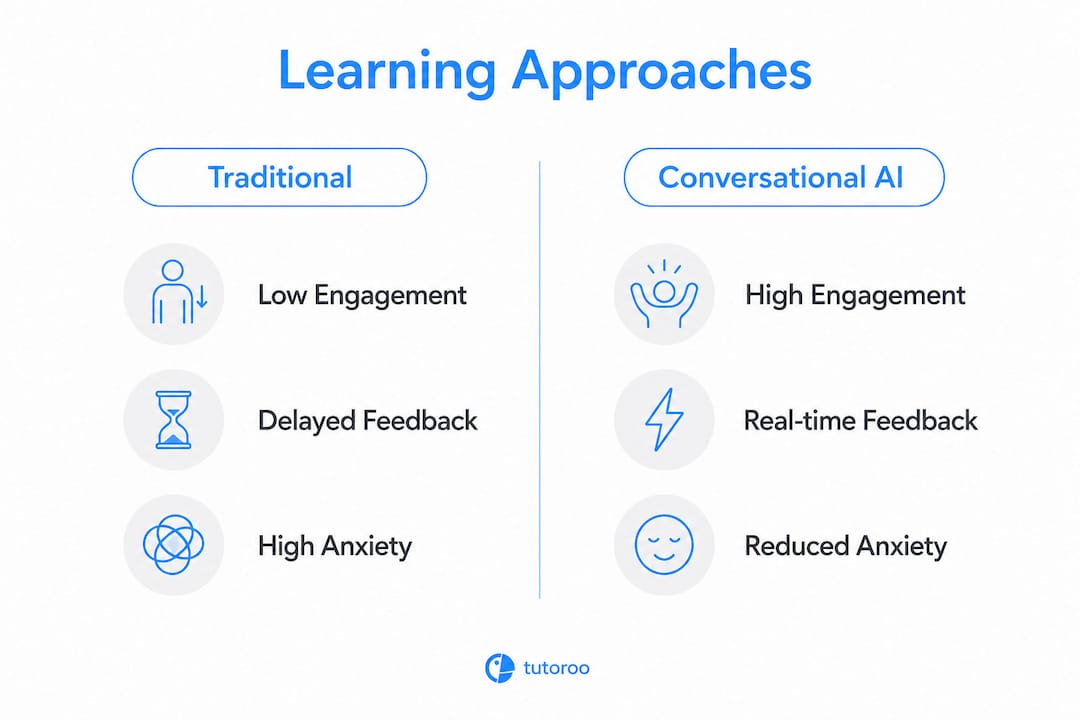
| Learning approach | Cognitive engagement | Real-time feedback | Cultural context | Anxiety level |
|---|---|---|---|---|
| Multimodal conversational AI | High | Yes | Simulated | Low |
| Text-only AI | Moderate | Partial | Limited | Low |
| Traditional textbook | Low | No | Minimal | Variable |
Conversationality itself, meaning the degree to which a system responds naturally and adapts to the learner, also affects perceived engagement. However, analysis of over 8,000 conversations found that combining instructional and cognitive conversational strategies outperformed any single strategy for fostering both cognitive and affective engagement. The lesson is clear: no single conversational feature does the job alone. The combination of visual input, natural dialogue, and structured instruction produces the strongest outcomes.
One caution worth noting is the illusion of competence. Learners using fluent conversational AI can feel more capable than they are, because casual chat rarely pushes them beyond comfortable vocabulary. Challenging exercises beyond easy conversation are necessary to ensure genuine progress rather than a false sense of fluency.
Why psychological safety reduces anxiety and builds speaking confidence
Speaking anxiety is one of the most consistent barriers to language fluency. A systematic review of conversational AI found that learners report higher confidence and less anxiety when practising with AI compared to traditional peer-evaluated classrooms. That difference comes down to the absence of social judgement.
In a classroom, the fear of making errors in front of peers activates what researchers call the affective filter, a psychological barrier that reduces willingness to experiment with new language. AI interlocutors remove that filter. Learners interacting with generative AI reported significantly greater reductions in English speaking anxiety compared to traditional peer role-play, describing the experience as judgment-free and psychologically safe.
Psychological safety does more than reduce discomfort. It actively encourages risk-taking, which is where real language growth happens. When learners know they will not be embarrassed by a mistake, they attempt more complex sentences, try unfamiliar vocabulary, and push their fluency further than they would in a high-stakes setting.
The benefits of a low-anxiety conversational environment include:
- Greater willingness to experiment with new grammar structures and vocabulary.
- Higher frequency of practice, because learners return to low-pressure sessions more readily.
- Faster fluency gains, as reduced anxiety allows the brain to focus on language rather than self-monitoring.
- Improved confidence transfer, where gains made in private practice carry over into real-world conversations.
Pro Tip: Use private AI practice sessions to rehearse difficult conversations before attempting them with a human tutor or native speaker. The confidence you build in a low-stakes setting transfers directly to higher-pressure situations.
Combining AI practice with personalised tutor feedback produces the strongest confidence gains. AI removes the fear of judgement, while a skilled human tutor provides the nuanced correction and cultural insight that AI cannot fully replicate.
Practical advantages of conversational learning for language fluency
The benefits of conversational learning extend well beyond reduced anxiety. A systematic review of 31 studies found that conversational AI tools improve speaking, writing, pronunciation, and fluency while also increasing learner autonomy, motivation, and confidence. That breadth of improvement reflects how dialogue integrates multiple language skills simultaneously rather than practising them in isolation.

Vocabulary and grammar consolidation happen naturally through conversation because learners must retrieve and apply both in real time. Hearing a word used correctly in context, then using it yourself in a response, creates a much stronger memory trace than reviewing a vocabulary list. Grammar rules become intuitive through repeated use rather than memorisation.
Cultural fluency is another dimension that conversational practice develops in ways that textbooks cannot. Conversational AI acts as a cultural informant, enabling learners to rehearse pragmatic language within culturally rich scenarios without social stigma or fear of negative peer judgement. Knowing when to use formal versus informal register, how to open and close a conversation appropriately, and how to navigate culturally specific topics requires practice in context, not just knowledge of rules.
Effective conversational learning for fluency follows a clear progression:
- Start with structured dialogue. Use guided conversation topics that match your current level. Unstructured chat too early leads to practising errors rather than correcting them.
- Integrate cognitive and instructional strategies. Combine explanation-based tasks, such as describing a process, with open conversation to engage both analytical and communicative skills.
- Practise cultural scenarios. Rehearse greetings, negotiations, and culturally specific interactions to build pragmatic competence alongside linguistic accuracy.
- Add challenging exercises regularly. Push beyond comfortable vocabulary and sentence structures to avoid the illusion of competence that easy chat can create.
- Seek human feedback. A tailored language course or private tutor session provides the nuanced correction and cultural depth that automated practice alone cannot deliver.
Effective conversational learning also depends on what researchers call grounding. Conversation must be tied to reliable, structured content and consistent feedback to produce genuine language mastery rather than surface-level fluency. This is why pairing regular conversational practice with a skilled tutor produces results that neither approach achieves alone.
Key takeaways
Conversational learning is effective because it activates neurological, psychological, and cultural mechanisms that passive study cannot replicate, producing measurable gains in fluency, confidence, and comprehension.
| Point | Details |
|---|---|
| Dialogue activates deeper cognition | Speaking forces real-time organisation of ideas, exposing knowledge gaps faster than reading or writing. |
| Multimodal AI outperforms text-only methods | Combining visual and verbal input reduces cognitive load and produces higher post-test scores. |
| Psychological safety drives risk-taking | Low-anxiety environments encourage learners to experiment with complex language and return to practice more often. |
| Combined strategies outperform single ones | Mixing instructional and cognitive conversational approaches produces stronger engagement than either alone. |
| Human tutors add irreplaceable depth | AI builds confidence and fluency, but skilled tutors provide cultural nuance and precise correction that AI cannot fully match. |
Tutoroo's view: conversation is the work, not the warm-up
After working with learners across dozens of languages and skill levels, one pattern stands out clearly. Learners who treat conversation as the core of their practice progress faster than those who treat it as a reward after "real" study. The research supports this completely. Dialogue is not a supplement to language learning. It is the primary mechanism through which the brain builds, tests, and retains language.
The temptation to delay speaking until you feel "ready" is understandable, but it is also the most common reason learners plateau. Fluency does not come from knowing enough words. It comes from using words under pressure, making mistakes, and adjusting in real time. That process only happens in conversation.
What we have also seen is that AI practice and human tutoring are not competing approaches. They serve different functions. AI removes the fear of judgement and allows high-frequency, low-stakes repetition. A skilled human tutor provides the cultural context, precise feedback, and genuine connection that make language feel alive. The learners who combine both consistently outperform those who rely on either alone. Conversation is where language becomes real. Start there, and build everything else around it.
— Tutoroo
Practise with a native-speaking tutor through Tutoroo
Real conversational fluency comes from live practice with someone who speaks the language naturally and can respond to you in the moment.
Tutoroo connects learners with over 386,000 private language tutors across the world, offering one-on-one sessions in English, Spanish, French, Arabic, Chinese, and many more languages. Every session is built around your goals, your level, and your schedule. Whether you want to sharpen your English speaking skills or build fluency in another language, Tutoroo makes it straightforward to find a tutor who fits. Live conversation with a skilled tutor is the fastest path from knowing a language to actually using it.
FAQ
What is conversational learning in language acquisition?
Conversational learning is a method that uses interactive dialogue to build language skills through real-time speaking, listening, and responding. It activates cognitive and social brain processes that passive study methods cannot replicate.
Why does speaking out loud improve language retention?
Speaking forces the brain to organise and retrieve language simultaneously, which creates stronger memory traces than reading or writing. Neuroscience research confirms that explaining ideas aloud activates cognitive and social brain areas more strongly than study alone.
How does conversational AI reduce speaking anxiety?
Conversational AI creates a judgment-free environment where learners can practise without fear of peer evaluation. Studies show learners report significantly higher confidence and lower anxiety when practising with AI compared to traditional classroom role-play.
Is conversational AI as effective as a human tutor?
Conversational AI improves fluency, pronunciation, and confidence, but human tutors provide cultural nuance, precise correction, and authentic connection that AI cannot fully replicate. Combining both approaches produces the strongest learning outcomes.
How often should learners practise conversational skills?
Regular, frequent practice produces better results than occasional long sessions. Consistent short conversations, whether with AI tools or a private language tutor, build fluency faster than infrequent intensive study.