

TL;DR:
- Practising structured conversation techniques accelerates fluency more effectively than passive study.
- Focusing on three skills weekly, such as follow-up questions and active listening, builds a practical toolkit in a month.
Conversation skills practice is the deliberate act of building fluency through repeated, structured interaction rather than passive study. Learners who focus on specific techniques, such as asking follow-up questions, using active listening markers, and applying the FORD method (Family, Occupation, Recreation, Dreams), progress far faster than those who rely on grammar drills alone. Good conversation skills outperform perfect grammar; communicating meaning matters more than flawless sentences in live exchanges. This guide explains how to practise conversation skills step by step, which techniques to prioritise, and how to push through the obstacles that stall most learners.
Which conversation skills should you focus on first?
The most effective starting point is a small set of techniques that cover the vast majority of real interactions. Focusing on three specific techniques per week builds a functional conversational toolkit in four weeks. That is a manageable pace that prevents overwhelm and lets each skill settle before the next one is added.
Ask follow-up questions using the 5 Ws and How
Follow-up questions are the engine of any good conversation. When someone tells you they spent the weekend hiking, asking "What trail did you take?" or "How did you find the difficulty?" signals genuine interest and keeps the exchange alive. The 5 Ws (Who, What, Where, When, Why) and How give you a ready-made framework to generate relevant questions on the spot, even in a language you are still learning.
Switching from surface-level questions to "why" or "how" questions deepens connection and conversation quality. A "what" question collects facts; a "why" question opens up values and experiences. Practise shifting between the two depending on how comfortable the conversation feels.

Use active listening markers and filler phrases
Backchannelling, the small verbal signals that show you are listening, is one of the most underrated skills in language learning. Phrases like "Right," "I see," "That makes sense," and "Go on" reassure the other person that you are engaged. They also buy you a moment to process what was said before you respond.
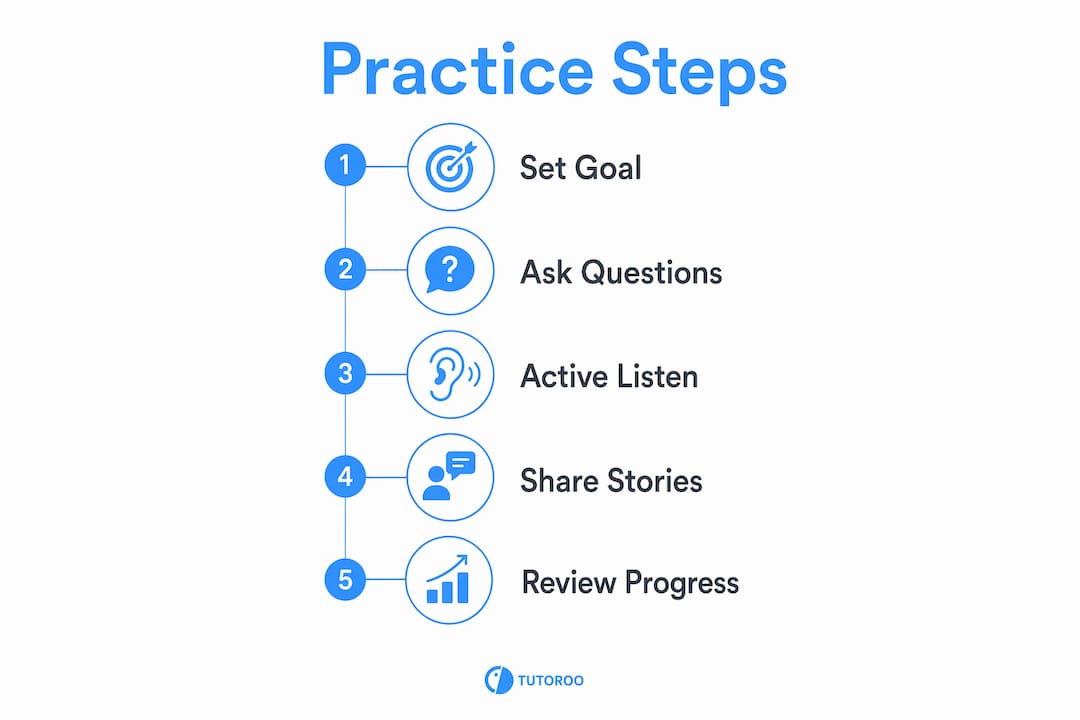
Filler phrases keep conversations flowing and prevent premature endings caused by silence. Expressions like "That's a thoughtful question" or "Let me think about that for a second" create breathing room without making you appear lost. For language learners, these phrases are particularly valuable because they reduce the pressure of instant recall.
Balance questions with personal stories
A conversation that is all questions starts to feel like an interview. Sharing a brief, related personal story after asking a question balances the exchange and invites reciprocity. The FORD method works well here: touch on Family, Occupation, Recreation, or Dreams to find common ground quickly. The echo technique, repeating the last few words of what someone said as a question, is another low-effort way to show you are listening and prompt the other person to elaborate.
Pro Tip: Practise open-ended questions separately from yes/no questions. Write five of each on a topic before a conversation, then notice which ones generate longer, richer responses.
How to practise conversation skills progressively
Building conversational fluency works best when you move from low-pressure solo practice to live interaction in gradual steps. Trying to jump straight into high-stakes conversations creates anxiety that blocks learning. A staged approach lets confidence grow alongside skill.
-
Start with scripted dialogues. Write out a short conversation on a familiar topic, such as ordering food or describing your weekend. Read it aloud, record yourself, and listen back. This trains pronunciation and phrasing without the pressure of a real partner.
-
Add shadowing. Choose a podcast or short video in your target language. Pause after each sentence and repeat it, matching the speaker's rhythm and intonation. Shadowing builds the muscle memory that makes speech feel natural rather than constructed.
-
Try the solo follow-up game. Pause shows or podcasts to imagine genuine follow-up questions and improve spontaneous thinking. This trains real-time question generation, which is one of the hardest skills to develop in a new language.
-
Move to text-based exchanges. Language exchange platforms and messaging with a study partner let you practise at your own pace. You have time to look up words and construct sentences carefully before the pressure of live speech.
-
Progress to voice, then live conversation. Voice calls remove the safety net of typing time. Live, face-to-face conversation adds body language and real-time turn-taking. Each step up the ladder is a meaningful challenge.
-
Use a 14-day micro-rep plan. A 14-day micro-repetition plan with one tiny daily interaction builds rhythm and confidence without the anxiety of high-stakes events. One brief exchange per day, whether with a cashier, a neighbour, or a language partner, compounds into real fluency over time.
Pro Tip: Set a single skill goal for each practice session. Trying to improve everything at once dilutes focus. Spend one week only on follow-up questions, then move to filler phrases the next.
The key to this progression is volume. Micro-habit practice focusing on one skill at a time in low-pressure settings leads to better mastery and confidence than occasional marathon study sessions. Brief, regular interactions with real people build the kind of fluency that sticks. You can find more ideas in this guide to language practice activities that make learning feel rewarding rather than like a chore.
What are the most common mistakes in conversation practice?
Most learners hit the same walls. Knowing what they are makes them far easier to get past.
-
Conversational narcissism. This is the habit of steering every topic back to yourself. Egocentric bias causes speakers to assume shared background and limits listening. Allocentric listening, actively prioritising the other person's perspective, corrects this. A practical fix is to count how many questions you ask versus how many statements you make in a single conversation.
-
Freezing mid-sentence. Silence feels catastrophic when you are learning a language, but it is normal. Filler phrases like "How do I put this..." or "Give me a moment" signal that you are thinking, not lost. Practise these phrases until they feel automatic.
-
Over-relying on scripted apps. Apps that offer pre-set dialogues are useful for beginners, but they do not prepare you for the unpredictability of real conversation. Transition to live exchanges as soon as you can hold a basic scripted dialogue without hesitation.
-
Going too deep too soon. Connection builds gradually from casual to deeper topics; asking too personal questions too early can push people away. Start with light topics like weekend plans or local recommendations, then let the conversation deepen naturally over multiple interactions.
-
Scripting your replies while the other person is still talking. Effective conversation requires focusing on "receiving," "building," and "committing" without scripting replies mid-conversation. When you plan your next sentence while someone is speaking, you miss what they actually say. Genuine listening is the foundation of genuine connection.
-
Neglecting conversation endings. Knowing how to close a conversation cleanly is as important as opening one. Phrases like "It was great chatting with you" or "I'll let you get back to it" signal warmth and social awareness. Practise these just as deliberately as your opening lines.
Understanding top challenges in language learning helps you anticipate these obstacles rather than being caught off guard by them.
What tools and resources support conversation practice?
The right tools reduce friction and make consistent practice easier to maintain. Each type of resource serves a different stage of the learning process.
| Resource type | Best use | Example formats |
|---|---|---|
| Scripted dialogue apps | Beginner to intermediate structured practice | Audio lessons, phrase builders |
| Shadowing tools | Pronunciation and rhythm training | Podcasts, short video clips |
| AI conversation partners | No-pressure, any-topic practice | Text and voice chat interfaces |
| Language exchange platforms | Real dialogue with native speakers | Video calls, text messaging |
| Private tutors | Personalised feedback and goal-specific practice | One-on-one lessons, online or in person |
AI conversation partners are particularly useful for learners who feel anxious about making mistakes in front of others. They offer a judgement-free space to try new phrases, stumble, and try again. The limitation is that AI cannot fully replicate the spontaneity and cultural nuance of a real human exchange.
Language exchange platforms connect you with native speakers who want to learn your language in return. This creates a natural incentive for both parties to be patient and supportive. The challenge is finding a partner whose schedule and goals align with yours.
Private tutors offer something neither apps nor exchange partners can: structured, personalised feedback tied to your specific goals. A tutor who specialises in conversational fluency can identify your exact weak points, whether that is turn-taking, question variety, or filler phrase use, and design practice sessions around them. Tutoroo connects learners with over 386,000 language teachers worldwide, making it straightforward to find a tutor who matches your language, level, and availability. Explore conversational language practice methods to understand how structured tutor-led sessions differ from self-study.
Tutoroo's perspective on building real conversational fluency
The most common mistake we see is learners treating conversation practice as something to schedule once a week. Real fluency comes from daily micro-habits, not occasional marathon sessions. A two-minute exchange with a shopkeeper counts. A voice note to a language partner counts. Every real interaction, however brief, builds the neural pathways that make speech feel automatic.
What separates learners who plateau from those who keep improving is curiosity. The learners who progress fastest are genuinely interested in the people they speak with. They ask follow-up questions because they want to know the answer, not because they are running through a checklist. That authentic interest makes conversations feel natural rather than rehearsed, and it is something no app can teach you.
We also see learners hold themselves back by waiting until their grammar is "good enough" to speak. That threshold never arrives. The grammar improves through speaking, not before it. Embrace the mistakes. A mispronounced word or a clumsy sentence is not a failure; it is a data point that tells you exactly what to practise next. The learners who progress fastest are the ones who treat every conversation, successful or awkward, as useful feedback.
— Tutoroo
Ready to practise with a real language tutor?
Consistent, personalised practice with a native speaker accelerates conversational fluency faster than self-study alone. Tutoroo connects learners of all ages and levels with private language tutors for one-on-one lessons tailored to individual goals, whether that is casual small talk, academic discussion, or professional communication.
Lessons run online or in person, fitting around your schedule and learning pace. With over 386,000 tutors across dozens of languages, finding the right match is straightforward. Visit Tutoroo's main platform to browse tutors by language, location, and availability. Learners seeking Malay conversation practice can connect directly with a Malay language tutor for targeted, culturally rich sessions.
Key takeaways
Consistent practice of specific conversational techniques, starting with follow-up questions and active listening, builds genuine fluency faster than grammar study alone.
| Point | Details |
|---|---|
| Prioritise key techniques | Focus on three skills per week: follow-up questions, filler phrases, and active listening markers. |
| Use a staged practice approach | Move from scripted dialogues and shadowing to live conversation through gradual, low-pressure steps. |
| Build micro-habits daily | One brief real interaction per day compounds into lasting fluency more effectively than weekly study sessions. |
| Avoid common pitfalls | Prevent conversational narcissism and mid-sentence scripting by practising allocentric listening. |
| Use tutors for personalised feedback | Private tutors identify specific weak points and design practice sessions around your individual goals. |
FAQ
What is the fastest way to improve conversation skills?
Practising one specific technique per day in low-pressure settings, such as asking a follow-up question with a cashier or neighbour, builds mastery faster than studying grammar rules. Volume and consistency matter more than session length.
How do I stop freezing mid-conversation?
Memorise a small set of filler phrases like "Let me think about that" or "How do I put this" and practise them until they feel automatic. These phrases buy cognitive time and prevent silence from derailing the exchange.
What are good conversation starters for language learners?
Open-ended questions based on the FORD method (Family, Occupation, Recreation, Dreams) work reliably across cultures and age groups. Questions like "What do you enjoy doing on weekends?" or "What brought you to this city?" invite detailed responses without feeling intrusive.
How long does it take to become a confident conversationalist?
Focusing on three techniques per week builds a functional conversational toolkit in roughly four weeks. Confidence in live conversation typically follows after consistent daily practice over one to three months, depending on the language and starting level.
Should I practise conversation skills alone or with a partner?
Both approaches serve different purposes. Solo practice through shadowing and the follow-up game trains spontaneous thinking and pronunciation. Partner practice with a tutor or language exchange contact builds real-time adaptability and cultural understanding.