

TL;DR:
- Learning with native speakers provides authentic pronunciation, cultural insights, and confidence beyond grammar. Regular, real-time interaction accelerates fluency, improves pronunciation, and develops pragmatic and cultural competence that textbooks cannot match. Combining native conversation with structured grammar support yields the fastest language learning progress.
Learning with native speakers is defined as studying a language through direct, real-time interaction with people who grew up speaking it as their first language. The benefits of learning with native speakers go well beyond correct grammar. Learners gain authentic pronunciation, cultural fluency, and the kind of spontaneous confidence that textbooks simply cannot teach. Platforms like Tutoroo connect learners with over 386,000 native-speaking tutors worldwide, making this level of access more achievable than ever.

1. What are the benefits of learning with native speakers for fluency?
Conversational fluency grows fastest when learners face real-time retrieval pressure. Interactive conversation with native speakers trains spontaneous language use far more effectively than passive reading or pre-scripted dialogues. When you cannot pause, rewind, or look up a word mid-sentence, your brain builds the retrieval pathways that fluent speakers rely on.
Learners who engage in 20–30 minutes of daily conversation with a tutor typically see measurable reductions in hesitation and steady vocabulary growth within 4–6 weeks. Short, consistent sessions outperform long, infrequent ones. That pattern holds across proficiency levels because frequency keeps active retrieval pathways open.
Structured oral practice also produces significant gains in formal assessments. Scaffolded conversation practice has shown mean proficiency score increases from 10.440 to 12.200 across learner groups. Those numbers reflect real communicative gains, not just test technique.
Pro Tip: Ask your native tutor to give you micro-corrections in real time rather than saving feedback for the end of a session. Immediate correction prevents errors from becoming habits.
- Speak for at least 20 minutes without switching to your first language
- Ask your tutor to rephrase, not just correct, so you hear the natural version
- Record short sessions and listen back to catch hesitation patterns
2. How native speakers shape your accent and pronunciation
Accent development depends on auditory input that textbooks cannot provide. Native speakers model rhythm, prosody, and intonation in ways that are impossible to replicate through written exercises alone. Hearing a native speaker stress the right syllable, drop an unstressed vowel, or link words across a phrase trains your ear before your mouth catches up.
Non-native teachers can explain pronunciation rules clearly, but they often carry the phonetic patterns of their own first language. Native tutors produce the sounds naturally and without conscious effort. That difference matters most for learners targeting near-native fluency in languages like French, Mandarin, or Arabic, where tonal or prosodic features are central to meaning.
Immediate feedback on phonetic errors is one of the clearest advantages of native speaker lessons. A native tutor hears the difference between a close approximation and the real sound instantly. They correct it in context, which is far more effective than drilling isolated sounds from a pronunciation guide.
- Stress and rhythm patterns specific to the target language
- Vowel reduction and linking in natural speech
- Regional accent variation and when it matters socially
- Informal contractions and elisions that textbooks omit
3. Cultural insights you only get from native speakers
Cultural knowledge is the layer of language that determines whether you sound fluent or merely correct. Native speakers offer an authentic anchor for current language usage, social registers, and cultural norms that no curriculum keeps fully up to date. A textbook published three years ago will not teach you the slang a 25-year-old in Buenos Aires or Seoul uses today.
Politeness levels, humour, and contextual appropriateness vary enormously across cultures. A phrase that sounds friendly in Australian English may read as blunt or even rude in Japanese or Korean. Native tutors explain these distinctions from lived experience, not from a grammar note. That kind of cultural calibration builds real communicative competence.
Cultural immersion through native interaction also sustains motivation. Learners who connect language to real people, real stories, and real places stay engaged longer than those working through abstract exercises. The cultural exchange itself becomes a reason to keep practising.
- Slang, idioms, and expressions that change with each generation
- Social norms around formality, directness, and politeness
- Cultural references in film, music, food, and current events
- Unwritten rules about when and how to use certain phrases
4. Pragmatic competence: the skill most learners miss
Pragmatic competence is the ability to use language appropriately in social situations, not just grammatically correctly. Learners often overlook this skill entirely. Native interaction builds pragmatic competence through exposure to slang, professional registers, and the way language evolves in real communities. A learner who can conjugate every verb perfectly but misreads a social situation will still struggle to connect.
Native speakers teach you when to be formal, when to be casual, and when silence or a short phrase carries more weight than a full sentence. These are not rules you can memorise from a list. They emerge through repeated, authentic interaction. A native tutor who works in business, education, or hospitality brings the register of that world directly into your lessons.
This is one of the most underrated advantages of native speaker lessons. Apps and textbooks teach you what to say. Native speakers teach you how, when, and why.
5. Native speaker lessons vs other learning sources
The table below compares native speaker lessons against common alternatives across four dimensions that matter most to learners.
| Feature | Native speaker lessons | Language apps | Non-native tutors | Textbooks |
|---|---|---|---|---|
| Authenticity of language | High: current, natural usage | Moderate: scripted content | Variable: depends on fluency | Low: often dated |
| Pronunciation modelling | Accurate, natural prosody | Synthetic or recorded | May carry L1 accent | None |
| Cultural content | Deep, lived experience | Surface level | Partial, learned knowledge | Minimal |
| Error correction quality | Immediate, contextual | Automated, limited | Strong for grammar rules | None |
| Fluency gains | Fastest with daily practice | Slow without speaking | Good for structure | Minimal |
Non-native tutors are not a lesser option across the board. They often explain grammar rules more clearly because they learned those rules consciously. The most effective learners combine native speaker conversation with structured grammar support from a skilled non-native teacher.
Pro Tip: Use a non-native tutor for grammar foundations and a native speaker for conversation practice. The two approaches reinforce each other rather than compete.
6. How to maximise your sessions with native speakers
The frequency and structure of your sessions determines how fast you progress. Daily short practice maintains the active retrieval pathways that fluent speaking requires. Waiting a week between sessions lets those pathways go cold. Twenty to thirty minutes every day beats two hours once a week.
Goal-setting before each session sharpens focus. Tell your tutor what you want to practise: ordering food, negotiating at work, or discussing current events. Specific goals produce specific gains. Open-ended conversation is valuable, but targeted practice builds skills faster.
Overcoming anxiety is part of the process. Many learners feel embarrassed making mistakes in front of a native speaker. That discomfort is actually productive. The personalised feedback and cultural insights that native tutors provide are most effective when learners push past the urge to stay comfortable and attempt harder language.
Tutoroo and the Tandem app both connect learners with native speakers for structured or conversational practice. Choosing a platform that matches your language, schedule, and learning style makes consistency easier to maintain.
- Set a specific topic or scenario for each session
- Ask for micro-corrections on pronunciation and word choice
- Practise speaking without translating in your head
- Review new vocabulary and phrases within 24 hours of the session
- Gradually increase session complexity as your confidence grows
7. Why immersive language learning accelerates results
Immersive language learning means surrounding yourself with the target language as much as possible, not just during lessons. Native speaker interaction is the most concentrated form of immersion available to learners who are not living abroad. A one-on-one session with a native tutor replicates the cognitive demands of real-world communication in a safe, supportive setting.
Successful learners treat native tutoring as a catalyst for active output, not passive study. Native speakers model language rhythm and flow in ways that shift a learner's internal sense of the language. After enough exposure, you stop translating and start thinking directly in the target language. That shift is the clearest sign of genuine fluency.
The immersive effect compounds over time. Each session builds on the last, reinforcing vocabulary, cultural knowledge, and phonetic patterns simultaneously. No single app or textbook replicates that layered, cumulative effect.
8. Finding the right native tutor for your goals
Not every native speaker makes an effective tutor. The best native tutors combine fluency with the ability to explain, adapt, and respond to a learner's specific needs. Look for tutors who have experience teaching your target level, who offer structured feedback, and who can discuss cultural context as well as language mechanics.
Matching on language, availability, and learning style matters as much as native fluency. A native Spanish tutor from Mexico and one from Spain will teach you different vocabulary, pronunciation, and cultural references. Neither is wrong. The right choice depends on where you plan to use the language and what register you need.
Tutoroo lists native tutors across dozens of languages, from English and French to Arabic and Mandarin, with filters for location, availability, and lesson format. That level of specificity helps learners find a tutor who fits their actual goals rather than settling for whoever is available.
Key takeaways
Learning with native speakers accelerates fluency, builds authentic pronunciation, and develops the cultural and pragmatic competence that no textbook or app can fully replicate.
| Point | Details |
|---|---|
| Daily practice beats long sessions | Twenty to thirty minutes daily builds fluency faster than infrequent long sessions. |
| Pronunciation requires native input | Native speakers model prosody and rhythm that non-native sources cannot accurately replicate. |
| Cultural knowledge is non-negotiable | Native tutors teach social norms, slang, and registers that keep learners contextually appropriate. |
| Pragmatic competence is often missed | Knowing when and how to use language matters as much as knowing the grammar rules. |
| Combine learning sources strategically | Native conversation paired with structured grammar support produces the fastest overall progress. |
Tutoroo's perspective on what actually moves the needle
After working with learners across dozens of languages and skill levels, the pattern is consistent. The learners who make the most visible progress are not the ones who study the hardest in isolation. They are the ones who put themselves in front of a native speaker regularly, accept correction without embarrassment, and treat every session as a chance to produce language rather than absorb it.
The intangible benefits are real. Learners who connect with native tutors often describe a shift in how they feel about the language. It stops being a subject and starts being a means of connection. That emotional shift drives the consistency that produces fluency. No app replicates the feeling of making a native speaker laugh at your joke in their language.
The challenge most learners face is not access to information. It is the willingness to be imperfect in front of another person. Native speaker sessions make that discomfort productive. The faster results that come from tutoring are not magic. They come from the combination of real-time pressure, immediate feedback, and genuine human connection that only a native tutor provides.
— Tutoroo
Connect with a native tutor through Tutoroo
Tutoroo gives learners direct access to over 386,000 native-speaking tutors across languages including English, Spanish, French, Arabic, and Mandarin. Lessons run online or in person, with flexible scheduling that fits around work, study, or travel.
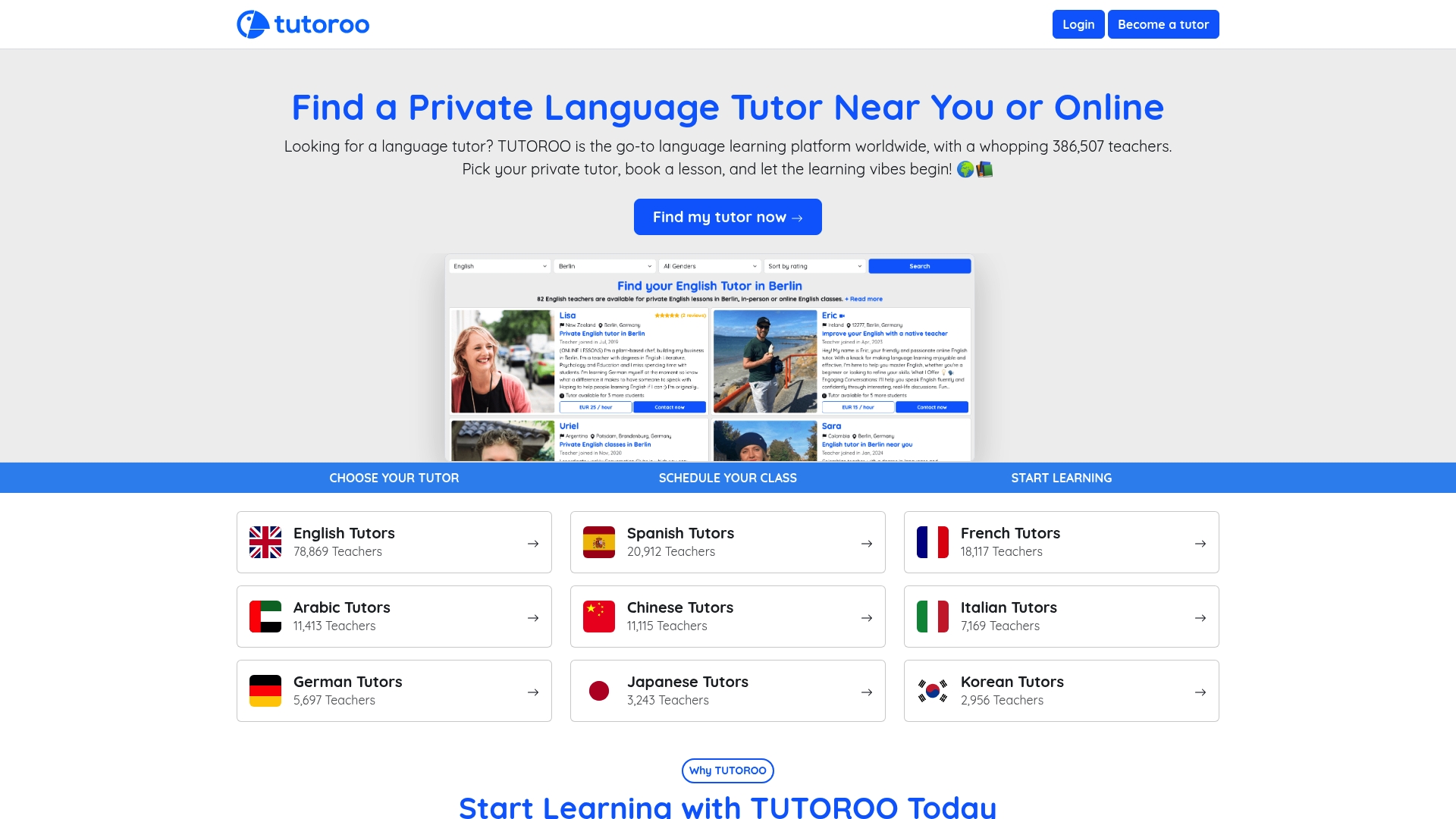
Every tutor on Tutoroo offers personalised, one-on-one sessions built around your goals and current level. Whether you want to sharpen your accent, build conversational confidence, or prepare for a professional context, a native tutor brings the authentic feedback and cultural depth that accelerates real progress. Find your native language tutor on Tutoroo and start building the fluency that only comes from genuine human connection.
FAQ
What are the main benefits of learning with native speakers?
The main benefits include faster fluency development, authentic pronunciation modelling, cultural and pragmatic competence, and immediate contextual feedback. These gains are difficult to replicate through apps, textbooks, or non-native instruction alone.
How often should you practise with a native speaker?
Daily sessions of 20–30 minutes produce the strongest fluency gains. Consistent short practice maintains active retrieval pathways better than longer, infrequent sessions.
Can non-native teachers replace native speaker lessons?
Non-native teachers are highly effective for grammar instruction and structural foundations. Native speakers add authentic pronunciation, cultural knowledge, and pragmatic competence that complement rather than duplicate what non-native teachers provide.
What is pragmatic competence and why does it matter?
Pragmatic competence is the ability to use language appropriately in social contexts, not just grammatically correctly. Native speakers develop this skill through lived experience, making them uniquely qualified to teach it.
How do I find a qualified native tutor?
Platforms like Tutoroo list native tutors online across dozens of languages, with filters for availability, location, and lesson format. Look for tutors with teaching experience at your level and clear feedback practices.