

TL;DR:
- Technology enhances language learning through immersive, adaptive tools like VR, AI, and mobile apps that target specific skills. When aligned with clear goals and supported by human instruction, these tools produce measurable improvements, but ethical considerations like privacy and access must be prioritized. Effective integration involves goal-focused selection, scaffolding, collaborative use with tutors and parents, and ongoing evaluation to maximize outcomes.
Technology is defined as a critical enabler in language education, providing adaptive, immersive, and interactive tools that measurably improve how people acquire and practise new languages. From AI-powered conversation partners to virtual reality classrooms, the role of technology in language education has expanded well beyond digital textbooks and grammar drills. Platforms like Duolingo, tools like Grammarly, and immersive VR environments now sit alongside expert human tutors to create richer, more personalised learning experiences. Research confirms that VR interventions produce a moderately positive effect size of g = 0.538 on productive language skills, a finding drawn from 2,503 participants across varied educational settings. That figure signals a genuine, measurable shift in what technology can deliver for learners and educators alike.
What are the main technology tools used in language education?
Modern language education draws on four broad categories of technology, each serving a distinct pedagogical purpose. Understanding which tool fits which learning goal is the first step toward using them well.

Artificial intelligence tools are the most rapidly adopted category. AI conversation partners such as those built into platforms like Speak or Elsa Coach offer low-pressure speaking practice at any hour, detecting patterns in learner errors and adjusting feedback in real time. The British Council confirms that AI tools support vocabulary exploration, drafting assistance, and adaptive conversation practice, though they also warn of misinterpretation risks when learners rely on AI output without critical evaluation.
Virtual reality environments place learners inside simulated real-world contexts, from ordering coffee in a Parisian café to negotiating a business deal in Mandarin. This matters because authentic social context is one of the hardest things to replicate in a traditional classroom. VR reduces speaking anxiety and cognitive load, increasing a learner's willingness to communicate and overall fluency in ways that static exercises simply cannot.
Digital learning platforms and mobile apps form the backbone of most blended learning programmes. Learning management systems such as Moodle or Canvas allow educators to sequence content, track progress, and deliver automated assessments. Mobile apps extend practice into daily life, making short, consistent exposure possible even for busy adults. Explore online language learning to understand how these platforms work together in a structured curriculum.
Automated assessment and feedback tools like Grammarly and Turnitin's writing feedback features give learners immediate, specific guidance on grammar, coherence, and vocabulary range. This closes the feedback loop far faster than a weekly marked assignment can.
- AI conversation tools: best for speaking confidence and vocabulary building
- VR environments: best for authentic social interaction and anxiety reduction
- LMS and mobile apps: best for structured progression and daily habit formation
- Automated feedback tools: best for writing accuracy and self-correction
Pro Tip: When selecting technology tools for a class or home learning programme, match each tool to a specific skill gap rather than adopting every platform at once. One well-integrated tool used consistently outperforms five tools used sporadically.
How does technology improve language learning outcomes?
The evidence for technology's positive impact on language learning is now substantial enough to move beyond anecdote. A meta-analysis of 2,503 participants found that VR benefits speaking and writing skills consistently across educational levels, with an effect size of g = 0.538. In educational research, an effect size above 0.4 is considered meaningful. This means VR is not merely engaging; it is producing real gains in productive language use.
AI tools contribute differently. Rather than replacing structured instruction, AI supports personalised feedback and confidence building by allowing learners to practise without the social risk of making errors in front of peers or teachers. This is particularly valuable for adult learners and those with language anxiety, two groups that traditional classroom formats often underserve.
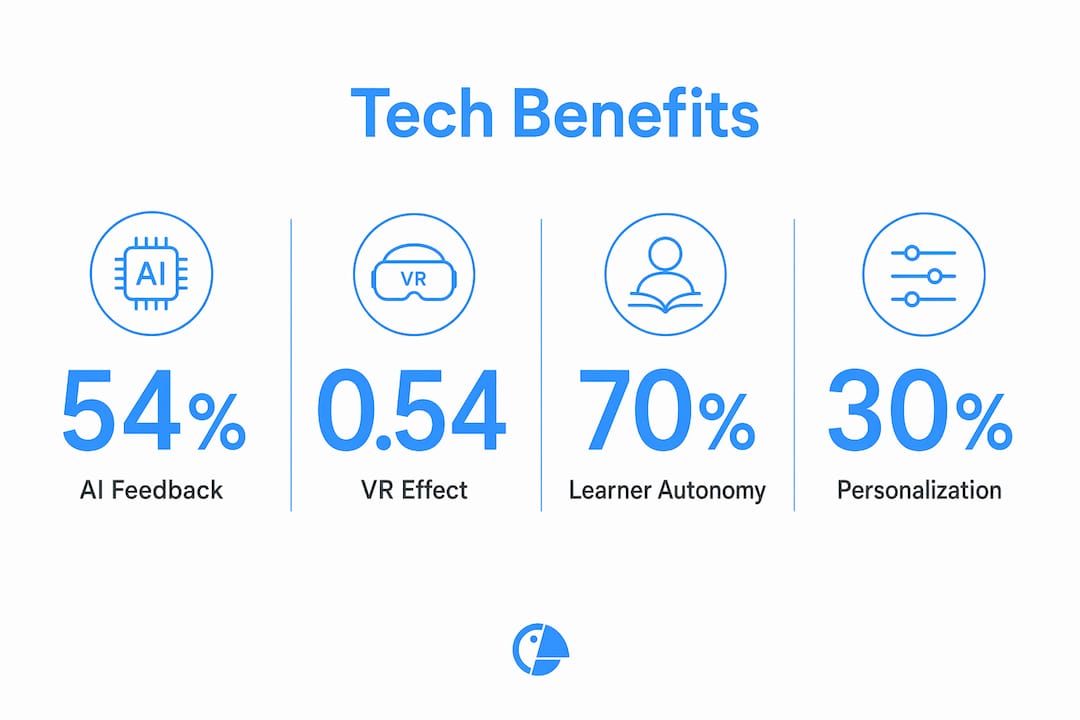
The concept of task-technology fit is central to understanding when digital tools actually work. A study of 537 undergraduates found that performance and effort expectancy predict AI use behaviour, which in turn influences perceived English learning success. Put plainly: when a tool feels manageable and clearly relevant to the task, learners use it more effectively and report stronger outcomes.
| Technology | Primary skill supported | Key pedagogical benefit |
|---|---|---|
| Virtual reality | Speaking and writing | Reduces anxiety, simulates authentic contexts |
| AI conversation tools | Speaking and vocabulary | Adaptive feedback, low-pressure practice |
| Mobile learning apps | Listening and reading | Daily habit formation, spaced repetition |
| Automated writing tools | Writing accuracy | Immediate, specific grammar feedback |
| LMS platforms | All skills | Structured sequencing and progress tracking |
Technology also supports learner autonomy in ways that traditional instruction struggles to match. A systematic review proposing the Integrated Pedagogical-Andragogical Model describes technology as an epistemic mediator, meaning it does not just deliver content but actively shapes how learners construct knowledge. When designed well, digital tools encourage self-directed study, reflection, and genuine ownership of the learning process.
What are the ethical challenges of technology in language education?
Technology in education carries real responsibilities, and the risks deserve the same attention as the benefits. Three areas demand particular care: data privacy, algorithmic bias, and unequal access.
Data privacy is governed by clear legal frameworks. The EU AI Act 2024 and GDPR require schools and platforms to adopt risk-based approaches to AI use, including transparency about how learner data is collected, stored, and used. For educators working in Australian schools, equivalent obligations exist under the Privacy Act 1988 and state-based education privacy guidelines. Compliance is not optional; it is a professional and legal baseline.
Algorithmic bias is a subtler risk. AI language tools trained predominantly on standard varieties of English or other dominant languages may perform poorly for learners with regional accents, non-standard dialects, or lower-resource first languages. This can inadvertently disadvantage the learners who most need support, reinforcing rather than reducing educational inequalities.
Access inequality remains a structural challenge. Not every learner has reliable internet, a capable device, or a home environment conducive to digital study. Technology that is only available to well-resourced schools or families widens the gap it could otherwise close.
- Review all AI tools against your institution's data governance policy before adoption
- Check whether a tool's training data reflects your learners' linguistic backgrounds
- Establish clear classroom norms about when and how AI outputs may be used
- Involve parents in conversations about data consent and acceptable use
Pro Tip: Build a simple governance checklist based on EU ethical guidelines before introducing any new AI tool. Document the tool's purpose, data handling practices, and the safeguards in place. This protects learners and gives parents confidence.
How can educators and parents integrate technology effectively?
Effective integration is not about adding more technology. It is about aligning the right tool with a clear learning goal and providing enough scaffolding for learners to use it well. The following steps offer a practical framework for both educators and parents.
-
Define the learning goal first. Before selecting any tool, identify the specific skill or gap being addressed. A learner who struggles with spoken fluency needs a different solution than one who makes consistent grammar errors in writing. Task-technology fit, confirmed by research with 537 undergraduates, is the strongest predictor of whether a digital tool will actually improve outcomes.
-
Scaffold the technology introduction. Do not assume learners know how to use a tool effectively. Walk through the interface, model how to interpret feedback, and set clear expectations for how the tool fits into broader study. Research on pedagogical scaffolding confirms that instructional design and learner readiness determine whether technology mediates genuine learning or simply adds distraction.
-
Combine technology with human interaction. AI and apps build habits and provide practice volume, but a skilled tutor brings cultural nuance, motivational support, and the kind of responsive dialogue that no algorithm replicates. Personalised one-on-one lessons accelerate progress precisely because a human tutor can read a learner's confidence, adjust pacing, and offer encouragement in the moment.
-
Involve parents as digital citizenship partners. The Council of Europe's digital citizenship education roadmap identifies family involvement as critical to safe, inclusive digital participation. Parents who co-define acceptable technology use norms at home significantly support learners' effective and safe language practice. This means discussing screen time, evaluating AI outputs together, and modelling critical thinking about digital content.
-
Review and adjust regularly. Technology changes quickly. A tool that served your learners well in one term may be superseded or may no longer align with evolving goals. Schedule a regular review of the digital tools in use, assess whether outcomes are improving, and be willing to retire tools that are not earning their place in the curriculum.
Educators who want to deepen their own practice will find digital literacy for tutors an increasingly non-negotiable skill set. Understanding how AI tools work, what their limitations are, and how to guide learners through them is now part of professional teaching competence.
Key takeaways
Technology improves language learning outcomes most reliably when it is matched to specific pedagogical goals, supported by human instruction, and governed by clear ethical standards.
| Point | Details |
|---|---|
| VR delivers measurable gains | An effect size of g = 0.538 confirms VR's positive impact on speaking and writing skills. |
| Task-technology fit drives results | Aligning AI tools to specific learning tasks produces stronger perceived and actual outcomes. |
| Ethics and privacy are non-negotiable | EU AI Act 2024 and GDPR set the legal baseline for responsible AI use in classrooms. |
| Parental involvement strengthens outcomes | Families who co-define digital norms support safer and more effective language practice at home. |
| Human tutors remain central | Technology complements but does not replace the cultural nuance and responsiveness of expert human instruction. |
Tutoroo's perspective on technology and human connection in language learning
After working with over 386,000 language tutors and learners across dozens of countries, Tutoroo has a clear view on where technology genuinely helps and where it falls short.
The tools are impressive. VR environments that simulate real conversation, AI that catches grammar patterns a learner repeats across weeks of writing, apps that build vocabulary through spaced repetition. These are not gimmicks. They work, and the research confirms it. But Tutoroo has also seen what happens when technology is treated as the whole solution rather than part of one.
Learners who rely entirely on AI conversation tools often plateau. They get fluent at talking to a machine but hesitate when a native speaker uses slang, shifts register, or responds with cultural context the algorithm never modelled. The British Council's position that AI should support human-centred education rather than supplant it aligns exactly with what Tutoroo observes in practice.
The most effective learners Tutoroo sees are those who use technology to build volume and habit, then bring that practice into sessions with a real tutor who can push them further. Digital literacy matters too. Educators and parents who understand how these tools work, what data they collect, and where their outputs can mislead are far better positioned to guide learners responsibly. That is not a technical skill. It is a teaching skill.
— Tutoroo
Find a language tutor who makes technology work for you
Technology opens doors to culture, connection, and opportunity in language learning. The most rewarding results come when those digital tools are guided by an expert tutor who understands your goals, your pace, and your learning style.
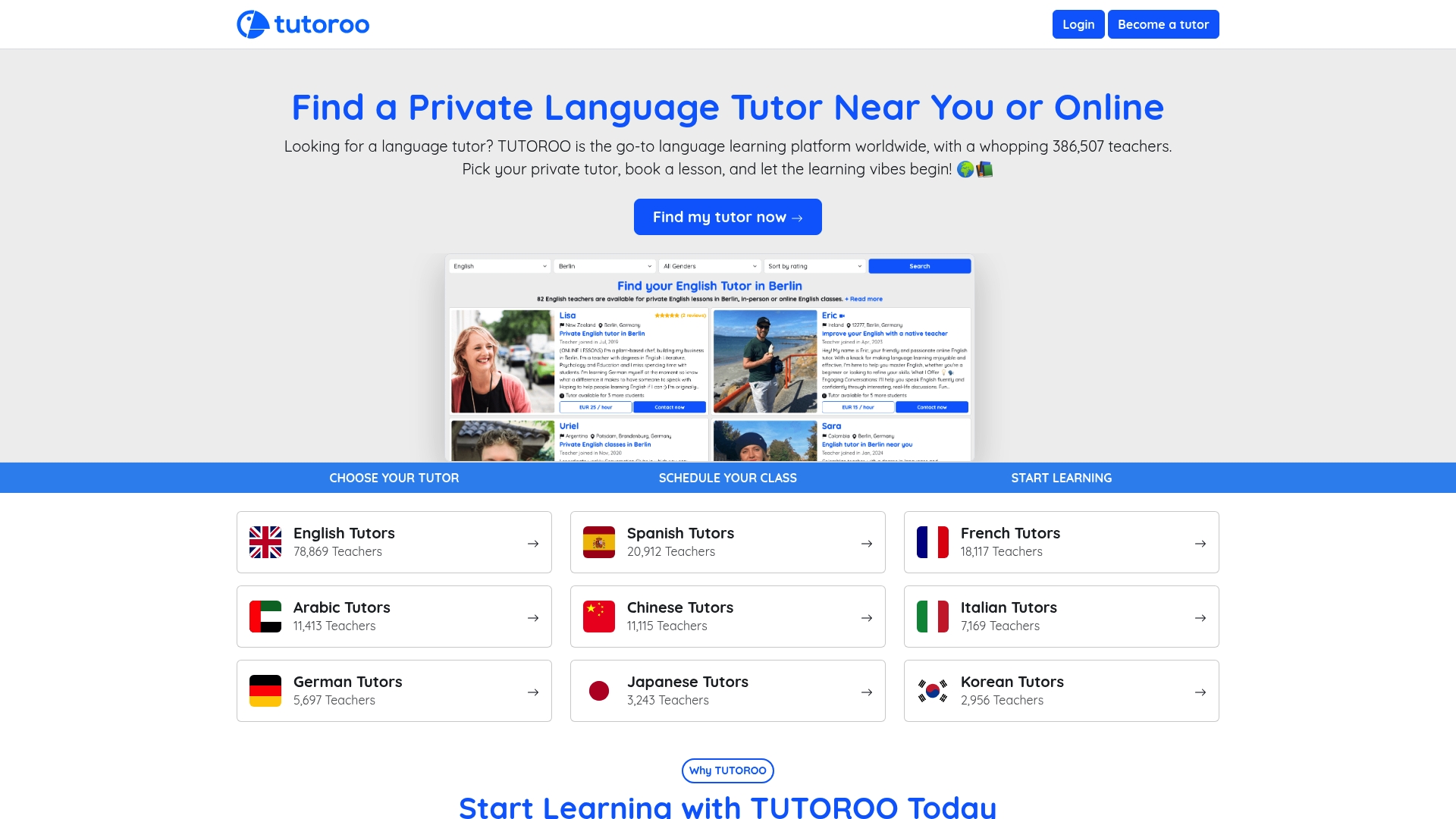
Tutoroo connects learners with over 386,000 private language tutors worldwide, offering personalised lessons in English, Spanish, French, Arabic, Chinese, and many more languages. Whether you prefer online sessions or in-person tuition, Tutoroo makes it straightforward to find the right match. Find your tutor today and experience language learning that combines the best of technology with the warmth of genuine human connection.
FAQ
What is the role of technology in language education?
Technology in language education provides adaptive, immersive, and interactive tools that support language acquisition across all skill areas. AI tools, VR environments, mobile apps, and digital platforms each serve distinct pedagogical purposes when aligned with clear learning goals.
Does VR actually improve language learning outcomes?
Yes. A meta-analysis of 2,503 participants found VR produces an effect size of g = 0.538 on productive language skills, including speaking and writing, across varied educational levels and contexts.
What ethical issues should educators consider when using AI in language teaching?
Educators must address data privacy under GDPR and the EU AI Act 2024, guard against algorithmic bias that disadvantages non-standard language users, and establish transparent classroom governance policies before adopting any AI tool.
How can parents support technology use in language learning at home?
Parents play a critical role by co-defining acceptable technology use norms, discussing how to evaluate AI outputs critically, and staying engaged with the digital tools their children use. The Council of Europe identifies family involvement as central to safe digital participation.
Is technology a replacement for human language tutors?
No. Technology builds practice volume and habit, but human tutors provide cultural nuance, motivational responsiveness, and adaptive dialogue that AI cannot replicate. The most effective approach combines both.