

TL;DR:
- Tutor matching aligns teaching style, goals, and personality for effective language learning.
- The process involves intake, attribute evaluation, trial lessons, and ongoing adjustments.
- Combining human oversight with algorithmic tools improves the chances of finding a suitable tutor.
Choosing a language tutor feels straightforward until you realise that speaking the language fluently does not automatically make someone the right teacher for you. The real challenge is finding someone whose teaching approach, availability, cultural knowledge, and personality genuinely align with where you are and where you want to go. Tutor matching is the structured process platforms use to pair learners with tutors based on needs, goals, level, learning style, schedule, and tutor expertise. This guide explains how that process works, what factors shape a great match, and how you can actively improve your chances of finding a tutor who truly accelerates your progress.
Table of Contents
- What is tutor matching and why does it matter?
- How tutor matching works: The process explained
- What factors determine the best tutor fit?
- Manual vs algorithmic vs AI matching: What works best?
- Why perfect tutor matches are rare—and how to make them work for you
- Find your ideal tutor with TUTOROO
- Frequently asked questions
Key Takeaways
| Point | Details |
|---|---|
| Tutor matching basics | It's a process connecting learners with tutors who align in skills, style, and availability for more effective lessons. |
| How matching works | Platforms use assessments and technology to pair you based on goals, learning preferences, and tutor expertise. |
| Choosing best fit | Consider learning style, goals, and soft skills to maximise language progress with your tutor. |
| No process is perfect | Communicate openly and use feedback or trial lessons to refine your match and boost results. |
What is tutor matching and why does it matter?
At its core, tutor matching is about alignment. It goes far beyond checking whether a tutor speaks your target language. A well-matched tutor understands your current level, shares your learning goals, fits your schedule, and uses a teaching style that resonates with how you absorb new information. That kind of fit is what transforms tutoring from a pleasant chat into genuine, measurable progress.
The private tutoring benefits become most visible when the match is right. Without it, even a highly qualified tutor can leave a learner feeling frustrated, unchallenged, or simply bored. A beginner paired with a tutor who favours rapid immersion may shut down. An advanced learner paired with someone who over-explains basics may disengage entirely.
Research supports this strongly. Tutoring yields 0.14 to 0.37 standard deviation gains in learning outcomes, and those gains are most consistent when the tutor and learner are genuinely compatible. These are not small numbers in educational terms. A 0.37 SD gain is roughly equivalent to moving from the 50th to the 63rd percentile in language proficiency.
The personalised learning gains from well-matched tutoring also address common barriers that hold learners back:
- Lack of motivation: A tutor who connects with your personal goals keeps sessions energising rather than draining
- Miscommunication: A tutor who understands your cultural background reduces confusion and builds rapport faster
- Inconsistent practice: A tutor whose schedule genuinely fits yours means fewer cancellations and more consistent progress
- Plateau effect: A tutor who pushes you at the right pace prevents stagnation at intermediate levels
"The right tutor does not just teach the language. They open doors to culture, connection, and confidence that no textbook can replicate."
This applies equally to beginners finding their footing and advanced learners refining their fluency. The match matters at every stage.
How tutor matching works: The process explained
Understanding the value is the first step, so how does tutor matching actually happen? Most platforms follow a structured sequence, though the depth and tools involved vary considerably.
- Intake and needs assessment: You complete a profile or intake form covering your target language, current level, learning goals, preferred lesson style, availability, and budget. Some platforms conduct a short call instead.
- Attribute evaluation: The platform reviews your profile against tutor profiles. Matching considers over 100 attributes including subject expertise, teaching style, personality fit, and availability.
- Initial match or shortlist: You receive one recommended tutor or a curated shortlist to browse and compare.
- Trial lesson: Most platforms encourage or require a trial session to test the fit before committing to ongoing lessons.
- Feedback and adjustment: After the trial, you rate the experience. If the fit is not right, the platform refines the match based on your feedback.
- Ongoing check-ins: Good platforms revisit compatibility as your goals evolve, especially if you move from conversational practice to exam preparation.
Exploring online tutoring examples can help you understand what different lesson formats look and feel like before you commit. If you are weighing up formats, the local vs online tutoring comparison is worth reading before your intake.
| Matching stage | What happens | Your role |
|---|---|---|
| Intake | Share goals, level, schedule | Be specific and honest |
| Evaluation | Platform assesses attributes | Review tutor profiles carefully |
| Trial lesson | Test the fit in a real session | Note what works and what doesn't |
| Feedback | Rate and refine the match | Give detailed, constructive input |
| Ongoing review | Adjust as your goals change | Communicate evolving needs |
For learners preparing for specific language exams, tutor assignment for exam preparation follows a similar process but with additional focus on test format knowledge and structured study plans.
Pro Tip: Before your intake, write down three specific goals. Not "I want to speak French" but "I want to hold a 10-minute conversation about my work in French within three months." Specific goals produce far better matches.
What factors determine the best tutor fit?
With the process laid out, it is vital to understand what actually goes into making a great match. Platforms evaluate a wide range of attributes, and knowing these helps you provide better intake information.
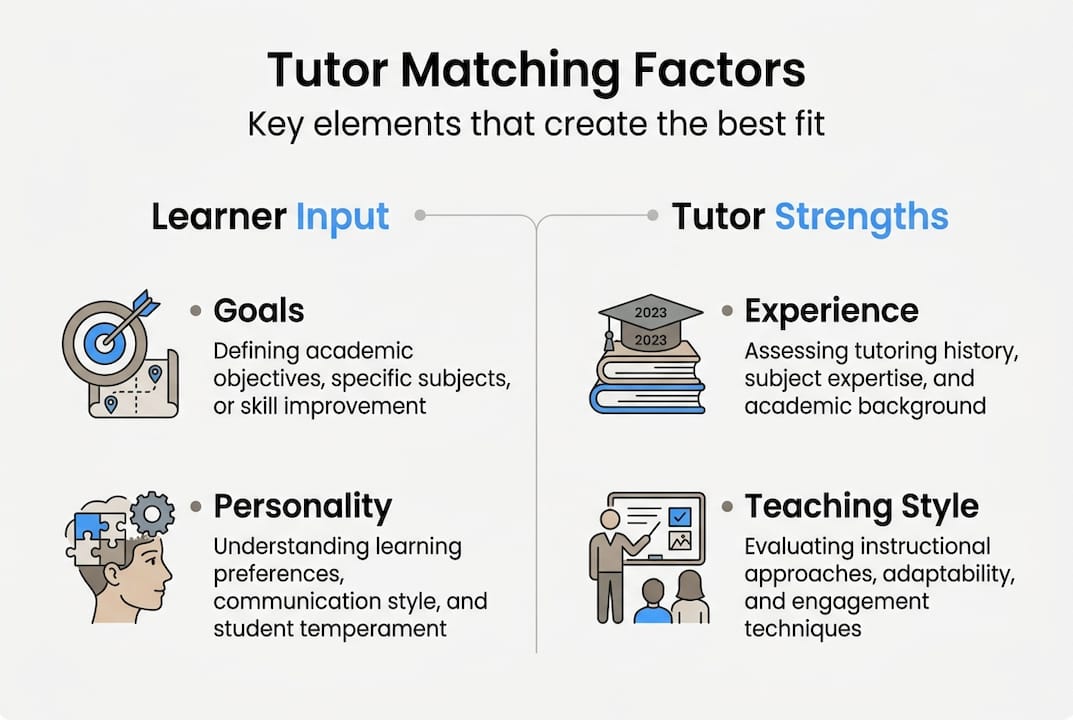
| Factor | Why it matters | Example |
|---|---|---|
| Language and dialect | Regional accents and vocabulary differ significantly | Brazilian Portuguese vs European Portuguese |
| Teaching style | Structured vs conversational vs exam-focused | Grammar drills vs free dialogue |
| Learner goals | Shapes lesson content entirely | Travel, career, academic, cultural interest |
| Availability | Consistent scheduling drives progress | Weekly slots at fixed times |
| Tutor credentials | Reflects formal training and experience | CELTA, TESOL, native fluency |
| Personality and communication | Affects comfort, rapport, and retention | Patient, energetic, detail-oriented |
The tutoring styles that work best depend heavily on your learning personality. Some learners thrive with structured grammar instruction and clear rules. Others absorb language fastest through free conversation and real-world context. Neither is wrong. The mismatch is the problem.

Cultural fluency is another underrated factor. A tutor who understands the cultural context of the language you are learning brings authenticity that goes beyond vocabulary lists. They can explain why certain phrases carry specific social weight, which idioms to avoid in formal settings, and how communication norms differ across regions.
The benefits of working with a native-speaking tutor are particularly strong when cultural immersion is part of your goal. Native speakers model authentic pronunciation, natural rhythm, and colloquial usage that non-native tutors may not replicate as naturally.
Soft skills also play a bigger role than most learners expect:
- Patience: Critical for beginners who need time to process new sounds and structures
- Adaptability: The ability to shift approach mid-lesson when something is not landing
- Encouragement: Positive reinforcement keeps motivation high during difficult phases
- Clarity: The skill to explain a grammar rule three different ways until it clicks
Over 100 attributes feed into a strong match, and teaching style and personality fit rank among the most influential. Do not underestimate the human side of this equation.
Manual vs algorithmic vs AI matching: What works best?
Not all matching is created equal. The method a platform uses to connect you with a tutor shapes the quality and speed of that match in meaningful ways.
Matching methodologies range from manual expert review to AI-driven algorithms, and each carries genuine trade-offs.
Manual matching relies on a human coordinator reviewing your profile and selecting a tutor based on experience and judgement. This approach captures nuance that algorithms miss, such as the subtle difference between a learner who says they want "conversational practice" but actually needs structured grammar support first. The downside is scale. Manual matching is slow and expensive, making it harder for large platforms to sustain.
Algorithmic matching processes your intake data against tutor profiles at speed, filtering by language, level, schedule, and preferences. It works well when learners provide accurate, detailed information. The problem is that algorithmic matching produces around 28% mismatches when learner input is vague or inaccurate. Garbage in, garbage out.
AI-enhanced matching blends speed with greater nuance by analysing patterns across thousands of successful pairings to predict compatibility. It is promising but still evolving. AI systems can surface unexpected compatibility signals, but they are not yet reliable enough to replace human judgement entirely, particularly for complex learning goals.
| Method | Speed | Nuance | Accuracy | Best for |
|---|---|---|---|---|
| Manual | Slow | High | High | Complex or niche needs |
| Algorithmic | Fast | Moderate | Variable | Standard language goals |
| AI-enhanced | Fast | High | Improving | Broad platform use |
"The best matching systems combine algorithmic speed with human oversight. Neither alone is sufficient for consistently strong outcomes."
For learners, the practical takeaway is this: regardless of the method, your input quality determines your match quality. International platform results consistently show that learners who provide detailed, honest intake information receive better initial matches and reach their goals faster.
Pro Tip: If a platform uses algorithmic matching, treat your intake form like a job application. Every field matters. Vague answers produce generic matches. Specific answers produce genuinely useful ones.
Why perfect tutor matches are rare—and how to make them work for you
Here is what most guides do not tell you: no platform, no matter how sophisticated its matching system, can guarantee a perfect tutor fit on the first attempt. And that is completely fine.
Matching is not about finding a clone of your ideal learning self. It is about maximising fit across the factors that matter most and staying open to adjustment. The learners who get the most from tutoring are not the ones who land a flawless first match. They are the ones who communicate clearly, give honest feedback after trial lessons, and stay willing to refine the pairing.
Even a mismatch teaches you something valuable. It clarifies exactly what you do and do not want in a tutor, which makes your next intake response sharper and your next match stronger. Following practical language learning tips alongside your tutoring sessions also accelerates progress between lessons.
Treat matching as an ongoing conversation, not a one-time event. Your goals will evolve. Your level will change. The tutor who was perfect for your beginner phase may not be the right fit when you are ready to tackle business-level fluency. Staying proactive about communicating those shifts is what turns good tutoring into transformative learning.
Find your ideal tutor with TUTOROO
Ready to put tutor matching into action? TUTOROO connects language learners with over 386,000 private tutors across dozens of languages, making it straightforward to find someone who fits your goals, schedule, and learning style.
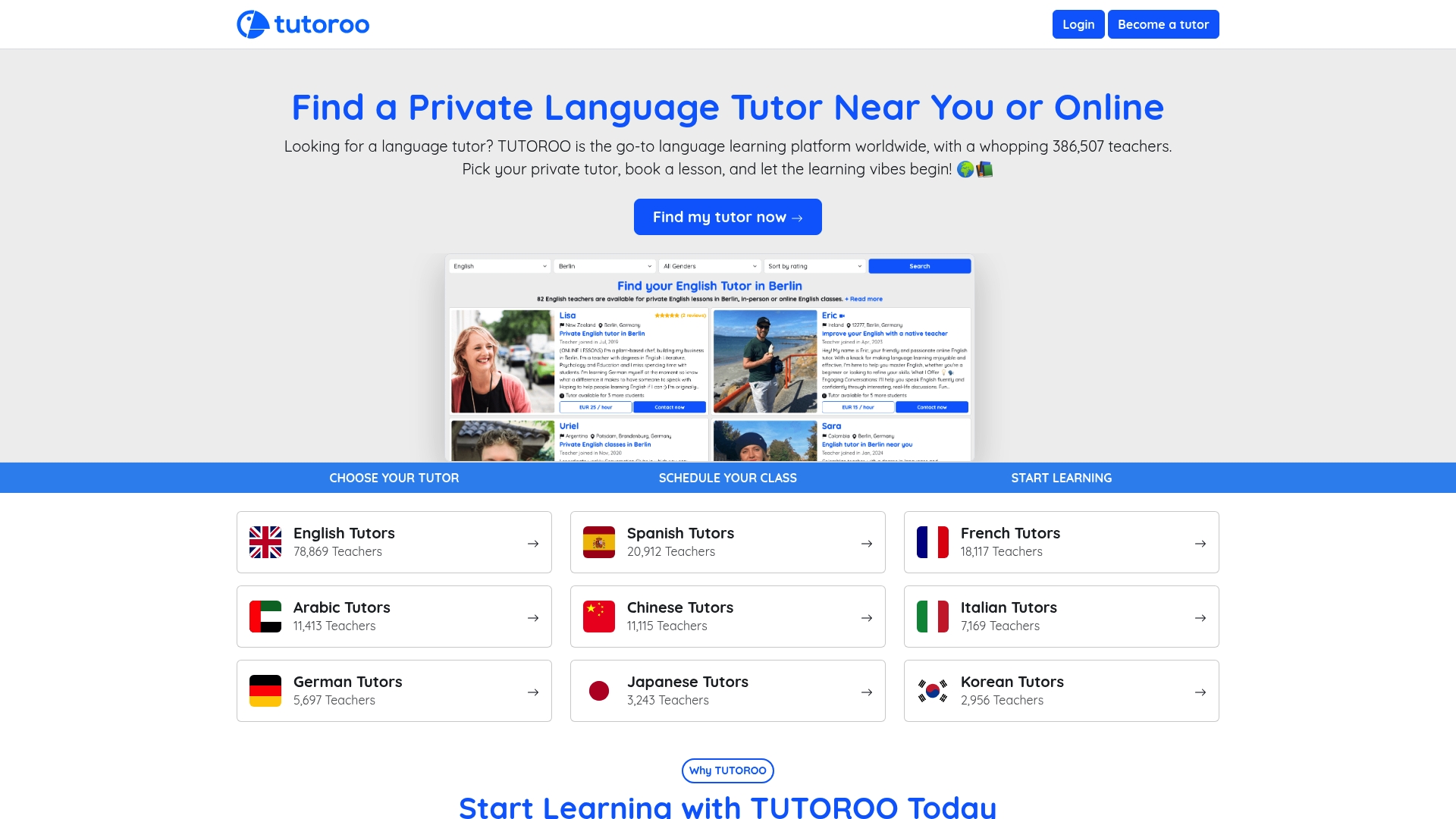
Whether you are looking to find a language tutor for general fluency, searching for a specialist Malay tutor, or keen to work with a dedicated Tamil tutor, TUTOROO's platform makes the process simple and transparent. Browse tutor profiles, read genuine reviews, and book a trial lesson with confidence. Your language journey deserves a tutor who genuinely fits, and TUTOROO is built to help you find exactly that.
Frequently asked questions
How does tutor matching improve my language learning?
Tutor matching pairs you with someone suited to your style, goals, and schedule, and research shows this approach yields measurable learning gains of 0.14 to 0.37 standard deviations in language proficiency. A well-matched tutor keeps you motivated and progressing consistently.
What information do I need to provide for a tutor match?
Most platforms ask about your language goals, current skill level, preferred learning style, availability, and any special requirements. The initial needs assessment typically happens via an intake form or a short introductory call, so being specific and honest gives you the best starting point.
Are AI-based tutor matching systems better than manual selection?
AI systems match quickly across many factors, but manual matching adds human nuance that algorithms can miss. Algorithmic matching produces roughly 28% mismatches when input is vague, so combining both approaches generally delivers the best balance of speed and personalisation.
What if my tutor isn't the right fit?
Provide honest feedback to the platform after your trial lesson. Most services allow you to request a different tutor with no penalty, and your feedback helps the platform refine its next recommendation for you.