

That number is your minimum, not your quote. The complete worksheet below walks you through every input so you can run the math in under 15 minutes and arrive at a rate you can defend with confidence.
This setting hourly rates guide is built around a worksheet-first approach, meaning you collect your real numbers first, then let the formula do the work. Most freelancers skip straight to checking what competitors charge, which is backwards. Market rates tell you where to position; your cost floor tells you whether you can afford to be there.
Key takeaways
Setting your hourly rate correctly requires calculating a cost-plus floor from real income targets, realistic billable hours, and actual business costs, then adjusting upward for market position and value.
| Point | Details |
|---|---|
| Start from take-home, not gross | Calculate required gross revenue by grossing up your net target for taxes, then add business costs. |
| Use realistic billable hours | Full-time freelancers typically bill 1,200–1,500 hours per year; plan at 60–70% utilisation until you have tracked data. |
| Add a 15–25% profit buffer | A healthy solo operation carries a 15–25% margin above the cost floor; higher margins suit specialist work. |
| Quote above the floor | Your floor rate is the minimum, not the price; your quoted rate should include the buffer and reflect market position. |
| Tutoroo for tutors | Language tutors can find students and manage rates directly through Tutoroo, with no ongoing commission on lessons. |
Table of Contents
- What inputs does the hourly rate worksheet need?
- Step 1: How do you set your target annual income?
- Step 2: How many billable hours can you realistically expect?
- Step 3: How do you add business costs, taxes, and a profit buffer?
- Step 4: How do you convert your revenue target into a base hourly rate?
- Step 5: When should you charge more than the math says?
- Step 6: When should you use hourly, day rates, retainers, or fixed projects?
- Step 7: How do you present your rate and handle pushback?
- Step 8: When and how should you raise your rates?
- Is $50/hr a reasonable rate? Worked examples across three levels
- Which tools and calculators make this process repeatable?
- How language tutors can apply this framework using Tutoroo insights
- How do you research competitors' hourly rates in your market?
- What legal and tax obligations apply when you charge hourly rates?
- The mistakes freelancers make when setting rates (and how to avoid them)
- Tutoroo connects tutors with students who are ready to learn
- Sources
What inputs does the hourly rate worksheet need?
The worksheet has two sides: inputs you gather once (and update annually) and outputs the formula produces. Copy the table below into a spreadsheet or a notes app and fill in each row.
| Input field | What to enter | Example value |
|---|---|---|
| Target take-home (annual, after tax) | The net income you want to keep | $75,000 |
| Annual personal living costs | Rent, food, transport, insurance | $60,000 |
| Annual business expenses | Software, hardware, subscriptions, marketing | $8,400 |
| Assumed effective tax rate | Income tax + self-employment tax combined | 30% |
| Desired profit buffer | Percentage above cost floor | 15% |
| Total working weeks per year | 52 minus holidays, sick leave, training | 46 weeks |
| Average billable hours per week | Realistic paid hours only (not total hours worked) | 25 hrs |
| Annual billable hours | Working weeks × billable hours per week | 1,150 hrs |
Outputs the formula produces:
- Required gross revenue = (target take-home ÷ (1 − tax rate)) + business expenses
- Base (floor) hourly rate = required gross revenue ÷ annual billable hours
- Buffered rate = floor rate × (1 + profit buffer %)
- Suggested quoted range = buffered rate to buffered rate × 1.15
Using the example values: required gross revenue = ($75,000 ÷ 0.70) + $8,400 = $115,614. Floor rate = $115,614 ÷ annual billable hours yields a floor hourly rate around $100.
According to freelance rate methodology guides, the most reliable way to calculate a freelance hourly rate is to use (target annual income + expenses + taxes) ÷ realistic billable hours, then add a 10–20% buffer.
Step 1: How do you set your target annual income?
The most common mistake in rate-setting is starting from a gross salary figure and working backwards. Start from take-home instead. That is the number that pays your rent, funds your superannuation equivalent, and covers your life.
There are three practical methods to land on a target:
- Replace your previous salary. Take your last net pay and add 15–20% to account for the benefits you no longer receive (paid leave, employer super contributions, health cover). A $65,000 net salary becomes a $75,000–$78,000 take-home target.
- Build from monthly costs. List every personal expense, multiply by 12, then add a savings goal. If your monthly costs are $5,000 and you want to save $12,000 per year, your target is $72,000.
- Goals-based approach. Work backwards from a specific financial milestone: a house deposit, a business investment, or a target retirement date. This method produces the most honest number because it forces you to confront what your life actually costs.
FreelanceMath's layered method makes the case clearly: starting from desired take-home is more accurate than dividing a desired salary by 2,080 hours, because that shortcut ignores taxes, overheads, and the reality that you will never bill 2,080 hours in a year.
For a solo freelancer just starting out, a take-home target of $50,000–$60,000 is common. A part-time contractor working 20 hours per week might target $35,000–$45,000. A small business owner with staff and overheads might need $120,000 or more in gross revenue just to take home $70,000. The right number is yours, not the industry average.
Step 2: How many billable hours can you realistically expect?
This is where most freelancers undercut themselves without realising it. The theoretical maximum of 40 hours per week, 52 weeks per year gives you 2,080 hours. You will not bill anywhere near that.

Research on freelance utilisation consistently shows that realistic billable hours for full-time freelancers usually bill realistic hours per year, commonly ranging around the lower to mid-thousands. Errors in utilisation assumptions are the single largest source of underpricing.
Here is why the gap is so large. A typical working year of about 46 weeks, after holidays, sick leave, and professional development, gives a realistic total of working hours significantly fewer than the theoretical maximum. From those, subtract:
- Admin and invoicing: 8–12% of total hours
- Business development and sales: 10–15%
- Learning and upskilling: 5–8%
- Unbillable project prep and communication: 5–10%
At a 65% utilisation rate, 1,840 hours becomes roughly 1,200 to 1,300 billable hours. Overestimating utilisation by a significant margin can lead to substantial expected revenue that does not materialize.
Pro Tip: Track your actual hours for four weeks before setting a rate. Most freelancers discover their real utilisation is 10–15 percentage points lower than they assumed.
It is better to price conservatively and beat your target than to underprice and run short.
Step 3: How do you add business costs, taxes, and a profit buffer?
Once you have a take-home target and a billable hours estimate, you need to build up to the gross revenue figure that actually funds both. This is the cost-plus layer.
Common business costs to include:
- Software subscriptions (project management, invoicing, design tools): $1,200–$3,600/yr
- Hardware replacement and maintenance: $800–$2,000/yr
- Professional insurance (public liability, professional indemnity): $600–$2,400/yr
- Marketing and website hosting: $500–$2,000/yr
- Accounting and legal fees: $1,000–$3,000/yr
- Home office or co-working space: $0–$6,000/yr
- Professional development and courses: $500–$2,000/yr
A lean solo operation might total $6,000–$8,000 in annual business costs. A more established contractor with a dedicated workspace and active marketing could easily reach $15,000–$20,000.
Grossing up for taxes is where many freelancers get caught. In the US, self-employed individuals pay both the employee and employer portions of Social Security and Medicare tax, totalling 15.3% on net self-employment income up to the annual threshold. You can deduct half of that self-employment tax from your gross income before calculating income tax, which reduces the effective rate slightly.
The simple gross-up formula: required gross revenue = target take-home ÷ (1 − effective tax rate) + business expenses.
A healthy profit margin for a solo freelance operation is typically 15–25% on top of the all-in cost floor; higher margins suit scarce specialisations.
The buffer absorbs slow months without forcing you to dip into personal savings.*
Step 4: How do you convert your revenue target into a base hourly rate?
With required gross revenue and annual billable hours in hand, the base rate calculation is straightforward:
Base (floor) hourly rate = required gross revenue ÷ annual billable hours
Here is a worked example with concrete numbers:
- Target take-home: $80,000
- Effective tax rate: 28%
- Annual business expenses: $9,000
- Required gross revenue: ($80,000 ÷ 0.72) + $9,000 = $111,111 + $9,000 = $120,111
- Annual billable hours (65% utilisation, 46 working weeks, 30 hrs/week): 46 × 30 × 0.65 = 897 hours
- Base floor rate: $120,111 ÷ 897 = $133.90/hr
- With 15% profit buffer: $133.90 × 1.15 = $153.99/hr
- Suggested quoted range: $154–$177/hr
Notice how sensitive the rate is to utilisation. That 15-percentage-point difference in utilisation assumption produces a $25/hr gap in the floor rate, which compounds across every project.
Pro Tip: Round your quoted rate to a psychologically clean number. $155/hr reads as considered and confident; $153.99/hr reads as if you ran the math and stopped there. Clients notice the difference, even if they cannot articulate why.
The minimum viable rate framework reinforces this: calculate your floor from annual expenses and taxes divided by realistic billable hours, then use market benchmarks to position your final rate above that floor.
Step 5: When should you charge more than the math says?
Your cost-plus floor is the minimum you can accept without losing money. Market rates and value-based adjustments determine where above that floor you can actually quote.
Market research methods that work:
- Job boards and freelance platforms: Filter for your role and experience level. Note the range, not just the average, because the top 20% of earners often reflect what specialists charge.
- Industry salary surveys: Many professional associations publish annual compensation reports. Take the median full-time salary for your role and apply a 1.5–2× multiplier to account for the overheads and benefits a freelancer self-funds. LinkedIn's freelance rate guidance describes this reverse-engineering approach as one of the most reliable market checks available.
- Direct client conversations: Ask prospects what budget they have allocated before you quote. This is not weakness; it is intelligence gathering.
- Peer networks and communities: Slack groups, professional forums, and industry associations often share real rate data in ways that public job boards do not.
Value-based adjustments to layer on top:
- Specialisation premium: A generalist copywriter and a SaaS conversion copywriter with a portfolio of measurable results are not the same product. Niche expertise typically commands 20–40% above generalist rates.
- Proof-of-results premium: If you can point to a specific, quantified outcome you delivered for a previous client (revenue generated, costs saved, time reduced), that evidence justifies a premium. Clients are buying a result, not hours.
- Client-size premium: Enterprise clients have larger budgets, longer procurement cycles, and more compliance requirements. Charging them the same rate as a solo founder leaves money on the table.
The practical rule: if your floor rate is below the market median for your role, you have room to raise it without losing competitiveness. If your floor is above the market median, you need to either reduce costs, specialise into a higher-value niche, or target clients who pay above-median rates.
Step 6: When should you use hourly, day rates, retainers, or fixed projects?
Hourly billing is not always the most profitable format. Choosing the right pricing structure for each engagement type, including considerations like lesson length and class format, can significantly affect your effective hourly rate. For those in education and tutoring, exploring a Free Trial Coding Class for Kids | Kidocode Malaysia offers insights into how lesson duration impacts overall rates.
| Format | Best for | Conversion rule | Sample client wording |
|---|---|---|---|
| Hourly | Unclear scope, ongoing support, variable work | Base rate (as calculated) | "My rate is $X/hr, billed in 30-min increments with a two-hour minimum." |
| Day rate | On-site work, workshops, consulting sprints | Hourly rate × 7–8 hrs × 1.1 buffer | "My day rate is $X for up to eight hours on-site." |
| Fixed project | Defined deliverables, creative work | Estimated hours × hourly rate × 1.2–1.3 buffer | "This project is $X, covering [deliverables], with two rounds of revisions." |
| Retainer | Ongoing relationship, predictable monthly work | Monthly hours × hourly rate × 0.9 (slight discount for predictability) | "My monthly retainer is $X for up to Y hours, with unused hours not rolling over." |
Day rates suit engagements where you are physically present and cannot easily track incremental time. Fixed-project pricing rewards efficiency: if you complete a $3,000 project in 15 hours instead of 20, your effective hourly rate rises to $200/hr. Retainers trade a small rate discount for the security of predictable income, which has real value when your pipeline is variable.
The buffer on fixed-project pricing (1.2–1.3×) is not padding; it is scope insurance. Projects almost always expand beyond the original brief, and a buffer means you absorb minor scope creep without renegotiating every time.
Step 7: How do you present your rate and handle pushback?
Stating a rate with confidence is a skill, and it is one most freelancers underinvest in. The way you present your rate shapes how clients perceive your value before they have seen a single deliverable.
Proposal language that holds margin:
Specificity protects you. Vague proposals invite negotiation on every line; specific ones focus the conversation on scope, not price.
Contract essentials to include:
- Deliverables defined in measurable terms (word count, number of screens, hours of tuition)
- Milestones and payment schedule (deposit upfront, balance on delivery, or monthly)
- Late payment fee and the trigger date
- Scope-change clause: any work outside the agreed brief is quoted separately before it begins
- Termination clause: notice period and payment for work completed to date
Negotiation tactics when clients push back on price:
- Ask about budget before discounting: "What budget have you allocated for this?" often reveals the client can afford your rate.
- Trade scope for price: "I can bring the fee down to $X if we reduce the deliverables to [Y]." Never discount without removing something.
- Set a clear floor and hold it: know your minimum acceptable rate before the conversation starts, and be prepared to walk away.
Pro Tip: Silence is a negotiation tool. After stating your rate, stop talking. The first person to speak after a price is stated tends to make concessions. Let the client respond.
Step 8: When and how should you raise your rates?
Rates that never change are rates that shrink in real terms every year. Inflation, skill growth, and market shifts all create legitimate grounds for increases, and the mechanics of raising rates are simpler than most freelancers expect.
Common triggers for a rate increase:
- You are consistently at or near capacity (a reliable signal that demand exceeds supply at your current price)
- You have completed significant upskilling or earned a new credential
- Your annual cost review shows expenses have risen
- You have been at the same rate for 12 months or more
- New clients are accepting your rate without hesitation (a sign you are underpriced)
Timing and notice for existing clients:
Give existing clients 30–60 days' notice of a rate increase. Frame it as a scheduled review, not an apology. A simple, direct email works well:
Grandfathering (holding existing clients at the old rate for a transition period) can preserve goodwill, but limit it to 60–90 days. Indefinite grandfathering creates a two-tier client base that is difficult to manage and signals that your stated rate is negotiable.
For new clients, the new rate applies immediately. There is no need to explain or justify a rate to a prospect who has never paid a different one.
Is $50/hr a reasonable rate? Worked examples across three levels
The answer depends entirely on your cost structure and location. Here are three scenarios that illustrate when $50/hr works and when it does not.
The $50/hr question: For an entry-level contractor working part-time with low overheads and a modest income target, $50/hr sits just above the floor rate of $48.72 and below the buffered rate of $56.03. It is viable but leaves almost no margin for slow months.
The variables that move the rate most are utilisation and tax rate. A 5-point rise in effective tax rate adds approximately $5–$8/hr to the floor at mid-level income. These sensitivities are why the worksheet matters: small assumption errors compound into large pricing mistakes.
Which tools and calculators make this process repeatable?
The worksheet in this guide is the foundation, but several tools make the process faster and more auditable over time.
Hourly rate calculators: Dedicated freelance rate calculators (available through sites like Bonsai, AND.CO, and various accounting platforms) let you plug in your income target, expenses, and utilisation rate and receive an instant floor rate. They are useful for quick sanity checks, though they rarely account for the profit buffer or value-based adjustments covered in this guide.
Time tracking: Toggl Track, Harvest, and Clockify all let you tag time as billable or non-billable. After a quarter of consistent tracking, you will have real utilisation data to replace your planning assumptions. This is the single most valuable input for future rate reviews.
Invoicing and accounting: FreshBooks, Wave, and QuickBooks Self-Employed each handle invoicing, expense tracking, and basic tax estimates. Connecting your invoicing tool to your time tracker closes the loop between hours worked and revenue earned, making your effective hourly rate visible at a glance.
Templates: A simple spreadsheet with the worksheet table from this guide, updated quarterly, is often more useful than a dedicated app. The goal is a record you can compare year-over-year.
Pro Tip: At the end of each quarter, divide total revenue earned by total hours worked (billable and non-billable). That is your effective hourly rate. If it is significantly below your quoted rate, your non-billable time is higher than you planned, and your next rate review needs to account for it.
How language tutors can apply this framework using Tutoroo insights
Language tutoring has a cost structure that differs from most freelance work, and those differences matter when running the worksheet.
Tutor-specific costs to add to your business expenses:
- Lesson preparation time (typically 20–40% of lesson duration for new material)
- Travel time and transport costs for in-person sessions
- Teaching materials, textbooks, and digital resources
- Platform introduction fees or marketplace charges
- Verification and profile setup costs
Tutor-specific considerations including lesson prep, travel time for in-person lessons, and platform match fees must be added to a tutor's cost base and billable-hours estimate. A tutor who charges $40/hr for a one-hour lesson but spends 25 minutes preparing and 20 minutes travelling each way is effectively earning closer to $22/hr on a time-invested basis.
Practical adjustments for tutors:
- Count only lesson time as billable. Prep and travel are real costs; factor them into your rate rather than absorbing them silently.
- For online versus in-person lessons, online sessions eliminate travel costs and often allow back-to-back scheduling, which improves utilisation significantly.
- Marketplace platforms typically charge an introduction fee to students rather than an ongoing commission on lessons, which means your per-lesson revenue is predictable once a student relationship is established.
- Niche language demand affects your premium. Tutors in high-demand, lower-supply languages (Mandarin, Arabic, Japanese) can often command rates 20–40% above generalist English tutors in the same market. Language diversity and niche demand create real pricing opportunities for tutors who specialise.
For tutors building their profile and client base, the Tutoroo tutor launch guide covers profile setup, verification, and initial rate presentation in detail.
How do you research competitors' hourly rates in your market?
Competitor research is not about copying what others charge. It is about understanding the range your target clients are already paying, so you can position your rate within that range with intention.
Where to look:
Job boards such as Indeed, LinkedIn Jobs, and Upwork publish rate ranges for contract and freelance roles. Filter by your specific skill set and location, and note both the posted range and the rates that appear in active job listings (which reflect what clients are currently willing to pay, not just what they hope to pay).
Industry associations in fields like copywriting, graphic design, web development, and consulting publish annual rate surveys. These are often the most reliable benchmarks because they reflect self-reported data from practitioners rather than platform averages.
For tutors and educators, platforms that list tutor profiles publicly allow you to see what others in your language and location are charging. This is direct, current market data.
The salary multiplier method is useful when direct freelance rate data is scarce. Find the median full-time salary for your equivalent role, divide by 2,080 to get an implied hourly rate, then multiply by 1.5–2× to account for the taxes, benefits, and overheads a freelancer self-funds. A role with a $90,000 median salary implies a freelance rate of $65–$87/hr before any value-based premium.
What to do when your floor exceeds the market rate: This is a signal, not a dead end. Either your cost structure needs review, your target client segment needs to move upmarket, or your positioning needs to emphasise specialisation more clearly. A floor that exceeds the market median is not a reason to underprice; it is a reason to compete differently.
What legal and tax obligations apply when you charge hourly rates?
Setting a rate is a financial decision, but charging it involves legal and tax obligations that vary by jurisdiction and business structure.
Self-employment tax (US): Self-employed individuals in the US pay self-employment tax at 15.3% on net self-employment income up to the Social Security wage base, plus 2.9% Medicare on income above that threshold. You can deduct half of this tax from your gross income when calculating income tax, which reduces the effective combined rate slightly.
In the US, service providers are generally not subject to sales tax, though rules vary by state and service type. Always confirm the rules for your specific jurisdiction and service category.
Business structure: Whether you operate as a sole trader, LLC, S-Corp, or company affects how your income is taxed and what deductions are available. An S-Corp election, for example, can reduce self-employment tax liability for higher-earning US freelancers by splitting income between salary and distributions. These decisions have meaningful dollar impacts and warrant a conversation with a qualified accountant.
Contracts and invoicing: A written contract is not just good practice; in many jurisdictions it is the primary document that establishes the nature of the working relationship (contractor versus employee). Misclassification as an employee when you are operating as a contractor (or vice versa) carries tax and legal consequences for both parties.
Record-keeping: Keep records of all invoices, expenses, and contracts for a minimum of five years in most jurisdictions. Digital accounting tools make this straightforward, but the obligation is yours regardless of the tool you use.
This section provides general information only. Tax laws and legal requirements vary significantly by country, state, and business structure. Confirm your specific obligations with a qualified accountant or legal adviser.
The mistakes freelancers make when setting rates (and how to avoid them)
Most rate-setting errors are not mathematical. They are psychological, and they tend to repeat until someone names them.
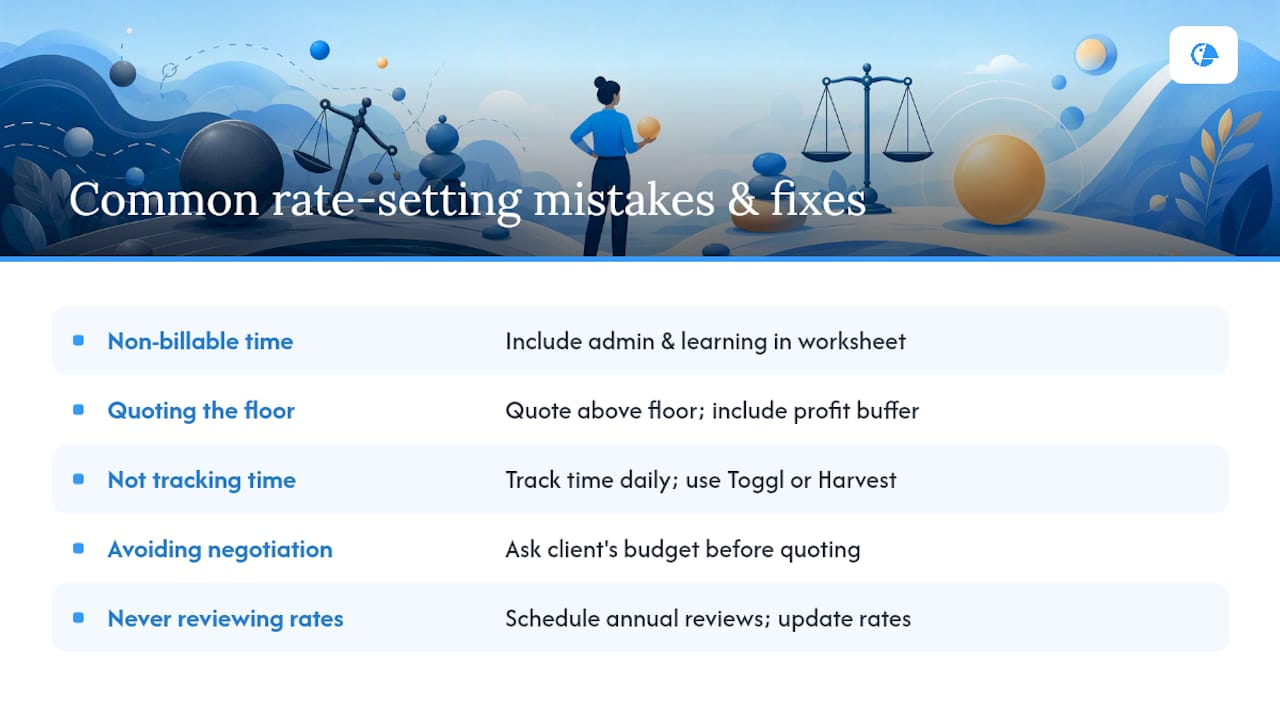
Underestimating non-billable time is the most expensive mistake. Admin, business development, and learning are real work. Build them into the worksheet from day one rather than treating them as inefficiency to be eliminated.
Quoting the floor as the price is the second most common error. The floor rate is the minimum you can accept without losing money. It is not a price; it is a boundary. Your quoted rate should sit above the floor, reflecting your profit buffer and market position. Quoting the floor leaves you with no margin for slow months, scope creep, or unexpected costs.
Not tracking time makes every future rate review a guess. Without data on how your hours actually split between billable and non-billable work, you are repricing based on hope rather than evidence. Toggl Track or Harvest takes less than two minutes per day to maintain.
Avoiding the negotiation conversation costs more than any other single habit. Many freelancers accept the first number a client offers because the conversation feels uncomfortable. Asking "What budget have you allocated for this?" before quoting is not aggressive; it is professional. The answer often reveals that the client's budget exceeds your intended quote.
Never reviewing rates is a slow erosion. A rate set in 2023 that has not changed is worth less in real terms every year. Schedule a rate review at the same time each year, treat it as a business obligation, and approach new clients with the updated rate immediately.
Treating every client the same ignores the reality that different clients have different budgets, different risk profiles, and different value perceptions. An enterprise client and a solo founder are not the same buyer. Segmenting your client base and pricing accordingly is not inconsistency; it is good business.
The most useful mindset shift: treat your rate as an experiment. Set it, track outcomes (acceptance rate, project profitability, client quality), and adjust.
Tutoroo connects tutors with students who are ready to learn
For language tutors who want to spend more time teaching and less time chasing clients, Tutoroo offers a direct path to students across the world. With over 386,000 tutors on the platform and students searching for personalised one-on-one lessons in English, Spanish, French, Mandarin, Arabic, and dozens of other languages, the marketplace handles the discovery and matching so tutors can focus on what they do best.

The platform's model is straightforward: students pay an introduction fee to connect with a tutor, and ongoing lesson payments go directly to the tutor without further platform charges. That structure means your rate is yours to set, your schedule is yours to manage, and your relationship with each student is yours to grow. Whether you are building a client base from scratch or adding online students to complement your in-person work, finding students through Tutoroo is a practical starting point. Browse the English tutor listings to see how tutors present their rates and profiles, then register and set your own.
Sources
- How to Calculate Your Freelance Hourly Rate – 2026 Guide
- How to Set Your Freelance Rates in 2026: Method + Math | FreelanceMath
- How to Set Freelance Rates in 2026 (Complete Guide)